ICD-10 code S61.201A: Open wound of left index finger without nail damage
ICD-10 code S61.201A covers a left index finger wound of unstated type ICD-10 co...

Last Updated: Oct 16, 2026
Billable Code Specific Code
M87.9 is the billable ICD-10-CM code for osteonecrosis, unspecified. It became effective October 1, 2025 under the 2026 ICD-10-CM edition. Coders reach for it correctly when chart notes carry no site detail, though payers increasingly scrutinize unspecified codes.
Osteonecrosis affects an estimated 10,000 to 20,000 Americans each year, and the hip is the most common site. That estimate comes from the NIH's National Institute of Arthritis and Musculoskeletal and Skin Diseases. The M87 family offers far more precise alternatives, so choosing M87.9 where the record supports one of them can flag a claim for review.
Let Pabau's smart automation suggest the right codes, reduce claim denials, and keep your practice compliant—effortlessly.
Automate repetitive tasks and focus on what matters most—your patients.
Reduce coding errors and ensure compliance with the latest regulations.
Clean claims, fewer denials, and faster reimbursements.
Powerful insights and reporting to help your practice thrive.
HIPAA compliant SOC 2 certified GDPR-compliant Trusted by 4,000+ clinics worldwide

M87.9 is the billable ICD-10-CM code for osteonecrosis when the record names no site and no cause.
The M87 category carries site-specific and etiology-specific subcodes, and they take priority whenever the note supports one.
Payers may reject M87.9 when the record shows the site was known, so query the provider first.
Most M87 subcodes need laterality at the sixth character, and M87.1x also needs a T36-T50 adverse effect code.
Practice management software like Pabau records site, laterality and etiology during the visit, so coders rarely default to M87.9.
ICD-10 Code M87.9 is the ICD-10-CM diagnosis code for osteonecrosis, unspecified. It covers cases where bone cell death is diagnosed but the record names neither the affected site nor the cause.
M87.9 sits at the bottom of the M87 hierarchy, so every more specific subcode outranks it. Use it only when a provider query is not possible, or when the record genuinely cannot support a more precise code.
Osteonecrosis is also called avascular necrosis (AVN), aseptic necrosis, or ischemic necrosis of bone. It occurs when blood supply to bone tissue is interrupted and the bone cells die. Without perfusion the bone collapses over time, causing pain, joint dysfunction, and eventually structural failure that needs surgery.
The hip (femoral head) accounts for the majority of AVN diagnoses. The condition also affects the knee, shoulder, ankle, wrist, and jaw. Causes range from corticosteroid use and alcohol consumption to trauma, sickle cell disease, and radiation. Each of those causes maps to a distinct M87 subcode once it is documented.
M87.9 is reserved for records that carry none of these details, particularly the affected site and the precipitating cause. When any of them is documented, a more specific M87 subcode should be selected instead.
Coders meet several terms in clinical notes that all map to the M87 category. Recognizing these synonyms prevents miscoding to adjacent categories such as M86 (osteomyelitis) or M89 (other bone disorders). The CDC/NCHS ICD-10-CM coding tool lists the following terms as index references for M87.9.
When a note reads “AVN” with no named site, M87.9 is the correct landing code. When it reads “AVN femoral head, left hip,” the coder moves to the site-specific subcode instead. The failure mode is assigning M87.9 while site information sits elsewhere in the chart, unqueried.
Knowing where M87.9 sits in the ICD-10-CM tree helps coders avoid category-level errors during an audit. Every entry in the ICD-10-CM code library follows the same chapter, block, category and code structure, so the pattern transfers to any diagnosis.
M87.9 is a leaf-node code, so there are no child codes beneath it. The only route to greater specificity is a different M87 subcode that names the anatomical site or the etiology.
The M87 category contains six subcategories, each covering a distinct etiology or anatomical grouping. Choosing among them needs clear documentation of cause and site. The full structure, as published in the AAPC ICD-10-CM reference, is set out below.
Hip AVN is the most common site that calls for a site-specific code. When the note confirms osteonecrosis of the femoral head, the idiopathic subcodes are M87.051 (right hip) and M87.052 (left hip). Secondary osteonecrosis of the same site takes M87.351 or M87.352.
The choice turns entirely on whether the provider named the side and the cause. A bilateral note that supplies neither detail falls back to M87.9.
Medication-related osteonecrosis of the jaw (MRONJ) maps to M87.180, a subcode under osteonecrosis due to drugs. It is most often associated with bisphosphonate therapy and with antiangiogenic agents.
Documentation must record the responsible drug and name the jaw as the affected site. The drug itself is reported with an additional adverse effect code from the T36-T50 range. M87.9 is never correct once MRONJ is explicitly diagnosed.
Every M87.1x claim needs a second code. The adverse effect code from the T36-T50 range names the drug responsible, with a 7th character of A, D or S appended. Payers processing musculoskeletal claims increasingly expect it, and submitting M87.1x alone is a common denial trigger.
The ICD-10-CM Official Guidelines for Coding and Reporting instruct coders to use the most specific code the documentation supports. For the M87 category, four elements decide whether a more specific code can be assigned.
Those four elements route the claim to one of six destinations, and only one of them is M87.9.
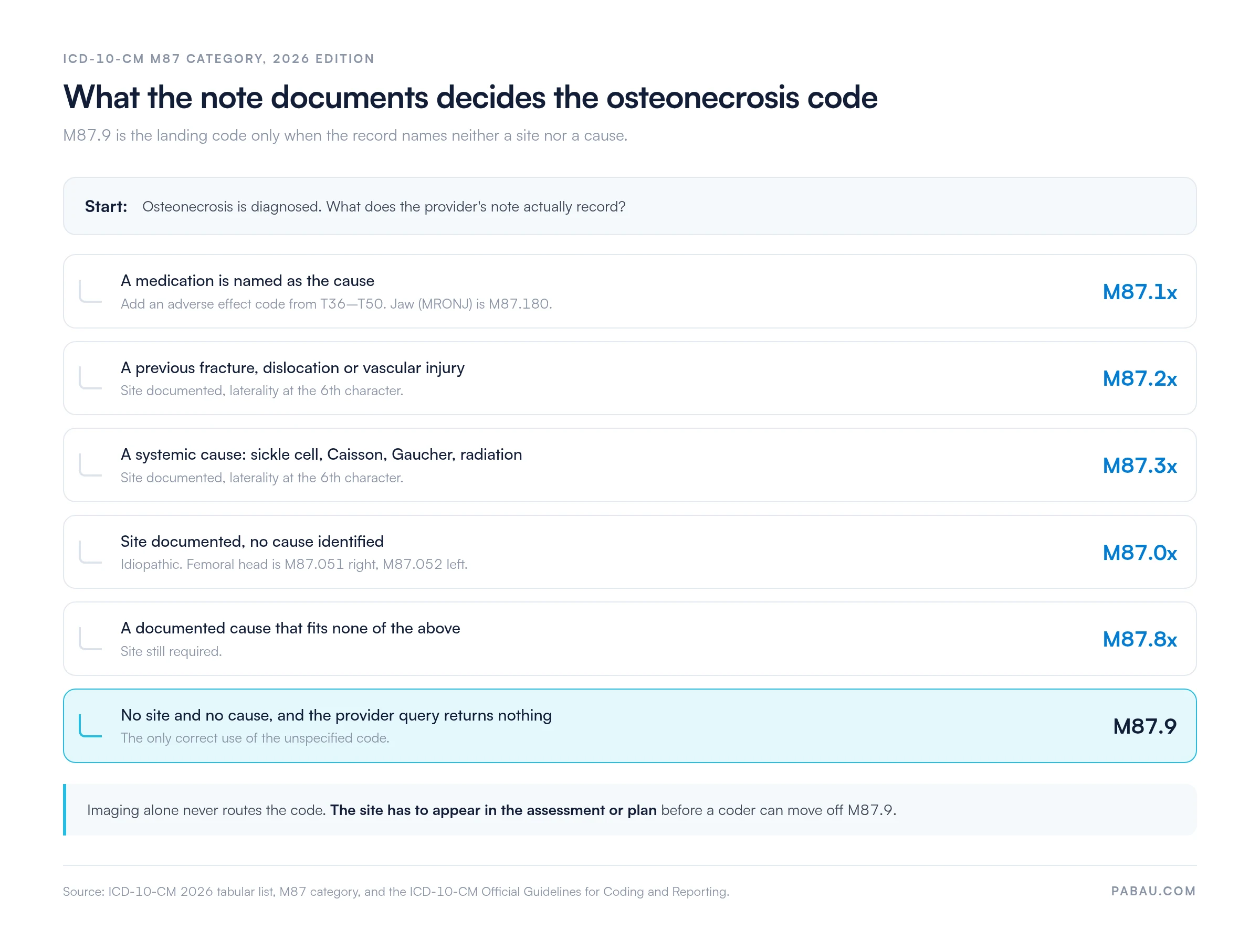
When an element is missing, the coder chooses between querying the provider and defaulting to M87.9. The Official Guidelines do not let a coder infer the site from an imaging report. The physician has to document it in the assessment or the plan.
Practices coding for orthopedics or rheumatology benefit from note templates that prompt the clinician to record site, laterality and contributing factors at each encounter.
Fixing the record upstream is what keeps M87.9 off claims that could have carried a precise code. Steady medical billing compliance depends on capturing those specifics during the visit rather than chasing them afterwards.
Unspecified codes draw payer attention, and M87.9 is no exception. These are the errors that surface most often in musculoskeletal billing audits, and tighter documentation habits prevent all of them.
Validating diagnosis codes against procedure codes before submission catches most of these at the claim-building stage. A clearinghouse that applies payer-specific edits will flag a missing laterality character before the claim leaves the practice.
Practices auditing historical records or appealing older denials may need to map legacy ICD-9-CM codes to ICD-10-CM. The crosswalk for M87.9 is short compared with other musculoskeletal categories. The mappings below follow the official code files published by CMS.
The move to ICD-10-CM made laterality mandatory for most M87 subcodes. Historical records coded as 733.42 without a left or right distinction will map to a laterality-unspecified ICD-10 code. Note that difference when reconciling old and new coding for the same patient.
Most M87.9 over-use starts with documentation written after the encounter, when nothing prompts the clinician to record site or laterality. Practice management software like Pabau closes that loop with structured clinical note templates.
Pabau ties diagnosis code selection to the clinical record inside one platform. A coder sees the documented site and etiology beside the claim, which removes a round of back-and-forth before submission. Validating claims against payer edits before they leave the practice is the job accurate claims management software does best.

For a practice submitting osteonecrosis claims every week, the payoff is fewer M87.9 defaults on notes that supported a precise code. Specificity matters most on surgical claims, where medical necessity depends on a confirmed anatomical site.
Run a quarterly report on M87.9 volume against total M87 claims. If unspecified codes clear 15 to 20 percent of the osteonecrosis total, the notes need attention before the coding does. A short provider session on site and laterality notation usually moves the number.

Pabau helps orthopedic and musculoskeletal practices capture site, laterality and etiology at the point of care. Coders then have the detail they need to move off M87.9 and onto a more specific subcode.

M87.9 is valid and billable, but it is the last resort in the M87 family rather than the default. Once the record carries site, laterality and etiology, a more specific subcode is available and easier to defend.
The fix sits upstream of the coder. Note templates that prompt for those elements during the encounter cost less than a quarterly audit of denied musculoskeletal claims. Book a demo to see how Pabau captures site and laterality while the patient is still in the room.

Need to see where coding sits in the wider billing cycle? What is revenue cycle management walks through the claim lifecycle from diagnosis to payment.
Telling bone death apart from bone infection? ICD-10 code M86.9 covers osteomyelitis, unspecified, the category most often confused with M87.
Want fewer denials from unspecified diagnosis codes? Denial management in healthcare sets out a workflow for preventing and recovering rejected claims.
ICD-10 Code M87.9 is the billable ICD-10-CM diagnosis code for osteonecrosis, unspecified. It applies when bone death is diagnosed but the record names no anatomical site and no underlying cause. It is valid for the 2026 ICD-10-CM edition, effective October 1, 2025.
Yes. M87.9 is a billable and specific ICD-10-CM code that can be reported on a claim. Payers may still scrutinize it when documentation could support a more specific M87 subcode. Use a site-specific code whenever the provider’s note identifies the affected bone and the cause.
Avascular necrosis of the femoral head maps to M87.051 for the right hip and M87.052 for the left hip. Secondary osteonecrosis of the same site takes M87.351 or M87.352. These codes replace M87.9 whenever laterality and etiology appear in the record.
Use M87.9 only when the site and the cause are both absent from the documentation and a provider query is not possible. If any site detail appears in the record, including an imaging report, query the provider first. Payers may deny unspecified codes when the chart suggests the site was known.
The ICD-9-CM equivalent of M87.9 is 733.40, aseptic necrosis of bone, unspecified. ICD-9-CM did not require laterality for most bone necrosis codes. Historical records coded under 733.4x therefore need careful review when crosswalking to ICD-10-CM subcodes that mandate a left or right character.
Medication-related osteonecrosis of the jaw (MRONJ) is bone death of the jaw caused by bisphosphonates, antiangiogenic agents or similar drugs. The correct ICD-10-CM code is M87.180, osteonecrosis due to drugs, jaw. An additional adverse effect code from the T36-T50 range identifies the responsible medication. M87.9 is not appropriate once MRONJ is specifically diagnosed.