

CPT Code 30801: Superficial turbinate ablation billing guide
CPT Code 30801: Official descriptor and procedure overview The American Medical ...

Last Updated: Nov 27, 2026
W2620 is the CCSD code for manipulation under anaesthesia of fractured nose (as sole procedure). It covers a closed reduction of displaced nasal bones, with no incision and no other nasal operation in the same session.
Bupa lists W2620 under nasal sinuses in its ENT chapter, at fee category MINOR 5. If a septoplasty, rhinoplasty or open repair is also performed, the episode takes that procedure's code instead.
Let Pabau's smart automation suggest the right codes, reduce claim denials, and keep your practice compliant—effortlessly.
Automate repetitive tasks and focus on what matters most—your patients.
Reduce coding errors and ensure compliance with the latest regulations.
Clean claims, fewer denials, and faster reimbursements.
Powerful insights and reporting to help your practice thrive.
HIPAA compliant SOC 2 certified GDPR-compliant Trusted by 4,000+ clinics worldwide

CCSD Code W2620 covers closed reduction of a fractured nose under anaesthesia, billed only when no other nasal procedure is performed in the same session.
The ‘as sole procedure’ qualifier is part of the official descriptor. Adding septoplasty or rhinoplasty to the episode moves the claim to that procedure’s own code.
Bupa lists W2620 under nasal sinuses in the ENT chapter, at fee category MINOR 5.
Most major UK private insurers (Bupa, AXA Health, Aviva, Vitality) require pre-authorisation before elective nasal fracture manipulation.
Pabau’s practice management platform supports private ENT billing workflows, operative note capture, and insurer claim submission for UK practices.
CCSD Code W2620 is the UK private-healthcare procedure code for manipulation under anaesthesia of a fractured nose, as sole procedure. H3 Insurance’s schedule of procedures lists it with exactly that descriptor, under nasal sinuses, with separate surgeon and anaesthetist fees.
The code is maintained in the CCSD schedule and appears in the ENT chapter of Bupa’s schedule, at fee category MINOR 5. It describes a closed reduction, with no open surgical incision, no cartilage work and no septal intervention.
The surgeon manually moves the displaced nasal bones back into position while the patient is anaesthetised. Because the procedure is closed, there is no wound closure, and the operative note will reflect that.
Three conditions must all be true for W2620 to apply:
CCSD codes are used only in UK private healthcare billing. NHS episodes use OPCS-4 procedure codes instead, so coders trained in NHS settings should not cross-reference W2620 with an OPCS-4 equivalent.
For Bupa-specific context, our Bupa CCSD procedure codes reference covers how the schedule applies across Bupa-recognised consultants.
Coders and practice managers need to know what happens in theatre, because that is what the operative note must record. It is also what the insurer’s clinical reviewer looks for when the claim lands.
Nasal fractures are among the most common facial injuries in adults, typically caused by blunt trauma such as assault, falls or contact sport. Displaced nasal bones cause both functional impairment and cosmetic deformity.
Most ENT surgeons attempt closed reduction within 10 to 14 days of injury, before callus formation makes manipulation ineffective. Insurers may scrutinise the clinical necessity of procedures done outside this window.
The procedure itself follows a consistent sequence:
The operative note must capture each of these steps to support the claim. A note that records only “nasal fracture reduced” is inadequate. It does not confirm the anaesthetic, the closed technique or the absence of concurrent procedures.
W2620 is billable only when nasal fracture manipulation under anaesthesia is the sole operative procedure in that session. There are no exceptions to this.
This is the most often misapplied rule for W2620. An ENT surgeon may find a deviated septum at the same sitting and perform a septoplasty, which is a sound clinical decision. That decision immediately disqualifies W2620. Concurrent rhinoplasty, turbinate reduction or any other nasal operation moves the episode outside the sole-procedure boundary in the same way.
When a concurrent nasal procedure is performed: W2620 must not be submitted. Code the procedure that was performed, such as E0360 for septoplasty, and apply the CCSD schedule’s rules for any further codes. Submitting W2620 alongside a septoplasty code typically results in a denial or an adjudication query.
W2620 has no numbered siblings in the W26xx range. Bupa lists it alone among the E-coded procedures of its nasal sinuses section. The codes it is confused with are the nasal operations that replace it when the surgeon does more than a closed manipulation.
Which code the episode takes turns on one question: was anything done to the nose beyond closed manipulation? The chart below sets out the answer and what each outcome is worth on Bupa’s schedule.
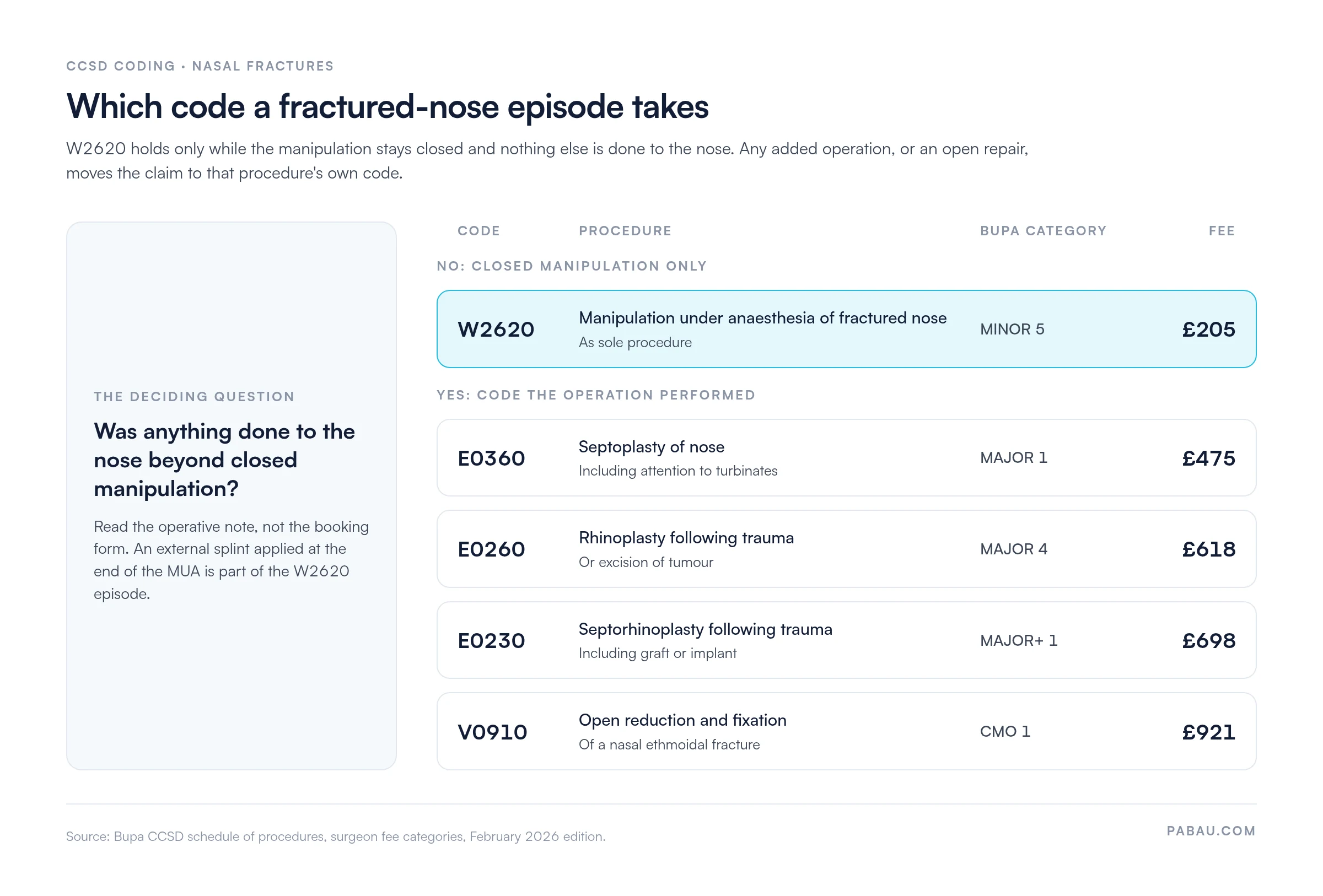
Practical note on late or complex repairs: A nose that has set badly is often treated later by E0260. When the septum also needs reconstruction, the code is E0230. Neither is a variant of W2620, so the operative note decides which one applies.
Septal work done for obstruction follows the same logic, and a resection of the septum is coded E0310. Closed reduction of other facial fractures has codes of its own, such as V0930 for the zygomatic complex. The full CCSD code library lists the rest of the schedule by chapter.
Before submitting W2620, check the anaesthetist’s record. A separate anaesthetist fee confirms the manipulation was done under anaesthesia, as the descriptor requires. A W2620 claim with no matching anaesthetist invoice will usually attract an insurer query.
A clean W2620 claim needs the operative note and supporting documents to confirm four elements. These are the anaesthetic, closed nasal reduction, sole-procedure status and a corroborating diagnosis. If any one is missing from the submitted documentation, expect a query or a denial.
The operative note must address each of these areas specifically. Generic phrases such as “nose reduced” fall short of the Royal College of Surgeons of England’s operative note guidance.
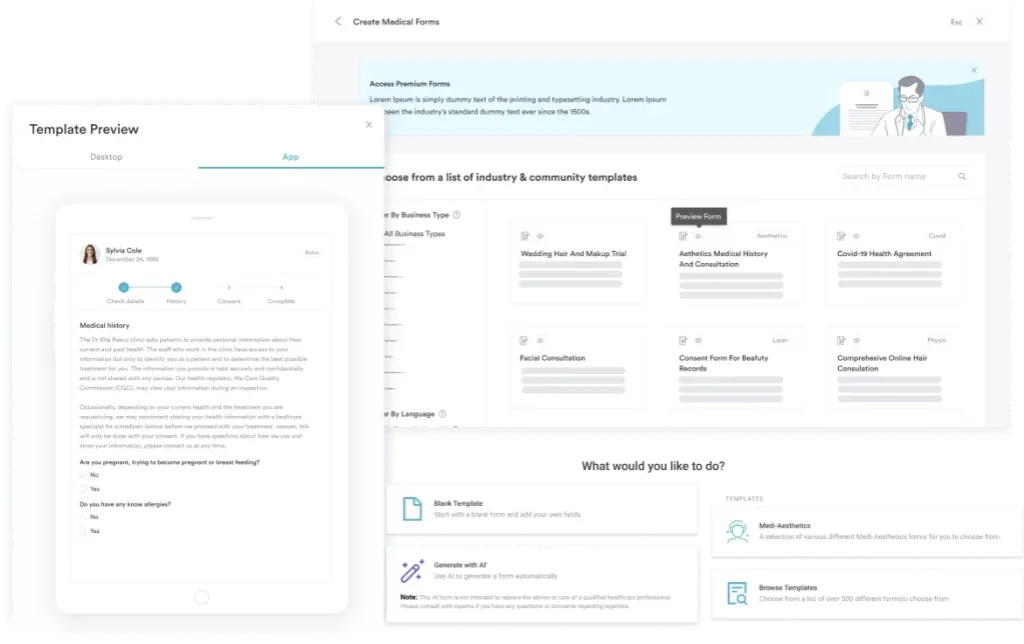
They also fall short of what insurer clinical reviewers expect. Practices that capture operative notes on digital clinical forms can build a W2620 template. It prompts surgeons for each required element before the note is signed.
Most major UK private medical insurers require pre-authorisation before elective ENT surgery, and nasal fracture manipulation under anaesthesia typically falls within this. Submitting W2620 without prior authorisation, on a policy that mandates it, is one of the most avoidable causes of denial.
Requirements vary by insurer and by policy type. The table below reflects general published guidance, so confirm current requirements with the insurer before booking the procedure. Pre-authorisation tracking belongs in the booking workflow from the start.
When pre-authorisation is granted, record the authorisation reference before submitting the claim. Healthcode submissions require this reference. A claim sent without it will typically be queried or rejected, even when the procedure was clinically appropriate.
W2620 denials follow consistent patterns. The same documentation failures and coding errors recur across practices, and a structured submission checklist prevents most of them.
When a patient is anaesthetised for W2620, two separate fee claims are raised. The operating surgeon bills W2620, and the anaesthetist bills under their own CCSD anaesthetic codes.
Both are submitted independently via Healthcode. Insurers expect two invoices, one from each clinician, and combining both fees on the surgeon’s invoice is a recognised denial trigger.
Key rules for the surgeon’s W2620 invoice:
Healthcode is the main electronic submission route for CCSD-coded claims to major UK private medical insurers. Submitting W2620 through the portal follows a consistent workflow. Interface details may change with platform updates, so treat these steps as the standard process rather than a screen-by-screen guide.
Common portal errors on W2620 include dropping the final zero (“W262” rather than “W2620”) and a procedure date outside the pre-auth validity period. Both trigger a system-level rejection before the claim reaches a clinical reviewer.
Create a Healthcode submission checklist for W2620: code confirmed, ICD-10 S02.2 linked, pre-auth reference attached, anaesthetist invoice filed separately, operative note available. Running through it before you submit takes under two minutes and prevents most avoidable claim failures.
Most W2620 queries trace back to paperwork held in separate places. The operative note sits in one system, the consent form in another, and the pre-authorisation reference in an email. The coder then rebuilds the episode at billing time.
Pabau, a practice management platform for private practices, stores operative notes, consent forms, imaging reports and pre-authorisation references in one linked patient record. A claim is less likely to go out with incomplete supporting documentation.
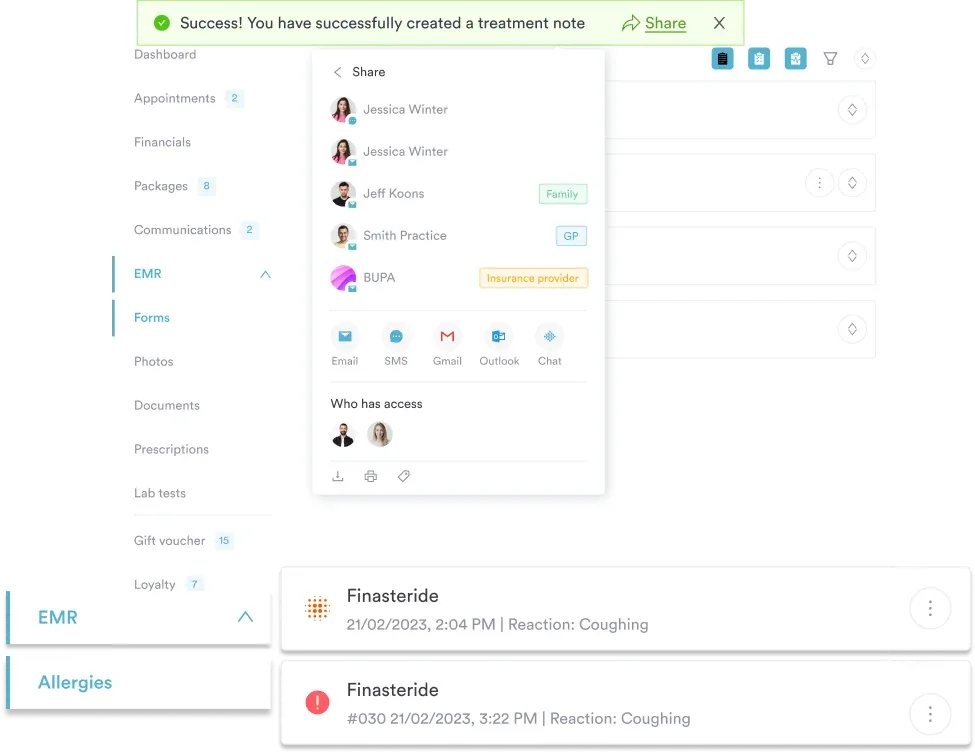
Pabau’s claims management software then tracks the surgeon’s and the anaesthetist’s invoices separately. That reduces the risk of bundling errors when the claim is prepared.
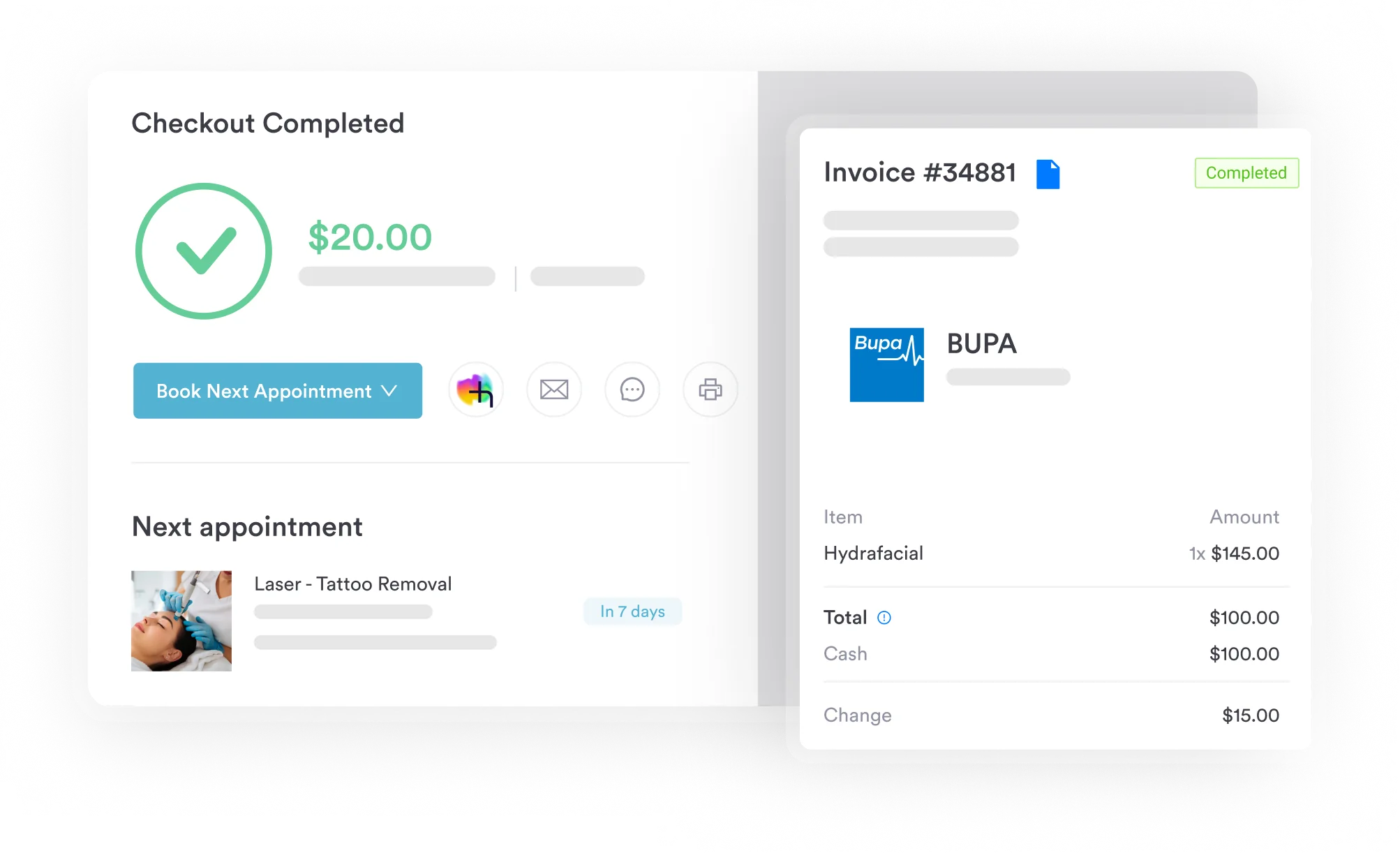

Pabau helps UK private practices track pre-authorisation references, capture operative notes, and submit insurer claims without manual workarounds. See how it fits your ENT workflow.

W2620 is a low-value code, and its whole worth depends on the surgeon doing nothing more than a closed manipulation. Once a septoplasty or rhinoplasty joins the episode, W2620 drops out and the procedure performed is coded instead. So decide the code from the signed operative note, never from the theatre booking.
Get the pre-authorisation reference and the anaesthetist’s separate invoice in place before the claim goes out. Those two checks remove the most common queries on this code. Book a demo to see how Pabau keeps operative notes, pre-auth references and Healthcode claims in one record for private ENT practices.

Looking up another procedure in the schedule? The CCSD code library lists every code page by chapter.
CCSD Code W2620 covers manipulation under anaesthesia of a fractured nose, performed as the sole operative procedure. It applies when a surgeon performs a closed reduction of displaced nasal bones under anaesthesia, with no other nasal procedure in the same session.
W2620 is used only when nasal fracture manipulation under anaesthesia is the only operative procedure in the episode. If septoplasty, rhinoplasty or any other nasal procedure is done at the same sitting, the qualifier is not met. The procedure performed is then coded instead.
No. W2620 covers closed manipulation only. Bupa’s schedule codes open reduction and fixation of a nasal ethmoidal fracture as V0910, in fee category CMO 1. A late reshaping of a badly set nose is usually rhinoplasty following trauma, E0260.
Bupa typically requires pre-authorisation for elective ENT operative procedures, including nasal fracture manipulation under anaesthesia. Obtain the authorisation reference before the procedure date and include it on the Healthcode claim. Confirm current requirements with Bupa, as policy thresholds change.
The most common reasons are a missing pre-authorisation reference and W2620 submitted alongside a concurrent nasal procedure. Others are an operative note that does not confirm the anaesthetic and sole-procedure status, a missing or wrong ICD-10 code, and late submission.
No. The “as sole procedure” qualifier in the W2620 descriptor means it cannot be billed with a septoplasty code for the same episode. If septoplasty is performed alongside the manipulation, code the septoplasty (E0360) and apply the CCSD schedule’s rules for any further codes.
S02.2 (fracture of nasal bones) is the usual ICD-10 diagnosis code for W2620 claims. UK private insurers use WHO ICD-10, where S02.2 carries no encounter-type extension. Confirm any insurer-specific diagnosis requirements before submitting.




