CPT code 28825: Amputation, toe; interphalangeal joint
CPT code 28825: official descriptor and anatomical scope CPT code 28825 is descr...

Last Updated: Oct 6, 2026
CCSD code E0230 covers septorhinoplasty with a graft or implant after trauma or tumor removal, including work on the turbinates. The surgeon rebuilds both the septum and the outer nose. Cartilage, bone or an implant replaces the support that the injury or the tumor surgery took away.
UK private medical insurers band E0230 as a major procedure. AXA Health lists a £650 surgeon fee, while National Friendly lists £807. That fee only holds when the record proves a graft, a full septorhinoplasty and a traumatic or tumor cause. Miss one, and the claim slides to a cheaper neighboring code or a cosmetic exclusion. The operative note is where all three facts get proved.
Let Pabau's smart automation suggest the right codes, reduce claim denials, and keep your practice compliant—effortlessly.
Automate repetitive tasks and focus on what matters most—your patients.
Reduce coding errors and ensure compliance with the latest regulations.
Clean claims, fewer denials, and faster reimbursements.
Powerful insights and reporting to help your practice thrive.
HIPAA compliant SOC 2 certified GDPR-compliant Trusted by 4,000+ clinics worldwide

CCSD code E0230 covers septorhinoplasty with a graft or implant after trauma or tumor removal, with turbinate work included.
AXA Health bands E0230 as Major with a £650 surgeon fee, while National Friendly lists £807.
Without a graft and a traumatic or tumor cause on record, the case usually belongs under a neighboring code such as E0220.
Septoplasty (E0360) is an unacceptable combination with E0230, so it never goes on the same claim.
The operative note should name the graft, where it came from, and the injury or tumor behind the surgery.
CCSD code E0230 is the schedule entry for “septorhinoplasty including graft/implant following trauma or excision of tumour (including attention to turbinates)”. In plain terms, the surgeon reshapes both the septum and the outer nose. They also add cartilage, bone or an implant to rebuild what the injury or the tumor surgery took away.
The code sits in chapter 5 of the schedule, Ear, nose and throat, under the Nose and nasal cavity heading. You can browse its neighbors in our CCSD codes by chapter index.
The Clinical Coding and Schedule Development Group maintains the codes and their descriptors. It doesn’t set fees, though. Each insurer decides its own complexity band and payment for E0230.
That split matters, because the same nose operation can land on four different codes. The descriptor decides which one, so start there.
Read the descriptor as a test with three parts. A claim only holds when the clinical record supports every one of them.
Turbinate work is already part of the descriptor. So a reduction of the inferior turbinates during the same operation doesn’t earn a second code.
Here’s a typical case. A patient breaks their nose playing rugby, and the fracture heals crooked. Months later they still can’t breathe through one side. The surgeon straightens the septum, rebuilds the bridge with a septal cartilage graft and reduces the turbinates. All three facts are present, so the whole operation bills as E0230.
Most E0230 queries start with the wrong neighbor. The table compares the codes closest to it, with the complexity band National Friendly publishes for each.
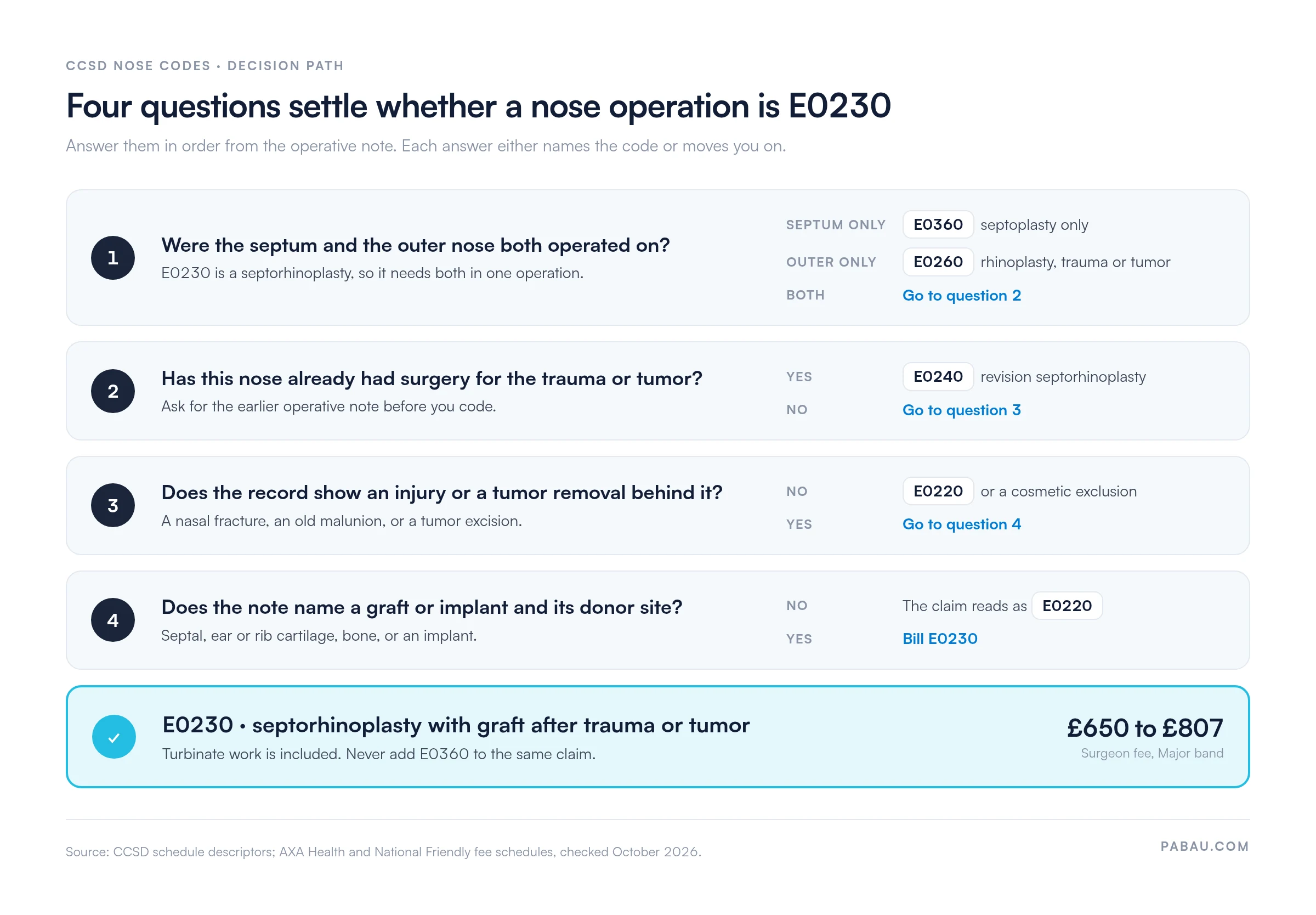
The revision code trips up many billing teams. If the same nose was repaired after the original injury, the second operation is E0240, not E0230. Ask for the earlier operative note before you code.
To settle the code, run four questions against the operative note, in this order. Each answer either names the code or moves you on.
Submucous resection of the septum also has its own entry. Our guide to CCSD code E0310 explains where that procedure stops.
The fee follows the schedule of the patient’s insurer, not the code itself. Two published schedules show how far the figure moves.
Both figures were checked in October 2026. AXA Health’s schedule for fee-approved specialists and the National Friendly schedule of fees are both public, so check the live figure before you quote.
A worked example shows the effect. Say the surgeon charges £1,000 for a post-traumatic septorhinoplasty. An AXA Health patient’s benefit covers £650, which leaves a £350 shortfall.
The patient pays that balance unless the surgeon works within AXA Health’s fees. Put the figure in writing before surgery. Our Bupa fee schedule guide shows how another insurer groups its fees.
Insurers read the note against the descriptor. If the note never mentions a graft, the claim reads as E0220. Before the note is signed, confirm it covers these points.
Pre-operative photographs and any scans help too. They show the insurer that the deformity predates surgery and came from the injury.
UK insurers expect a WHO ICD-10 diagnosis on the claim. For E0230, the diagnosis should tell the same story as the descriptor. These are the codes that usually fit.
Lead with the code that explains why the nose needed rebuilding. J34.2 on its own describes a septoplasty case, not a reconstruction. Our page on ICD-10 code M95.0 covers the acquired deformity code in more depth.
A clean claim starts long before the operation. Here’s the usual path for an insured patient.
Most delays trace back to step two. If the authorized code differs from the billed code, the insurer will query it.
Run this check on every E0230 invoice. It catches the usual query triggers before the insurer sees them.
Ask the surgeon to dictate the graft details while the case is fresh. A note that only says “septorhinoplasty” is the most common reason an E0230 claim gets queried.
When an insurer queries an E0230 claim, the paperwork is usually to blame. These are the slips to watch for.
In many ENT practices, an E0230 claim gets typed twice. The details go into the practice system, then again into Healthcode, with the authorization number copied from an email.
Pabau, practice management software built for private practices, connects to Healthcode instead. Its claims management builds the claim from the patient record. The CCSD code, membership number and authorization reference carry across, and required fields are checked before sending.
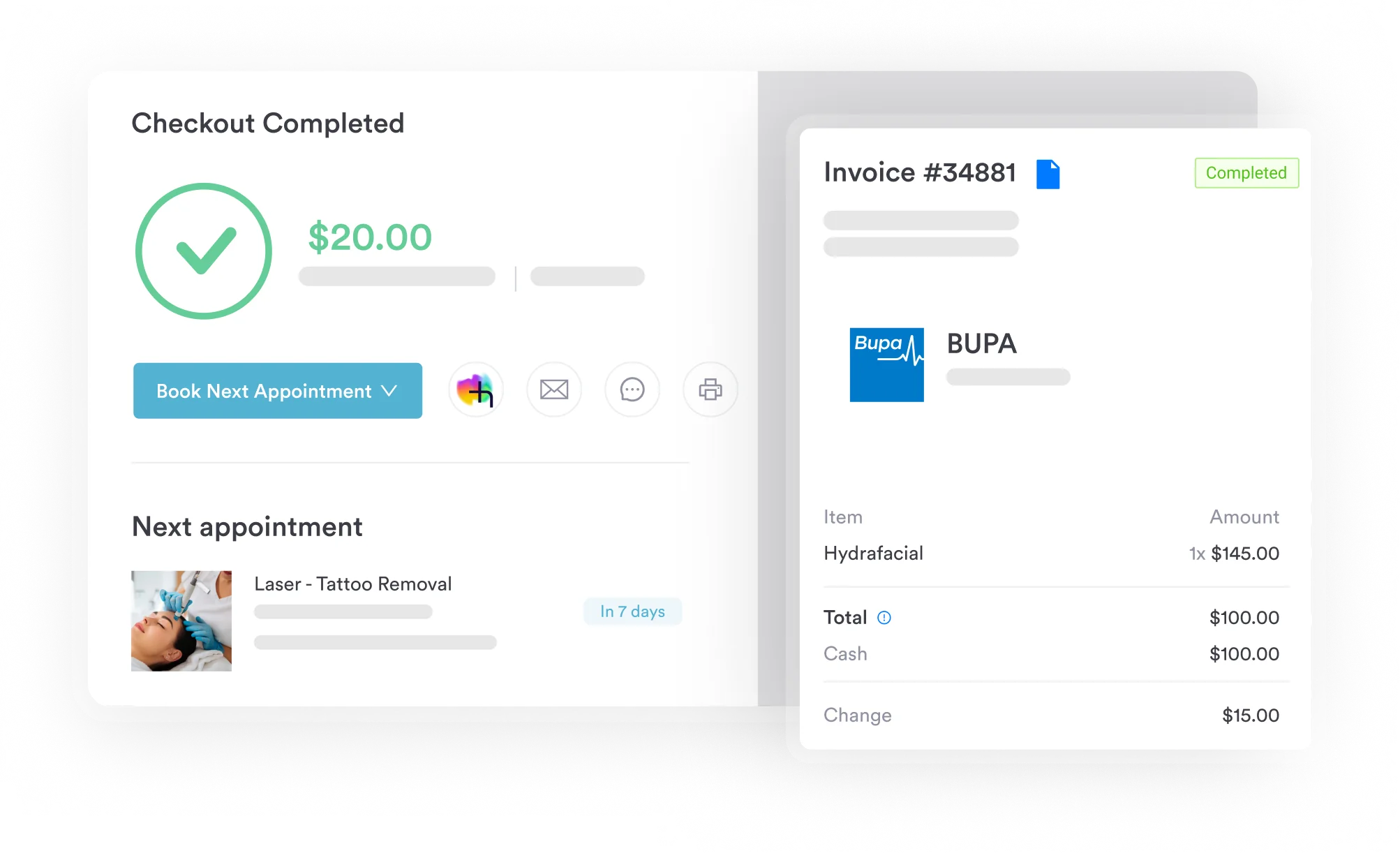
Your team then tracks each claim’s status and payment in one place. A missing authorization number gets flagged while your team can still fix it.

Pabau builds CCSD claims like E0230 from the patient record and checks required fields before submission. You then track every claim’s status in one place.

E0230 is a well-paid code with a narrow door. It needs a graft, a full septorhinoplasty and a documented injury or tumor. Each missing piece pushes the case toward a cheaper code or a cosmetic exclusion.
So treat the operative note as part of the claim, and write it with the coder in mind. When it names the cause and the graft, the code choice settles itself, and the insurer has little left to query.
Book a demo to see how Pabau carries an E0230 claim from the operative note to Healthcode without retyping a field.

Billing septal surgery without reconstruction? CCSD code E0310 covers submucous resection of the nasal septum.
Treating scarring inside the nose? CCSD code E0440 explains how division of turbinate adhesions is coded.
Need the diagnosis side of the claim? ICD-10 code M95.0 covers acquired deformity of the nose.
Want every Bupa code in one place? Bupa CCSD procedure codes sets out the schedule and its fee categories.
Billing a nosebleed procedure instead? CCSD code E0380 covers nasal septum cauterization.
Often, when it restores function or repairs damage from an injury or tumor. Most UK policies exclude purely cosmetic nose surgery. Always get pre-authorization, and check the policy wording for accident or reconstruction cover.
Usually not. The E0230 descriptor already includes the graft or implant. Check the schedule’s unacceptable combinations before adding a harvest code, and confirm with the insurer at pre-authorization.
The descriptor sets no time limit. A fracture that healed badly years ago can still qualify, as long as the record links the deformity to that injury.
Yes, on a separate invoice. UK insurers pay anesthetists against the procedure code from their own fee column. AXA Health, for example, lists £285 for the anesthetist on E0230.
Some patients go home the same day, while others stay overnight. The code stays the same either way. The hospital invoices its own charges separately from the surgeon.