CPT code 46255: Hemorrhoidectomy billing and coding guide
CPT code 46255 covers one column, inside and out CPT code 46255 reports a hemorr...

Last Updated: Oct 9, 2026
E0260 is the CCSD code for rhinoplasty following trauma or excision of tumour (including attention to turbinates).
Let Pabau's smart automation suggest the right codes, reduce claim denials, and keep your practice compliant—effortlessly.
Automate repetitive tasks and focus on what matters most—your patients.
Reduce coding errors and ensure compliance with the latest regulations.
Clean claims, fewer denials, and faster reimbursements.
Powerful insights and reporting to help your practice thrive.
HIPAA compliant SOC 2 certified GDPR-compliant Trusted by 4,000+ clinics worldwide

CCSD code E0260 covers rhinoplasty after trauma or tumour excision only; purely cosmetic rhinoplasty is excluded from all standard UK PMI policies
Attention to turbinates is bundled within E0260 and must not be coded as a separate billable item in the same operative session
Prior authorisation from Bupa, AXA Health, Vitality, and most other UK PMIs is required before surgery and does not guarantee payment
Pabau supports E0260 billing with structured clinical records, digital forms, and pre-authorisation workflow tracking for private practices
CCSD code E0260 is defined by the Clinical Coding and Schedule Development (CCSD) Group as: Rhinoplasty following trauma or excision of tumour (including attention to turbinates). This is the exact wording published in the CCSD schedule, maintained jointly by the Association of British Insurers and the relevant surgical Royal Colleges, and it is used by every major UK private medical insurer (PMI) to adjudicate claims.
Three elements appear explicitly in the descriptor and each has direct billing implications.
The code sits within the CCSD ENT and facial surgery schedule. It is used exclusively in UK private practice; it has no equivalent in NHS coding and is not a CPT or ICD-10 code.
E0260 has two primary clinical indications, and billing staff must be able to distinguish them because each requires different supporting documentation.
Both indications require that the rhinoplasty is reconstructive in nature. The functional or structural deficit caused by the trauma or tumour must be clearly documented. A patient who also wishes a cosmetic improvement at the same time does not disqualify the claim, but any purely aesthetic component must be clearly separated in the operative note or insurers may reclassify the whole procedure as cosmetic.
E0260 covers a full reconstructive rhinoplasty, which may include several surgical components depending on the nature and extent of the deformity.
The extent of surgery depends on whether the indication is traumatic or oncological. Post-trauma cases often involve osteotomies and cartilage grafts. Post-tumour cases frequently require soft-tissue flaps or skin grafts alongside framework reconstruction. Both scenarios can include turbinate attention, and both use E0260.
Every major UK PMI excludes cosmetic procedures from cover. The adjudication question for E0260 claims is always the same: is this rhinoplasty reconstructive or cosmetic?
The insurer’s test focuses on medical necessity. This means the procedure must be the clinically appropriate response to a documented structural or functional deficit, not to a subjective dissatisfaction with appearance. NHS England’s published criteria for reconstructive versus cosmetic surgery are routinely referenced by UK PMIs when setting their own policy language, and surgeons should familiarise themselves with that framework when documenting E0260 cases.
Red flags that trigger cosmetic reclassification include: no documented trauma date in the records; a pre-operative consultation note that emphasises aesthetic goals; imaging taken only at the time of the surgical request (rather than at the time of injury); and the absence of functional complaints such as airway obstruction, epistaxis, or breathing difficulty.
Prior authorisation (also called pre-authorisation or pre-approval) is required by all major UK PMIs before E0260 surgery proceeds. Obtaining authorisation is not a guarantee of payment; it confirms only that the insurer has reviewed the request and has not excluded it at the pre-operative stage. Payment remains conditional on the submitted claim meeting all policy terms.
For guidance on managing pre-authorisation workflows in a private ENT or facial surgery practice, see our article on ENT and plastic surgery practice software.
Standard pre-authorisation submission requirements across Bupa, AXA Health, VitalityHealth, and Aviva typically include:
Authorisation timelines vary by insurer and by the urgency of the reconstruction. Routine pre-authorisation requests are typically processed within 5 to 10 working days. Practices should not book theatre slots until written authorisation has been received. Each insurer’s specific requirements should be verified directly, as policy terms change and what Bupa requires may differ from AXA Health or VitalityHealth.

Pabau gives ENT and plastic surgery practices a single platform for CCSD coding, pre-auth tracking, structured operative notes, and insurer document submission. See how it works for your practice.

Insufficient documentation is the single most common reason E0260 claims are challenged or rejected. The complete documentation set for a successful claim includes records from three stages: pre-operative, intra-operative, and post-operative.
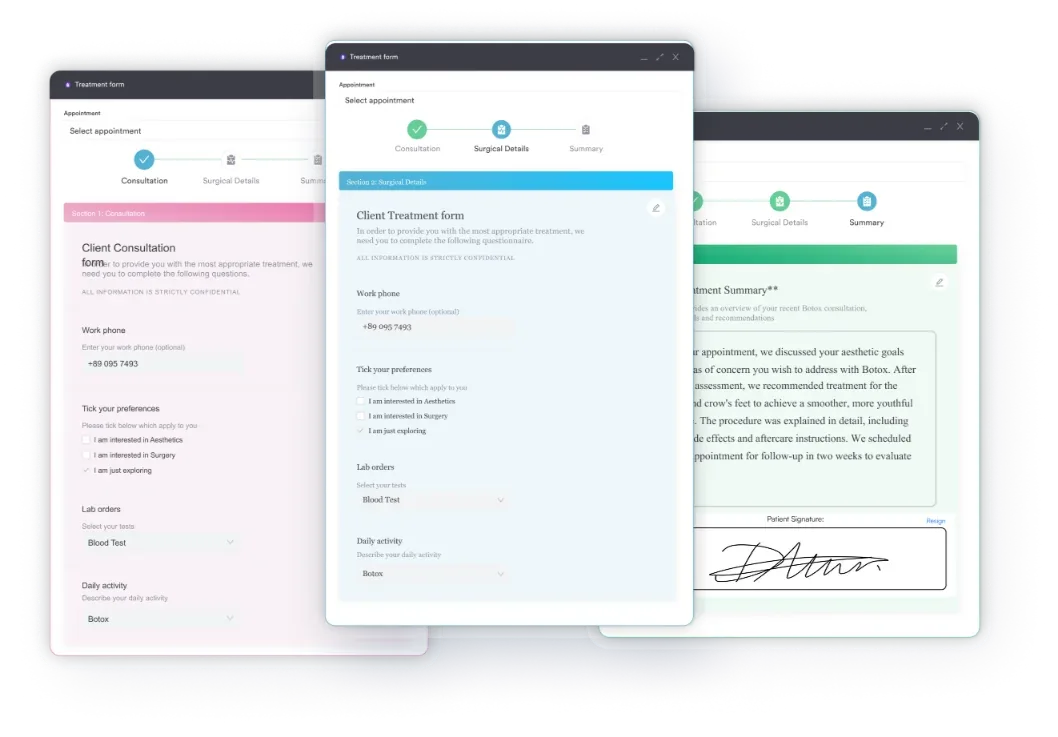
Using digital consent and referral forms that capture structured fields (injury date, functional symptoms, pre-operative photographs) reduces the risk of missing evidence at the claim stage.
Private practices should retain all documentation for a minimum period consistent with CQC documentation standards, which set a baseline for record retention and accessibility in England. GMC guidance additionally requires that records are adequate to justify the clinical decisions made.
The operative note is the document insurers scrutinise most closely when auditing or querying an E0260 claim. A well-written operative note using structured clinical records should capture every element below.
Operative notes that use vague language (“nasal reshaping performed”) or that fail to describe specific structures are the most common targets for insurer audit and cosmetic reclassification. The Royal College of Surgeons of England (RCS England) guidance on operative note standards provides a useful framework for consistent documentation across all surgical specialties.
Document the functional complaint in the pre-operative note using the patient’s own words wherever possible. An entry reading ‘Patient reports persistent mouth-breathing since nasal fracture in 2026, confirmed by rhinomanometry’ is far harder for an insurer to reclassify as cosmetic than a generic ‘nasal deformity post-trauma’.
E0260 sits within the CCSD nose and ENT procedure schedule. Choosing the correct code requires understanding what the neighbouring codes cover and when each applies.
Always verify the current CCSD schedule via the Bupa code search or your insurer’s portal before submitting, as code descriptors and fee values are updated periodically. For a broader guide to Bupa CCSD procedure codes, including ENT and facial surgery codes, see Pabau’s dedicated reference.
This depends on whether the septoplasty constitutes a genuinely distinct and separately documented procedure. The CCSD schedule explicitly includes “attention to turbinates” in the E0260 descriptor, which means turbinate work is bundled. Septoplasty does not appear in the E0260 descriptor in the same way, so a concurrent septoplasty coded as E0270 may be billable as a separate line item, provided the operative note clearly distinguishes the septal correction from the rhinoplasty steps and documents the clinical rationale for each component independently.
In practice, insurers vary in how they adjudicate combined nasal procedure claims. Some apply a percentage reduction to the secondary procedure. Practices should verify the current bundling rules in the individual insurer’s fee schedule (see Aviva’s fee schedule guidance and the VitalityHealth fee finder for procedure-level fee and bundling information) and check the latest CCSD technical guide for bundling rules before submitting combined claims. Because CCSD bundling rules may be updated, always cross-reference against the most recently published schedule.
E0260 claims are rejected more often than most surgical codes because insurers apply heightened scrutiny to nasal procedures. Understanding the denial patterns helps billing staff prevent them before submission.
Appeals against E0260 denials are possible and often successful when the original denial was due to missing documentation rather than a genuine policy exclusion. The appeal should include all previously missing records, a covering letter from the surgeon restating the clinical rationale, and the relevant sections of the CCSD schedule confirming E0260 as the correct code.
ENT and plastic surgery practices billing E0260 regularly deal with a consistent set of administrative challenges: capturing all pre-authorisation documents before theatre, ensuring operative notes meet insurer standards, and tracking claims through to payment. Pabau’s private practice billing tools address each of these workflows within a single system.
For practices running multi-surgeon ENT or facial surgery departments, Pabau’s compliance management software helps maintain consistent documentation standards across the whole team, reducing variability in operative note quality that can otherwise lead to inconsistent adjudication outcomes. Practices seeking a broader overview of how software supports reconstructive surgery workflows can explore Pabau’s resources for plastic surgery practice management.

Need a structured framework for CCSD surgical claims? Bupa CCSD procedure codes provides a complete reference to the ENT and surgical codes most commonly used in UK private practice.
Managing consent and pre-operative forms across your surgical team? Cosmetic surgery consent form covers the documentation elements required before any elective or reconstructive facial procedure.
Looking to streamline how your practice handles private insurance claims? Best plastic surgery software compares the practice management tools best suited to ENT and plastic surgery billing workflows.
CCSD code E0260 is a specific reconstructive code with well-defined inclusion criteria and a clear exclusion boundary: trauma or tumour excision triggers it; cosmetic intent excludes it. The most preventable cause of denied claims is documentation that fails to establish that boundary explicitly, whether in the operative note, the pre-operative records, or the pre-authorisation submission.
Pabau’s structured operative note templates, pre-authorisation tracking, and document management tools help ENT and plastic surgery practices keep E0260 claims clean from the start.
To see how Pabau fits your private practice billing workflows, book a demo with our team.
CCSD code E0260 covers rhinoplasty performed following trauma or excision of a tumour, and includes attention to the turbinates performed during the same operative session. It does not cover cosmetic rhinoplasty, which is a separately coded and insurer-excluded procedure.
Yes. The official CCSD descriptor explicitly states “including attention to turbinates,” which means any turbinate work performed during the same rhinoplasty is bundled within E0260 and should not be submitted as a separate billable item.
A complete E0260 claim requires a referral letter, pre-operative clinical photographs, imaging (for trauma cases) or a histopathology report (for tumour cases), written prior authorisation, a structured operative note confirming reconstructive intent, and post-operative follow-up notes if requested on audit.
The most common rejection reasons are cosmetic reclassification (the operative note does not establish reconstructive intent), missing prior authorisation, turbinate work incorrectly billed as a separate item, absent histopathology for tumour cases, and selection of E0280 (cosmetic rhinoplasty) instead of E0260.
Septoplasty (E0270) may be billed as a separate concurrent procedure if the operative note clearly documents it as a distinct intervention with its own clinical rationale. However, individual insurers apply different bundling rules, and a percentage reduction on the secondary procedure is common. Always verify current bundling policy with each insurer before submitting combined claims.
Yes. All major UK PMIs, including Bupa, AXA Health, VitalityHealth, and Aviva, require prior authorisation before E0260 surgery proceeds. Written authorisation must be obtained and retained before the theatre date. Note that authorisation confirms the insurer has not pre-excluded the claim; it does not guarantee payment.
The operative note must record the date and nature of the original trauma or tumour excision, the specific deformity corrected, the named surgical steps (osteotomies, grafts, flap design), the structures addressed including any turbinate work, and an explicit statement of reconstructive intent signed by the operating surgeon.