

CPT Code 30801: Superficial turbinate ablation billing guide
CPT Code 30801: Official descriptor and procedure overview The American Medical ...

Last Updated: Nov 27, 2026
V2500 is the CCSD code for primary posterior fusion +/– decompression +/– discectomy – lumbar region (1 or 2 levels) including spinal cord monitoring. It is the surgeon's procedure code for a first-time posterior lumbar fusion at one or two levels in UK private practice.
Decompression and discectomy at the fusion level are part of the code when performed, and spinal cord monitoring is always included. A fusion at three or more levels is coded V2501.
Let Pabau's smart automation suggest the right codes, reduce claim denials, and keep your practice compliant—effortlessly.
Automate repetitive tasks and focus on what matters most—your patients.
Reduce coding errors and ensure compliance with the latest regulations.
Clean claims, fewer denials, and faster reimbursements.
Powerful insights and reporting to help your practice thrive.
HIPAA compliant SOC 2 certified GDPR-compliant Trusted by 4,000+ clinics worldwide

CCSD Code V2500 covers primary posterior lumbar fusion at one or two levels, and V2501 covers the same procedure at three or more levels.
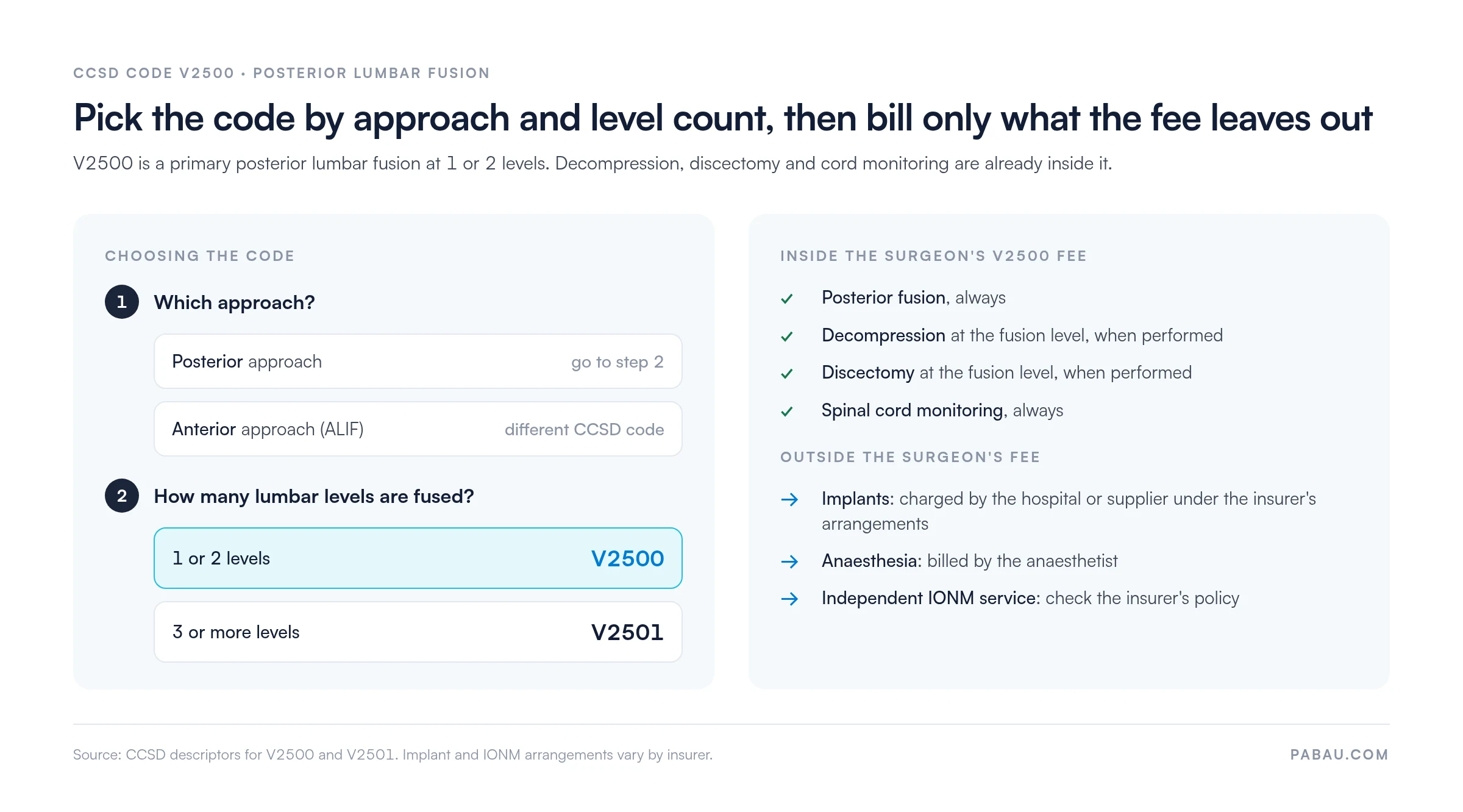
V2500 bundles decompression and discectomy at the fusion level when the surgeon performs them, and it always includes spinal cord monitoring. None of them earns a separate line.
Bupa, AXA Health, and Aviva require pre-authorisation before surgery. Insurers rarely grant retrospective authorisation.
Implants are not part of the surgeon’s V2500 fee. The hospital or supplier charges them under the insurer’s implant arrangements, so check the insurer.
The CCSD defines Code V2500 as “Primary posterior fusion +/- decompression +/- discectomy – lumbar region (1 or 2 levels) including spinal cord monitoring.” The Clinical Coding and Schedule Development Group publishes the code in the CCSD schedule. It applies to UK private healthcare billing only, so NHS procedures do not use it.
Three points in the descriptor need careful reading. The “+/-” notation makes decompression and discectomy optional, and V2500 includes them when the surgeon performs them. “1 or 2 levels” is a hard ceiling, because V2501 codes fusion at three or more levels. The phrase “including spinal cord monitoring” folds neuromonitoring into the code, so it carries no separate charge.
Also, the word “primary” matters. Revision spinal surgery, for instance, has its own codes, such as V2543 for a revision posterior disc excision with facetectomy. A standalone discectomy under live X-ray, with no fusion, is billed under a different code again, CCSD code XR510.
Surgeons perform posterior lumbar fusion with the patient prone. The surgeon accesses the lumbar spine through a midline posterior incision, retracting the paraspinal muscles to expose the target vertebrae. The key surgical steps are as follows.
Meanwhile, intraoperative neuromonitoring (IONM) runs continuously. The team tracks somatosensory evoked potentials (SSEPs) and motor evoked potentials (MEPs) in real time. They also pick up changes in spinal cord and nerve root function during pedicle screw placement and decompression. Because the CCSD descriptor names spinal cord monitoring, the monitoring is part of V2500 and earns the surgeon no extra fee.
The table below sets out the bundled and excluded components. Submitting a separate code for any included component is the fastest route to a denial.
Bone graft billing varies by insurer. Some treat autograft harvesting as separately billable, while others consider it included, so check the insurer’s current policy before submission.
V2500 sits within the CCSD’s V2000-series spinal procedure range. Selecting the wrong code for the number of levels operated on is one of the most common reasons claims are returned. Also, check both descriptors in the table against the current CCSD schedule before submission, as CCSD updates the schedule every year. Other spinal codes are listed in Pabau’s full CCSD code reference.
Surgeons perform PLIF (posterior lumbar interbody fusion) and TLIF (transforaminal lumbar interbody fusion) from the back. Both are posterior approaches, so V2500 captures them at one or two levels.
In contrast, an anterior lumbar interbody fusion (ALIF) uses a different approach and requires a different CCSD code. A revision anterior lumbar fusion, for example, carries code V2680. The diagram below puts the approach and level-count choices next to what the surgeon’s V2500 fee covers.
A complete operative note is the foundation of any successful V2500 claim. Private insurers routinely request operative documentation before settling complex spinal claims, and an incomplete note is grounds for denial without appeal. Build these documentation habits into the surgical workflow, so the note is complete before anyone queries the claim.
The operative note must clearly record all of the following.
Also, structured digital operative forms in your practice management system make it harder to skip a mandatory field before the claim goes out.
CCSD Code V2500 covers a complex elective spinal procedure. Bupa, AXA Health, and Aviva all require pre-authorisation before surgery takes place. Insurers rarely grant retrospective authorisation for elective procedures of this complexity. Indeed, submitting a V2500 claim without a valid authorisation reference is the most common single cause of non-payment. Check Bupa’s procedure code portal for current authorisation requirements.
Pabau’s reference on Bupa CCSD procedure codes lists Bupa’s accepted codes. Major UK private medical insurers typically ask for the following before they grant authorisation.
Because requirements vary by policy year and insurer, always verify directly against the insurer’s current provider portal before submission.
Confirm the authorisation reference number covers the exact code V2500 before the patient enters theatre. An authorisation for the wrong code or a different level count creates a billing dispute that is extremely difficult to resolve retrospectively.
Claim denials on CCSD Code V2500 follow predictable patterns. Still, process checks before submission avoid most of them. Thus, check the seven denial triggers below first.
Unbundling is an audit priority for all UK private medical insurers. V2500 bundles decompression and discectomy when the surgeon performs them at the fusion level, and it always includes spinal cord monitoring. Check the current CCSD schedule for updates, as bundling rules change every year. Healix’s fee schedule guidelines give a detailed reference on how insurers apply CCSD unbundling policy in practice.
Intraoperative neuromonitoring (IONM) runs continuously in posterior lumbar fusion, from patient positioning through wound closure. It detects any change in neurological signal that might indicate cord or nerve root compromise. The two types are somatosensory evoked potentials (SSEPs), which assess sensory pathway integrity, and motor evoked potentials (MEPs), which assess motor pathway function.
Because the CCSD Code V2500 descriptor states “including spinal cord monitoring,” the operating surgeon’s fee already accounts for this service. The surgeon cannot add a separate neuromonitoring line item to their claim.
However, an independent monitoring company that the hospital contracts works under a different billing arrangement and may submit its own claim under a different code. That claim does not make monitoring billable by the surgeon. Policies on independent IONM billing vary, so check with the insurer before submission.
A structured submission workflow reduces the risk of denial. Also, integrated claims management software captures the correct codes, authorisation references, and documentation before the claim reaches the insurer.
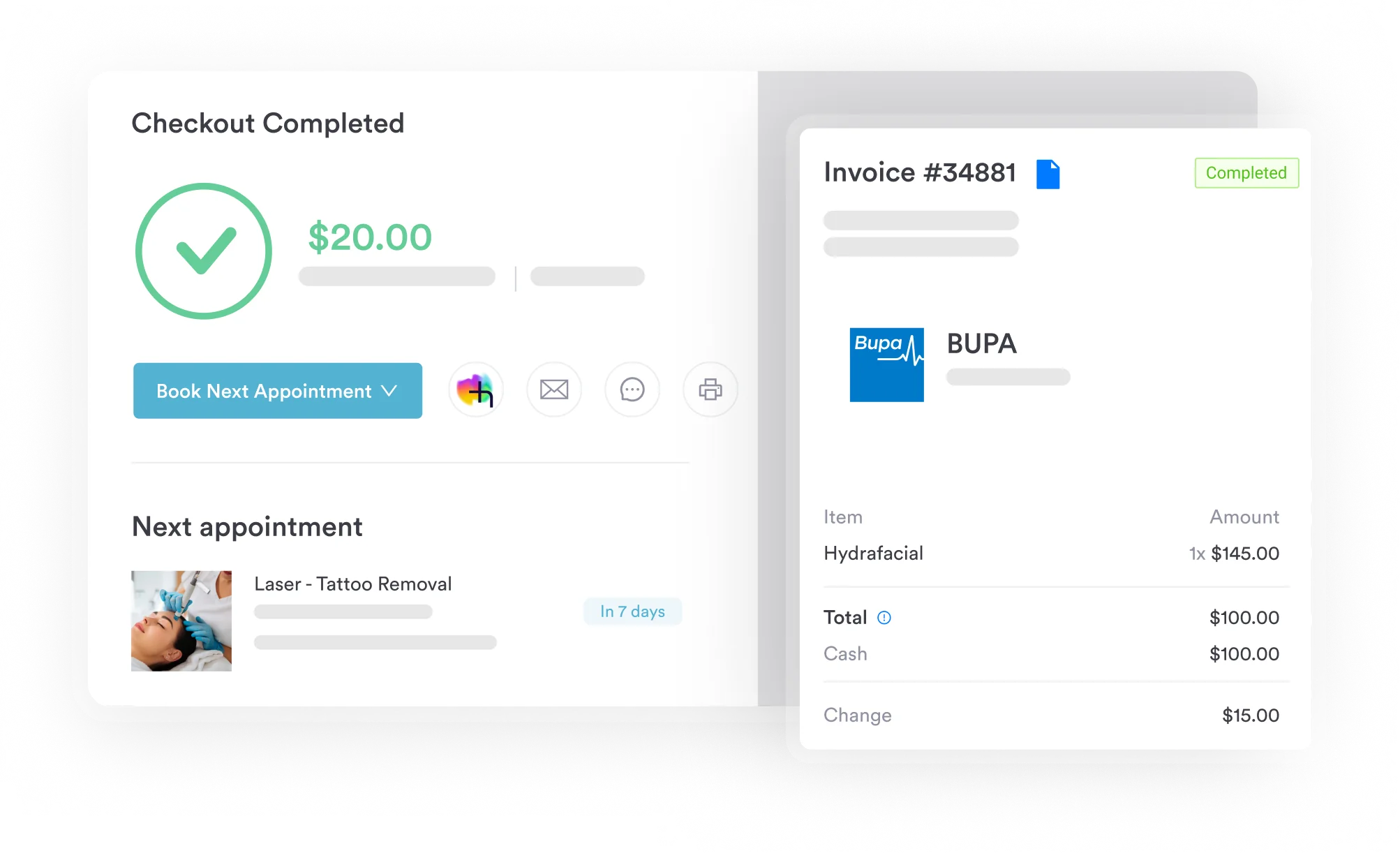
A V2500 claim depends on records gathered weeks apart. The authorisation reference arrives before surgery, the operative note after it, and the IONM report from a separate team. When those sit in different systems, the claim waits while someone chases them.
Pabau, a practice management platform for private practices, keeps those records on one patient file. Structured digital forms capture the approach, the levels fused, and the monitoring confirmation as required fields. Pabau’s claims management then submits UK claims through Healthcode and Bupa, so the code and its supporting record go out together.
As a result, claims answer the insurer’s usual queries before the insurer raises them, and your team spends less time chasing paperwork after theatre.

Pabau helps private surgical practices track authorisations, attach operative documentation, and submit CCSD-coded claims without switching between systems. See how it handles spinal surgery billing workflows.

Coding V2500 correctly comes down to three checks made before theatre. Confirm the approach is posterior, count the levels, and get the authorisation for that exact code.
After surgery, the surgeon’s claim carries V2500 on its own. Decompression, discectomy, and monitoring stay inside it, while implants and anaesthesia are charged by others. Finally, an operative note that records each of these points settles most insurer queries before they start.
Book a demo to see how Pabau links the authorisation, the operative note, and the CCSD claim for spinal surgery.

Need a full reference for Bupa procedure codes? Bupa CCSD codes covers the full range of Bupa-accepted CCSD procedure codes with fee and submission guidance.
Looking for broader CCSD billing context? Bupa procedure codes fee schedule explains how CCSD fee schedules are structured and what influences reimbursement levels.
Billing a revision decompression instead? CCSD code V2660 covers revision of decompression for central spinal stenosis.
CCSD Code V2500 is the procedure code for primary posterior lumbar fusion of one or two levels. It includes decompression and discectomy when performed, and intraoperative spinal cord monitoring is bundled in. Implants, anaesthesia, and procedures at three or more levels are excluded.
Yes. The official V2500 descriptor explicitly states “including spinal cord monitoring,” so the operating surgeon cannot submit a separate neuromonitoring code alongside this claim. An independently contracted IONM service may bill separately under its own arrangement, but that is a distinct matter from the surgeon’s claim.
V2500 covers primary posterior lumbar fusion at one or two levels. V2501 is the same procedure at three or more levels, and both include spinal cord monitoring. The number of levels recorded in the operative note decides which one applies.
No. Discectomy performed at the fusion level is bundled into V2500 by the “+/-” notation in the official descriptor. Submitting a separate discectomy code alongside V2500 constitutes unbundling and will result in claim denial.
Yes. All major UK private medical insurers, including Bupa, AXA Health, and Aviva, require pre-authorisation for V2500-class spinal procedures before surgery. Retrospective authorisation for elective procedures is rarely granted, so obtaining a valid authorisation reference before the patient enters theatre is essential.




