CCSD Code D1010: Radical mastoidectomy including meatoplasty
CCSD Code D1010: Definition and clinical scope CCSD Code D1010 is the UK private...

Last Updated: Nov 25, 2026
V2543 is the CCSD code for revision of posterior excision of disc prolapse with undercutting facetectomy +/- decompression (lumbar region). It applies when a surgeon re-operates at a lumbar level that has already had posterior disc surgery. The surgeon removes recurrent or residual disc material and undercuts the facet joint to widen the lateral recess.
Two facts decide the code. A first-time operation with the same facetectomy is V2542, and a revision without the facetectomy is V2544.
Let Pabau's smart automation suggest the right codes, reduce claim denials, and keep your practice compliant—effortlessly.
Automate repetitive tasks and focus on what matters most—your patients.
Reduce coding errors and ensure compliance with the latest regulations.
Clean claims, fewer denials, and faster reimbursements.
Powerful insights and reporting to help your practice thrive.
HIPAA compliant SOC 2 certified GDPR-compliant Trusted by 4,000+ clinics worldwide

CCSD Code V2543 covers a revision of posterior lumbar disc excision with undercutting facetectomy, at a level that has already had posterior disc surgery.
The undercutting facetectomy separates V2543 from V2544, the revision code without it. If the operative note omits that step, insurers may downcode to V2544.
UK private medical insurers expect pre-authorisation before revision spinal surgery. A claim for surgery done without it is usually refused, however accurate the coding.
Pabau’s claims management software keeps the insurer’s authorisation code, the operative note and the Healthcode claim in one patient record.
CCSD Code V2543 is the CCSD procedure code for revision of posterior excision of disc prolapse with undercutting facetectomy +/- decompression, lumbar region.
It is listed in the CCSD schedule of procedure codes, the common coding language of UK private healthcare. The descriptor sets three conditions, and each one must be met before the code applies:
The CCSD schedule places V2543 in a group of five posterior lumbar disc codes, V2540 to V2544. V2540 and V2541 are primary excisions without a facetectomy, and V2542 is the primary excision with an undercutting facetectomy. V2543 is the revision counterpart of V2542, and V2544 is the revision without a facetectomy.
Each code has its own descriptor and clinical requirements, and insurers pay them at different levels. Picking the wrong one can amount to upcoding or downcoding and attract audit scrutiny. Neighbouring spinal procedures have their own entries in our CCSD codes library. A revision for recurrent central canal stenosis, with no disc excision, is coded V2660 instead. Percutaneous vertebroplasty at a single level, for example, is billed as code V2570. A posterior fusion of one or two cervical levels, with spinal cord monitoring included, is coded CCSD V3720.
Revision posterior discectomy is substantially more complex than the primary operation. After the first procedure, the disrupted tissue planes heal with epidural fibrosis. This scar tissue binds the dura, the nerve root and the surrounding structures. The surgeon must dissect carefully through it before the recurrent disc fragment can be identified and removed.
The key surgical steps in a V2543 procedure are as follows:
An operative note for revision spinal surgery should name each distinct surgical step. For V2543, the word “facetectomy”, or an unambiguous equivalent, must appear in the body of the operative note. A mention in the pre-operative plan alone does not support the code.
V2543 is the right code when the clinical record confirms all three of the following:
If any one of these elements is missing, a different code applies. Common clinical scenarios that justify V2543:
V2543 is not appropriate for first-time (primary) disc surgery at a level with no prior operation. A primary excision with an undercutting facetectomy maps to V2542. A primary excision without one maps to V2540 (one or two levels) or V2541 (three or more levels).
V2543 is also wrong when the revision involves no undercutting facetectomy, because that case maps to V2544. The distinction is clinical, so both the pre-operative consent and the operative note must reflect it. Disc removal can also form part of a larger fusion. When it is done through the anterior approach of a combined anterior and posterior lumbar fusion, the whole operation falls under code V3350.
V2543 has two close neighbours. V2542 is the same operation done for the first time, and V2544 is a revision without the undercutting facetectomy. The table sets out the whole posterior lumbar disc group, including V2540 and V2541, the primary codes without a facetectomy.
Two questions settle the code. Has this lumbar level been operated on before? Does the operative note document an undercutting facetectomy? The grid below reads the code off both answers.
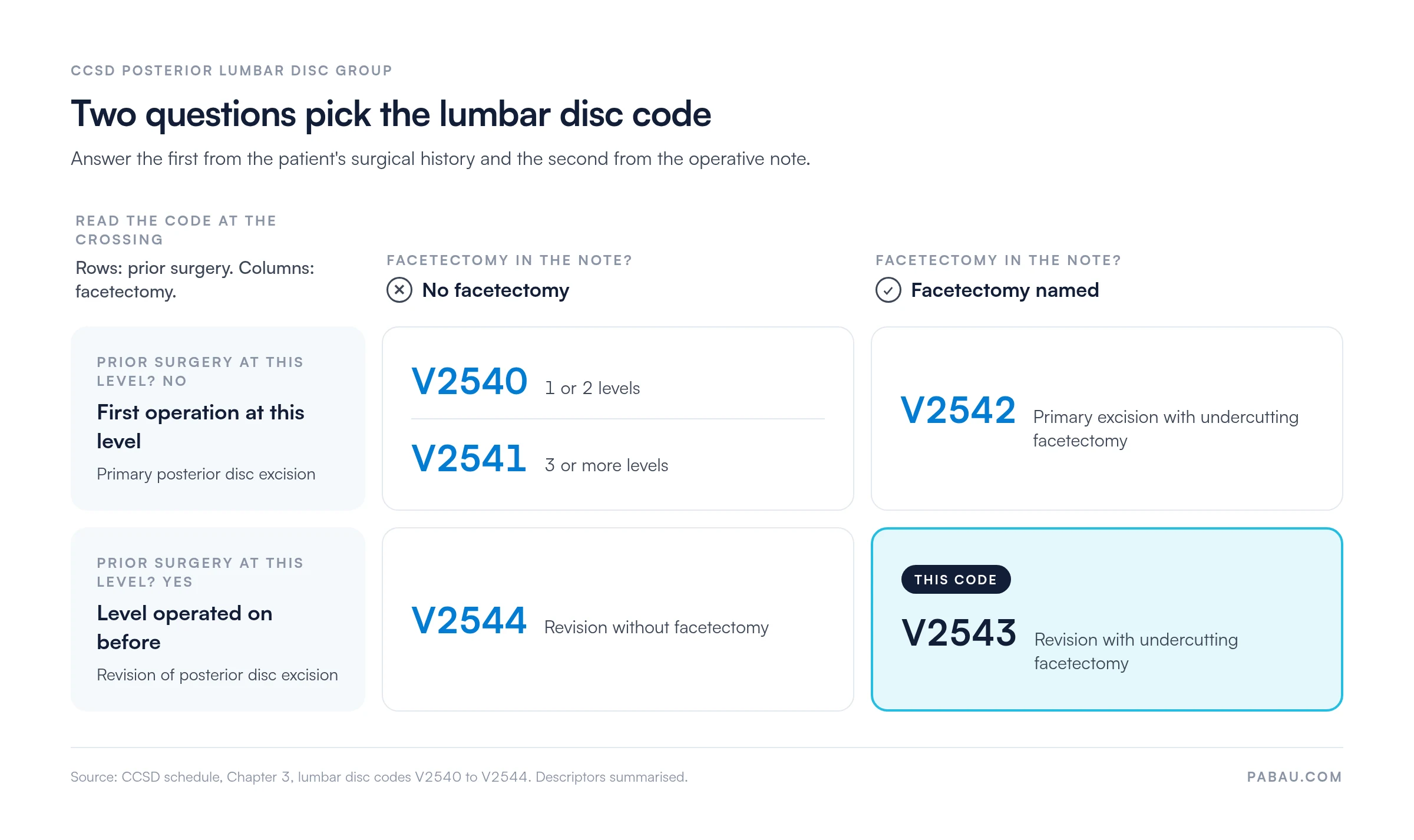
No prior surgery and no facetectomy gives V2540 for one or two levels, or V2541 for three or more. No prior surgery with a facetectomy gives V2542. Prior surgery without a facetectomy gives V2544, and prior surgery with an undercutting facetectomy gives CCSD Code V2543. Never apply V2543 to a first-time operation, even one that includes a facetectomy, because that case is V2542.
A V2543 claim that lacks any one of the following documents is at high risk of denial. UK PMI providers assess claims against the operative note, pre-operative imaging and prior surgical history. Meeting the CCSD descriptor is necessary, but the insurer pays on auditable evidence that it was met.
In England, the Care Quality Commission expects registered providers to keep complete and accurate patient records. For a V2543 case, that covers the operative notes, imaging reports and anaesthetic records. Incomplete records weaken both the clinical audit trail and the billing record, so the full evidence bundle should travel with each submission.
The ICD-10 diagnosis code submitted with a V2543 claim must reflect the current clinical presentation, not the original diagnosis from the first surgery. UK private claims use the WHO edition of ICD-10. A code that describes a primary disc herniation when the patient presents with recurrence may trigger a review and delay payment.
These codes are examples based on typical recurrent lumbar disc prolapse presentations. The correct code for any individual claim must be assigned by a qualified clinical coder from the patient’s current documented diagnosis. A code that maps to the operative findings supports the claim, and one that conflicts with the imaging or operative note will be queried.
Virtually all UK private medical insurance (PMI) providers require pre-authorisation for revision spinal surgery. Bupa, AXA Health, Vitality and Aviva each run pre-authorisation for high-value or complex procedures.
Revision lumbar disc surgery under CCSD Code V2543 falls in that complex category for all of them. A claim for surgery done without pre-authorisation is usually refused outright, however accurate the coding and the operative note.
What most UK PMI providers require before authorising V2543:
Pre-authorisation requirements vary by insurer and change periodically, so confirm the current rules with the payer before the procedure. Our Bupa CCSD billing guidance covers Bupa’s procedural requirements. For AXA Health, the AXA Health specialist procedure codes portal carries current fee and authorisation guidance.
Attach the pre-authorisation reference to the invoice when you create it, not afterwards. If the reference is missing when the claim reaches the insurer, the claim is queued for manual review, even when authorisation was granted. Storing the number against the booking lets it populate the invoice automatically.
V2543 is a high-value revision code and attracts closer scrutiny than primary discectomy claims. The table below maps the most frequent denial reasons to their corrective actions.
Deliberately submitting a code that the clinical record does not support is upcoding, and insurers treat it as fraud. The table covers honest errors only. It is no guide to choosing a code beyond the documented procedure.
Once a month, audit the previous quarter’s V2543 claims. Check that each one has a pre-authorisation reference on record and that the operative note names the facetectomy. Then confirm the ICD-10 code matches the current MRI report, so the insurer never has to raise the shortfall first.
CCSD Code V2543 is a surgical package code. Some items are included in the package and cannot be billed separately. Others are billed separately by the relevant specialist or service provider.
Included within V2543 (not separately billable): Standard wound closure, haemostasis, intraoperative fluoroscopy used to confirm spinal level, and routine post-operative wound care. Submitting these items as separate charges will trigger duplicate-billing denials.
Separately billable by the relevant provider:
Check the current Bupa procedure fee schedule and the Aviva fee schedule to confirm which ancillary codes each insurer accepts alongside V2543. Unbundling rules vary by payer and are revised with each annual schedule update.
A revision code like V2543 passes through a chain of hand-offs before it is paid. The pre-authorisation request comes first, then the operative note, the invoice and the claim. At each hand-off, the reference number, the facetectomy wording or the prior surgical history can drop out.
Pabau, a practice management platform with built-in insurance billing, keeps that chain in one patient record. The practice records the insurer’s authorisation code against the patient’s policy, so it is on hand when the invoice is raised. Consent forms and the operative note sit in the same file the billing team works from.
UK claims go out through Healthcode and Bupa from Pabau’s claims management software. The billing team sees each claim’s progress by insurer. A query about the facetectomy or the prior surgery then gets answered while the case is fresh.

Pabau keeps authorisation codes, operative notes and Healthcode claims in one patient record for UK private practices. See how it handles revision spinal surgery billing.

V2543 turns on two facts that no coder can infer from the descriptor alone. The level was operated on before, and the surgeon undercut the facet joint. Both have to be written down before the claim goes out. A surgeon who names the facetectomy in the operative note protects the fee. A coder who checks the surgical history keeps a primary code off a revision case.
Pre-authorisation is the one step that cannot be repaired afterwards, so secure it before the theatre date. With those three pieces on file, a V2543 claim reaches the insurer ready to be paid. Book a demo to see how Pabau keeps authorisation codes, operative notes and insurer claims together for UK spinal practices.

Looking for the Bupa procedure fee schedule? Bupa procedure codes fee schedule sets out Bupa reimbursement across CCSD chapters, including spinal surgery codes.
Billing a later operation on the same spine? CCSD code V4140 covers removal of a posterior spinal implant and what its claim needs.
Coding a stabilisation procedure instead? CCSD code V5484 explains the code for interspinous dynamic stabilisation.
Need a tissue diagnosis before spinal surgery? CCSD code V4740 covers billing for CT-controlled percutaneous spinal biopsy.
CCSD Code V2543 covers revision of posterior excision of disc prolapse with undercutting facetectomy in the lumbar region. It applies when a surgeon re-operates at a previously operated lumbar level. The surgeon removes recurrent or residual disc material through a posterior approach and undercuts the facet joint to widen the lateral recess or foramen. The code is specific to the lumbar spine.
V2543 and V2542 both cover posterior excision of lumbar disc prolapse with an undercutting facetectomy. V2542 is the primary operation, while V2543 is a revision at a previously operated level. A revision without the facetectomy is coded V2544, not V2543. Insurers may downcode a V2543 claim to V2544 when the operative note does not name the facetectomy step.
Yes. Bupa, AXA Health, Vitality and Aviva expect pre-authorisation for revision spinal surgery before the procedure takes place. The request should name the CCSD code (V2543), the proposed hospital and the surgeon. It should come with a referral letter and an MRI report confirming the indication. Retrospective requests are routinely refused, so pre-authorisation is the first administrative step in any V2543 case.
The operative note must document the revision status and the undercutting facetectomy step. A pre-operative MRI should confirm recurrence or lateral recess stenosis at the operated level. The claim also needs records of the original procedure at the same level, a current ICD-10 diagnosis code and the pre-authorisation reference. Insurers scrutinise the operative note most closely, and a facetectomy left unnamed is a frequent shortfall.
No. V2543 is a revision code and applies only when a prior posterior lumbar discectomy has been performed at the same level. First-time posterior disc excision with an undercutting facetectomy maps to V2542, and without one to V2540 or V2541. Insurers check the revision requirement against the patient’s surgical history when they process the claim.