HCPCS Code V5095: Semi-implantable middle ear hearing prosthesis
HCPCS Code V5095: Definition and clinical descriptor HCPCS Code V5095 is the Lev...

Last Updated: Nov 25, 2026
T8550 is the CCSD code for block dissection of inguinal lymph nodes. The surgeon clears the superficial and deep inguinal nodes from the femoral triangle in one specimen. It is usually done to treat cancer that has spread to the groin.
It sits in the lymphatic system section of chapter 9 of the CCSD schedule. UK private medical insurers such as Bupa, AXA Health, Aviva and Vitality use it on claims submitted through Healthcode.
Let Pabau's smart automation suggest the right codes, reduce claim denials, and keep your practice compliant—effortlessly.
Automate repetitive tasks and focus on what matters most—your patients.
Reduce coding errors and ensure compliance with the latest regulations.
Clean claims, fewer denials, and faster reimbursements.
Powerful insights and reporting to help your practice thrive.
HIPAA compliant SOC 2 certified GDPR-compliant Trusted by 4,000+ clinics worldwide

CCSD Code T8550 covers a complete open block dissection of the inguinal lymph nodes, not a sentinel node biopsy or a single diagnostic excision.
Main indications are melanoma, vulval and penile squamous cell carcinoma, anal canal cancer and Merkel cell carcinoma that has spread to the groin.
The CCSD schedule lists T8551 and T8552 (robotic-assisted dissections) and T8700 (diagnostic node excision) as unacceptable combinations with T8550.
A clean claim needs the insurer’s authorisation code, a detailed operative note and WHO ICD-10 codes for the primary cancer and the nodal disease.
CCSD has no modifiers, so laterality and multiple-procedure rules follow the insurer’s CCSD guidance and the operative note carries the detail.
CCSD Code T8550 describes block dissection of inguinal lymph nodes. That descriptor is the entry in the CCSD schedule, the code set UK private medical insurers use. The surgeon removes the superficial and deep inguinal node-bearing tissue of the femoral triangle in one en-bloc specimen. It is a therapeutic clearance of the groin nodal basin, not a sampling or staging procedure.
The schedule is maintained by the Clinical Coding & Schedule Development (CCSD) Group. UK private medical insurers such as Bupa, AXA Health, Aviva and Vitality use it, and specialists submit claims through Healthcode. T8550 sits in sub-chapter 9.8.0, the lymphatic system section of chapter 9. It is not a skin code. The Bupa CCSD codes guide explains how the wider schedule is organised.
Block dissection of inguinal lymph nodes removes the whole node-bearing tissue of the femoral triangle in a single specimen. The boundaries run from the inguinal ligament above to the apex of the femoral triangle below. Sartorius forms the lateral border and adductor longus the medial border.
The surgeon removes the superficial inguinal nodes above the fascia lata and the deep inguinal nodes beneath it, alongside the femoral vessels. That includes Cloquet’s node at the femoral canal, which is often sent separately for pathology. Its status helps the team decide whether the pelvic nodes also need attention.
Open surgery is the usual approach for this code. The dissection runs close to the femoral artery, vein and nerve, so careful haemostasis matters. Many surgeons transpose sartorius over the femoral vessels to protect them if the wound breaks down, particularly in an irradiated groin. A closed-suction drain is placed routinely.
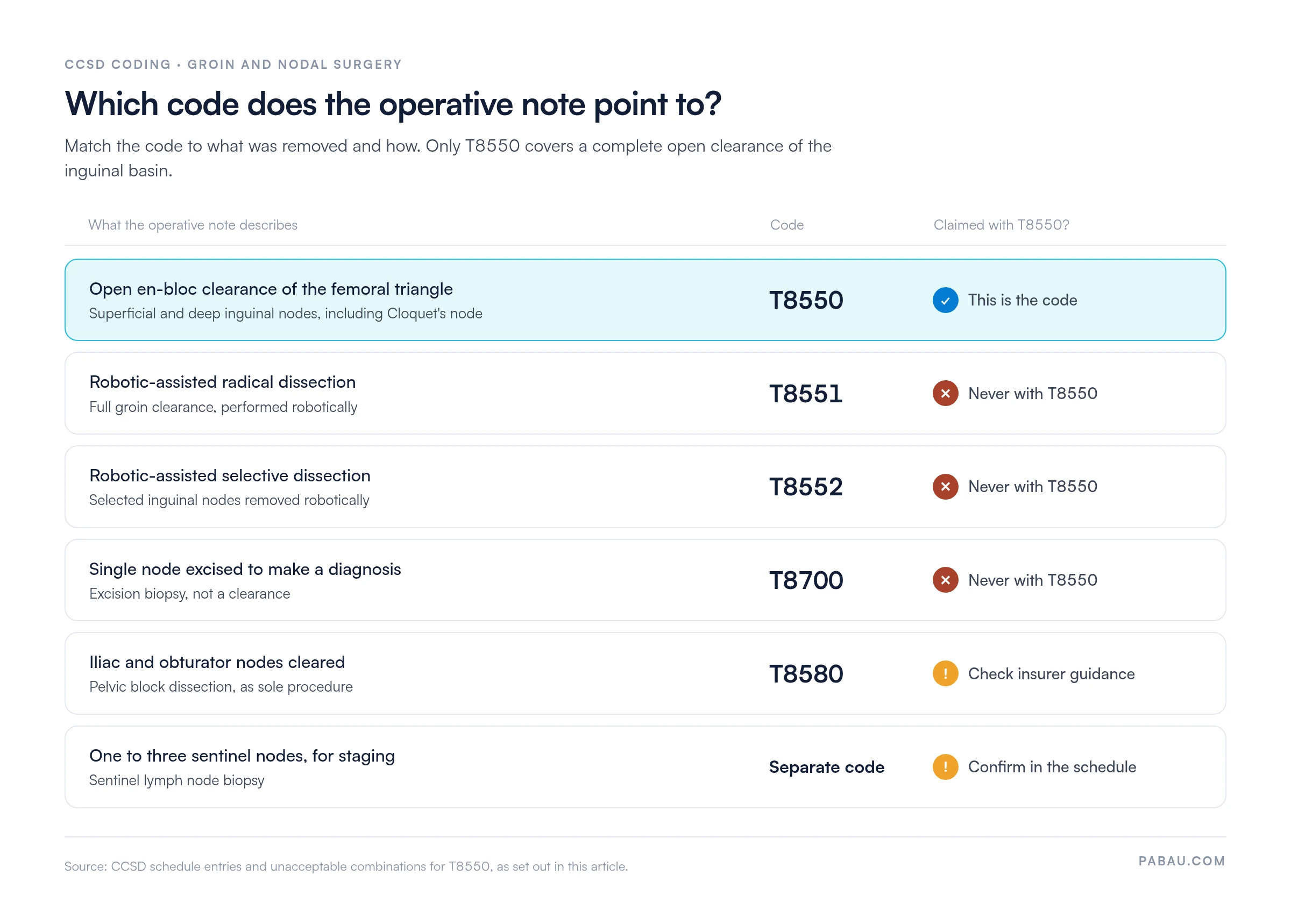
Approach matters for coding. T8551 covers a robotic-assisted radical dissection of the inguinal nodes, and T8552 covers a robotic-assisted selective dissection. Neither is claimed with T8550. The table below matches each groin or nodal operation to the code its operative note supports.
T8550 is used for a narrow set of cancers that drain to the groin. Each indication carries its own ICD-10 pairing and its own evidence for pre-authorisation.
The decision to operate rests with the treating team and the relevant multidisciplinary meeting. Coders should never infer the indication from the code. The operative note and histopathology report confirm it before the claim goes out.
The two procedures often happen in the same patient, but they are never the same operation. The deciding factors are how much tissue was removed and why.
Claiming T8550 for a sentinel node biopsy overstates the work. Claiming only a biopsy after a full clearance understates it. In both cases the operative note settles the question.
Several lymphatic codes sit close to T8550 in the schedule. Picking the wrong one is a common audit finding, so match the code to the basin and the approach. The wider list of CCSD codes gives each neighbouring entry its own page.
The CCSD schedule lists T8551, T8552 and T8700 as unacceptable combinations with T8550. A robotic and an open dissection of the same groin cannot both be claimed. A diagnostic node excision is absorbed into the full dissection.
Some dissections continue from the groin into the pelvic nodes in one operation. Check the insurer’s CCSD guidance before claiming T8580 alongside T8550, because its as-sole-procedure wording limits when it can be added.
Every T8550 claim carries at least one diagnosis code. UK insurers use WHO ICD-10, 5th edition, not the US ICD-10-CM. Code the primary cancer driving the dissection, and add the nodal code where metastasis is confirmed.
Sending C77.4 without the primary is a frequent query trigger. Insurers expect both codes where both are known. Check the operative note and the pathology report together before you choose.
Code the primary cancer every time, then add C77.4 for the involved groin nodes. A claim that carries only the secondary code reads as incomplete and invites a query from the insurer.
T8550 claims attract scrutiny because the procedure is major and the indications are narrow. A structured operative note is the simplest defence against an insurer query.
A note that describes only removal of a groin lump, or excision of an inguinal node, does not support T8550. It reads as a diagnostic excision, which is T8700.
UK private medical insurers expect the patient to obtain pre-authorisation before planned surgery. The insurer then issues an authorisation code, which goes on the specialist’s claim. Requirements vary by insurer and by policy, so confirm them before you book theatre time.
The insurer usually needs the following to approve T8550:
Ask for a new authorisation if the plan changes, for example from one side to both, or from open to robotic surgery. The code on the claim has to match the code the insurer approved.
The T8550 descriptor does not state a side. When both groins are dissected, laterality and multiple-procedure rules follow the insurer’s CCSD guidance. Check how the insurer wants a bilateral operation shown before you submit, and record the side in the operative note either way.
CCSD has no modifiers. Unlike US CPT coding, there is no two-character suffix to mark a bilateral, reduced or repeat procedure. Laterality and complexity come from the code’s own wording and the schedule’s rules, so the operative note has to carry the detail.
Specialists submit CCSD claims to UK insurers electronically through Healthcode. The claim carries the patient’s membership details, the authorisation code, the CCSD procedure code and the ICD-10 diagnosis. Each insurer sets its own benefit for T8550, so check the insurer’s published fee schedule before you quote the patient.
The anaesthetist bills on a separate account under the insurer’s arrangements. Histopathology on the nodal specimen is billed by the pathology provider, not on the surgeon’s claim.
Keep the authorisation and the claim together in claims management software. A missing or mismatched authorisation code is the easiest rejection to prevent.
Most T8550 rejections trace back to five avoidable errors. The table below shows what triggers each one and how to prevent it.
When a claim comes back, read the insurer’s reason before resubmitting. Resending without fixing the documentation simply earns a second rejection. Filing the pathology, authorisation and operative note against one encounter heads off most of these rejections.
Insurer schedules, such as the Healix fee schedule, also explain which routine steps are included in the main procedure. Drain placement and wound closure are normally part of T8550, not separate claims.
A T8550 claim depends on paperwork that usually sits in different places: the pathology report, the insurer’s approval and the operative note. Pabau keeps all three on one patient record, so nobody chases them when the insurer asks.
Your team can record the insurer’s authorisation code on the patient’s insurance case, and Pabau warns when one is missing. Each claim is then tracked through Healthcode until it is paid. Pabau does not choose or attach the procedure and diagnosis codes. Your surgeon and coder still decide those, and Pabau keeps the evidence for them in one place.
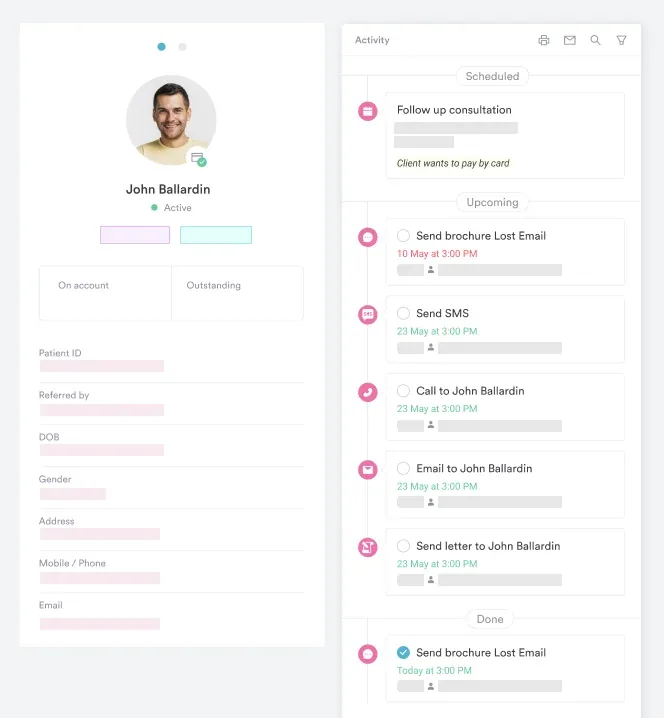

Pabau keeps the operative note, pathology report and insurer authorisation code on one patient record, and tracks each claim through Healthcode until it is paid.

T8550 covers a complete open clearance of the groin nodes and no smaller operation. A sentinel node biopsy, a single diagnostic excision or a robotic dissection each points to a different code. The operative note is what proves which one happened.
Get the authorisation first, code the primary cancer with the nodal disease, and follow the insurer’s CCSD guidance when both sides are done. Do that, and the claim reaches Healthcode in a state the insurer can pay. To see how Pabau keeps that evidence together, book a demo.

Clearing the pelvic nodes instead? CCSD Code T8580 covers block dissection of pelvic lymph nodes as a sole procedure.
Coding a single diagnostic node excision? CCSD Code T8700 explains when an excision biopsy applies, and why it cannot be claimed with T8550.
Need the wider CCSD picture? The Bupa CCSD codes guide explains how the schedule is organised and how insurer claims work.
CCSD Code T8550 covers block dissection of inguinal lymph nodes. The surgeon removes the superficial and deep inguinal node-bearing tissue of the femoral triangle in one specimen. It does not cover a sentinel node biopsy, a single diagnostic excision (T8700) or a robotic-assisted dissection (T8551 or T8552).
UK private medical insurers that use the CCSD schedule recognise T8550, including Bupa, AXA Health, Aviva and Vitality. Specialists submit claims electronically through Healthcode. Benefit levels and pre-authorisation rules vary by insurer and by policy, so confirm them before surgery.
T8550 is a therapeutic clearance of the whole inguinal nodal basin. A sentinel lymph node biopsy removes one to three nodes for staging. The two are coded separately, and a block dissection after a positive sentinel node is usually a later, separate episode.
The T8550 descriptor does not state a side. When both groins are dissected, laterality and multiple-procedure rules follow the insurer’s CCSD guidance. CCSD has no modifiers, so record the side clearly in the operative note and check the insurer’s rules before you submit.
You need the insurer’s authorisation code, an operative note naming the node groups, boundaries, side and open approach, and histopathology confirming the cancer. The claim also needs WHO ICD-10 codes for the primary cancer, plus C77.4 where nodal metastasis is confirmed.
The CCSD schedule lists T8551 and T8552, the robotic-assisted radical and selective inguinal dissections, as unacceptable combinations. T8700, excision biopsy of a lymph node for diagnosis, is excluded too. So are the prostatectomy codes M6180, M6193 and M6194.