

CPT Code 30801: Superficial turbinate ablation billing guide
CPT Code 30801: Official descriptor and procedure overview The American Medical ...

Last Updated: Nov 27, 2026
T9020 is the CCSD code for sentinel node mapping and sampling with blue dye and radioactive probe for breast cancer. The surgeon uses both tracers together to find and remove the first lymph nodes that drain the breast.
It sits in sections 7.1.0 Excision/Biopsy codes and 9.8.0 Lymphatic System of the schedule, and was added on 23 July 2013. Mapping with only one tracer takes T9000, and T9000, T8620 and T9030 cannot be billed with T9020.
Let Pabau's smart automation suggest the right codes, reduce claim denials, and keep your practice compliant—effortlessly.
Automate repetitive tasks and focus on what matters most—your patients.
Reduce coding errors and ensure compliance with the latest regulations.
Clean claims, fewer denials, and faster reimbursements.
Powerful insights and reporting to help your practice thrive.
HIPAA compliant SOC 2 certified GDPR-compliant Trusted by 4,000+ clinics worldwide

CCSD Code T9020 covers sentinel node mapping and sampling with blue dye and radioactive probe for breast cancer.
Both tracers must be documented. Mapping with only one of them takes T9000 instead.
T9000, T8620 and T9030 are unacceptable combinations with T9020, so never bill them on the same claim.
CCSD is the UK private healthcare coding schedule, and each insurer sets its own fees and authorisation rules.
Link a C50 breast cancer diagnosis, or D05.1 for staged DCIS, supported by the pathology report.
T9020 is the CCSD code for sentinel node mapping and sampling with blue dye and radioactive probe for breast cancer. It belongs to the CCSD schedule, the procedure coding schedule for the UK private healthcare sector. The surgeon uses both tracers together to find and remove the first lymph nodes that drain the breast.
The CCSD Group maintains the schedule. Its members are four UK private health insurers: Bupa, AXA Health, Aviva and Vitality. Because they share one code set, a T9020 claim uses the same code whichever of them pays it.
The schedule defines what each code means. It does not set fees, payment levels or pre-authorisation rules. Each insurer decides those for itself, which is why the same T9020 claim can be paid differently by two insurers. Other schedule entries are listed in the library of CCSD codes for practices.
Sentinel node mapping stages the axilla without removing every node in it. The sentinel nodes are the first to receive lymph from the tumour, so their status predicts the status of the rest. T9020 describes the version that combines two tracers.
Both tracers must be used for T9020 to fit. If the operative note shows only the dye or only the probe, the descriptor is not met. That case has its own code, covered below.
The procedure is used to stage early invasive breast cancer when the axilla shows no sign of disease before surgery. NICE guideline NG101 recommends pre-operative axillary ultrasound, and sentinel node biopsy where that shows no lymph node involvement.
T9020 is limited to breast cancer, and sentinel node biopsy for melanoma has its own code, S0608. The final decision belongs to the treating team and the multidisciplinary meeting. For billing, what matters is that the operative note and clinic letters record the indication clearly.
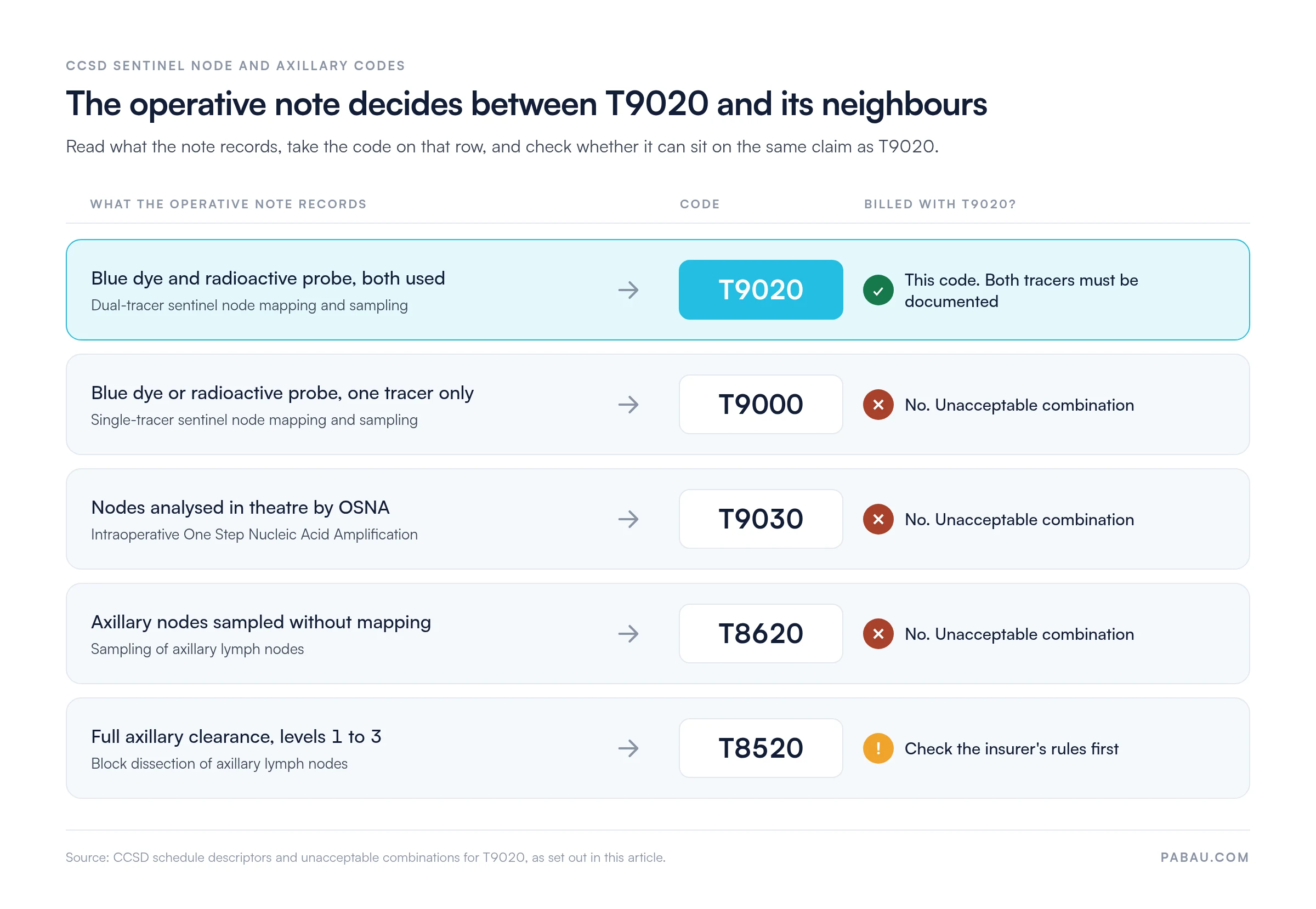
Choosing between the axillary codes comes down to the technique used and how much tissue was removed. The table sets T9020 against its nearest neighbours. The Bupa CCSD codes guide explains how the wider schedule is organised.
The schedule lists T9000, T8620 and T9030 as unacceptable combinations with T9020. Report one sentinel node code per axilla procedure, chosen by the technique the operative note records. For other pairings, check the CCSD technical guide and the insurer’s own rules.
UK private claims carry an ICD-10 diagnosis alongside the CCSD procedure code. For T9020, that diagnosis usually comes from category C50, malignant neoplasm of breast. Code the site from the pathology and imaging reports rather than from the referral letter.
If histology later shows tumour in the sentinel nodes, the final coding may add C77.3, secondary malignant neoplasm of axillary lymph nodes. Insurers differ on which diagnoses they accept with T9020, so check the policy before submission.
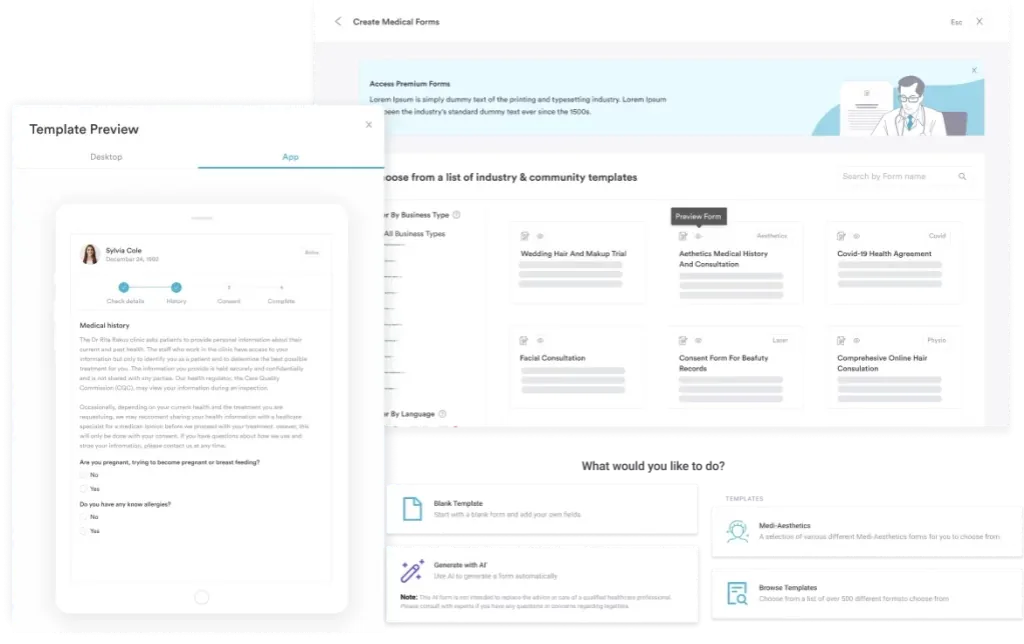
The operative note is the evidence for the dual-tracer technique. If an insurer queries a T9020 claim, it will ask for that note first. A structured note template in Pabau, a practice management platform, keeps the details in the same place every time.
The note should record these points for each T9020 procedure:
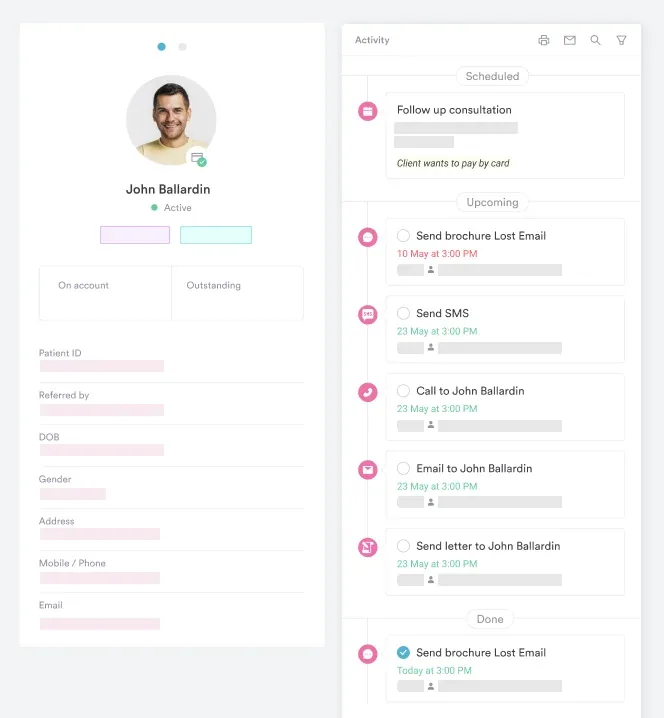
Linking the nuclear medicine record, the operative note and the histology to one episode makes a query quick to answer. Structured patient records keep those documents together.
UK private medical insurance policies usually ask the patient to get authorisation before treatment. The insurer will want the planned CCSD codes, so T9020 should be on the request with the breast procedure.
Each insurer sets its own authorisation steps and its own fees. Bupa, AXA Health, Aviva and Vitality publish their rules separately. Healix, for example, publishes its own Healix fees schedule of professional fees against CCSD codes.
Check the policy before the operation date, and record the authorisation number on the patient record. If the plan changes in theatre, for example from T9020 to T9000, tell the insurer when you submit.
Most UK private practices send insurer claims electronically through Healthcode. The steps below keep a T9020 claim consistent with the record behind it.
Most queries on T9020 trace back to the code choice, or to an operative note that leaves out a tracer or a probe count. Each insurer applies its own rules, so treat the table as a checklist rather than a rulebook.
Add a tracer checkbox to the operative note template: blue dye, isotope, or both. The coder can then choose between T9000 and T9020 without chasing the surgeon after the list.
The T9020 descriptor covers the mapping and sampling of the sentinel nodes. It does not name the isotope injection or any pre-operative lymphoscintigraphy scan.
Those steps are usually carried out by a nuclear medicine team rather than the operating surgeon. Whether they are charged separately, and by whom, depends on the hospital and the insurer. Agree the billing route before the list, so the same service is not claimed twice.
A T9020 claim draws on several records: the nuclear medicine note, the operative note, the histology and the authorisation. Each handover is a chance for a tracer or an authorisation number to drop out.
Pabau keeps those pieces on one patient record. Its digital forms structure the operative note around the details insurers query. Its claims management software submits UK insurer claims through Healthcode and BUPA, then tracks each one to payment.
Your billing team can see which claims are queried, part-paid or settled. Patient shortfalls are invoiced at checkout, so they do not sit unbilled after the insurer pays.
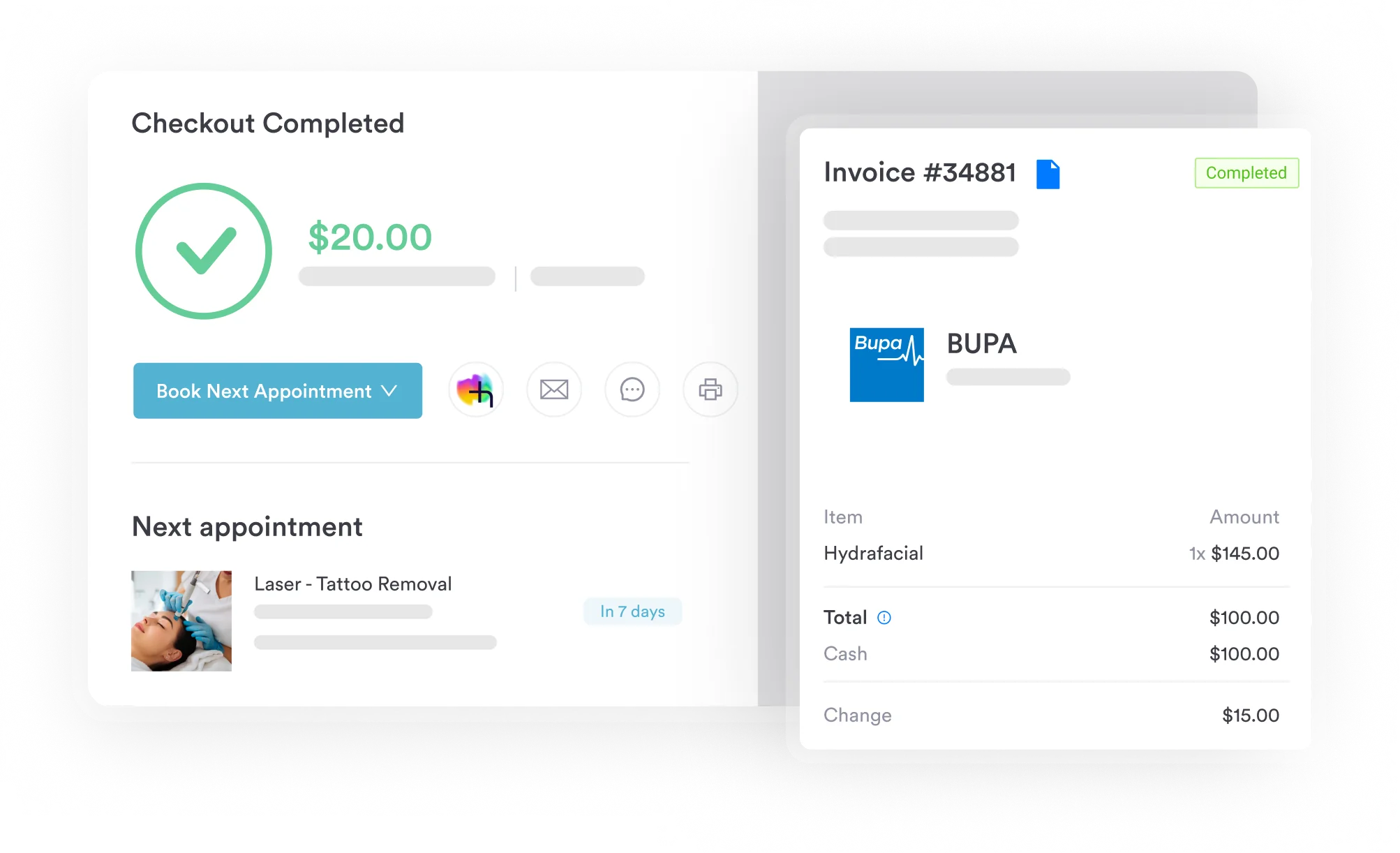

Pabau keeps the operative note, the authorisation number and the Healthcode claim on one patient record. Your billing team can follow each sentinel node claim from submission to payment.

T9020 rests on one fact in the operative note: both tracers were used. When the note says so, the code is straightforward. When it does not, T9000 is the honest choice, and the two can never sit on the same claim.
Fees and authorisation are a separate question, answered by each insurer rather than by CCSD. Check the policy before the operation, and the claim reaches Healthcode with fewer surprises.
Book a demo to see how Pabau links the operative note, the authorisation and the Healthcode claim for every sentinel node procedure.

Need a broader CCSD billing reference? Bupa CCSD procedure codes explains how the CCSD schedule is structured and how UK private insurers apply it.
Looking to cut insurer queries across your practice? Pabau’s claims management software helps practices submit claims through Healthcode and track each one to payment.
Coding the biopsy that confirmed the diagnosis? CCSD code B3212 explains how to bill a percutaneous suction core breast biopsy.
Staging a melanoma rather than a breast cancer? CCSD code S0608 covers sentinel node biopsy for melanoma and how to bill it.
CCSD Code T9020 covers sentinel node mapping and sampling with blue dye and radioactive probe for breast cancer. Both tracers must be used in the same procedure. The code sits in sections 7.1.0 Excision/Biopsy codes and 9.8.0 Lymphatic System of the schedule.
T9000 covers sentinel node mapping and sampling with blue dye or radioactive probe, so one tracer only. T9020 needs both tracers. The two are an unacceptable combination, so a claim carries one or the other, chosen from the operative note.
No. T9030 is intraoperative sentinel node mapping using OSNA, One Step Nucleic Acid Amplification, for breast cancer. It cannot be billed with T9020. Full axillary clearance has its own code, T8520, for block dissection of levels 1 to 3.
The CCSD Group maintains the schedule for the UK private healthcare sector. Its members include private insurers such as Bupa, AXA Health, Aviva and Vitality. The schedule defines the codes but does not set fees or authorisation rules.
Most T9020 claims carry a code from category C50, malignant neoplasm of breast, chosen by tumour site. D05.1 fits ductal carcinoma in situ staged at mastectomy. Code from the pathology report, and check which diagnoses the insurer accepts.
Most UK private medical insurance policies ask the patient to get authorisation before treatment. Each insurer sets its own process, so check the policy and put T9020 on the request with the breast procedure.
It should state that blue dye and the radioactive probe were both used. Name the dye, reference the isotope injection, and record probe counts. Also record the number of nodes removed and whether each was blue, radioactive or both.




