HCPCS code J3471: Hyaluronidase ovine injection billing guide
HCPCS code J3471: Descriptor, code type, and quick-reference data HCPCS code J34...

Last Updated: Oct 14, 2026
57425 is the CPT code for laparoscopy, surgical, colpopexy (suspension of vaginal apex). The surgeon reattaches a prolapsed vaginal apex to the sacrum, or to another pelvic anchor point, through laparoscopic ports.
Medicare values the code at 16.60 work RVUs with a 90-day global period, and pays it in a facility setting only. Denials usually trace back to thin medical-necessity documentation, or to NCCI bundling when a hysterectomy happens in the same session.
Let Pabau's smart automation suggest the right codes, reduce claim denials, and keep your practice compliant—effortlessly.
Automate repetitive tasks and focus on what matters most—your patients.
Reduce coding errors and ensure compliance with the latest regulations.
Clean claims, fewer denials, and faster reimbursements.
Powerful insights and reporting to help your practice thrive.
HIPAA compliant SOC 2 certified GDPR-compliant Trusted by 4,000+ clinics worldwide

CPT code 57425 covers laparoscopic colpopexy, the suspension of the vaginal apex through laparoscopic ports.
Medicare values 57425 at 16.60 work RVUs and 25.75 total RVUs, and pays it in a facility setting only.
N99.3 is the most precise diagnosis once the prolapse follows a hysterectomy, and it carries medical necessity best.
Neither 58571 nor 58573 mentions colpopexy in its descriptor, so the NCCI edit table decides any bundling.
Practice management software like Pabau pre-fills claim fields from the patient record and checks them for completeness before submission.
CPT code 57425 is the procedure code for laparoscopy, surgical, colpopexy (suspension of vaginal apex). The surgeon fixes the top of the vagina to the sacrum, or to another pelvic anchor point, using mesh or suture. All of it happens through laparoscopic ports, with no open abdominal incision.
The American Medical Association files the code under Endoscopy/Laparoscopy Procedures on the Vagina, in the 57420 to 57426 range. Most patients who need it have vaginal vault prolapse after a hysterectomy. Once the uterus is gone, the apex can lose the support that held it in place.
That clinical story matters to whoever builds the claim, because payer coverage follows the diagnosis rather than the technique. Here is the reference set for the code itself.
When the prolapse follows a hysterectomy, N99.3 is the most precise diagnosis to pair with 57425. It names the vaginal vault as the site and the earlier surgery as the cause, which is exactly what a medical reviewer wants to see.
The remaining options sit in the N81 family. Coverage turns on a documented prolapse diagnosis, and the specificity you choose inside that family moves your denial rate more than any other single decision.
Record the POP-Q staging, or an equivalent severity assessment, in the pre-operative note. A stage 3 or stage 4 finding justifies N81.3 instead of N81.4, and it survives a medical review that a vague code will not. Coders who work across both code sets can check the diagnosis side in the ICD-10-CM code reference before the claim is built.
Medicare pays roughly $860 nationally for CPT 57425, and only when the procedure happens in a facility. The office column of the fee schedule is marked NA, so an office place of service has no payable rate at all.
Two conversion factors apply in 2026. Clinicians outside an advanced alternative payment model are paid $33.4009 per RVU. Qualifying participants are paid $33.5675, which lifts the same 25.75 RVUs to about $864.
Those are national figures. Geographic practice cost indices move the number by locality, so your Medicare administrative contractor pays something a little different. Pull the locality-adjusted file from the CMS physician fee schedule before quoting a rate to a surgeon.
Run a locality check before you quote reimbursement to your surgeons. The national average for 57425 understates payment in high-cost areas like San Francisco or New York, and overstates it in rural markets. Pull your contractor’s locality-adjusted fee schedule from the CMS download and quote from that instead.
Whether 57425 can be reported alongside a laparoscopic hysterectomy is decided by the NCCI procedure-to-procedure edit table. It is not decided by the hysterectomy descriptor, and neither 58571 nor 58573 mentions colpopexy anywhere in its wording.
Here is what those descriptors actually cover.
So the question is never what the descriptor says. Look the pair up in the current NCCI edit file, which CMS republishes every quarter. The file tells you whether an edit exists for that pair, and whether its modifier indicator lets you override it.
A modifier indicator of 1 means an override is possible. Modifier -59, or the more specific -XS, can then separate the pair where the operative note describes a distinct service. An indicator of 0 means no modifier will ever split them. Commercial plans sometimes run stricter rules than Medicare, so read the payer policy as well.
Set your billing system to hold any claim carrying 57425 alongside 58571 or 58573 for coder review. A five-minute check at the claim stage beats a 45-day denial cycle. Build it as a standing rule rather than a reminder somebody has to remember.
Several modifiers turn up on 57425 claims, and -59 is the one payers audit hardest. Append it only when the operative note describes a colpopexy that genuinely stands apart from the other procedure. Payer policies and the AAPC coding reference govern the rest.
Modifiers on a drug code answer a different question. On HCPCS code J0895, the route of administration decides the line, with JA for an IV infusion and JB for the overnight subcutaneous pump.
CPT 57425 carries a 90-day global period, so routine follow-up care for the colpopexy is already paid for. What catches billers out is how unevenly that package divides when two providers share the patient.
The fee schedule assigns 12% of the payment to pre-operative care, 74% to the procedure itself, and 14% to post-operative management. Against the national facility rate, that works out at roughly $103, $636 and $120.
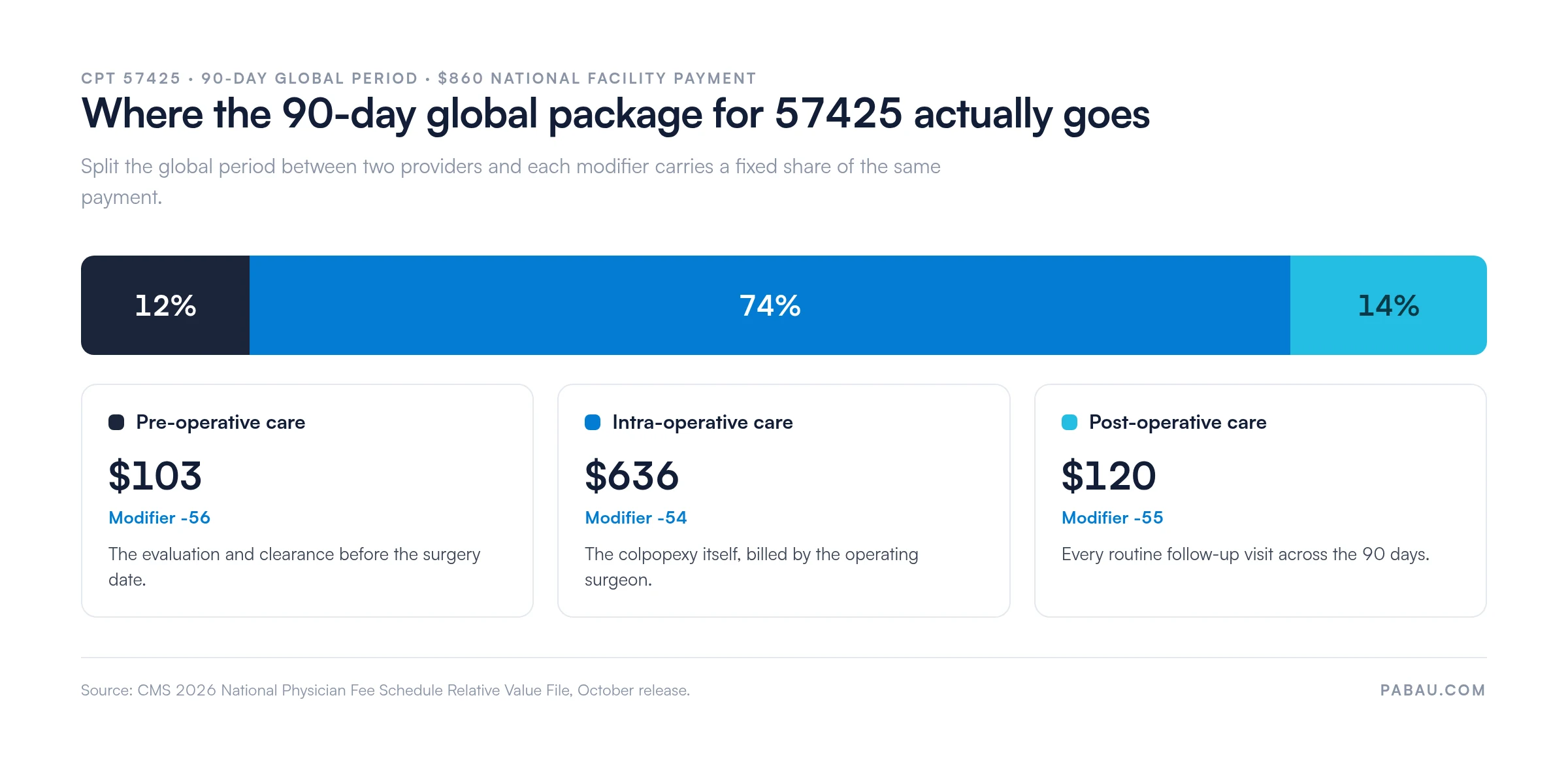
Those percentages are what modifiers -56, -54 and -55 actually move. A surgeon who operates and hands the follow-up to a local ob-gyn bills -54 and keeps the 74%. The receiving physician bills -55 for the remainder, and the transfer date belongs in both records.
Some services stay separately billable inside the 90 days:
Medical reviewers read the operative note before they pay 57425, and five details carry the decision. Miss one and the claim moves to manual review, which adds weeks to the payment cycle.
Medicare does not require prior authorization for 57425 as a condition of payment, though local coverage determinations still apply. Commercial and managed-care plans usually do require it for major pelvic floor surgery.
Send the pre-operative evaluation note, the POP-Q staging, evidence that conservative treatment failed, and the proposed diagnosis code. Turnaround varies by plan, so file the request as early as the surgery date allows.
A 57425 claim that clears these five checks rarely comes back. Run them while the claim is being built, not after the remittance lands.
Two mistakes cause most of the rework. The first is reaching for -59 by reflex whenever two surgical codes appear together. The second is billing a follow-up visit inside the 90-day window with no modifier on it.
Both are process problems rather than coding problems, and the habits behind clean claim submission catch them before the batch goes out.
Medicare covers 57425 for qualifying prolapse diagnoses, subject to the local coverage determination in your region. No national coverage determination restricts the procedure, but individual contractors set their own documentation thresholds. When a claim does come back, it is usually one of these four.
Denial patterns are easier to read in aggregate than one at a time. A single 57425 rejection is noise. Five from the same payer in a month is a policy nobody on the team has read yet.
Reference pages tell you the rules. Applying them is a workflow problem, and it lands at the moment the claim is built. Practice management software like Pabau closes that loop with claims management built in. The claim gets assembled from the encounter instead of retyped from it.
Diagnosis, procedure, provider and place of service all pre-fill from the patient record, so nobody copies them across from the operative note. Pabau then checks the claim for required-field completeness before it can be submitted. That alone removes the half-finished claims and the transposed code numbers.
In the US, claims route through Claim.MD, our clearinghouse partner. The connection runs eligibility checks ahead of the visit. It posts electronic remittance advice back against the original claim, and tracks claim status without a payer portal login. Your biller sees where a 57425 claim sits without chasing it.
What Pabau will not do is make the coding call for you. Whether 57425 unbundles from a hysterectomy is still a coder’s judgment against the NCCI file. The software removes the transcription error and the incomplete submission, which is where the avoidable denials actually sit.

Pabau pre-fills claim fields from the patient record and checks them for completeness before submission. In the US, Claim.MD handles eligibility, remittance and claim status. See how it works on a laparoscopic gynecology claim.

Two decisions carry most of the money on a 57425 claim. The first is which prolapse diagnosis the record can genuinely support. The second is whether the NCCI edit file lets the colpopexy stand apart from a same-session hysterectomy.
Both get settled before the claim is built, never after the denial arrives. A coder who reads the operative note against the current edit file will be right far more often. Reading the descriptor and guessing is what produces the rework.
If retyping and half-finished claims are what slow your billing team down, that part is fixable. Book a demo to see how Pabau builds a surgical claim straight from the patient record.

Seeing the same rejections month after month? Denial management in healthcare sets out how to work denials by pattern rather than one claim at a time.
Want fewer surgical claims coming back? Clean claim submission walks through the pre-submission checks that stop the most common edit conflicts.
Need charge capture that matches the operative note? Superbill documentation explains how to structure charges so diagnosis and procedure linkage is right before the claim exists.
Worried about how an audit would read your notes? Medical billing compliance covers the documentation standards reviewers apply to high-value surgical codes.
Yes. The Medicare fee schedule gives 57425 an assistant-at-surgery indicator of 2, which means the payment restriction does not apply. The assistant reports the same code with modifier -80, or -82 where a qualified resident was not available. The operative note has to name the assistant and describe what they did.
Yes, with documentation. The fee schedule sets the co-surgery indicator for 57425 to 1, so co-surgeons can be paid where the record shows why two were needed. Each surgeon reports 57425 with modifier -62 and writes a separate operative report. Team surgery is not permitted on this code.
Report 57425 itself. CPT has no separate code for a robotic approach, so robotic sacrocolpopexy uses the laparoscopic code. Some commercial payers accept HCPCS S2900 alongside it for the robotic system. Medicare does not recognize that code, because S2900 carries status indicator I.
Use 21 for hospital inpatient, 22 for on-campus hospital outpatient, and 24 for an ambulatory surgery center. Place of service 11, the office, has no payable rate for 57425 and will reject. Confirm which setting the hospital registered the case under before you submit.