CCSD code L6530: Revision femoral bypass graft
CCSD code L6530: Definition and clinical scope CCSD code L6530 carries the offic...

Last Updated: Nov 13, 2026
N3210 is the CCSD (Clinical Coding and Schedule Development) code for biopsy of lesion of penis. The specialist takes a small sample from a penile lesion and sends it for histology. Bupa’s February 2026 schedule lists it as Minor, band MINOR 3.
The code covers diagnostic sampling only, and the lesion stays in place. Complete removal has its own code, N2710, excision of lesion of penis.
Let Pabau's smart automation suggest the right codes, reduce claim denials, and keep your practice compliant—effortlessly.
Automate repetitive tasks and focus on what matters most—your patients.
Reduce coding errors and ensure compliance with the latest regulations.
Clean claims, fewer denials, and faster reimbursements.
Powerful insights and reporting to help your practice thrive.
HIPAA compliant SOC 2 certified GDPR-compliant Trusted by 4,000+ clinics worldwide

CCSD code N3210 covers diagnostic biopsy of a penile lesion by punch or incisional technique. Complete removal is a different code, N2710.
Bupa’s February 2026 schedule lists N3210 in band MINOR 3, with a fee of £138. Other UK insurers set their own fees.
Every N3210 claim needs a paired ICD-10 code, most often from C60, D07.4, A63.0, N48.0 or D29.0.
Bupa, AXA Health, Aviva and Vitality usually expect pre-authorisation, so confirm it for each patient before the procedure.
Pabau, the practice management platform we build, submits CCSD-coded claims through Healthcode and keeps the procedure note beside each one.
CCSD code N3210 is the UK private healthcare code for biopsy of lesion of penis. AXA Health’s specialist code schedule lists it under chapter 12 as a minor procedure. A urologist or dermatologist takes a small tissue sample from a penile lesion and sends it for histology. The purpose is diagnostic: the biopsy confirms or excludes a diagnosis, and the lesion itself stays in place.
CCSD stands for Clinical Coding and Schedule Development, the shared schedule of private insurer procedure codes in the UK. The CCSD Group of Bupa, AXA Health, Aviva and Vitality maintains it. WPA, Cigna, Allianz Care and H3 Insurance use it too, and claims usually travel electronically through Healthcode.
Fees and bands change, so check the insurer’s current schedule before you quote a patient. Our Bupa CCSD codes reference lists the full schedule by chapter.
N3210 covers a tissue biopsy of a penile lesion by punch or incisional (wedge) technique. The lesion may sit on the glans, prepuce, shaft skin, frenulum or meatus. What qualifies the procedure is diagnostic intent: the specialist removes a small sample for histology rather than treating the lesion.
The exclusions matter as much as the inclusions. If the whole lesion is removed, the operation is an excision, and billing a biopsy as well describes the same tissue twice. Widening a tight foreskin is a separate operation again, coded as N3010. So is frenuloplasty, which lengthens a short frenulum and is billed under CCSD code N2842. The table below sets out where N3210 starts and stops.
A penile biopsy is indicated when the lesion’s appearance alone cannot settle the diagnosis and treatment depends on histology. Treating without a biopsy risks mismanaging malignant or premalignant disease. Common indications include:
The clinical notes must state the specific indication. A claim that says only “penile lesion”, with no description that justifies the diagnostic doubt, invites questions from the insurer’s claims team.
Knowing what happens clinically helps billing staff spot the documentation each claim needs. A typical penile biopsy under N3210 follows this sequence:
UK insurers expect a diagnosis code from the WHO ICD-10 classification on each claim. A missing or unsupported diagnosis is one of the most common reasons a claim is returned. The table lists codes often paired with N3210, by clinical indication. Pick the code the clinical notes support.
Use the most specific code available. C60.9, malignant neoplasm of penis, unspecified, is weaker than C60.1 when the notes place the lesion on the glans. Match the diagnosis code to the documented site, and keep it consistent with the one on the pre-authorisation.
Telling a biopsy from an excision is the most important coding decision in this area. The table shows Bupa’s February 2026 band and fee for the nearby penile codes, so coders can see how the operative note changes the claim. Injury repairs sit in the same section, and repair of skin torn or degloved from the penile shaft is coded CCSD N2840.
A biopsy of one lesion and the excision of a different lesion are two procedures, and each needs its own site in the note. How an insurer pays for two codes in one session follows the CCSD Technical Guide business rules and its own policy. CCSD has no CPT-style modifiers, so check with the insurer before you invoice more than one code.
Two details in the note settle the claim: what happened to the lesion, and who gave the anaesthetic. The chart below runs through both in that order.
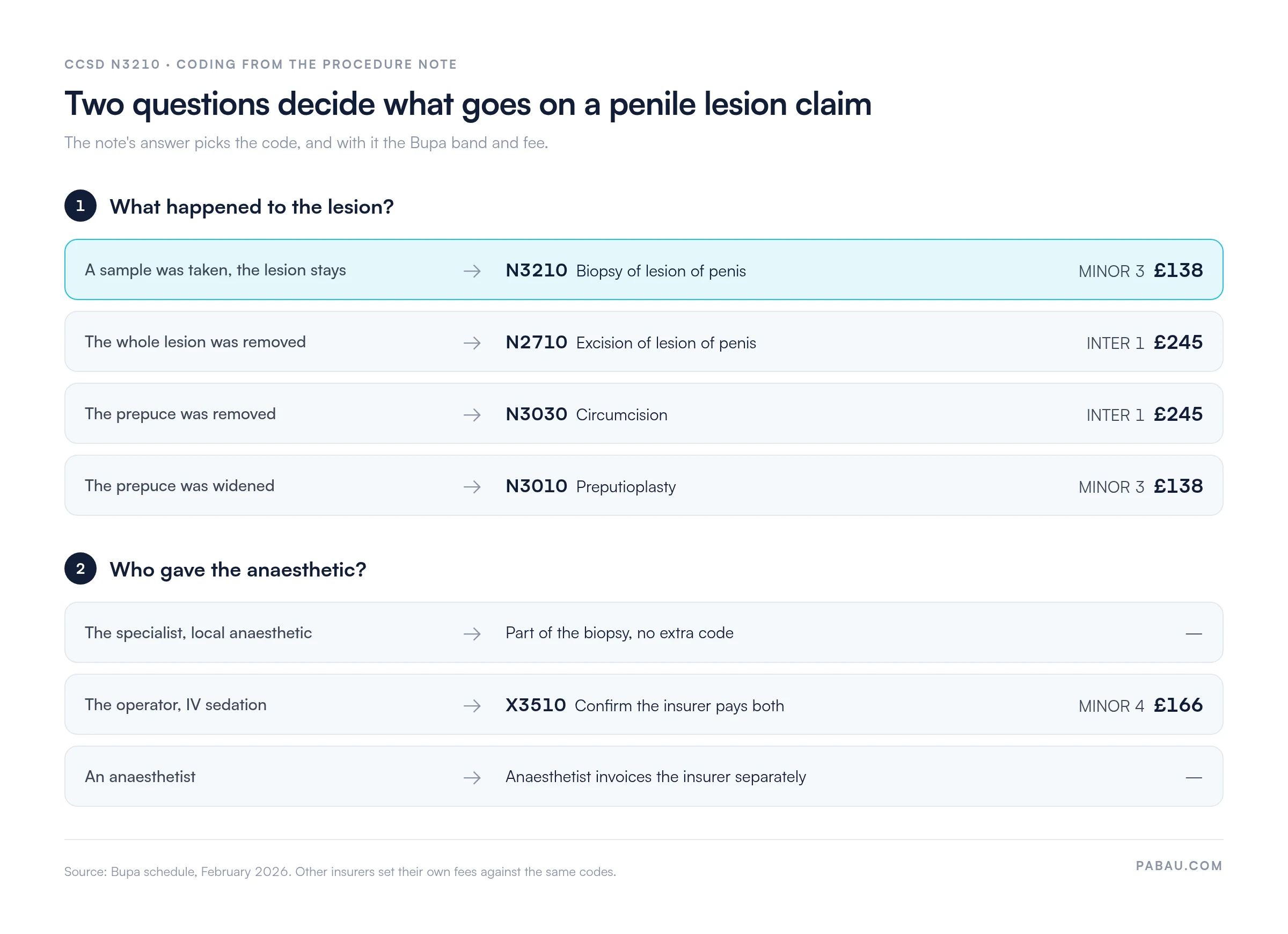
CCSD sets the codes, and each insurer sets its own fee schedule against them. Bupa’s February 2026 schedule places N3210 in band MINOR 3, with a fee of £138. Other insurers, such as AXA Health, Aviva and Vitality, publish their own schedules and benefit maximums.
A specialist who charges more than the insurer pays leaves the patient with a shortfall. Tell the patient about any shortfall in writing before the procedure. When comparing UK medical billing software, check that it holds each insurer’s schedule against the CCSD code.
Check the N3210 fee in each insurer’s current schedule whenever it is republished. Bupa’s £138 is not another insurer’s figure, so record the shortfall conversation with the patient when you charge above the insurer’s rate.
Most UK private medical insurers expect pre-authorisation before a procedure. Requirements differ between insurers, policies and settings, so confirm them for each patient before you book.
When you request authorisation, have the following ready:
Record the authorisation reference in the patient’s file before the procedure, and quote it on the invoice. An invoice without one, where the insurer required it, is likely to be rejected.
Clean N3210 claims start with thorough procedure notes. The record must show the insurer that the biopsy was indicated, performed as described and sent for histology. Capture each field in structured notes at the point of care, rather than rebuilding them at billing time.
The procedure note must document each of the following:
A procedure note template with these fields built in stops one from being missed. Link the pathology request to the billing record, so the histology report is to hand if the insurer asks for clinical support.
Whether another code goes on the claim depends on the setting and the insurer. These are the situations billing teams meet most often with N3210:
When you are unsure how an insurer handles a combination, ask its provider services team before you submit. Keeping each insurer’s answer on file saves the same query next time.
Most N3210 denials are predictable and preventable. They surface when the insurer returns the claim, and most can be caught before submission. The table maps each common reason to its fix.
If a claim is declined, raise it with the insurer’s provider services team first. A patient whose claim the insurer still refuses can use the insurer’s complaints process, then the Financial Ombudsman Service. The same steps apply to wider denial management in healthcare: find the cause, correct it, then resubmit.
Run a short check on every N3210 claim before it goes out. Confirm the authorisation reference, the site-specific ICD-10 code, one code per lesion and the pathology reference. Two minutes at billing time saves weeks of resubmission.
Private urology and dermatology practices billing N3210 need each claim to reach the insurer complete. Pabau submits CCSD-coded claims through Healthcode, with the procedure note attached to the same patient record.
With Pabau’s claims management software, your team tracks each claim and reconciles the insurer’s payment. The pathology reference sits beside the note, ready if an insurer asks for clinical support.

Pabau helps UK private practices record procedure notes, authorisation references and ICD-10 codes at the point of care, then submits CCSD-coded claims through Healthcode.

N3210 pays for a diagnostic sample from a lesion that stays in place. The whole claim rests on the note showing that.
Before the invoice goes out, check that the note records the site, the technique and the pathology reference. Then confirm the insurer’s authorisation and its own fee, since Bupa’s £138 is one schedule among several.
Book a demo to see how Pabau sends CCSD claims through Healthcode and keeps the procedure note beside each one.

Is the whole lesion being removed? CCSD code N2710 covers billing for excision of lesion of penis.
CCSD code N3210 covers diagnostic biopsy of a lesion of the penis, by punch or incisional technique. It applies at any site on the penis, including the glans, prepuce, shaft, frenulum and meatus. The specimen goes for histology, and the code does not cover removing the whole lesion.
Bupa’s February 2026 CCSD schedule lists N3210 in band MINOR 3, with a fee of £138. AXA Health, Aviva, Vitality and other insurers publish their own schedules. Check each insurer’s current figure before you quote a patient.
Most UK private medical insurers, including Bupa, AXA Health and Vitality, expect pre-authorisation before treatment. Requirements vary by insurer and policy, so confirm them for each patient. Quote the authorisation reference on the invoice.
Common pairings are C60.0 and C60.1 (malignant neoplasm of prepuce or glans) and D07.4 (carcinoma in situ of penis). A63.0 (anogenital warts), N48.0 (leukoplakia of penis, including BXO) and D29.0 (benign neoplasm of penis) are also used. Use the most site-specific code the notes support.
N3210 is a diagnostic biopsy, and the lesion stays in place. N2710 is excision of lesion of penis, which removes the whole lesion. Code the procedure the note describes, and do not bill both for the same lesion.
Local anaesthetic given by the specialist is part of the biopsy. Sedation given by the operator has its own code, X3510, so confirm the insurer pays both. An anaesthetist giving sedation or a general anaesthetic invoices the insurer separately.