CCSD code L6530: Revision femoral bypass graft
CCSD code L6530: Definition and clinical scope CCSD code L6530 carries the offic...

Last Updated: Nov 13, 2026
N3010 is the CCSD code for preputioplasty, an operation that widens a tight foreskin without removing it. Bupa grades it MINOR 3, with a surgeon fee of £138.
N3010 sits in chapter 12 of the CCSD schedule, with the other operations on the prepuce. Circumcision is coded N3030, and division of preputial adhesions is N3020.
Let Pabau's smart automation suggest the right codes, reduce claim denials, and keep your practice compliant—effortlessly.
Automate repetitive tasks and focus on what matters most—your patients.
Reduce coding errors and ensure compliance with the latest regulations.
Clean claims, fewer denials, and faster reimbursements.
Powerful insights and reporting to help your practice thrive.
HIPAA compliant SOC 2 certified GDPR-compliant Trusted by 4,000+ clinics worldwide

CCSD code N3010 covers preputioplasty, which widens a tight foreskin without removing it. Bupa grades it MINOR 3, with a surgeon fee of £138.
Pair N3010 with ICD-10 N47 (N47X in NHS format) for phimosis or paraphimosis, N48.0 for BXO, or N48.1 for balanoposthitis.
UK insurers such as Bupa, AXA Health, Vitality and Aviva expect pre-authorisation, so get the authorisation number before the operation date.
Pabau’s practice management software sends claims to UK insurers through Healthcode, pulling the CCSD code and authorisation number from the patient record.
CCSD code N3010 is the UK private-healthcare procedure code for preputioplasty. It belongs to the CCSD Schedules, the standard procedure codes for UK private healthcare. The Clinical Coding & Schedule Development group (CCSD) maintains them, and its members are Bupa, AXA Health, Vitality and Aviva.
The code covers a foreskin-preserving operation that widens a tight or non-retractile preputial opening. That separates it from the circumcision codes, which remove the foreskin. Surgery on a short or tight frenulum is a different operation too, billed as N2842.
UK private medical insurers use CCSD codes to identify the procedure on a claim and to set their fees. The practice submits the CCSD code with an ICD-10 diagnosis, usually through Healthcode, the electronic billing hub for UK private healthcare.
Each insurer then pays the consultant against its own schedule. Bupa grades N3010 as MINOR 3 and pays a surgeon fee of £138.
Preputioplasty widens a narrowed preputial ring while keeping the foreskin intact. The surgeon makes a longitudinal incision through the tight band, then closes it transversely to increase the circumference of the opening.
Some surgeons use a Y-V plasty instead. No foreskin is excised, and that is the difference between N3010 and the circumcision codes.
Children usually have a general anaesthetic, while adults may have a local or a general anaesthetic. Most cases are day surgery. Because the foreskin stays in place, recovery is usually quicker than after circumcision.
For coding, the operation note must name the technique used, such as longitudinal incision with transverse closure or Y-V plasty. It must also confirm that no foreskin was removed, and record why surgery was chosen over conservative treatment.
UK insurers pay for N3010 when the clinical record supports an accepted indication. These conditions can justify preputioplasty over watchful waiting or circumcision:
Insurers may ask for evidence that conservative treatment failed before they authorise an elective preputioplasty, particularly in children. A topical steroid course of 4 to 8 weeks is the usual first step. Including its outcome in the pre-authorisation request removes the most common reason for a query.
Every N3010 claim needs an ICD-10 diagnosis that matches the documented indication. UK insurers work with the WHO ICD-10 classification, which NHS coding applies in its 5th edition. In that edition, N47 is a single three-character code with no subcodes.
Be careful with codes copied from US sources. The US ICD-10-CM edition splits N47 into separate subcodes for phimosis and paraphimosis, and those subcodes do not exist in the WHO edition. BXO is another trap: it belongs under N48.0, not under N48.1.
When a lesion needs histology to confirm BXO before surgery, that biopsy is claimed on its own under N3210. A diagnosis that does not match the procedure, or a code from the wrong edition, invites a query from the insurer.
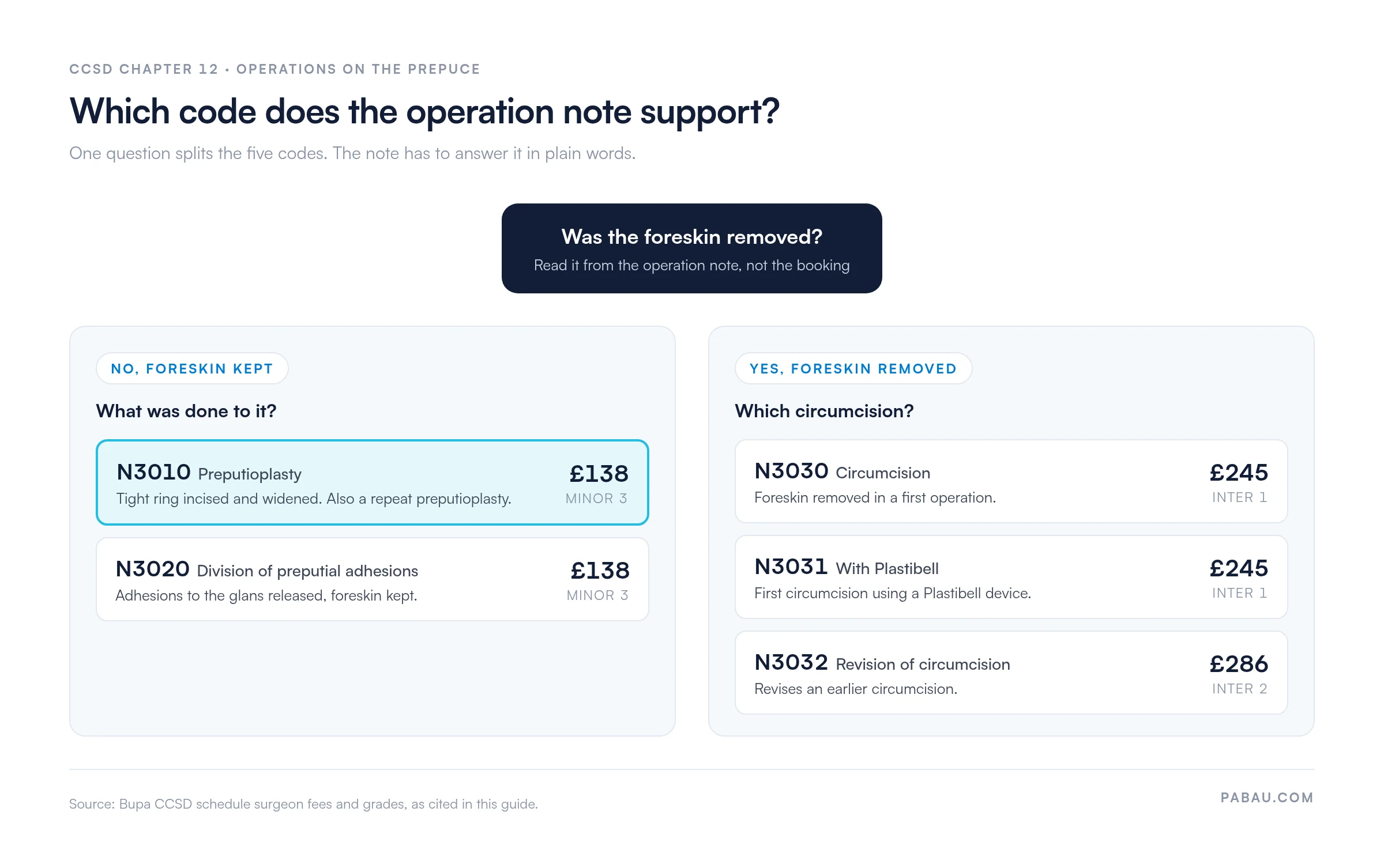
Preputioplasty sits in chapter 12 of the CCSD schedule, with the other operations on the prepuce. Choosing the wrong code is a billing error, and coding a smaller operation as a larger one is overbilling. The grades and fees below come from the Bupa CCSD schedule. For a wider view, see the Pabau guide to Bupa CCSD codes.
Billing N3030 or N3031 when a preputioplasty was performed overstates the operation, and Bupa pays £245 for circumcision against £138 for N3010. The operation note is the audit trail.
If it describes widening without excision, only N3010 is defensible. Insurers that audit after payment will ask for the note, and a mismatch can lead them to recover the fee.
The chart below turns the five codes into the one question the operation note has to answer.
UK insurers treat preputioplasty as elective surgery. The patient usually contacts the insurer to pre-authorise treatment before the operation is booked, and the insurer issues an authorisation number. Without that number, the insurer can decline the claim even when the surgery was clinically sound.
Rules differ by insurer and policy, so check with Bupa, AXA Health, Vitality, Aviva, WPA or Healix directly.
A pre-authorisation request for N3010 usually needs the following information:
Children add a consent step. A parent or guardian with parental responsibility signs the consent form, and the record should hold a copy.
Storing consent and clinical details against the patient keeps that record ready if the claim is queried. Each insurer publishes its own guidance for providers, and the WPA medical fees portal is one example.
Ask the patient to pre-authorise as soon as the operation is agreed in clinic, not the week before. Put the outcome of any steroid course in the clinic letter. An insurer that expects proof of failed conservative treatment will query the request without it, and the operation date slips.
A complete billing record for CCSD code N3010 lowers the risk of a rejection and supports you in an audit. Each item below is a line in the claim or the clinical record:
Rejections and queries on N3010 follow predictable patterns. The table below maps each one to its cause and the fix to make before you resubmit.
Insurers check the procedure and the diagnosis together. The Bupa code search shows the CCSD descriptors and fees Bupa applies, so it is a quick way to confirm the code before you submit.
CCSD code N3010 pays the surgeon’s fee only. Other fees for the same operation are billed by the people or the hospital that provided them, and each follows the insurer’s own rules.
The Healix fee schedule shows how one UK insurer sets out these roles, with each fee on its own claim.
Preputioplasty treats a single structure, so there is no side to record on the claim. A repeat operation needs its own pre-authorisation. If a patient returns because the ring has narrowed again, the surgeon requests a new authorisation and explains why a second operation is needed.
A repeat preputioplasty is billed as N3010 again. N3032 covers revision of a circumcision, so it does not apply here. If the second operation removes the foreskin, the code becomes N3030. Record the date of the first operation and the reason for the second in the new operation note.
Flag a repeat N3010 claim clearly to the insurer. State the original operation date, the outcome, and the clinical reason for the second procedure. A claim that looks identical to an earlier one without that context is likely to be queried as a duplicate.
In many urology and paediatric surgery practices, the authorisation number sits in an email and the diagnosis sits in the clinic letter. The two meet only when someone keys the claim into Healthcode by hand. That is where the missing-field rejections and the wrong ICD-10 codes come from.
Pabau, the practice management platform we build, supports UK insurance claims through Healthcode. The CCSD code, the ICD-10 diagnosis and the pre-authorisation number are recorded against the episode.
Pabau’s claims management software then pulls them from the patient record, and checks that required fields are complete before the claim can be sent.
Digital consent forms are signed and stored against the same record. A parent’s consent for a child’s preputioplasty is there the moment an insurer asks for it.

Pabau records the CCSD code, ICD-10 diagnosis and pre-authorisation number against each episode, then sends the claim through Healthcode. Consent forms sit on the same record.

N3010 is a low-value code, so a rejected claim can cost more in admin time than the £138 fee is worth. That makes it a code to get right the first time. Most N3010 problems come from the diagnosis rather than the procedure, because US sources split N47 into subcodes the WHO edition does not have.
Code the indication from the WHO edition, get the authorisation number before the operation, and write a note that says the foreskin was kept. Pabau’s Healthcode integration carries all three from the patient record to the insurer. To see it with your own CCSD claims, book a demo.

Coding other operations on the same insurer schedule? The CCSD code library lists UK private-healthcare procedure codes by chapter.
Want to see how Bupa sets its surgeon fees? The Bupa procedure codes fee schedule explains the grades and the fees attached to them.
CCSD code N3010 is the UK private-healthcare procedure code for preputioplasty. The operation widens a narrowed preputial ring to relieve phimosis while keeping the foreskin. Urologists and paediatric surgeons use it when claiming from insurers such as Bupa, AXA Health, Vitality and Aviva.
Preputioplasty (N3010) widens the foreskin opening without removing tissue. Circumcision (N3030, or N3031 with a Plastibell) removes the foreskin. Bupa pays £138 for N3010 and £245 for N3030, so the code must match what the operation note describes.
Use the WHO ICD-10 codes that UK insurers expect. N47 covers phimosis and paraphimosis, and NHS coding writes it N47X. N48.0 covers BXO, and N48.1 covers balanoposthitis. The US ICD-10-CM subcodes of N47 do not exist in the WHO edition.
Yes, in most cases. UK insurers treat preputioplasty as elective surgery, so the patient pre-authorises it before the operation. The request carries CCSD code N3010, the ICD-10 diagnosis and the clinical details. Rules vary by insurer and policy, so confirm with the insurer first.
Yes, but not on the surgeon’s claim. The anaesthetist invoices the insurer separately, quoting the same CCSD code and authorisation number. The hospital bills its own charges in the same way.
The usual reasons are a missing pre-authorisation number and a diagnosis code from the US edition. BXO coded as N48.1 instead of N48.0 is another. So are circumcision codes billed for a preputioplasty, and operation notes that do not confirm the foreskin was kept. A short check before submission catches each of them.