CCSD code L6530: Revision femoral bypass graft
CCSD code L6530: Definition and clinical scope CCSD code L6530 carries the offic...

Last Updated: Nov 13, 2026
N2820 is the CCSD code for reconstruction of penis, the surgery that rebuilds the penis after cancer, trauma or a congenital condition. UK private medical insurers such as Bupa, AXA Health and Aviva use it to identify the operation on a surgeon's claim. It sits in Chapter 12 of the CCSD schedule, with the other male genital operations.
Reconstruction usually runs over several operations, and each one is billed as its own claim. Insurers read the operative note for the reason, the technique and the stage. Most also want preauthorization before every planned operation.
Let Pabau's smart automation suggest the right codes, reduce claim denials, and keep your practice compliant—effortlessly.
Automate repetitive tasks and focus on what matters most—your patients.
Reduce coding errors and ensure compliance with the latest regulations.
Clean claims, fewer denials, and faster reimbursements.
Powerful insights and reporting to help your practice thrive.
HIPAA compliant SOC 2 certified GDPR-compliant Trusted by 4,000+ clinics worldwide

CCSD code N2820 is the UK private-insurance code for reconstruction of penis, filed in Chapter 12 of the CCSD schedule.
Repair of an acute avulsion injury has its own code, N2840, so match the code to the operation the note describes.
The operative note should name the cause, the tissue used, the stage and the functional goal.
Reconstruction is often staged, so get preauthorization for each planned stage and quote its number on the claim.
Each insurer sets its own fee for N2820, because the CCSD group publishes codes but not prices.
The CCSD schedule gives N2820 a short narrative: reconstruction of penis. It’s the code a consultant urologist or plastic surgeon puts on a private claim after rebuilding part or all of the penis. Bupa, AXA Health, Aviva and VitalityHealth all read claims against the same set of CCSD codes.
The patients behind these claims tend to fall into three groups. Some have had a partial or total penectomy for cancer, an earlier operation coded N2620 or N2610. That cancer is usually confirmed beforehand by a biopsy of the penile lesion, coded N3210. Some have lost tissue to trauma, burns or an amputation injury. Others were born with a condition such as micropenis, aphallia, or epispadias linked to bladder exstrophy.
Few of these cases finish in one operation. A 2020 review in Plastic and Aesthetic Research describes forearm-flap phalloplasty running to four or more stages. A penile prosthesis typically comes last, no sooner than 6 to 12 months after the reconstruction is complete. That timeline shapes every billing decision that follows.
The closest neighbor in the schedule is N2840, repair of avulsion of penis. The CCSD entry for N2840 sits in the same Chapter 12 genitalia section as N2820. The two codes describe different operations, and insurers notice when the code and the note disagree.
Here’s the test we use. If the surgeon repaired skin or tissue torn away in an acute injury, that’s an avulsion repair and N2840 fits better. Repair of other acute injuries to the penis has its own entry, N2880. If the surgeon rebuilt a penis that was missing, shortened or never formed, that’s reconstruction and N2820 applies.
Use the table to start the coding decision, and let the operative note settle it. Surgery that corrected curvature from Peyronie’s disease points to N2780 instead. For work limited to the urethra, check the schedule for a more specific entry before you settle on N2820. Widening a tight foreskin is preputioplasty, billed under the N3010 code.
Three words of descriptor give an insurer very little to check against. So the clinical reviewer reads the operative note instead, looking for a reason, a method and an outcome. A note that covers the points below rarely comes back with questions.
That last point matters more than it looks. Most UK policies exclude cosmetic surgery, and a note that never mentions function leaves the reviewer guessing.
Ask the surgeon to put the stage number in the first line of the operative note, such as “Stage 2 of 3”. A reviewer who sees it straight away can match the claim to the right authorization without writing back to you.
A CCSD code says what was done. The ICD-10 diagnosis code on the same claim says why. UK insurers use the WHO version of ICD-10, and these are the codes we see most often next to a penile reconstruction.
Pick the code that matches the patient’s position on the day of surgery. A man in remission after penectomy usually fits Z90.7 better than C60, and the note should say so.
Because the work spreads over months, each operation is billed as its own episode. Take an illustrative patient, rebuilt after a partial penectomy. Stage one raises and shapes a forearm flap. A later stage joins the new urethra, and the prosthesis goes in last.
Each of those operations needs its own preauthorization, its own operative note and its own claim. Insurers don’t carry an approval across from one stage to the next.
If a patient changes policy partway through, the new insurer may also treat the condition as pre-existing. Check cover before every stage, not just the first. The flow below lays out what each operation repeats.
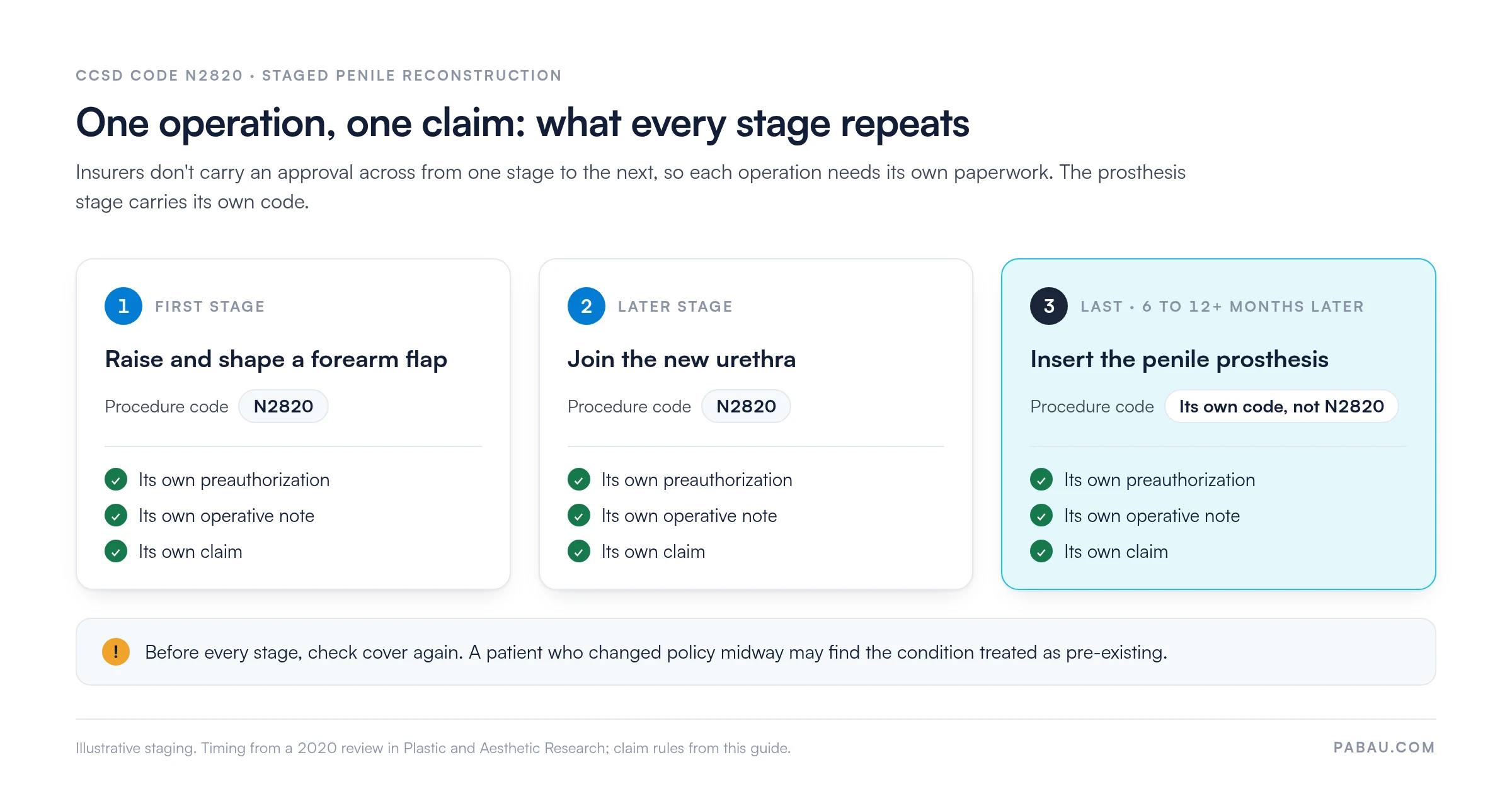
The prosthesis stage may not carry N2820 at all. Implant insertion is a separate operation, so look up its own code rather than repeating the reconstruction code.
Fees are where people most often go wrong. The CCSD group writes the codes and their narratives, but each insurer sets its own price. Our guide to Bupa CCSD codes explains how one insurer applies the schedule.
Staged surgery spreads one patient’s billing across months of notes, approvals and invoices. On paper or in spreadsheets, an authorization number gets copied to the wrong stage. A missing note can hold up a claim for weeks.
Pabau, the practice management platform we build, keeps consultation notes, operative notes and authorization numbers on one patient record. Its Healthcode integration sends CCSD-coded claims straight from that record. Before a claim leaves, it checks that required fields such as the membership and authorization numbers are filled in.
Your team can then follow each claim’s status and reconcile payments in the same place. With claims management software doing the tracking, nobody has to chase stage two while preparing stage three.

Pabau links operative notes, authorization numbers and CCSD-coded claims to the patient record, then sends them through Healthcode and tracks payment.

N2820 is simple to look up and easy to get wrong. The descriptor is short, the surgery is rare and the treatment runs across several operations. Claims succeed when the code, the diagnosis and the authorization all point to the same stage.
If you change one habit, make it this one. Treat each stage as a fresh claim, with its own approval and a note that says why the surgery was needed.
Book a demo to see how Pabau keeps every stage of a reconstruction claim on one record.

Was the injury an avulsion rather than a loss of tissue? CCSD code N2840 covers repair of avulsion of penis, the closest neighbor to N2820.
New to CCSD billing with Bupa? Bupa CCSD codes guide explains how the schedule maps to one insurer’s claims.
Want fewer queried claims across every code? Medical billing compliance sets out the documentation habits that keep claims clean.
Did the surgery treat curvature rather than rebuild the penis? CCSD code N2780 covers the operation for Peyronie’s disease.
Billing the penectomy that came before? CCSD code N2620 covers partial amputation of penis.
It depends on the policy. Reconstruction after cancer, injury or a congenital condition is usually assessed as medically necessary. Cosmetic procedures are commonly excluded. Check the policy wording and get preauthorization before each operation.
Not quite. Phalloplasty usually means building a new phallus, often from a forearm or thigh flap. Penile reconstruction is broader and can mean rebuilding part of an existing penis.
No. NHS hospitals record procedures with OPCS-4, where category N28 covers plastic operations on the penis. CCSD codes are used for private insurance claims.
The hospital does. It invoices the insurer for operating room time, the bed and any implants. The surgeon and the anesthetist each send their own invoice for their professional fees.
The patient owes the shortfall unless the surgeon has agreed to work within the insurer’s fee schedule. Explain any expected shortfall in writing before surgery.