HCPCS Code L1630: Ankle-foot orthosis billing guide
HCPCS Code L1630: Official Description and Device Type HCPCS Code L1630 is a Lev...

Last Updated: Nov 13, 2026
N2620 is the CCSD code for partial amputation of penis, the operation surgeons call a partial penectomy. It covers removal of the distal shaft and glans, keeping a proximal stump with a new urethral opening on it.
The code sits in chapter 12 of the CCSD schedule, in the Genitalia section, and Bupa grades it MAJOR 1. Total amputation, with no stump left, is a separate code, N2610.
Let Pabau's smart automation suggest the right codes, reduce claim denials, and keep your practice compliant—effortlessly.
Automate repetitive tasks and focus on what matters most—your patients.
Reduce coding errors and ensure compliance with the latest regulations.
Clean claims, fewer denials, and faster reimbursements.
Powerful insights and reporting to help your practice thrive.
HIPAA compliant SOC 2 certified GDPR-compliant Trusted by 4,000+ clinics worldwide

CCSD code N2620 covers partial amputation of the penis in the UK private-healthcare procedure schedule. Total penectomy is a different code, N2610.
UK private medical insurers such as Bupa, AXA Health, Aviva and VitalityHealth accept CCSD codes, and most claims clear electronically through Healthcode.
Bupa’s 2026 schedule places N2620 in category MAJOR 1, with a £475 surgeon fee, four grades below N2610 at MAJOR 5.
Pair N2620 with a WHO ICD-10 code, usually C60.0 to C60.9 for penile cancer, not a US ICD-10-CM code.
An inguinal lymph node dissection in the same session is a separate CCSD code, T8550, and needs its own operative record.
CCSD code N2620 is the procedure code for partial amputation of the penis, the operation surgeons call a partial penectomy. It sits in chapter 12 of the schedule, Urinary system and male reproductive organs, in the Genitalia section.
AXA Health lists N2620 as partial amputation of penis, graded Major, in its chapter 12 specialist code list. The Clinical Coding and Schedule Development (CCSD) Group maintains the schedule, and its members are Aviva, AXA Health, Bupa and VitalityHealth.
UK private medical insurers bill procedures with CCSD codes, including Bupa, AXA Health, Vitality, Aviva, Cigna, WPA, Allianz Care and H3. N2620 is one entry in our CCSD code library. The NHS codes the same operation in OPCS-4 instead, so an NHS coding reference will not show N2620.
Partial penectomy is a major urological operation, usually performed under general or spinal anaesthesia. Coders read the operation note against these steps to confirm that N2620, not N2610, is the right code.
Forming the new urethral opening is part of the operation itself. Under the CCSD principle that integral steps are not billed as extra lines, it travels with N2620 rather than as a separate code.
Partial penectomy is mainly a cancer operation, chosen when a distal tumour can be removed with a clear margin and a functional stump. UK insurers that ask for a diagnosis code expect the WHO edition of ICD-10, not the US ICD-10-CM.
Code the cancer to the most specific sub-site the histology report supports, using the WHO ICD-10 browser. WHO ICD-10 codes stop at four characters. A US code with a seventh character, such as S39.848A, does not belong on a UK claim.
When an injured penis can still be repaired, the operation is coded N2880 instead.
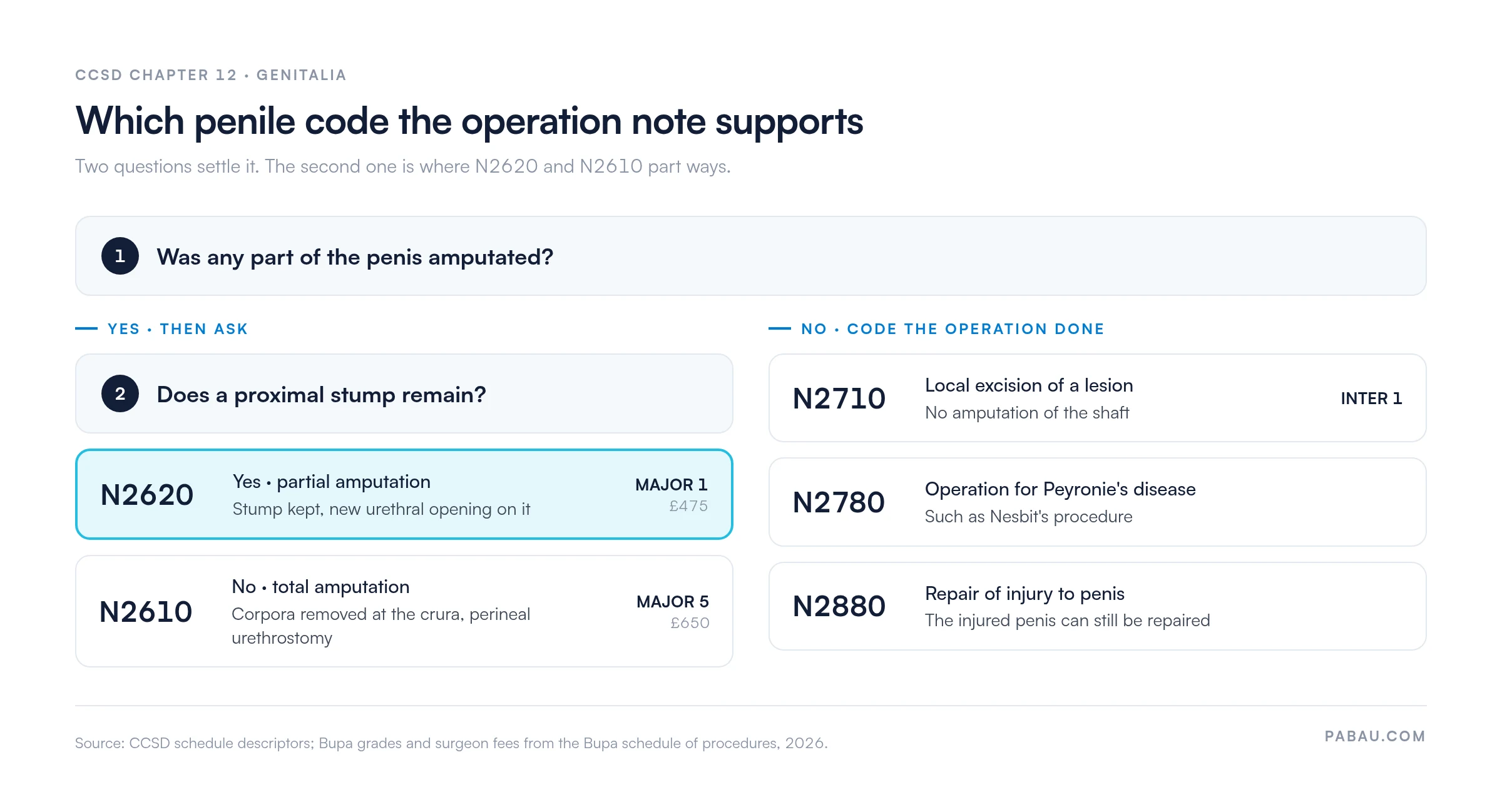
Choosing between partial and total amputation is the most common coding decision for this operation. CCSD code N2610 covers total amputation, where no stump remains and a perineal urethrostomy is formed.
The deciding question is whether a penile stump remains. If it does, N2620 is correct. If the corpora were removed at the crura, N2610 applies, and the fee moves four grades up the Bupa fee schedule.
Two smaller codes sit in the same section. Local excision of a penile lesion, with no amputation of the shaft, is N2710, graded INTER 1. An operation for Peyronie’s disease, such as Nesbit’s procedure, is coded N2780. Read as a decision, the five penile codes come down to two questions about the operation note.
Other codes may sit alongside N2620 when separate work is done in the same session. Each one needs its own operative record.
CCSD combination lists are guidance, and each insurer decides how it applies them. Check the insurer’s own coding policy before adding a companion line, because an unbundled line is cut from the payment.
Before booking theatre time, ask the patient’s insurer whether its authorisation covers N2620 alone or N2620 with T8550. A staged node dissection needs its own authorisation, and finding that out after surgery is how claims stall.
UK insurers rarely ask for the full record up front, but they often query cancer operations. Keep these elements in the record so a query can be answered the same day.
Write the operation note with the descriptor in mind. “Partial amputation of penis, proximal stump retained” maps straight to N2620, while a vague “penile resection” leaves the insurer’s reviewer guessing.
In UK private care, the patient usually calls the insurer for authorisation before treatment. The consultant’s team supplies the CCSD code and the planned admission date for that call.
An authorisation confirms cover at that moment. It does not guarantee payment if the claim later differs from what was authorised, such as an added node dissection.
Most N2620 denials trace back to a short list of causes. Fix the cause before resubmitting, since a second rejection on the same grounds only adds weeks to payment.
An appeal works when it answers the insurer’s stated reason directly. Generic letters get the same answer twice.
Coders who work across UK and US billing often need the nearest CPT match for N2620. CPT 54120, amputation of penis, partial, describes the same operation.
The cross-reference is for orientation only. A CPT code on a UK insurer claim, or a CCSD code on a US claim, is rejected on arrival.
In many urology practices, the authorisation number lives in an email and the histology report in a separate inbox. The two meet only when someone keys the claim into Healthcode by hand. That is where missing-field rejections start.
Pabau, the practice management software we build, sends UK insurer claims through Healthcode from the patient record. Its claims software for consultants keeps the CCSD code, the authorisation number and the operation note against the same episode. Pabau checks that required fields, such as membership and authorisation numbers, are complete before the claim goes out.
Claim status then shows in the same system, so your team answers insurer queries without logging in to each portal. For urology practices running cancer surgery alongside routine cases, that means fewer resubmissions and faster payment.

Pabau keeps the authorisation number, operation note and CCSD code on one patient record, then sends the claim to UK insurers through Healthcode. See how it fits your urology billing.

N2620 comes down to one line in the operation note: a proximal stump was retained, with a clear margin. Write that, and the code, the MAJOR 1 grade and the WHO ICD-10 pairing all follow.
Settle the authorisation, including any node dissection, before the admission date. Then make sure the histology report is on the record before the claim leaves for Healthcode. Book a demo to see how Pabau sends complete CCSD claims for your urology patients.

Need the full Bupa schedule? Bupa CCSD codes lists every code with its category and fee in one reference.
Billing another penile operation? CCSD code N2780 covers the operation for Peyronie’s disease.
N2620 covers partial amputation of the penis, where the distal shaft is removed and a proximal stump is kept. It is a code in the UK private-healthcare CCSD schedule.
N2620 is partial amputation, where a proximal stump remains. N2610 is total amputation, with no stump left and a perineal urethrostomy formed. Bupa grades N2620 at MAJOR 1 and N2610 at MAJOR 5.
UK private medical insurers use the CCSD schedule, including Bupa, AXA Health, Vitality, Aviva, Cigna, WPA, Allianz Care and H3. Most claims are submitted electronically through Healthcode.
Penile cancer codes C60.0 to C60.9 are the usual pairing, coded to the sub-site in the histology report. UK insurers that ask for a diagnosis code expect the WHO edition of ICD-10, not US ICD-10-CM.
Most UK insurers expect authorisation before a major cancer operation like this. The patient usually calls the insurer, and the consultant’s team supplies the CCSD code and admission date.
Yes, as a separate code. Block dissection of inguinal lymph nodes is T8550, and it needs its own operative record. Confirm that the authorisation covers both codes before surgery.
Correct and resubmit any coding error first, then use the insurer’s own complaints process. If the insurer’s final response does not settle it, the patient can refer it to the Financial Ombudsman Service.