CCSD code Q1802: Hysteroscopic fibroid resection billing guide
What CCSD code Q1802 covers CCSD code Q1802 is the UK private-practice code for ...

Last Updated: Nov 13, 2026
N1350 is the CCSD code for exploration of testis (including biopsy). It covers surgical inspection of the testis through a scrotal or inguinal incision. A biopsy taken in the same session is part of the code.
If the surgeon fixes or removes the testis during the same operation, the orchidopexy or orchidectomy code replaces N1350. Most UK private medical insurers require pre-authorisation for a non-emergency procedure.
Let Pabau's smart automation suggest the right codes, reduce claim denials, and keep your practice compliant—effortlessly.
Automate repetitive tasks and focus on what matters most—your patients.
Reduce coding errors and ensure compliance with the latest regulations.
Clean claims, fewer denials, and faster reimbursements.
Powerful insights and reporting to help your practice thrive.
HIPAA compliant SOC 2 certified GDPR-compliant Trusted by 4,000+ clinics worldwide

CCSD Code N1350 covers surgical exploration of the testis, and a biopsy taken in the same session is part of the same code.
Billing a separate biopsy code alongside N1350 is duplicate billing and a common audit trigger.
If the testis is fixed or removed in the same session, the orchidopexy or orchidectomy code replaces N1350.
Most UK private medical insurers require pre-authorisation before a non-emergency N1350 procedure, and a missing authorisation number is a leading cause of denial.
Pabau, the practice management platform we build, tracks the authorisation code on the patient’s case and submits CCSD-coded claims through Healthcode.
CCSD Code N1350 is the procedure code for surgical exploration of the testis, including a biopsy when one is taken during the same operation. CCSD stands for Clinical Coding and Schedule Development.
The schedule is maintained by the CCSD Group, whose members are four private medical insurers: Bupa, Vitality, AXA Health and Aviva. UK private practices use it to invoice insurers and submit claims.
The official descriptor reads Exploration of testis (including biopsy). The parenthetical makes the code inclusive of biopsy. If the surgeon explores the testis and takes a tissue sample in the same session, N1350 covers both, and no separate biopsy code is added.
The code sits in the genitalia section of the CCSD chapter on the urinary system and male reproductive organs. Its neighbours there include the orchidopexy and orchidectomy codes.
Surgical exploration of the testis is performed under general or regional anaesthesia, through a scrotal or inguinal incision. A scrotal incision delivers the testis for direct inspection. Surgeons prefer an inguinal approach when they suspect malignancy, because it allows early control of the spermatic cord vessels. The operative steps relevant to coding and documentation are:
If a biopsy is taken, the pathology provider bills the histopathology report separately. That laboratory fee is not part of N1350. Even so, an operative note that describes a biopsy with no matching pathology report in the record can trigger an audit query. The surgeon’s operative note is the primary evidence for the N1350 claim.
The clinical scenario drives both the documentation and the insurer’s willingness to cover the procedure. Common indications where N1350 applies include:
Each indication changes what the operative note must demonstrate to validate the claim. For torsion cases, timing (onset-to-surgery interval) and viability findings matter.
For mass cases, the biopsy result and pre-operative imaging correlation are relevant. Coders and practice managers should confirm the documented indication matches the insurer-approved clinical category before submitting.
Understanding the scope of N1350 prevents both undercoding (missing procedures) and upcoding (claiming codes that were not performed). The table below summarises the key inclusions and exclusions.
Several CCSD codes sit next to N1350 in the genitalia section. Knowing when each one applies prevents the most common coding errors in scrotal and testicular surgery. Varicocele surgery, for instance, has an entry of its own, N1900. Removal of one whole epididymis, a unilateral epididymectomy, is billed under N1520. Our Bupa CCSD code guidance shows how these codes map to Bupa’s fee schedule. Every neighbouring code also has its own page in our CCSD code library.
For fee amounts by insurer, the Healix fee schedule publishes CCSD-coded surgical fees.
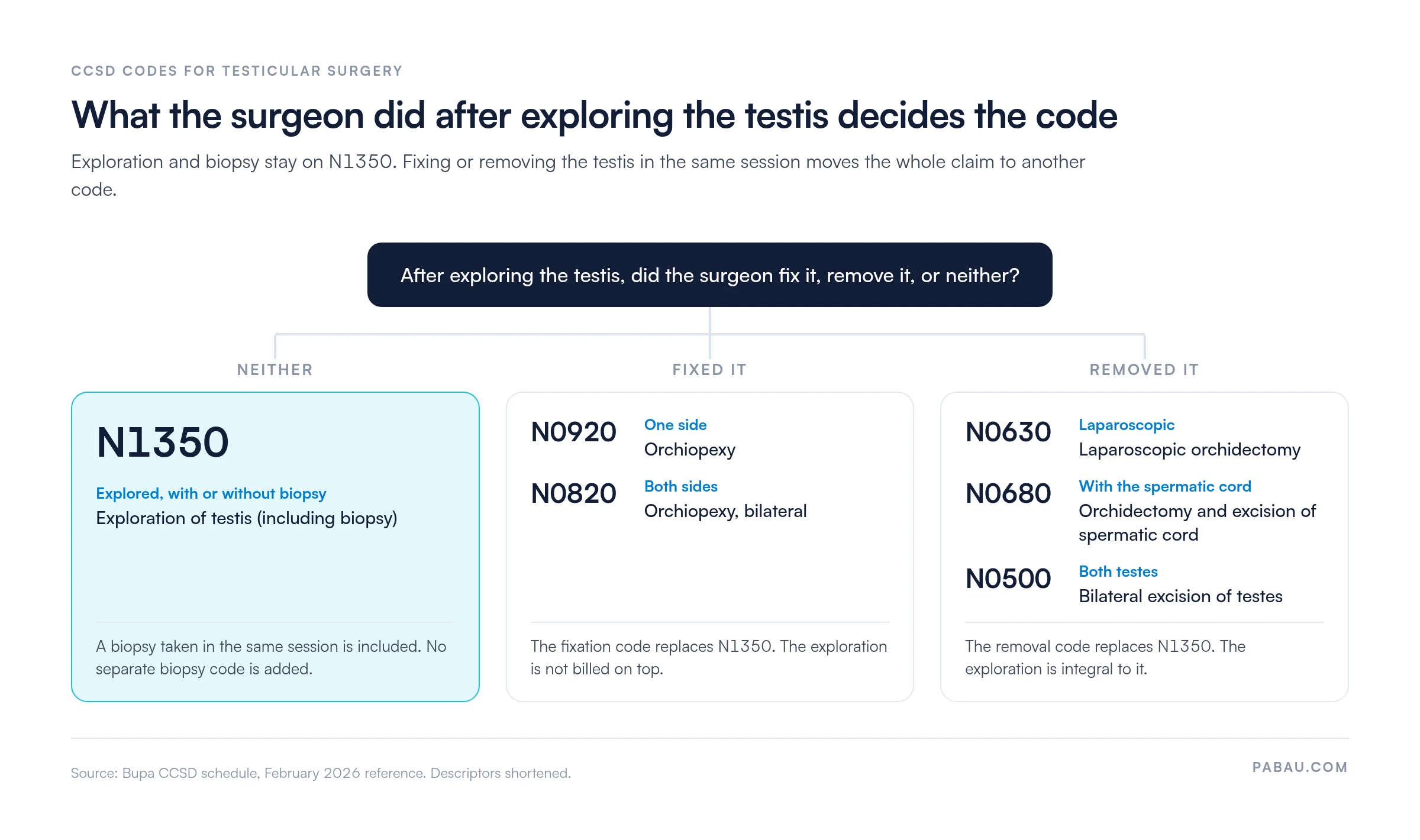
Key coding decision: If exploration reveals a tumour that needs immediate removal, the orchidectomy code replaces N1350 rather than being added to it. That is usually N0680 for an inguinal orchidectomy with the spermatic cord. A laparoscopic removal is N0630, and removal of both testes is N0500. If the surgeon removes only the tumour and keeps the testis, the claim moves to N0700, excision of lesion of testis.
The exploration counts as part of the orchidectomy when both happen in the same session, so record that clearly in the operative note.
Fixation follows the same rule. If the surgeon explores both testes and then fixes them, bill N0820 in place of N1350, and use N0920 when only one side is fixed. An abdominal testis once had a code of its own, N0930, but the schedule has listed it as inactive since January 2009. The diagram below maps each outcome in theatre to its code.
An incomplete operative note is the primary audit trigger for N1350 claims. The insurer’s clinical reviewer needs to reconstruct the procedure from the note alone, so every element below must appear for the claim to withstand scrutiny.
In Pabau, the practice management platform we build, an operative note template can carry a field for each element above. The note is then complete before it is signed. Practices on paper records often find the biopsy decision or closure details missing when an insurer queries the claim months later.
Pre-authorisation rules differ between insurers, but most major UK private medical insurers (PMIs) require authorisation before N1350 is performed. A claim with no authorisation number, or with one obtained after a non-emergency procedure, is the most common cause of N1350 denials.
The table below reflects general insurer policy. Verify current requirements with each insurer, because policies are updated annually.
Emergency exception: When N1350 is performed as an emergency (suspected torsion), most insurers accept retrospective authorisation obtained within 24-48 hours of surgery. Document the emergency clearly in the operative note and notify the insurer as soon as the patient is stabilised.
Healthcode is the standard EDI claims platform for UK private practice surgical billing. Most major insurers receive N1350 claims via Healthcode’s secure portal. The submission steps are:
Common portal-level errors include entering N1350 with an extra biopsy code and omitting the pre-auth number. Another is a consultant name that doesn’t match the insurer’s panel record.
When both testes are explored in the same operative session, the billing approach varies by insurer. No single UK-wide rule covers all PMIs, so practices should check the current insurer guide before submitting.
Claim denials for CCSD Code N1350 follow predictable patterns. The table below maps the most common denial reasons to their root cause and the fix.
Run a short check on every N1350 claim before it enters Healthcode. Confirm the pre-auth number is present and no separate biopsy code sits beside N1350. Then check the operative note is attached and the diagnosis code matches the documented indication. A 60-second check at submission prevents a 4-6 week denial cycle.
Most UK private medical insurance policies exclude a testicular biopsy performed as part of an azoospermia or male infertility workup. The exclusion applies even though N1350 is a surgical code. The operation itself looks the same as an exploration performed for any other indication.
Insurers apply the exclusion based on the documented clinical indication, not the procedure code. A claim with an indication of “infertility investigation” or “azoospermia workup” is typically denied under the fertility exclusion clause.
Correct coding of N1350 does not change that. The insurer is excluding the reason for surgery, not the surgery itself.
What practices need to do before the patient is listed for surgery:
A private urology practice billing several insurers usually keeps authorisations in one place, operative notes in another and claims in a third. For N1350, the pressure points are the authorisation status before surgery day and a complete operative note before submission.
Pabau’s claims management software submits CCSD-coded claims to UK insurers through Healthcode and Bupa. The authorisation code, its dates and its sessions sit on the patient’s case, and Pabau warns you when one is missing.
When an insurer queries an N1350 claim months later, the operative note and the authorisation are in the same record.
Practices that track authorisations in a spreadsheet often find the number missing, or stored apart from the billing system. That situation sits behind the most common N1350 denial.
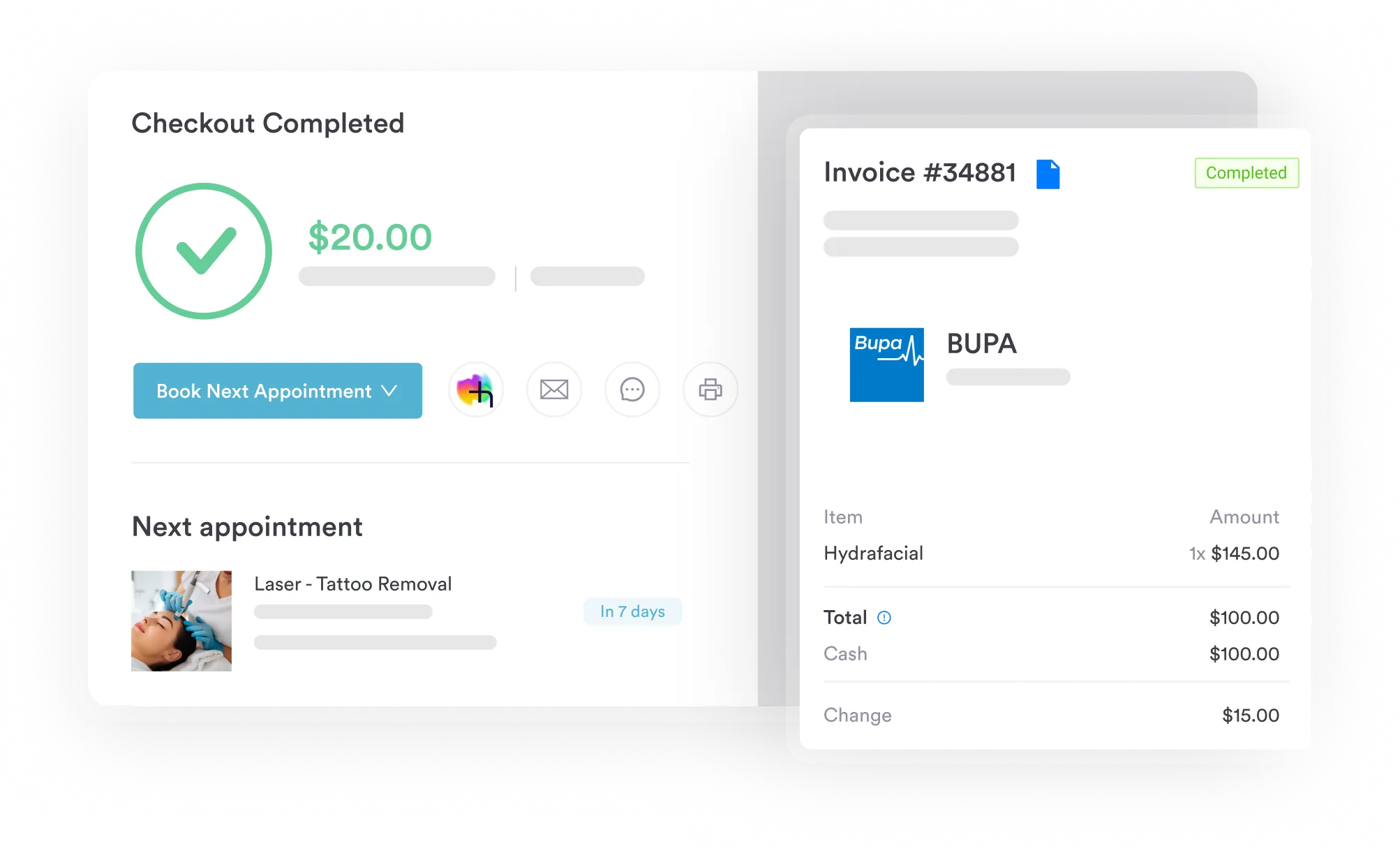

Pabau tracks pre-authorisation on the patient’s case and submits CCSD-coded claims through Healthcode. UK urology practices bill surgery from the same record that holds the operative note.

N1350 rewards precision on two points. The code already includes the biopsy, and it stops applying the moment the testis is fixed or removed. Code what happened in theatre rather than what was planned, and the claim matches the operation.
The denials that remain come from paperwork, not coding. Confirm the patient’s policy covers the indication before listing, and obtain the authorisation before a non-emergency operation.
Then check that the operative note names the approach, the findings and the biopsy decision. Book a demo to see how Pabau keeps authorisations, operative notes and CCSD claims in one record for UK urology practices.

Choosing billing software for a UK private practice? Best medical billing software in the UK compares the systems that submit claims to UK private insurers.
CCSD Code N1350 covers surgical exploration of the testis, including testicular biopsy when performed in the same operative session. The official descriptor is “Exploration of testis (including biopsy).” Orchidectomy, orchidopexy, and histopathology laboratory fees are excluded and require separate codes or billing pathways.
Yes. Biopsy performed during the same operative session as the exploration is included in N1350. Billing a separate biopsy code alongside N1350 constitutes duplicate billing and is a common claim denial and audit trigger.
Bupa, AXA Health, Vitality Health, and Aviva all require pre-authorisation for surgical urology procedures including N1350. WPA requirements vary by policy. Always verify the current pre-auth requirements with each insurer before the patient is listed for surgery, as policies are updated annually.
N1350 covers exploration with or without biopsy, and the testis stays in place. Orchidectomy codes cover removal of the testis and are separate CCSD codes: N0630, N0680 or N0500, depending on the approach and the number of testes. If an orchidectomy was performed, bill that code in place of N1350 and attach the operative note.
Yes, provided the operative note documents that the testis was delivered and examined, even if the planned procedure was curtailed. The note should record entry into the scrotal or inguinal field, delivery of the testis, and the reason further intervention stopped. That supports an N1350 claim, though some insurers apply a reduced fee for an incomplete procedure.
The operative note must record the clinical indication, the surgical approach (scrotal or inguinal) and the intraoperative findings. It must also record the biopsy decision, with the reason, and layer-by-layer closure. Where a biopsy was taken, the histopathology request form provides corroborating evidence. Missing any of these elements is an audit trigger.