

HCPCS Code L0472: Hyperextension TLSO billing guide
HCPCS code L0472: Official descriptor and device definition HCPCS code L0472 des...

Last Updated: Nov 5, 2026
N0630 is the CCSD code for laparoscopic orchidectomy, the removal of a testis through laparoscopic ports under general anaesthetic. It applies only when the operative note records a laparoscopic approach with no conversion to open.
Orchidectomy with excision of the spermatic cord is coded N0680, and removal of both testes is coded N0500. Gender-affirming orchidectomy takes GA515 or GA516. Most UK private insurers require pre-authorisation before the operation.
Let Pabau's smart automation suggest the right codes, reduce claim denials, and keep your practice compliant—effortlessly.
Automate repetitive tasks and focus on what matters most—your patients.
Reduce coding errors and ensure compliance with the latest regulations.
Clean claims, fewer denials, and faster reimbursements.
Powerful insights and reporting to help your practice thrive.
HIPAA compliant SOC 2 certified GDPR-compliant Trusted by 4,000+ clinics worldwide

CCSD Code N0630 covers laparoscopic (keyhole) orchidectomy only, not open removal or orchidectomy with excision of the spermatic cord.
Most UK private insurers require pre-authorisation before the operation, so confirm the rule on each patient’s policy.
Gender-affirming orchidectomy takes GA515 or GA516, and removal of both testes has its own code, N0500.
The most common denial reasons are missing pre-auth, the wrong approach code, and an operative note that does not show the laparoscopic method.
Pabau, the practice management platform we build, submits CCSD claims through Healthcode and logs each denial reason against the claim.
CCSD Code N0630 is the code for laparoscopic orchidectomy in the Clinical Coding and Schedule Development (CCSD) schedule. UK private medical insurers use that schedule for billing. It covers removal of a testis through laparoscopic ports under general anaesthetic. The official descriptor is Laparoscopic orchidectomy, and that phrase sets the scope of the code.
N0630 sits in Chapter 12 of the schedule, Urinary system and male reproductive organs, within the genitalia section. It does not extend to open surgery, or to orchidectomy with excision of the spermatic cord, which is coded N0680.
Confirm the approach before you code. If the operative note records an open incision rather than laparoscopic ports, N0630 is wrong, whatever the indication or the consultant’s intent.
Laparoscopic orchidectomy is performed under general anaesthetic through a port-based approach. The surgeon typically places a camera port at the umbilicus and one or two working ports in the lower abdomen. The testicular vessels and vas deferens are divided, and the specimen comes out through a port site or a small extension of one incision.
The operative elements a coder needs to confirm in the notes are:
Where the surgeon converts from laparoscopic to open mid-procedure, the approach code changes. The documentation and the CCSD code submitted must both reflect the conversion.
N0630 is appropriate when the laparoscopic approach is used for any of the indications below. The indication does not change the code, but it must appear in the operative record to pass insurer review.
Gender-affirming orchidectomy is not an N0630 indication. CCSD added dedicated codes for it, GA515 and GA516, in October 2024, so bill those instead.
Where the procedure excises the spermatic cord through an inguinal incision, N0680 applies instead. The code comparison below sets out the difference.
The most common orchidectomy miscoding is choosing the wrong approach or extent. CCSD separates laparoscopic from open removal, one testis from both, and simple removal from excision of the spermatic cord. Insurers reject a claim when the code does not match the documented technique.
Coding goes fastest when the questions run in a fixed order, so that the first yes settles the code.
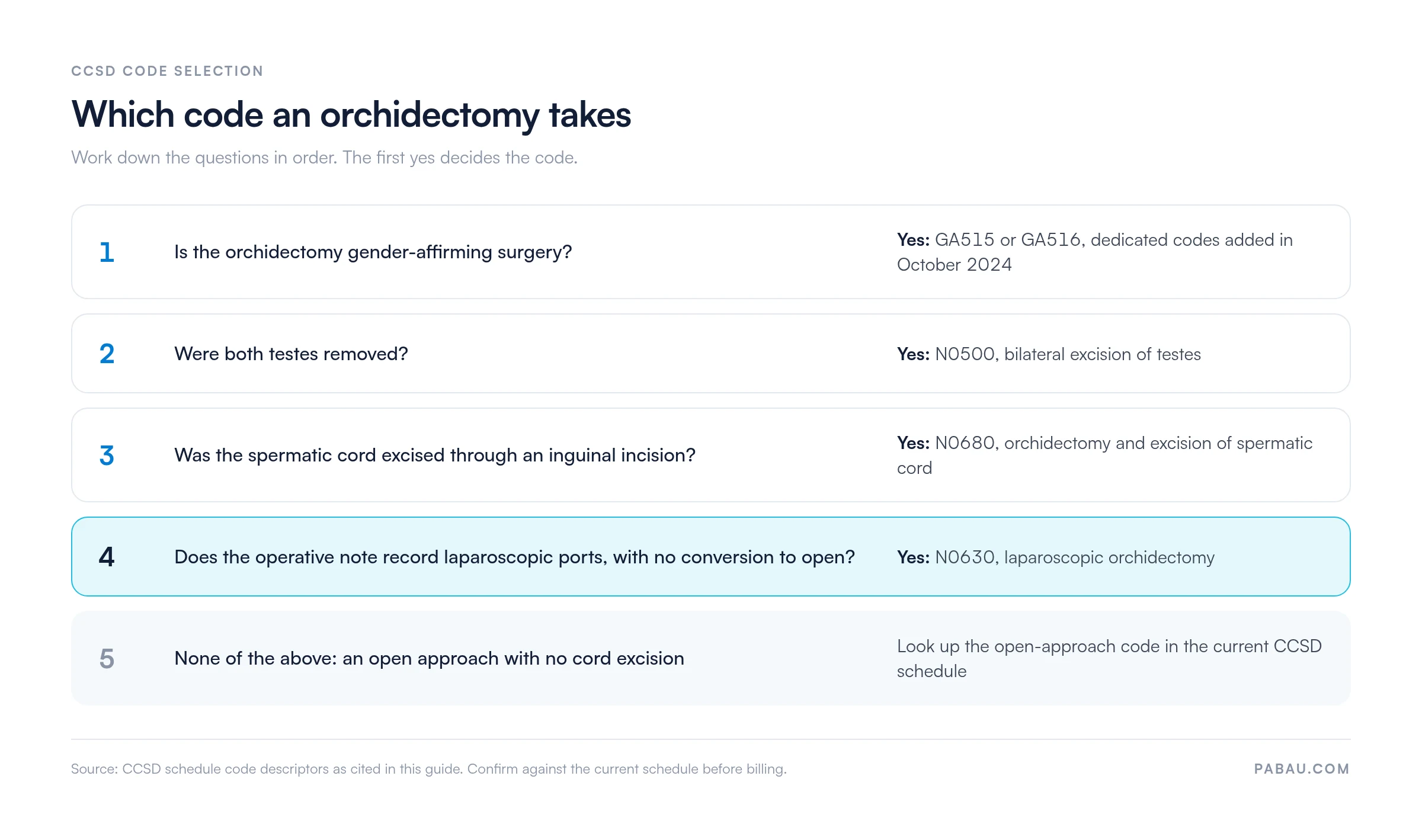
Descriptors can change between schedule releases, so check adjacent codes in our CCSD code library and the current schedule for your billing year. The principle holds whatever the year: match the code to the documented approach and extent.
Not as two separate N0630 claims. CCSD has a dedicated code for removing both testes, N0500. Check its CCSD principles and the insurer’s rules before you submit a bilateral laparoscopic procedure.
Document laterality explicitly in the operative note, for example “laparoscopic orchidectomy performed bilaterally”. That removes any ambiguity if the claim is audited.
An N0630 claim that lacks operative detail will be queried or rejected. Insurers audit laparoscopic claims to confirm the approach matches the code. The operative note must cover these elements:
A structured operative note template puts the laparoscopic elements in every note. That cuts the insurer queries that free-text notes tend to trigger.
Most UK private insurers require pre-authorisation before an elective laparoscopic orchidectomy, so confirm the rule on each patient’s policy. A claim submitted without a valid pre-auth reference is a common reason N0630 claims are denied. Pre-auth does not guarantee payment, but its absence usually leads to rejection.
Bupa requires pre-authorisation for orchidectomy before the procedure date. The referral must come from a Bupa-recognised GP or specialist, and the consultant urologist needs a current Bupa recognition number. Use the Bupa code search portal to confirm the current fee level and any co-payment rules for N0630 under the patient’s policy.
Our guide to Bupa CCSD codes covers the recognition and invoicing rules for every Bupa procedure claim. Confirm the current turnaround and notification windows with Bupa, including the separate pathway for emergency admissions. Have the pre-auth reference number before the patient is admitted.
AXA Health uses its own specialist forms and fee schedule for CCSD procedures. Consultants should check N0630 fees and pre-auth requirements on the AXA Health procedure codes portal before submission. AXA applies a recognised consultant list, and claims from non-recognised providers are not reimbursed, regardless of pre-auth status.
For other insurers, check each portal for the current rules on the patient’s plan:
Fee schedules change every year. Never rely on an amount remembered from a previous claim. Verify the current N0630 fee with the insurer or its online portal before invoicing.
Recheck your N0630 fee entries with each insurer at least once a year, and whenever an insurer announces a schedule change. A claim submitted at a superseded rate risks underpayment or a clawback.
Denials on laparoscopic orchidectomy claims tend to fall into five categories. Each one has a straightforward prevention step.
Tracking denial reasons across claims, rather than resolving each one in isolation, shows which error recurs. Pabau’s claims software for practices logs the denial reason against each claim, so patterns surface across the practice.
N0630 covers the surgical procedure only. Several associated services may be billed separately, depending on the insurer’s bundling rules and the clinical circumstances. Verify each one against the insurer’s fee schedule before submission.
Bundling rules are insurer-specific and change with annual schedule updates, so never assume co-billing is allowed without checking the current policy. The assistant surgeon and histopathology positions need confirming each year.
Billing a laparoscopic orchidectomy runs through several hands. The team confirms the code, checks the insurer’s current fee, records the pre-auth reference and the operative note, then follows the claim to payment. Spread across spreadsheets and email, those steps are where a pre-auth reference or a denied claim goes missing.
Pabau’s claims management connects to Healthcode, the UK’s private healthcare electronic data interchange (EDI) network. N0630 claims go straight to insurer systems rather than through manual invoicing, and the outcome returns to the same patient record.
When an insurer rejects a claim, Pabau logs the denial reason against it. Within a few months, that log shows whether missing pre-auth, the wrong approach code or thin operative notes cost the practice most. For the fee itself, check the current Bupa fee schedule and each insurer’s portal before you invoice.

Pabau’s claims management submits CCSD claims to UK insurers through Healthcode and logs each denial reason against the claim. Your team sees which errors cost the practice most and fixes them at the source.

N0630 rewards precision more than effort. The code is right only when the operative note shows laparoscopic ports, a single testis and no cord excision. The insurer also has to approve the procedure first.
Build those checks into the note template and the pre-admission routine, not the claim review. A coder who has to reconstruct the approach after surgery is already working from a weaker claim.
Book a demo to see how Pabau submits CCSD claims through Healthcode and tracks every denial reason for your urology practice.

New to CCSD billing as a consultant urologist? Bupa CCSD codes explains recognition requirements, invoicing rules, and how the Bupa code structure works for surgical procedures.
Removing both testes? CCSD code N0500 covers the bilateral excision code and the documentation it needs.
Checking the fee before you invoice? Bupa procedure codes fee schedule shows how Bupa sets and publishes its procedure fees.
Billing other male genital procedures? CCSD code N1580 covers excision of an epididymal cyst.
Choosing billing software for a UK practice? Best medical billing software in the UK compares the options for private practices that bill UK insurers.
CCSD Code N0630 is the billing code for laparoscopic orchidectomy. It covers keyhole removal of a testis through laparoscopic ports under general anaesthetic. Open orchidectomy and orchidectomy with excision of the spermatic cord take separate CCSD codes.
N0630 covers laparoscopic removal only, with no inguinal canal dissection. Orchidectomy with excision of the spermatic cord, usually through an inguinal incision for testicular cancer, is coded N0680. The documented approach and extent decide the code, not the diagnosis alone.
Most UK private insurers, including Bupa, require pre-authorisation for elective laparoscopic orchidectomy, but confirm the rule on each patient’s policy. Obtain it before the procedure date, because claims without a valid reference are routinely rejected. Emergency cases follow a separate notification process.
Yes, in most cases. The anaesthetist submits their own separate CCSD code alongside the surgeon’s N0630 claim. The anaesthetist must hold their own recognition number with the insurer. Check each insurer’s co-billing policy, as rules vary, particularly for bilateral procedures.
No. CCSD has a separate code for removing both testes, N0500, bilateral excision of testes. Check the CCSD principles and the insurer’s rules for a bilateral laparoscopic procedure, and document laterality explicitly in the operative note.
The most common reasons are missing pre-authorisation and an open approach billed as N0630. Others are cord excision billed as N0630 instead of N0680, missing laterality, and a stale fee. A pre-submission documentation checklist prevents each one.



