CPT code 48152: Whipple procedure without pancreatojejunostomy
CPT code 48152: Official description and procedure overview CPT code 48152 descr...

Last Updated: Nov 13, 2026
N0930 is the CCSD code for abdominal undescended testis. The CCSD schedule has listed it as inactive since January 2009, so it should not appear on a new claim.
Surgery for an abdominal testis is now billed with N0920 for one side or N0820 for both. A laparoscopy to find an impalpable testis has its own code, N1352.
Let Pabau's smart automation suggest the right codes, reduce claim denials, and keep your practice compliant—effortlessly.
Automate repetitive tasks and focus on what matters most—your patients.
Reduce coding errors and ensure compliance with the latest regulations.
Clean claims, fewer denials, and faster reimbursements.
Powerful insights and reporting to help your practice thrive.
HIPAA compliant SOC 2 certified GDPR-compliant Trusted by 4,000+ clinics worldwide

CCSD Code N0930 describes surgery for an abdominal undescended testis, and the CCSD schedule has listed it as inactive since January 2009.
Bill a current code in its place: N0920 for orchidopexy on one side, or N0820 when both testes are brought down in the same session.
A laparoscopy to locate an impalpable testis has its own code, N1352, so the operative note has to show what was done in theatre.
Pair the claim with WHO ICD-10 Q53.1 for one undescended testis or Q53.2 for both, matching the side in the note.
Pabau, the practice management platform we build, submits CCSD-coded claims to UK insurers through Healthcode and Bupa.
CCSD Code N0930 is the procedure code for surgery on an abdominal undescended testis, one that stopped inside the abdomen instead of reaching the scrotum. CCSD stands for Clinical Coding and Schedule Development.
The schedule is maintained by the CCSD Group, whose members are four UK private medical insurers: Aviva, AXA Health, Bupa and Vitality. UK private practices use it to invoice those insurers, and most claims travel to them through Healthcode.
The most important fact about N0930 is its status. The CCSD schedule lists it in the genitalia section of Chapter 12 as inactive from January 2009. Bupa’s February 2026 schedule of procedures does not include it either. A claim for this operation today goes under a current orchidopexy code instead.
Older practice systems and claim templates can still carry N0930 in their code lists. Removing it there stops a retired code reaching an insurer and coming back rejected.
An undescended testis is found at birth in 3 to 5% of boys born at term. Most reach the scrotum by three months of age. An abdominal testis is the form that cannot be felt on examination, so it is described as impalpable.
The facts below shape what the operative note needs to show:
Two surgical approaches appear in operative notes for an abdominal testis. Each places different demands on the note that supports the claim.
When the testicular vessels are long enough, the surgeon brings the testis down to the scrotum in one laparoscopic operation. The note should confirm the laparoscopic approach and the intra-abdominal position found. It should also record vessel length and fixation of the testis in the scrotum.
When the vessels are too short, the Fowler-Stephens technique divides them first, so the testis can survive on its collateral blood supply. In the staged version, a second operation months later brings the testis down. Some surgeons do both steps in a single operation.
Bupa’s February 2026 schedule lists no separate code for either stage. Agree how each operation will be coded with the insurer at pre-authorisation, and keep the first-stage authorisation number with the second-stage claim.
Because N0930 is inactive, the operation is coded by what happened in theatre. The chart below follows that decision from the operative findings to the code.
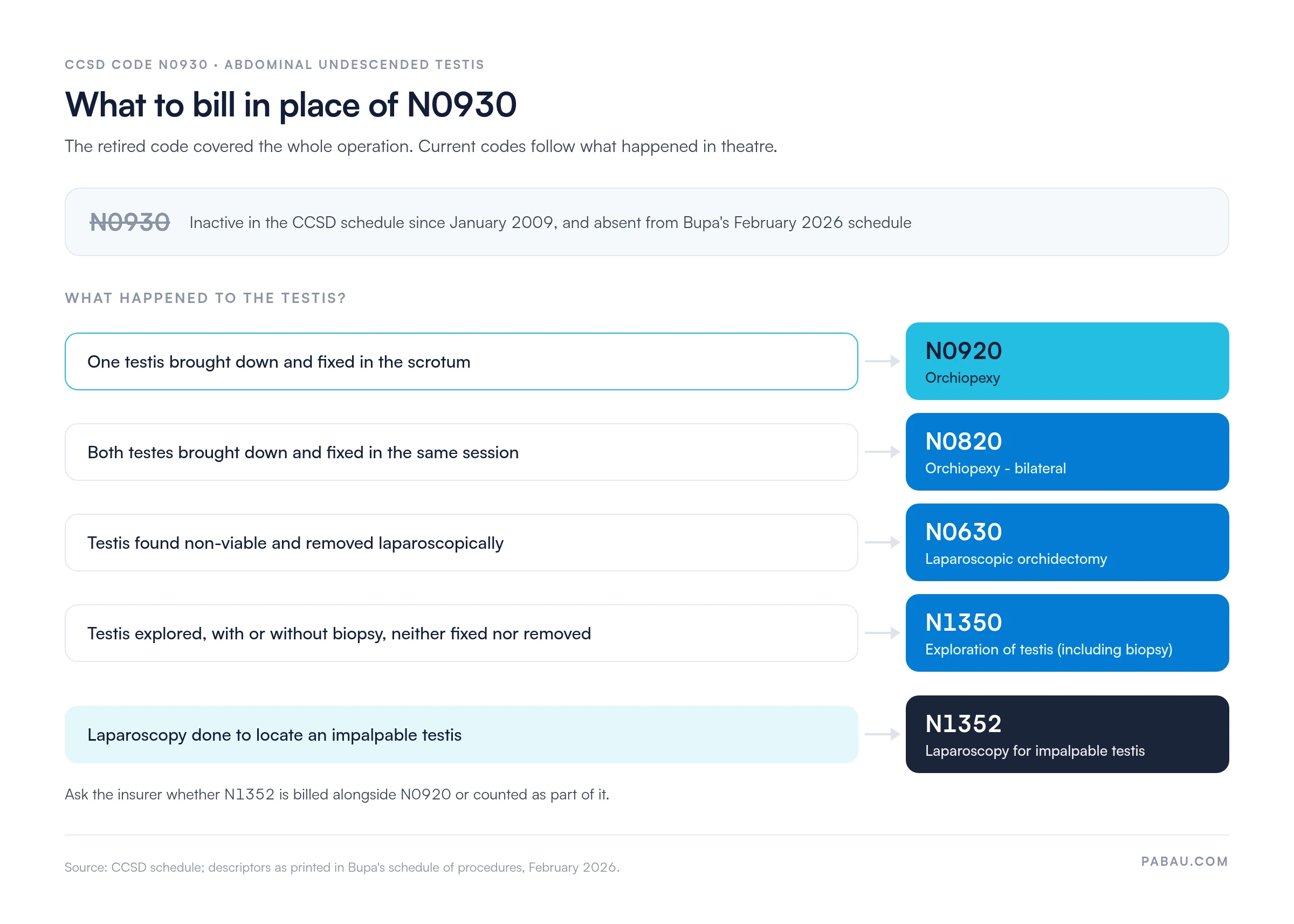
The table lists the current codes in the genitalia section that cover this work. Descriptors are quoted as Bupa’s February 2026 schedule prints them. Every code also has a page in our CCSD code library.
Laparoscopy and orchidopexy often happen in the same session. Ask the insurer whether N1352 is then billed alongside N0920 or counted as part of it. For a bilateral case, see CCSD Code N0820, which replaces two single-side claims.
When the testis is explored but neither fixed nor removed, the operative note supports CCSD Code N1350 instead. A removal is covered on our CCSD Code N0630 page.
Search your practice system for N0930 before the next urology list. If it is still on a fee list, template or saved claim, swap it for N0920 or N0820. Then it never reaches Healthcode.
UK private claims carry a diagnosis coded in the WHO edition of ICD-10, the version used across UK practice. The undescended testis codes sit in category Q53. The WHO ICD-10 browser gives each definition.
The WHO edition has no separate codes for an abdominal or inguinal position, so position and side belong in the operative note. Q53.21 and similar codes come from the US ICD-10-CM, not the WHO ICD-10 used in UK practice.
An insurer’s clinical reviewer needs to rebuild the operation from the note alone. Each element below should appear before the claim goes out:
Most UK private medical insurers expect authorisation before planned surgery. A claim with no authorisation number is a common reason for a denial. Rules differ between insurers and policies, so check them for each patient before the operation is listed.
Denials for this operation follow a predictable pattern. Most are fixed by correcting the claim and resubmitting it.
Anaesthetist fees are invoiced separately by the anaesthetist under the same authorisation.
A private paediatric urology practice often keeps authorisations, operative notes and claims in three places. A retired code such as N0930 survives longest there, inside an old template that nobody checks.
Pabau’s claims management software submits CCSD-coded claims to UK insurers through Healthcode and Bupa. The authorisation code, its dates and its sessions sit on the patient’s case, and Pabau warns you when one is missing. The operative note sits in the same record, so an insurer query can be answered in one place.

Pabau tracks pre-authorisation on the patient’s case and submits CCSD-coded claims through Healthcode and Bupa. UK urology practices bill surgery from the same record that holds the operative note.

N0930 still describes the operation accurately, but the CCSD schedule retired it in January 2009. A claim for an abdominal undescended testis today is built from current codes. That means N0920 or N0820 for the orchidopexy, and N1352 where a laparoscopy is agreed.
The rest depends on the note and the authorisation. Record where the testis was found, what was done and on which side, then quote the same codes to the insurer. Book a demo to see how Pabau keeps authorisations, operative notes and CCSD claims in one record for UK practices.

Looking for a wider view of CCSD billing in Bupa cases? Bupa CCSD codes overview covers how the CCSD schedule maps to Bupa’s fee structure across surgical specialties.
Choosing billing software for a UK private practice? Best medical billing software in the UK compares the systems that submit claims to UK private insurers.
No. The CCSD schedule lists N0930, abdominal undescended testis, as inactive from January 2009. Bupa’s February 2026 schedule does not include it. Bill a current code for the operation instead.
Use N0920 (Orchiopexy) when one testis is brought down, and N0820 (Orchiopexy – bilateral) when both are done in one session. A laparoscopy to find an impalpable testis is coded N1352.
UK claims use the WHO ICD-10. Use Q53.1 when one testis is undescended and Q53.2 when both are. The WHO edition has no separate abdominal code, so record the position and side in the operative note.
Bupa’s February 2026 schedule has no separate code for either stage. Agree the coding of each operation with the insurer at pre-authorisation. Keep the first-stage authorisation number with the second-stage claim.
Most UK private medical insurers expect authorisation before planned surgery, and a missing number is a common reason for denial. Check the requirements with the patient’s insurer before the operation is listed.
The operative note should record the consultant, the impalpable testis and its side, and the laparoscopic findings. It should also record the technique, the outcome, the authorisation number and the matching Q53 code.