CCSD code Q1802: Hysteroscopic fibroid resection billing guide
What CCSD code Q1802 covers CCSD code Q1802 is the UK private-practice code for ...

Last Updated: Nov 13, 2026
N0820 is the CCSD code for bilateral orchidopexy, listed in the schedule as "Orchiopexy - bilateral". It covers bringing both undescended testes into the scrotum and fixing them there in one operation, billed to UK private medical insurers.
A one-sided orchidopexy is coded N0920, so a bilateral operation never goes in as two lines of N0920. Bupa places N0820 in complexity category MAJOR 2, with a surgeon fee of £533 in its February 2026 schedule. Pair it with the ICD-10 diagnosis Q53.2.
Let Pabau's smart automation suggest the right codes, reduce claim denials, and keep your practice compliant—effortlessly.
Automate repetitive tasks and focus on what matters most—your patients.
Reduce coding errors and ensure compliance with the latest regulations.
Clean claims, fewer denials, and faster reimbursements.
Powerful insights and reporting to help your practice thrive.
HIPAA compliant SOC 2 certified GDPR-compliant Trusted by 4,000+ clinics worldwide

CCSD Code N0820 covers bilateral orchidopexy, where both undescended testes are brought down and fixed in the scrotum in one operation.
Bupa lists N0820 as “Orchiopexy – bilateral” in complexity category MAJOR 2, with a surgeon fee of £533 in its February 2026 schedule.
A one-sided orchidopexy is coded N0920, so never bill two lines of N0920 for a bilateral operation.
Most UK private insurers, including Bupa, AXA Health, Aviva and Vitality, require pre-authorisation before an elective orchidopexy, so confirm the rule on each policy.
Pabau, the practice management platform we build, submits CCSD claims through Healthcode and logs each denial reason against the claim.
CCSD Code N0820 is the code for bilateral orchidopexy in the Clinical Coding and Schedule Development (CCSD) schedule. Aviva, AXA Health, Bupa and Vitality develop that schedule jointly, and UK private medical insurers use it to bill procedures. It does not apply to NHS-funded care.
The code covers the operation that brings both undescended testes into the scrotum and fixes them there. The official descriptor is Orchiopexy – bilateral, so N0820 applies only when both sides are corrected in the same operation.
N0820 sits in Chapter 12 of the schedule, Urinary system and male reproductive organs, within the genitalia section. Bupa places it in complexity category MAJOR 2 and lists a surgeon fee of £533.
The one-sided operation, N0920, sits in INTER 3 at £329. Both figures come from the February 2026 Bupa schedule, summarised in our guide to Bupa CCSD codes.
Bilateral orchidopexy corrects cryptorchidism affecting both testes. The surgeon mobilises each testis from where it has stopped, most often the inguinal canal. The spermatic cord is lengthened until the testis reaches the scrotum without tension. The testis is then fixed in place, commonly in a dartos pouch.
The operation is mostly performed in children. European Association of Urology guidance recommends surgery between 6 and 12 months of age, and by 18 months at the latest. Early correction helps protect fertility. Adult bilateral orchidopexy is uncommon, but N0820 applies in those cases as well.
Key surgical steps coders must look for in the operative note:
The main indication for N0820 is bilateral cryptorchidism, where neither testis has descended by the time of surgery. Ectopic testes on both sides, lying outside the normal path of descent, are another indication. The diagnosis code on the claim should match the indication recorded in the notes.
The WHO ICD-10 classification places undescended and ectopic testis under Chapter XVII, block Q50-Q56. Q53.2 as the primary diagnosis gives the insurer the detail it needs to accept a bilateral procedure code.
The N0820 descriptor does not name an approach. Open orchidopexy on both sides, through inguinal or scrotal incisions, fits N0820. A laparoscopy to find an impalpable testis has its own entry in the schedule, N1352. Check the CCSD principles for both codes before you bill them together. An exploration of the testis falls under N1350, but once the surgeon fixes the testis in the same operation, the orchidopexy code replaces it.
N0920 is the CCSD code for orchidopexy on one side, with the descriptor Orchiopexy. N0820 covers both testes in one operation. Bupa pays more for N0820 because both sides take longer to correct. An abdominal testis is billed with these two codes as well, because N0930 has been inactive since January 2009.
Two lines of N0920 on the same date look like a duplicate claim. The CCSD schedule also lists N0920 as an unacceptable combination with N0820. A single line of N0820 from the start avoids both problems.
Do not confuse either code with N1380, Bilateral fixation of testes. That code covers fixing testes that already sit in the scrotum, so it is not an orchidopexy for undescended testes. Removing both epididymides and leaving the testes in place is another bilateral operation, with its own code, CCSD code N1510.
The chart below sorts the neighbouring codes by the first question a coder asks: where each testis sat before surgery.
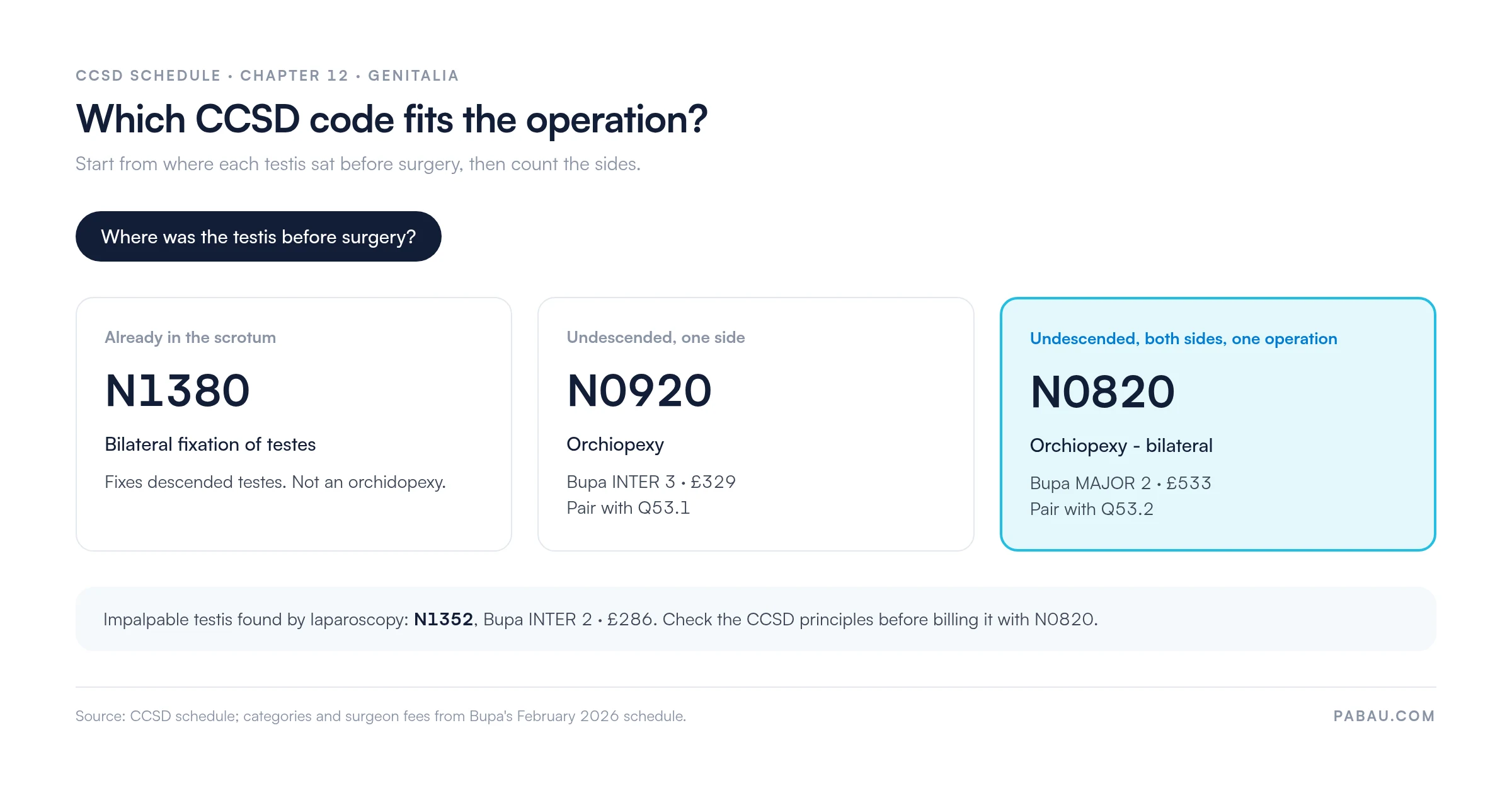
Several codes can appear alongside N0820 on a bilateral orchidopexy claim. Confirm each one is documented in the operative and anaesthetic records before you include it. Our CCSD code library lists the neighbouring codes in the genitalia section. Surgery on a varicocele, for example, is listed there as CCSD code N1900.
Every N0820 claim should carry an ICD-10 diagnosis that supports a bilateral procedure. Insurers check the procedure code against the diagnosis when they review a claim. Q53.1 on a bilateral claim, or Q53.9 where the notes support Q53.2, are the two diagnosis errors most likely to trigger a query.
UK private claims use the WHO edition of ICD-10, not the US ICD-10-CM. Check the exact descriptor in the WHO ICD-10 browser before you submit.
Most UK private insurers require pre-authorisation before an elective orchidopexy, so confirm the rule on each patient’s policy. A claim without a valid pre-auth reference is a common reason for rejection. Pre-auth does not guarantee payment, but its absence usually leads to a denial.
Bupa asks members to get pre-authorisation before treatment. The consultant needs a current Bupa recognition. Use the Bupa code search portal to confirm the current fee and any policy rules for N0820.
AXA Health uses its own specialist forms and fee schedule for CCSD procedures. Check the N0820 fee and pre-auth rule on the AXA Health procedure codes portal before submission. For other insurers, check each portal for the rules on the patient’s plan:
A pre-authorisation request for N0820 usually includes:
Keep the pre-auth reference and the insurer’s correspondence on the patient file. Insurers can review a claim after payment, and the reference is the first thing they ask for.
Request pre-authorisation for N0820 as soon as the consultant lists the operation. A staged Fowler-Stephens procedure needs a fresh reference for each admission, so diary the second request when the first stage is booked.
The operative report is the first document an insurer asks for if it queries an N0820 claim. Check these elements in the notes before you submit. Structured digital clinical documentation captures them at the point of care, so nobody rebuilds the note afterwards.
A note that only says “bilateral orchidopexy performed” is unlikely to satisfy a clinical review. Ask the surgeon for the missing detail before you submit N0820.
Most N0820 denials come from a small set of recurring errors. Each one has a straightforward prevention step.
Tracking denial reasons across claims shows which error recurs. Pabau’s claims management software logs the denial reason against each claim, so patterns surface across the practice.
Each UK insurer sets its own fee for N0820. Bupa’s February 2026 schedule places the code in MAJOR 2 with a surgeon fee of £533. AXA Health, Aviva and Vitality publish their fees through their own portals.
Fee schedules change every year, so never rely on an amount from a previous claim. Check the current Bupa fee schedule and each insurer’s portal before you invoice. A self-pay patient is quoted by the hospital and consultant directly, outside any insurer schedule.
Billing a bilateral orchidopexy runs through several hands. The team confirms the code, checks the insurer’s fee, records the pre-auth reference and the operative note, then follows the claim to payment. Spread across spreadsheets and email, those steps are where a reference or a denial goes missing.
Pabau keeps those steps on one patient record. Pabau’s claims management connects to Healthcode, the UK’s private healthcare electronic data interchange (EDI) network. N0820 claims go straight to insurer systems, and the outcome returns to the same record.
When an insurer rejects a claim, Pabau logs the reason against it. Within a few months, that log shows whether missing pre-auth, a diagnosis mismatch or thin operative notes cost the practice most.

Pabau’s claims management submits CCSD claims to UK insurers through Healthcode and logs each denial reason against the claim. Your team sees which errors cost the practice most and fixes them at the source.

N0820 turns on one fact: both testes were corrected in the same operation. The operative note has to say so plainly, with each testis’s position and fixation recorded. Q53.2 has to sit beside it on the claim.
Settle the code before admission, not after. Pre-authorisation is requested against a code, and an N0920 reference will not cover an N0820 claim.
Book a demo to see how Pabau submits CCSD claims through Healthcode and tracks every denial reason for your urology practice.

Removing a testis by keyhole surgery? CCSD code N0630 covers laparoscopic orchidectomy and the documentation it needs.
Removing both testes? CCSD code N0500 covers the bilateral excision code.
Choosing billing software for a UK practice? Best medical billing software in the UK compares the options for private practices that bill UK insurers.
CCSD Code N0820 covers bilateral orchidopexy, which brings both undescended testes into the scrotum and fixes them there in one operation. The official descriptor is “Orchiopexy – bilateral”. The operation is most often performed in infants and young children, but the code also applies to adults.
N0920 covers orchidopexy on one side, and N0820 covers both testes in one operation. Bupa lists N0920 in INTER 3 at £329 and N0820 in MAJOR 2 at £533. Billing two lines of N0920 for a bilateral operation is an error, so use a single line of N0820.
Usually, yes. Most UK private insurers, including Bupa, AXA Health, Aviva and Vitality, ask for pre-authorisation before an elective orchidopexy. Send the diagnosis code, the clinical findings for each testis and the planned admission date, and confirm the rule on each policy.
Bupa’s February 2026 schedule lists N0820 in complexity category MAJOR 2 with a surgeon fee of £533. Other insurers set their own fees, and every schedule changes yearly. Check the current figure on each insurer’s portal before you invoice.
Q53.2, undescended testicle, bilateral, is the preferred diagnosis for N0820. Q53.0 suits ectopic testes on both sides. Avoid Q53.1 on a bilateral claim, because a one-sided diagnosis with a bilateral procedure code is a common reason for a query.
The N0820 descriptor does not name an approach. A laparoscopy to find an impalpable testis has its own code, N1352, so check the CCSD principles before billing both. A staged Fowler-Stephens procedure has two admissions, and each needs its own claim and authorisation.
The most common reasons are billing N0920 twice instead of N0820, a diagnosis code that does not match a bilateral procedure, and missing pre-authorisation. Others include a missing operative report, a consultant the insurer has not recognised, and an assistant fee the policy does not cover.