CPT code 36468: Injection sclerotherapy of telangiectasia billing guide
CPT code 36468: Official descriptor and code family CPT code 36468 is defined by...

Last Updated: Nov 13, 2026
M3510 is the CCSD code for diverticulectomy of bladder, the operation to remove a pouch that has pushed out through the bladder wall. Urologists in UK private practice bill it to insurers such as Bupa, AXA Health and Aviva.
The claim rests on the operative note, which has to show that the surgeon excised the diverticulum itself. A note describing removal of a wider section of bladder wall points to M3500, partial cystectomy, instead.
Let Pabau's smart automation suggest the right codes, reduce claim denials, and keep your practice compliant—effortlessly.
Automate repetitive tasks and focus on what matters most—your patients.
Reduce coding errors and ensure compliance with the latest regulations.
Clean claims, fewer denials, and faster reimbursements.
Powerful insights and reporting to help your practice thrive.
HIPAA compliant SOC 2 certified GDPR-compliant Trusted by 4,000+ clinics worldwide

CCSD code M3510 covers diverticulectomy of bladder, the removal of a pouch that has pushed out through the bladder wall.
The operative note must name the diverticulum as the tissue removed, because a wider section of bladder wall points to M3500 instead.
A prostate resection in the same session is usually billed under its own code, M6530, subject to the insurer’s multiple-procedure rules.
Get the authorisation number before admission and put it on the invoice with the membership number and treatment date.
The full M3510 entry and its coding principles sit behind the CCSD login, so check them whenever the schedule updates.
CCSD code M3510 is the UK private billing code for diverticulectomy of bladder. A urologist uses it after removing a diverticulum, a pouch of bladder lining that has pushed out through a weak spot in the muscle wall.
The code sits in CCSD chapter 12, urinary system and male reproductive organs, under the bladder section. CCSD stands for Clinical Coding and Schedule Development, and four insurers make up the group behind it: Aviva, AXA Health, Bupa and Vitality.
In adults, most diverticula are acquired. They tend to form behind a blocked bladder outlet, and an enlarged prostate is a common cause. Surgery comes in when the pouch starts causing trouble:
The operation can be open, laparoscopic or robotic, and the approach should always be in the note. The exact descriptor and its coding principles sit behind a login on the CCSD website. Check the live entry before you bill, and use our CCSD billing guides for the codes around it.
Several codes near M3510 describe overlapping surgery on the bladder and its outlet. Pick the one that matches what the surgeon removed, whatever the referral letter called the operation. When the surgeon repaired the bladder wall rather than removing a pouch, the code is M3700.
The table sets out all four, and the chart after it turns the choice into one question.
Three of those descriptors say “including cystoscopy.” Check whether the live M3510 entry says the same before you add a separate cystoscopy line. Our guides to CCSD code M4110 and CCSD code M6530 cover those neighbours in more depth.
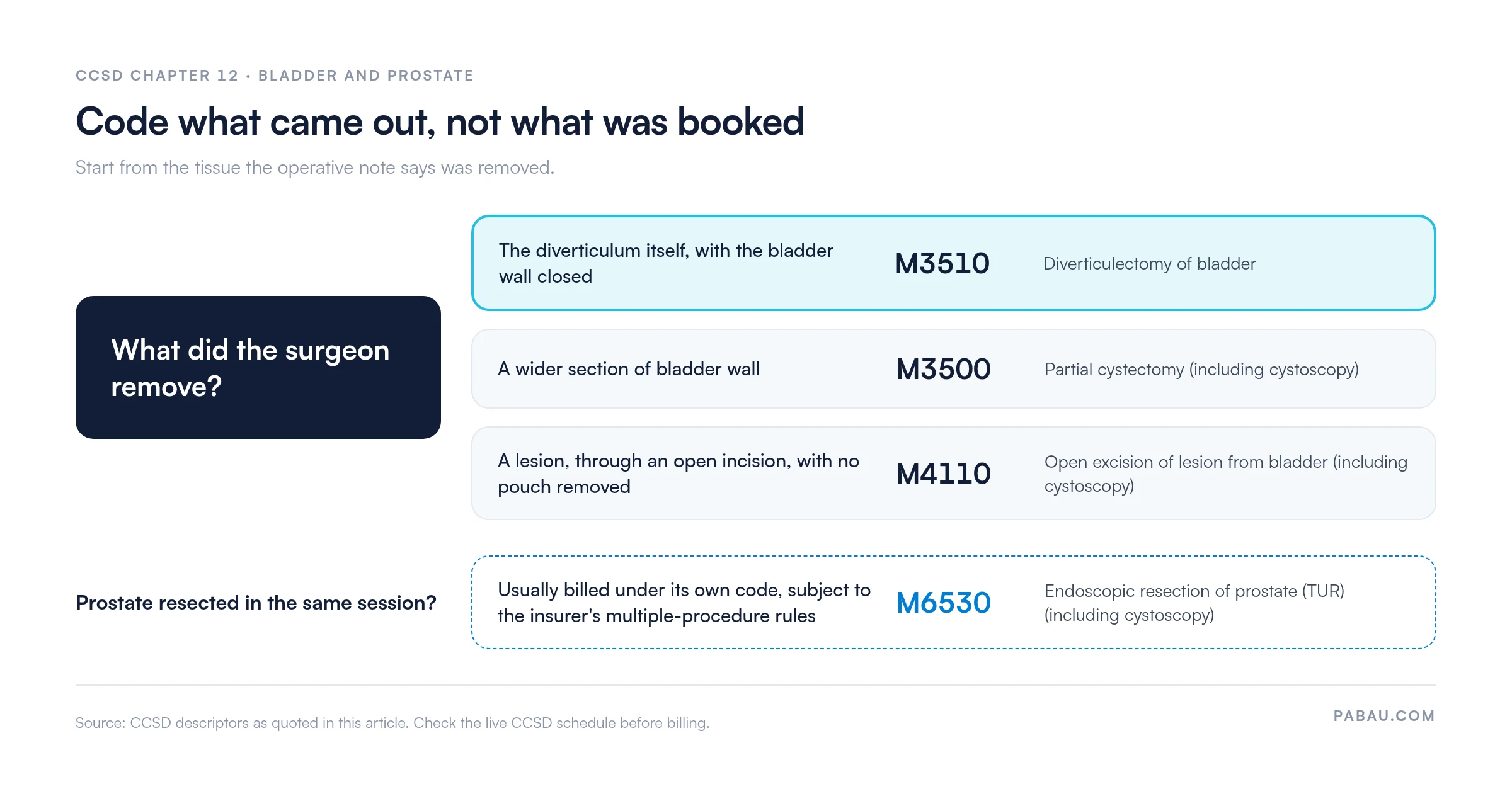
Take an illustrative patient, a 68-year-old man with an enlarged prostate. He has a large bladder diverticulum that holds urine and has started forming stones.
His urologist plans a TURP to clear the outlet and an open diverticulectomy under the same anaesthetic. A cystoscopy at the start maps the pouch and the ureteric openings.
On the claim, that usually becomes two procedure entries, subject to the CCSD principles and the insurer’s multiple-procedure rules:
The stones taken from the pouch go in the note. Whether they earn a line of their own depends on the CCSD principles and the insurer’s rules for multiple procedures.
Now say the pouch sat over the ureteric opening and the surgeon had to reimplant the ureter. That is a separate operation with its own code. So is an operation on the ureteric orifice alone, with no reimplantation, which is coded M3202. Tell the insurer about it before the claim goes in.
UK insurers generally expect planned surgery to be authorised before the patient is admitted. Usually the patient calls their insurer with the procedure code and gets an authorisation number back.
Give the patient the code in writing. A spoken “bladder operation” can come back authorised under the wrong entry. When a TURP is planned too, pass on both codes.
When the number comes back, check three points:
Surgery doesn’t always go to plan. If the surgeon does more than was authorised, call the insurer as soon as possible afterward and ask how they want the extra procedure handled.
Billing staff can only code what the surgeon writes down. For M3510, the note should cover these points:
If “partial cystectomy” appears anywhere in the note, expect a query. Ask the surgeon to confirm what was removed before the claim goes anywhere.
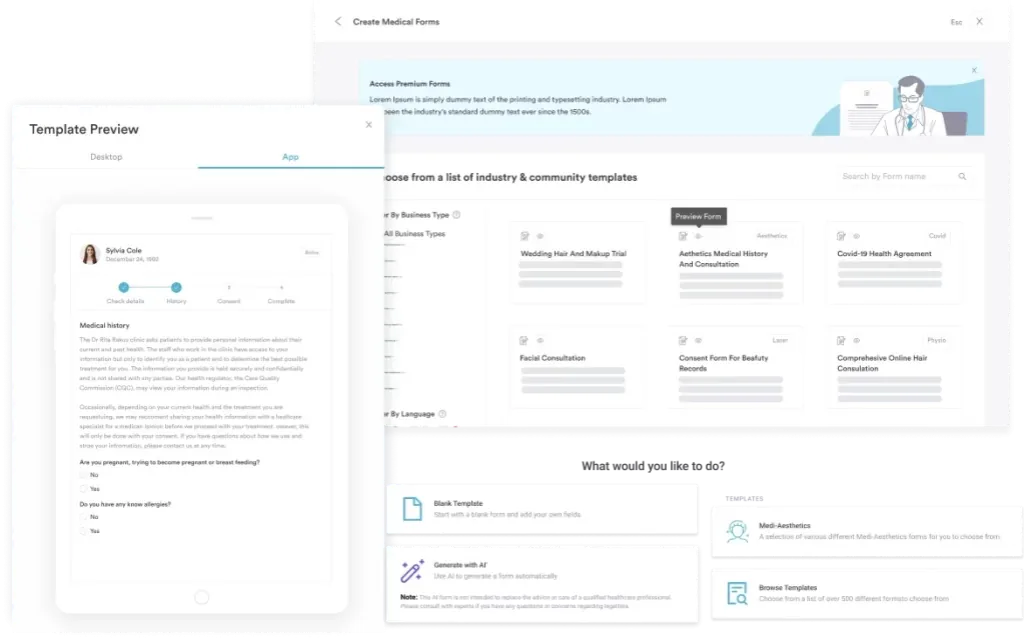
In Pabau, the practice management platform we build, the same form template can hold the indication and aftercare fields. Your coder then reads one consistent note for every case.
Most M3510 claims follow the same seven steps. Each one hands something to the next, so a slip early on shows up later as a query.
These are the questions that stall an M3510 claim, with the answer to send back.
“Why isn’t this a partial cystectomy?” Quote the note line that names the diverticulum as the tissue removed. If the surgeon took a wider section of wall, recode to M3500.
“Was the cystoscopy billed twice?” Check for a separate cystoscopy line when another code on the claim already includes one. Remove the extra line and resubmit. Urethral sphincterotomy, CCSD M4400, is one code whose descriptor includes cystoscopy. Bladder hydrodistension, billed as CCSD code M4320, includes the cystoscopy in its descriptor too.
“Where is the authorisation for the second procedure?” Send the authorisation that covers both codes, or your record of the call made after surgery.
“Does the membership number match?” A typo here sends the claim back before anyone reads the note. Copy the number from the authorisation, never from the referral letter.
“Is the consultant recognised for this procedure?” Insurers pay only consultants they recognise. Confirm urology recognition with each insurer before you book the case.
Most rejected M3510 claims trace back to one of these slips. Each has a simple fix once you know to look for it.
For how one insurer applies CCSD codes across its schedule, see our Bupa CCSD codes guide.
Many urology practices still copy claim details from the patient record into an insurer portal by hand. Every retyped membership or authorisation number is a chance for the claim to bounce.
Pabau sends claims through Healthcode and Bupa straight from the patient record, as invoices with the CCSD code recorded. Nobody on your team retypes the claim details into a portal.
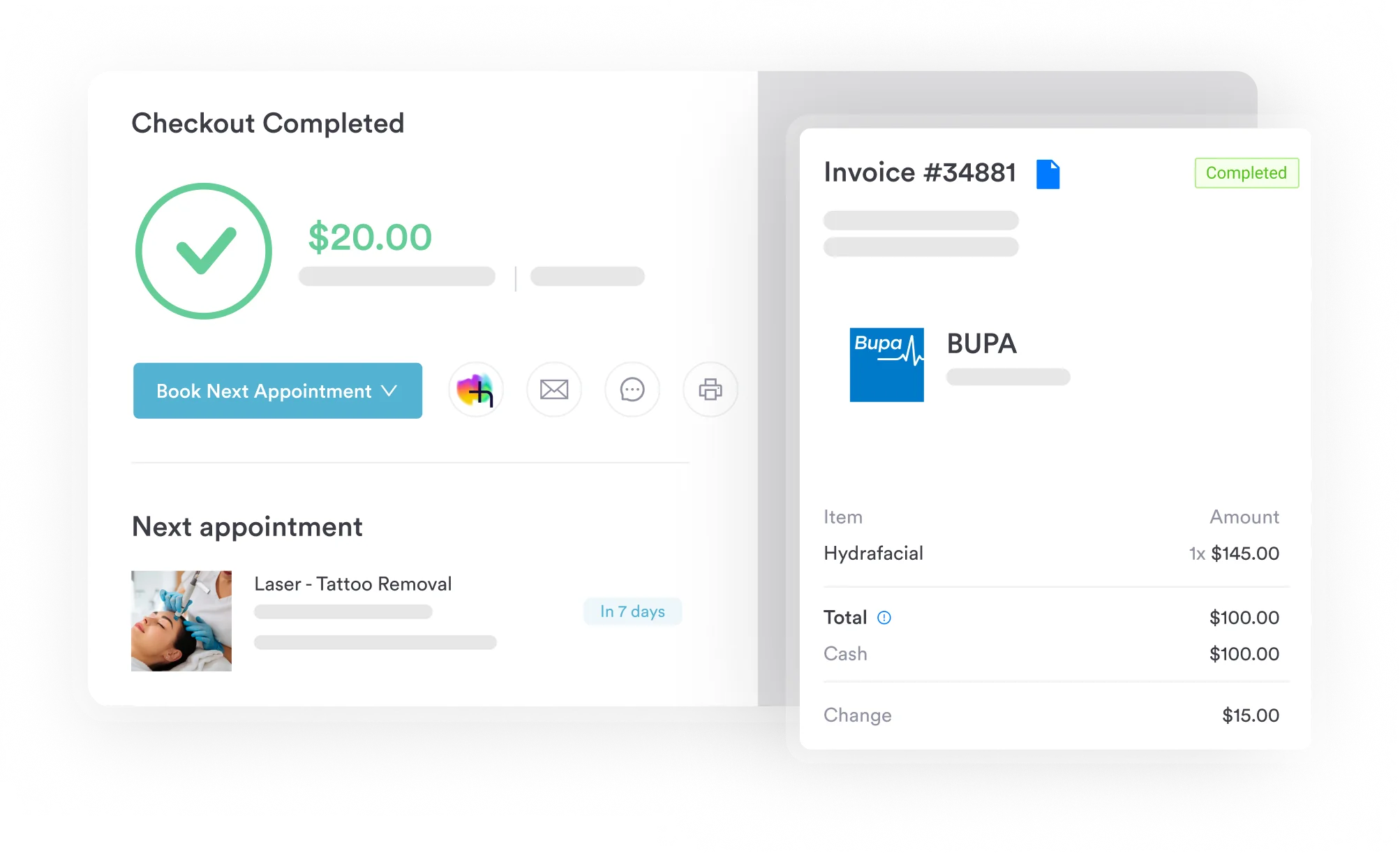
The claims management software in Pabau keeps the insurer, membership and authorisation numbers on the claim record. Once the claim is submitted, you track its status and reconcile the payment in one place.

Pabau keeps authorisation numbers on the patient record and sends claims through Healthcode and Bupa as invoices with the CCSD code recorded.

An M3510 claim stands or falls on one line of the operative note. When that line names the diverticulum as the tissue removed, the code holds up. When it is vague, expect a query or a recode to M3500.
So put your effort where it pays back. Give the patient every planned code for the authorisation, especially when a TURP is booked alongside. Hold the invoice until the note is signed, and check the live CCSD entry whenever the schedule changes.
Book a demo to see how Pabau sends M3510 claims through Healthcode and Bupa straight from the patient record.

Need the bigger picture on one insurer’s schedule? Bupa CCSD codes guide explains how Bupa applies CCSD codes to claims.
Removing a bladder lesion rather than a pouch? CCSD code M4110 covers open excision of a lesion from the bladder.
Treating the prostate in the same session? CCSD code M6530 walks through billing an endoscopic prostate resection.
Is a urethral stricture behind the obstruction? CCSD code M7940 covers internal urethrotomy claims.
No. M3510 is a UK private billing code, while CPT 51525 is the US code for cystotomy with excision of a bladder diverticulum. UK insurers expect the CCSD code on the claim.
Don’t assume so. The CCSD schedule gives some operations separate laparoscopic codes. Check for a laparoscopic or robotic entry before you code the case as M3510.
The anaesthetist sends their own invoice for their own fee. It usually quotes the same procedure code as the surgeon’s claim, but confirm each insurer’s format.
That’s the surgeon’s call. Many patients go home with a catheter for one to two weeks, sometimes with a bladder X-ray before it comes out.
The patient usually pays the shortfall, unless the consultant agreed to charge within the insurer’s fee. Warn the patient about any likely shortfall before surgery.
No insurer is involved, so the code isn’t required on a self-pay bill. Many practices still record it, so their activity reporting stays consistent across insured and self-pay cases.