HCPCS Code E0272: Foam rubber mattress billing guide
HCPCS Code E0272: official descriptor and code overview HCPCS Code E0272 is the ...

Last Updated: Nov 6, 2026
CCSD code L7032 covers a haemorrhoidal artery ligation operation, including image-guided ligation, with or without recto anal prolapse repair. The surgeon ties off the arteries that feed the haemorrhoids, working through a proctoscope above the dentate line. If tissue prolapses, the same operation can stitch it back into place.
L7032 sits in CCSD sub-chapter 11.6.0, Rectum/Anus, which makes it a colorectal surgical code. One code covers the ligation and any prolapse repair. That is why the CCSD lists several haemorrhoid and rectal codes as unacceptable combinations.
Let Pabau's smart automation suggest the right codes, reduce claim denials, and keep your practice compliant—effortlessly.
Automate repetitive tasks and focus on what matters most—your patients.
Reduce coding errors and ensure compliance with the latest regulations.
Clean claims, fewer denials, and faster reimbursements.
Powerful insights and reporting to help your practice thrive.
HIPAA compliant SOC 2 certified GDPR-compliant Trusted by 4,000+ clinics worldwide

CCSD code L7032 is a colorectal surgical code for haemorrhoidal artery ligation, with or without recto anal prolapse repair.
It sits in CCSD chapter 11, sub-chapter 11.6.0, Rectum/Anus, alongside the other haemorrhoid and rectal operations.
The CCSD lists H5100, H5101, H5230, H5240, H5250, H4200 and H6260 as unacceptable combinations, but each insurer decides whether to apply them.
Claims hold up best when the operation note records image guidance and whether a prolapse repair was done.
CCSD code L7032 is the procedure code for a haemorrhoidal artery ligation operation, often shortened to HALO or HAL. Its full narrative reads “Haemorrhoidal artery ligation operation (including image-guided) +/- recto anal prolapse repair.” The code sits in chapter 11 of the CCSD schedule, under sub-chapter 11.6.0, Rectum/Anus.
In plain terms, the surgeon ties off the arteries that feed the haemorrhoids. The sutures go in above the dentate line, through a proctoscope. A Doppler probe can help locate each artery, which is the image-guided part of the narrative.
When haemorrhoids prolapse, the surgeon can add a recto anal repair in the same operation. This step stitches the loose tissue back into place, a technique also described as mucosal plication.
For cross-reference, the NICE guidance on haemorrhoidal artery ligation (IPG342) maps the procedure to OPCS-4 code L70.3. Each insurer sets its own fee for L7032.
L7032 is a bundled code. One claim line covers the artery ligation, any Doppler or image guidance, and any recto anal prolapse repair done in the same operation.
That bundling shapes what you can and cannot add to the bill:
If the surgeon plans a different haemorrhoid operation, code that operation instead. L7032 only fits when artery ligation is the operation performed. The chart below splits what the code already pays for from the codes that never share its bill.
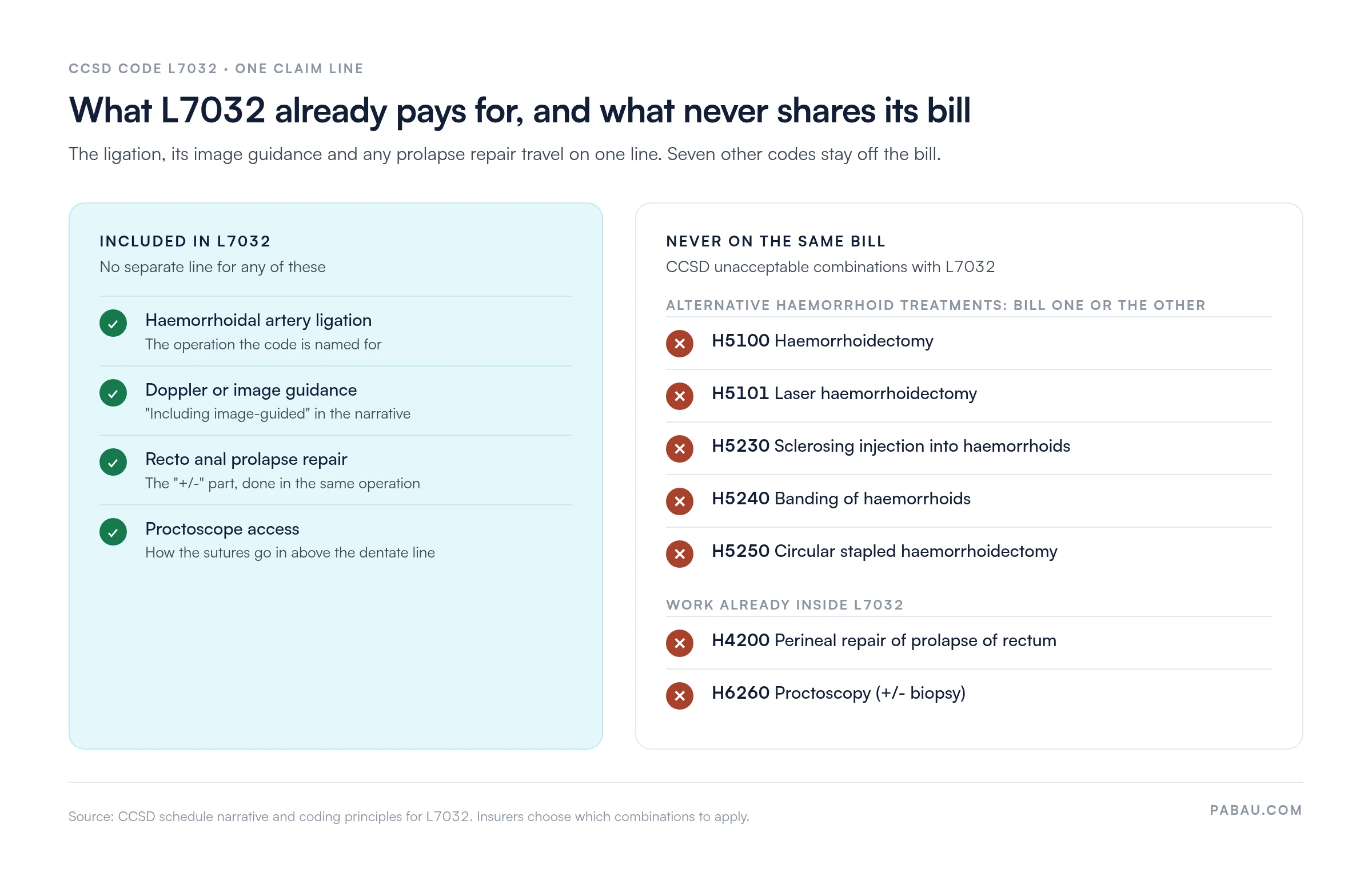
The CCSD publishes coding principles that name codes you should not bill alongside L7032. For this code, the list covers five other haemorrhoid treatments, plus two codes for work already inside the procedure.
The CCSD describes its coding principles as non-exhaustive guidelines. Each insurer chooses whether to adopt a given combination, so check the insurer’s own rules before you bill two codes together.
Billing banding instead? Our guide to H5240 covers that code. Sclerotherapy has its own guide under H5230.
For a standalone prolapse operation, see H4200.
UK private medical insurers generally expect pre-authorization before elective surgery. The patient usually contacts the insurer with the CCSD code the surgeon provides. The authorization is then tied to that code.
Give the patient L7032 only when artery ligation is the planned operation. Because the prolapse repair sits inside the code, adding a recto anal repair on the day needs no new code.
Switching procedures is different. If the surgeon converts to a haemorrhoidectomy, billed under H5100, the authorized code no longer matches the operation. Contact the insurer before you invoice, and record the reason in the operation note.
Insurers adopt CCSD rules individually, so cover terms and fees vary. Bupa, for example, lists L7032 against consultants on its Bupa Finder. Our Bupa CCSD codes guide explains how Bupa handles CCSD-coded bills.
Insurers query claims by comparing the code with the clinical record. For L7032, the operation note carries most of that weight, so make sure it records:
A note that only says “HAL performed” leaves the insurer guessing. Detail on guidance and prolapse repair shows the claim matches the code.
Healthcode is the UK clearing house many practices use to send insurer bills electronically. These steps apply whether you bill from your own system or from Healthcode directly.
Anesthetists usually invoice separately under their own provider number. Agree in advance who bills what, so the insurer never receives overlapping lines.
Most L7032 rejections start with a billing error your team can correct and resubmit. Here are the usual causes and the fix for each.
Run through these checks before each L7032 bill leaves the practice:
These errors come up again and again on L7032 bills:
Our CCSD codes hub lists the neighboring rectum and anus codes when you need to compare options.
Surgical billing slips when the operation note, the authorization and the invoice live in different places. One insurer query then means hunting through folders while the claim sits unpaid.
Pabau, the practice management software we build, links clinical notes to invoices. The operation note behind an L7032 bill stays with the invoice, ready when an insurer asks for it.
Pabau’s claims management software then sends the bill to Healthcode. Your team submits from the patient record instead of retyping details into a separate portal.

Pabau links operation notes to invoices and submits insurer bills through Healthcode, so your L7032 claims go out complete.

L7032 rewards precise coding. Bill it only when artery ligation is the operation, and let the code absorb the image guidance and any prolapse repair.
The biggest risk is adding lines the CCSD treats as part of the procedure. Keep the operation note specific, match the authorization to L7032, and check each insurer’s own rules. Book a demo to see how Pabau keeps your surgical notes and insurer bills together.

Billing a banding procedure instead? CCSD code H5240 covers haemorrhoid banding and its own unacceptable combinations.
Treating prolapse without ligation? CCSD code H4200 explains the perineal repair of rectal prolapse code.
Comparing other haemorrhoid treatments? CCSD code H5230 walks through billing for sclerosing injection of haemorrhoids.
Billing Bupa-insured patients? Bupa procedure codes fee schedule outlines how Bupa reimburses CCSD-coded procedures.
Converting to an excisional operation? CCSD code H5100 covers haemorrhoidectomy, the alternative L7032 cannot share a bill with.
Yes. HALO stands for haemorrhoidal artery ligation operation, the wording of the L7032 narrative. Doppler-guided versions also fall under L7032, because the code includes image guidance. Confirm any branded technique with the insurer before surgery.
Yes. NICE guidance IPG342 found it an efficacious alternative to conventional haemorrhoidectomy or stapled haemorrhoidopexy in the short and medium term. The guidance raised no major safety concerns.
The anesthetist usually sends a separate invoice under their own provider number. Both bills should show the same patient, date and authorisation details. Check each insurer’s anesthetist fee rules before submitting.
L7032 is the CCSD code private insurers use to pay the surgeon. L70.3 is the OPCS-4 code hospitals use to record the procedure, as NICE IPG342 maps it. A private bill to the insurer carries L7032.