HCPCS Code A4627: Spacer and valved holding chamber
HCPCS Code A4627: official descriptor and code definition HCPCS Code A4627 is th...

Last Updated: Oct 21, 2026
H5230 is the CCSD code for injection of sclerosing substance into haemorrhoids. It covers sclerotherapy of internal haemorrhoids above the dentate line, usually with 5% phenol in almond oil. The injection is given through a proctoscope as an outpatient or day-case procedure.
The code sits in CCSD section 11.6.0, Rectum/Anus. Its descriptor is plural, so one charge normally covers every site injected in a session. CCSD lists banding (H5240), haemorrhoidectomy (H5100) and haemorrhoidal artery ligation (L7032) as unacceptable combinations with it.
Let Pabau's smart automation suggest the right codes, reduce claim denials, and keep your practice compliant—effortlessly.
Automate repetitive tasks and focus on what matters most—your patients.
Reduce coding errors and ensure compliance with the latest regulations.
Clean claims, fewer denials, and faster reimbursements.
Powerful insights and reporting to help your practice thrive.
HIPAA compliant SOC 2 certified GDPR-compliant Trusted by 4,000+ clinics worldwide

CCSD code H5230 covers injection of a sclerosing substance into internal haemorrhoids. External haemorrhoids and banding take other codes.
The descriptor is plural, so one H5230 normally covers every site injected in a session. Confirm the billing unit with each insurer.
Many insurers require pre-auth for surgical-schedule procedures, so check each insurer’s current rules before the appointment.
The operative note must name the sclerosing agent, the haemorrhoid grade, the number of sites injected and the proctoscope used.
Pabau, the practice management platform we build, stores each insurer’s agreed rate and authorisation code, then sends the claim through Healthcode.
CCSD Code H5230 is the Clinical Coding and Schedule Development procedure code for the injection of a sclerosing substance into haemorrhoids. The CCSD Group places it in section 11.6.0 (Rectum/Anus) of its schedule, which UK private specialists use to bill consultant procedures.
CCSD codes are not NHS procedure codes. In fact, UK private medical insurers (PMIs) widely use them, and each insurer applies its own rules and fee schedule. The neighbouring Rectum/Anus codes each have their own entry in our CCSD code guides.
Next, the quick-reference table below summarises the core facts a coder needs before submitting an H5230 claim.
Haemorrhoid sclerotherapy is a minimally invasive outpatient treatment for Grade I, Grade II and selected Grade III haemorrhoids on the Goligher scale. The colorectal surgeon introduces a proctoscope to see the internal haemorrhoids above the dentate line. They then inject a sclerosing agent into the submucosa of the vascular pedicle at each affected site.
The sclerosant most commonly used in UK practice is 5% phenol in almond oil. However, clinicians may use other formulations at their discretion, and the operative note must name whichever agent they gave. The injection triggers fibrosis in the submucosal vascular pedicle, so the haemorrhoidal tissue shrinks and fixes to the underlying rectal wall.
A typical session involves the following steps:
External haemorrhoids and perianal skin tags are not suitable for sclerotherapy and are outside the clinical scope of H5230. Instead, a different code or procedure applies when external pathology is the main presentation.
Haemorrhoid codes sit close together in the H-series, so the wrong one is easy to pick. The table below sets out what H5230 includes and which procedures fall outside it. In fact, CCSD lists every coded procedure in the right-hand column as an unacceptable combination with H5230.
CCSD’s combination rules are principles, and each insurer decides whether to adopt them. So check the insurer’s own schedule if a claim queries a combination.
The CCSD H-series covers colorectal procedures, and H5230 sits within a cluster of haemorrhoid codes that billers often confuse. Bupa’s procedure fee schedule and the Healix fee schedule both publish H-series rates. Also, they serve as a practical reference for checking fee levels alongside the correct code.
When can a proctoscopy code be billed alongside H5230? Proctoscopy (H6260) is integral to H5230, so you do not code it separately alongside H5230. The proctoscope delivers the injection, so it is part of the procedure rather than a separate diagnostic act. However, where the surgeon excises the haemorrhoids rather than injecting them, the claim moves to H5100 instead.
Insurers can decline an H5230 claim when the operative note does not support the code. The CCSD technical guide requires that the procedure documentation supports the specific code claimed. For H5230, the note must confirm a sclerosing injection rather than banding or excision. So use the checklist below before submitting.
Every H5230 operative note must include:
In short, a structured operative note template that prompts for each of these fields at the point of care catches gaps before the claim goes out.
Many insurers require pre-auth for surgical-schedule procedures, so check each insurer’s current rules before every H5230 encounter. Rules vary by insurer and policy tier. Where pre-auth applies, insurers are likely to decline a claim without a valid reference, and the bill may then fall to the patient or the practice.
However, the table below shows general patterns only, because each policy’s rules differ.
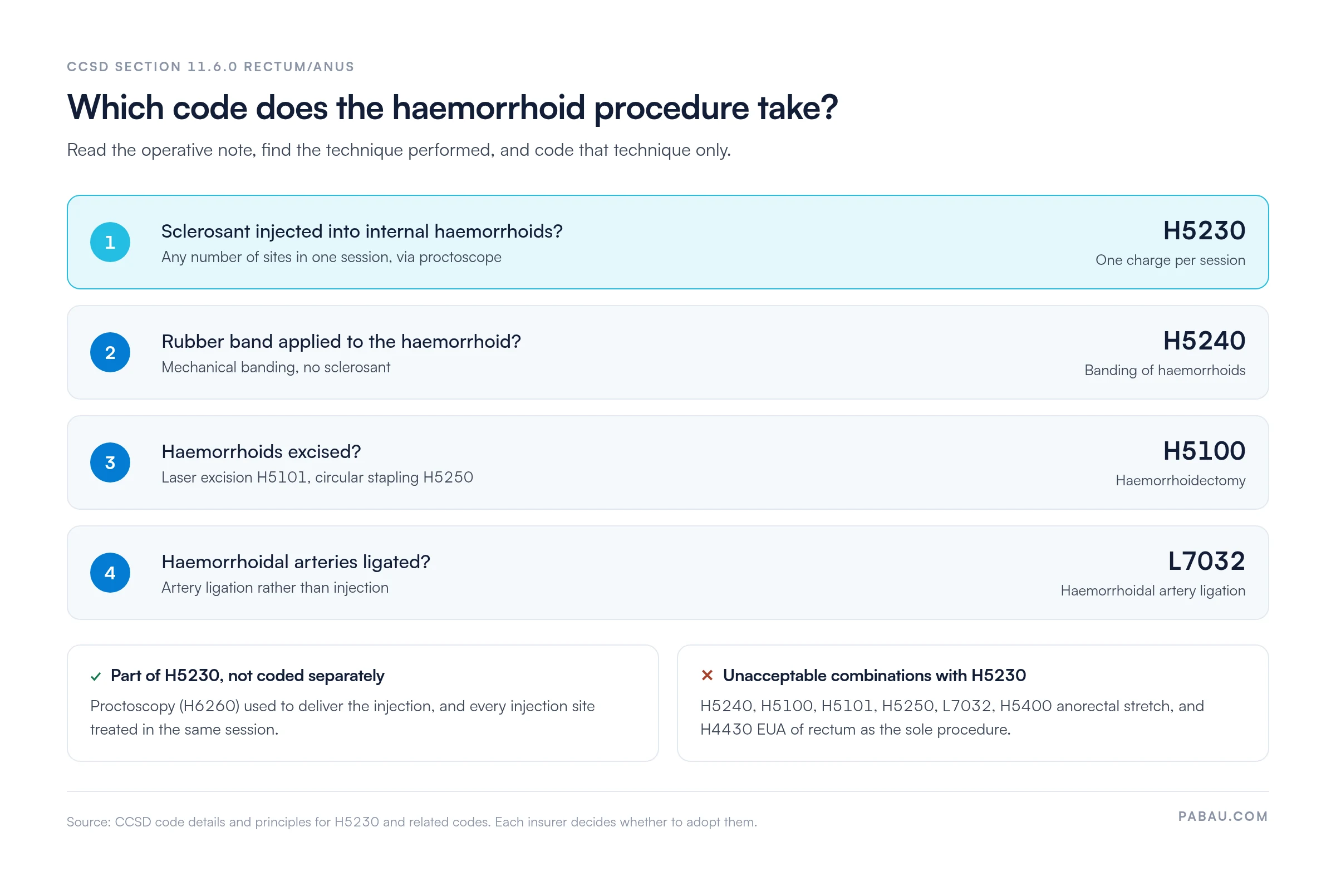
Sclerotherapy and rubber band ligation (RBL) are clinically distinct procedures with different CCSD codes, so the operative note decides which one applies. Next, use the decision logic below.
In short, the clinical difference is simple to state. Sclerotherapy uses a needle and a chemical, while banding uses an applicator and a rubber ring. If the operative note does not say which technique the clinician used, the coder cannot select the correct code. So send unclear notes back to the clinician before you submit the claim, rather than guessing the technique from the procedure name. Finally, the chart below sets the haemorrhoid codes side by side.
First, the table below maps common H5230 denial causes to a prevention step and an appeal route.
Bill H5230 once per session, however many haemorrhoid sites you inject. The CCSD descriptor is plural (“haemorrhoids”), which supports one charge per session, but confirm the billing unit with the insurer. Treating three haemorrhoids in one sitting still generates a single H5230 charge. However, claim repeat sessions separately by date of service.
The operative note must still record the number of sites injected. Insurers use this detail to assess medical necessity and to tell a single-site procedure from a multi-site session. For example, recording “three injection sites” rather than “multiple sites” protects the claim if the insurer queries the procedure scope.
However, where a clinician treats four or more distinct haemorrhoids in one session, some insurers may ask you to explain why. Record the reason in the operative note to pre-empt this. For example: “Grade II haemorrhoids at three positions; Grade III at the fourth position with early prolapse”. CCSD codes carry no modifiers, so check with the insurer whether it expects extra records for multi-site sessions.
Before submitting any H5230 claim involving more than three injection sites, call the insurer’s provider line to confirm whether extra clinical records are needed. A short call before submission is quicker than an appeal after a denial.
Many H5230 denials start before the procedure, when nobody captures the pre-auth code or the insurer’s rate. In Pabau’s claims management software, you store each insurer authorisation as a case and attach it at booking. The code then carries through to the claim without anyone retyping it.
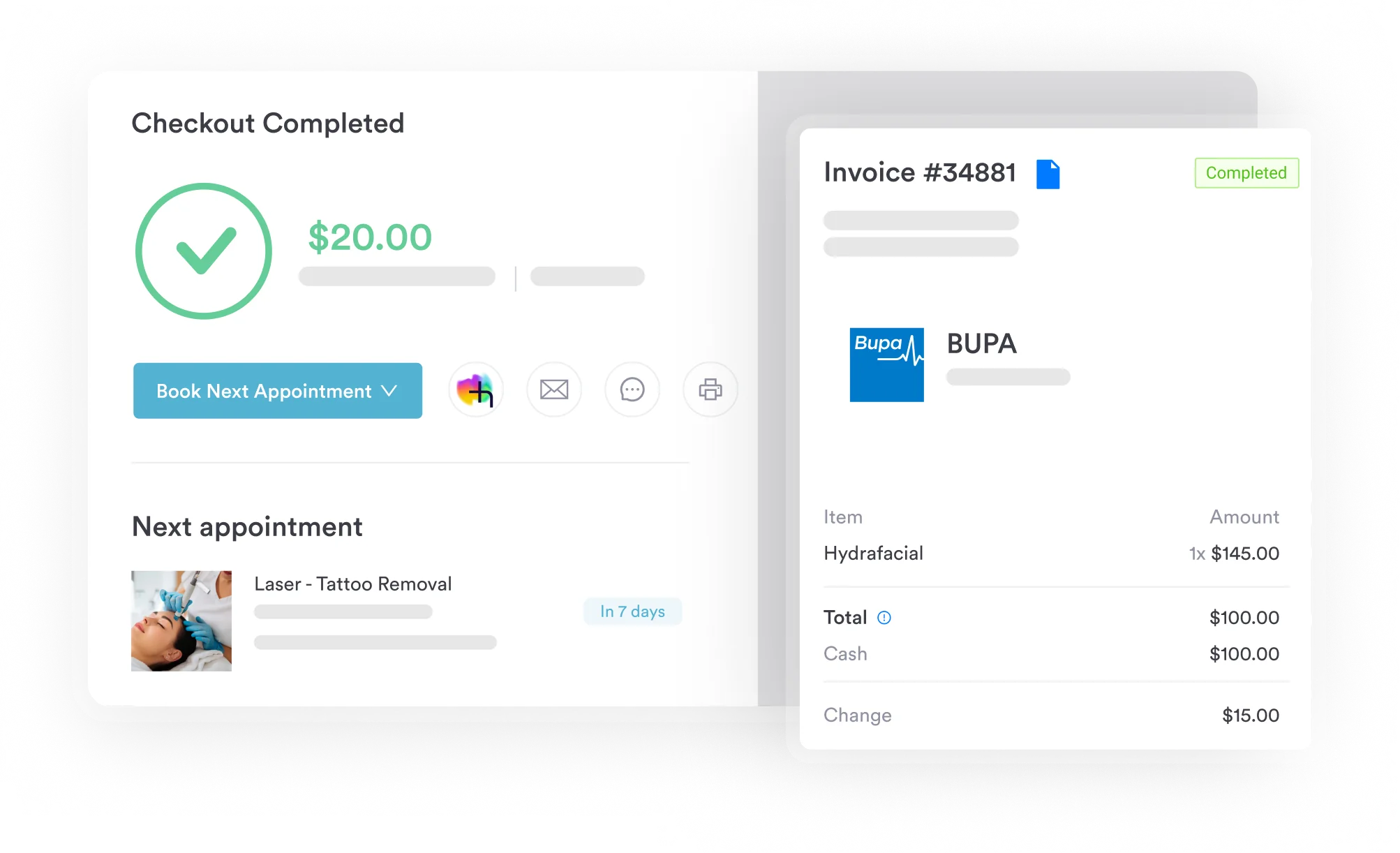
Key capabilities relevant to H5230 billing:
The operative note sits in the same patient record as the invoice. As a result, when an insurer queries the agent, grade or site count, the answer is already on file rather than in a separate system.

Pabau stores each insurer’s agreed rate and pre-authorisation code, then submits and tracks the H5230 claim through Healthcode. Rejected claims come back with the reason, so you can fix and resubmit them.

H5230 is one of the simpler codes in the Rectum/Anus section to assign. However, the work is in what surrounds it. The note states the technique, the claim avoids unacceptable combinations, and a pre-authorisation code is in place wherever the insurer wants one.
Start with the operative note template. Then, once it forces the agent, grade, site count and proctoscope fields, most of the denial causes above stop reaching the insurer. If a note is unclear about banding versus injection, send it back to the consultant instead of coding from memory.
To see how authorisation cases and insurer rates carry through to each claim, book a demo of Pabau’s claims workflow.

Billing an excision instead? CCSD code H5100 covers haemorrhoidectomy, the code CCSD lists as an unacceptable combination with H5230.
Coding another Rectum/Anus procedure? CCSD code H0480 explains abdominal revision of restorative proctocolectomy and how it is graded.
Billing other CCSD colorectal codes? Bupa’s CCSD code schedule guide covers the full range of Bupa-accepted procedure codes for colorectal and surgical specialties.
Need the complete Bupa fee schedule? Bupa’s procedure fee schedule on Pabau sets out how Bupa remunerates CCSD-coded procedures by category.
CCSD Code H5230 covers injection of a sclerosing substance into internal haemorrhoids under proctoscopic guidance. The descriptor is plural, so one charge normally covers every site injected in a session. External haemorrhoid injections, banding (H5240) and haemorrhoidectomy (H5100) fall outside it.
The most widely used sclerosant in UK private practice is 5% phenol in almond oil, though clinicians may use other formulations. The operative note must name the agent itself rather than calling it a sclerosant, because insurers check the agent against the claim.
Yes. The H5230 descriptor is plural, so several sites injected in one session are billed as a single H5230, not one charge per site. Confirm the billing unit with the insurer and record the number of sites in the operative note. Repeat sessions on other dates are claimed separately by date of service.
The codes most often confused with H5230 are H5240 (banding of haemorrhoids), H5100 (haemorrhoidectomy) and H6260 (proctoscopy +/- biopsy). H5240 gets picked when a note does not say which technique was used. H6260 is sometimes co-billed in error, but proctoscopy is integral to H5230 and is not coded separately.