HCPCS code G0248: Home INR monitoring demonstration
HCPCS code G0248: Official descriptor and code category HCPCS code G0248 is a Me...

Last Updated: Oct 26, 2026
CCSD code K4410 covers revision bypass for coronary artery(ies), including harvesting of grafts. Cardiac surgeons bill it to UK private medical insurers for a repeat bypass on a patient who has had one before.
The detail that trips claims sits in the bracket. Graft harvesting is already part of K4410, so it never goes on the invoice as a second line. A first bypass takes a different bypass code instead. Below, we cover the codes that clash with K4410, what insurers check and how the claim moves through Healthcode.
Let Pabau's smart automation suggest the right codes, reduce claim denials, and keep your practice compliant—effortlessly.
Automate repetitive tasks and focus on what matters most—your patients.
Reduce coding errors and ensure compliance with the latest regulations.
Clean claims, fewer denials, and faster reimbursements.
Powerful insights and reporting to help your practice thrive.
HIPAA compliant SOC 2 certified GDPR-compliant Trusted by 4,000+ clinics worldwide

CCSD code K4410 covers revision bypass for coronary artery(ies), and graft harvesting is already included in the code.
K4410 sits in Chapter 8 of the CCSD schedule, under sub-chapter 8.8.0 Heart – Cardiac Surgery.
Use K4410 for a repeat bypass operation only, since a first bypass takes a code such as K4100.
CCSD lists the bypass codes K4100, K4180 and K4600 and the catheterization code K6514 as unacceptable combinations with K4410.
Insurers check for a matching pre-authorization, an operative note that records the previous bypass, and a diagnosis code that explains the redo.
CCSD code K4410 is the code for revision bypass for coronary artery(ies), including harvesting of grafts. Cardiac surgeons use it to bill a UK private medical insurer for a repeat bypass operation. It describes the surgeon’s procedure, not the hospital stay or the theater team.
CCSD stands for Clinical Coding and Schedule Development. The CCSD Group brings together Aviva, AXA Health, Bupa and Vitality. It maintains one shared schedule of CCSD codes, so a procedure carries the same code at every insurer that uses it.
Here are the reference details for K4410 at a glance.
The CCSD Group does not set fees or reimbursement. Its coding principles are also not exhaustive. Each insurer decides whether to adopt them, so the insurer’s own rules have the last word on any claim.
A revision bypass is open-heart surgery on a patient who has already had coronary artery bypass grafting. The surgeon places new grafts to restore blood flow past failed grafts or newly diseased arteries. A typical operation runs like this.
Because graft harvesting is written into the descriptor, the vein or artery harvest is part of K4410. It never goes on the claim as a second line.
K4410 is for a repeat bypass operation. A first bypass takes a bypass code such as K4100, even when it uses several grafts. The patient’s history decides the code, not the number of grafts placed.
Treatment through a catheter is a different procedure with its own code. Balloon angioplasty takes K4900, and angioplasty with a stent takes K4910. The decision tree below shows how the three routes split.
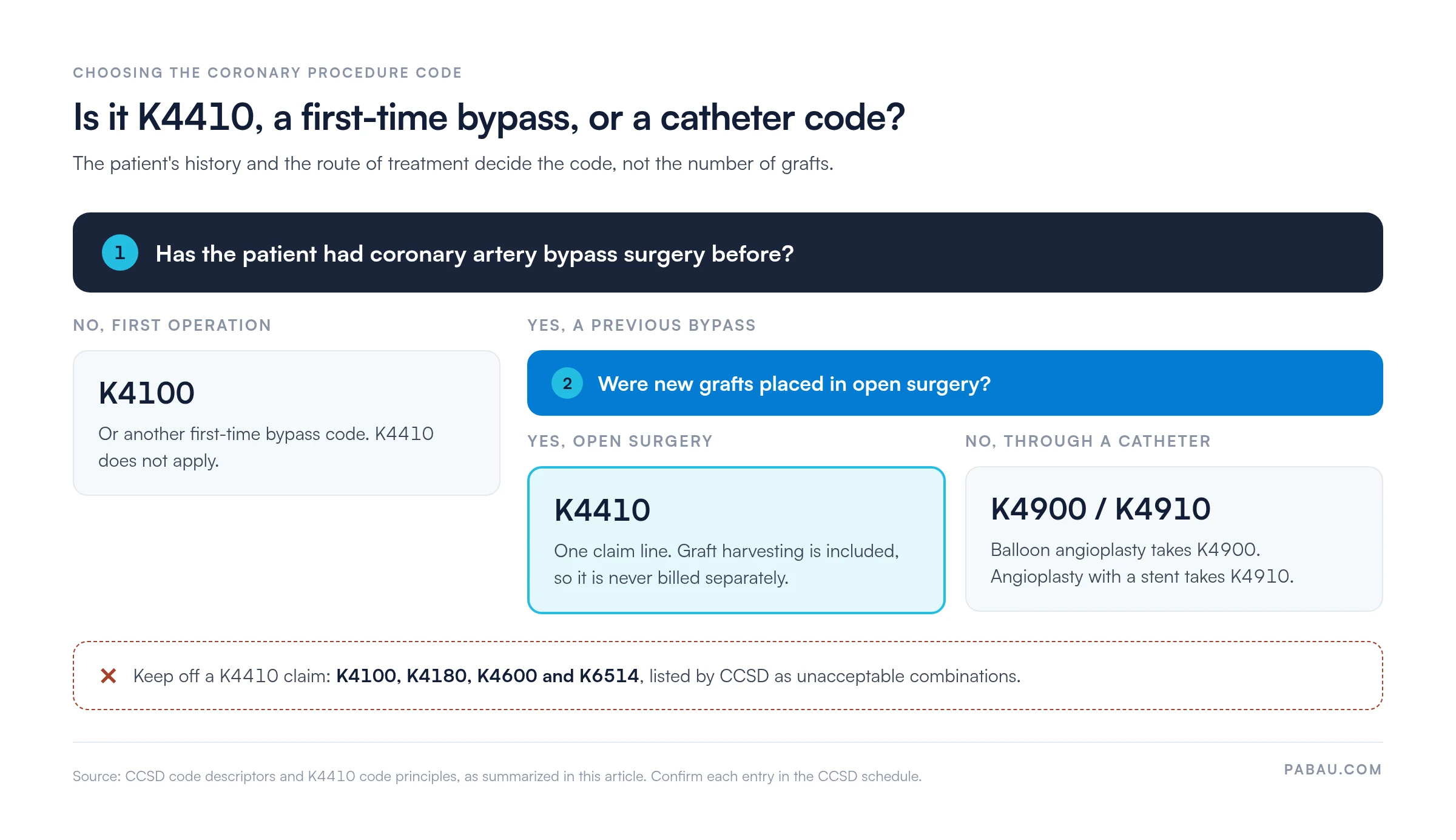
Here’s how that plays out. Say a patient had a triple bypass eight years ago, and a new angiogram shows two blocked vein grafts. The surgeon reopens the chest, harvests a radial artery and places two new grafts. That operation is one K4410 line, with Z95.1 added to show the earlier bypass.
Redo bypass carries more risk than a first operation, and percutaneous treatment is often considered first. So an insurer reviewing a K4410 claim may ask why surgery was chosen. The operative note and the referral letter should answer that before anyone asks.
Common reasons include several failed vein grafts, disease in the left main stem and anatomy that does not suit angioplasty. A previous stent failure that cannot be treated again is another.
The CCSD principles page for K4410 lists codes that should not be claimed with it. That page sits behind a CCSD login, so we could only read its entries through a public search index.
Treat the table as a starting point and confirm each line in the CCSD schedule.
Each entry has a clear reason behind it. A redo bypass already covers the grafting, so adding another bypass code would claim the same work twice.
The catheterization code K6514 is listed for a similar reason, as CCSD does not expect it on the bypass claim. The same listing also names K5020, K5050 and K6700, so check those entries in the schedule too.
Valve surgery in the same operation is a separate matter. It has its own code and its own line on the claim. Each insurer then applies its own rules on what it pays for a second procedure.
The diagnosis code has to tell the same story as the operative note. These ICD-10 codes are the usual matches for a revision bypass.
UK insurers work with the WHO version of ICD-10. Confirm each code against the insurer’s accepted list before you submit.
Most UK private medical insurance policies require pre-authorization for planned inpatient surgery. The patient usually contacts the insurer, but the surgeon’s team supplies the clinical detail. A complete request carries these items.
Record the authorization number on the patient’s file as soon as it arrives. If the plan changes in the operating room, contact the insurer promptly. An authorization for one code does not cover another.
The operative note is the evidence behind the code. Insurers can request it before or after payment, so write it with the claim in mind. It should cover these points.
With the note signed, the invoice can go out. Healthcode is the electronic billing service most UK private insurers use for consultant invoices. Its bills reach the insurer faster than paper and are checked against insurer rules on the way. A K4410 invoice takes six steps.
Send the K4410 invoice only after the operative note is signed. Then, if the insurer asks why a revision was needed, you can reply the same day with the note attached.
A quick review before the invoice leaves saves a round of insurer queries later. Work through this list on every K4410 claim.
Even a careful team slips on the same few points. Each of these errors can stall a K4410 claim, and each one has a straightforward fix.
A K4410 claim pulls paperwork from several places. The authorization letter sits in one inbox, and the angiogram report in another system. The details of the first bypass may be in an old discharge letter. When a query lands weeks later, someone has to find all of it again.
Pabau, the practice management platform we build for private consultants, keeps those documents on the patient record. Pabau’s claims management software sends the claim through Healthcode from the patient record.
Your team can also track each claim’s status and reconcile payments without leaving Pabau. When the insurer asks about the redo, the operative note is already on the same screen.
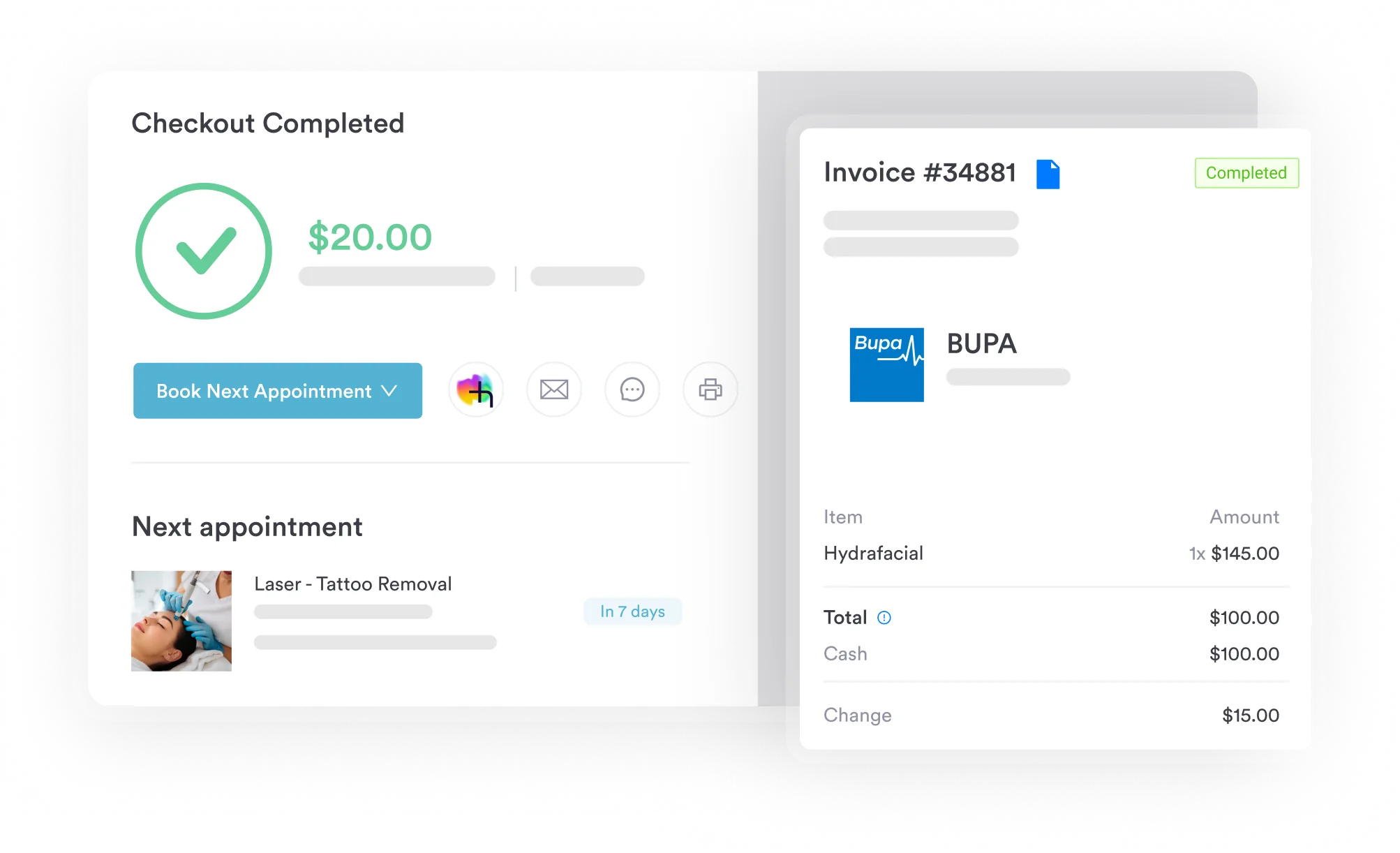

Pabau keeps authorizations, operative notes and invoices on one patient record. It then sends CCSD-coded claims to insurers through its Healthcode integration.

K4410 is the right code when the patient has had a bypass before and the surgeon placed new grafts in open surgery. A first bypass, or a blockage treated through a catheter, belongs under a different code.
The code choice is rarely what holds up payment. Claims stall when a second bypass code stays on the invoice, or when the note never mentions the earlier operation. Fix both before submission, and the insurer has little left to query.
Book a demo to see how Pabau keeps the authorization, the operative note and the K4410 invoice on one patient record.

Was a stent placed instead of a bypass? CCSD code K4910 covers coronary angioplasty with stent insertion and what insurers expect on the claim.
Was the artery opened with a balloon only? CCSD code K4900 explains how to bill coronary angioplasty without a stent.
New to the CCSD schedule? CCSD codes explains how the shared schedule works across UK private insurers.
Billing Bupa patients for cardiac surgery? Bupa CCSD codes walks through how Bupa applies the CCSD schedule.
Want CCSD claims sent from the patient record? Pabau’s claims management software sends claims to insurers through Healthcode.
Yes. The descriptor reads coronary artery(ies), so one new graft or several bill as one K4410 line. The earlier bypass decides the code, not the graft count.
It means taking the vein or artery used to build the new bypass. That is usually a saphenous vein, a radial artery or an internal mammary artery. The harvest is part of K4410, so it is never billed separately.
K44.2, revision of replacement of coronary artery, is the nearest OPCS-4 code. Treat it as the closest equivalent rather than an official mapping between the two systems.
OPCS-4 is the NHS classification for recording procedures in hospital data. CCSD codes are the schedule UK private insurers use for billing. A private hospital may record both for the same operation.
Each insurer sets its own fee. The CCSD Group maintains the codes but does not set fees or reimbursement. Check the insurer’s schedule before you quote the patient.