

CCSD code G5100: Bypass of duodenum billing guide
CCSD code G5100 bills a bypass that leaves the duodenum in place CCSD code G5100...

Last Updated: Oct 16, 2026
64302 is the CCSD code for transoesophageal echocardiography (including reporting) (as sole procedure). It covers the study itself, the use of the probe, and the written report. Bill it when TOE is the only cardiac procedure charged for that session.
The code sits in Chapter 8 of the CCSD schedule, under thorax and intra-thoracic organs. Sedation and anaesthesia are billed separately. Insurer unbundling rules restrict charging 64302 alongside cardiac interventions such as ablation or cardioversion.
Let Pabau's smart automation suggest the right codes, reduce claim denials, and keep your practice compliant—effortlessly.
Automate repetitive tasks and focus on what matters most—your patients.
Reduce coding errors and ensure compliance with the latest regulations.
Clean claims, fewer denials, and faster reimbursements.
Powerful insights and reporting to help your practice thrive.
HIPAA compliant SOC 2 certified GDPR-compliant Trusted by 4,000+ clinics worldwide

CCSD code 64302 covers a transoesophageal echocardiogram and its written report, charged as the only cardiac procedure that session.
Reporting already sits inside the fee, so a separate reporting code counts as unbundling and gets rejected.
The probe route picks the code, since 64301 describes a surface study that includes bubble contrast.
No CCSD code covers TOE performed alongside a cardiac intervention, so unbundling rules absorb the study instead.
Most insurers want pre-authorisation, a documented indication and a written report before they release payment.
CCSD code 64302 pays for a transoesophageal echocardiogram and the written report that follows it. The code applies only when TOE is the single cardiac procedure charged for that session.
Its official descriptor reads Transoesophageal echocardiography (including reporting) (as sole procedure), and three phrases inside that line carry all the billing consequences.
The descriptor comes from the Clinical Coding and Schedule Development Group, the board that maintains the schedule for Bupa, AXA Health, Aviva and Vitality. Read each phrase as an instruction rather than a description.
The CCSD technical guide sets out the business rules that govern how codes interact. Read it next to the schedule itself, because a descriptor alone will not tell you how two codes behave together. Those rules start with what the fee already buys.
The fee buys the imaging, the probe and the report. Sedation, anaesthesia and any concurrent cardiac procedure sit outside it. Most unbundling errors start on this line, so the table below splits the two sides.
A TOE passes a flexible probe down the oesophagus, which sits directly behind the heart. From there it produces sharper pictures of posterior cardiac structures than a surface echo can.
Two of the five steps below generate their own billing questions, so the sequence is worth knowing.
Insurers authorise 64302 against a named clinical indication, recorded before the procedure. The British Society of Echocardiography and the British Heart Rhythm Society both publish guidance on when TOE is appropriate.
These six come up most often in private cardiology:
Write the indication into the notes before the study rather than afterwards. A retrospective entry is the first thing an auditor questions, and it weakens an otherwise sound claim.
These two codes get mixed up because the numbers sit next to each other, but they describe different studies. 64302 is the transoesophageal code. 64301 is a transthoracic study that includes bubble contrast. Neither descriptor mentions whether a second procedure took place.
Check the procedure record before coding. A probe passed into the oesophagus means 64302. A probe held on the chest wall means 64300 or 64301, depending on whether bubble contrast was given. The whole decision fits into three questions.
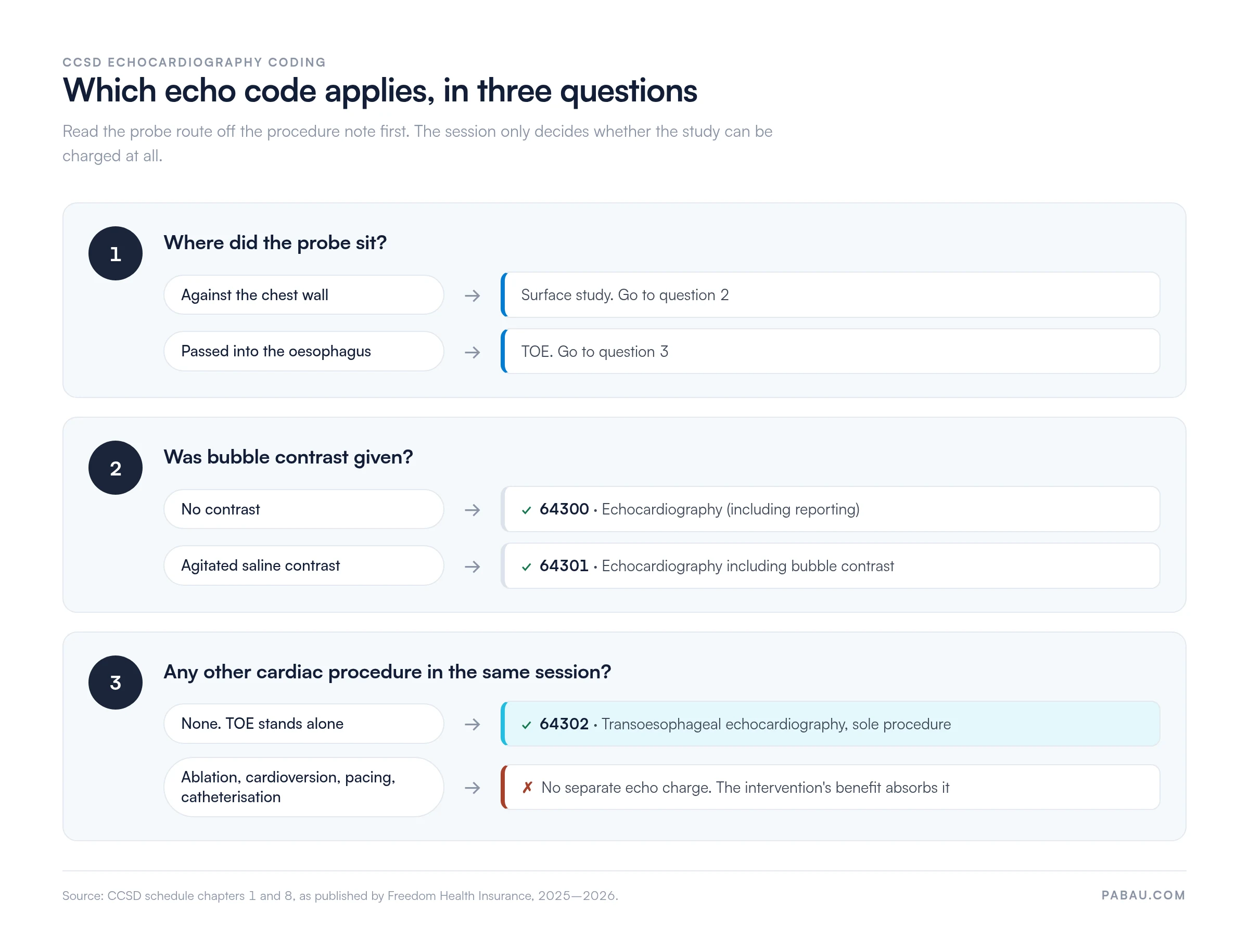
Neither code has a “with another procedure” variant, and nothing else in the schedule covers TOE alongside a cardiac intervention. Concurrency is handled by the combination and unbundling rules attached to 64302 itself.
AXA Health’s June 2018 notification of schedule changes added eight cardiac codes to the unbundling list for 64302:
Where one of those procedures happens in the same session, 64302 is not separately chargeable. Freedom Health Insurance’s Chapter 8 schedule states the wider principle plainly. Transoesophageal echocardiography “should not be charged in addition to any valve-related procedures”.
Each insurer keeps its own combination rules, and those lists get revised. So before adding 64302 to a claim that already carries an intervention, check the current rules for the insurer you are billing.
CCSD does not keep the echo codes in one block. Three sit together in the 643xx range, while stress echo sits with the investigations codes. A coder scanning only the neighbouring numbers will miss it.
Descriptors and rules change between editions, so confirm anything borderline against the current schedule. Our full CCSD code list covers the other codes a cardiology practice bills regularly.
File the echo report against the invoice when you bill, not when the insurer asks for it. Reporting is already paid for inside 64302, so a claim with no report on file is the one an auditor pulls first. A shared folder that nobody maintains is not a filing system.
A 64302 claim passes through five stages, and four of them happen before the invoice leaves the practice. Most rejections trace back to one of those four.
Consultant recognition sits underneath all five stages. An unrecognised consultant gets declined whatever the code says, so review recognition with each insurer at least once a year. Bupa CCSD codes sets out how one insurer applies the schedule, and individual codes can be checked through the Bupa code search portal.
Run these five lines before the invoice goes out. Each one maps to a denial reason further down this page.
A correct code still fails when the record behind it is thin. The British Society of Echocardiography sets the reporting standard, which asks for structured findings, measurements and a clear clinical conclusion. Insurers then add their own requirements on top.
Digital, time-stamped forms make this easier than paper ever did. When an insurer audits an episode, the date a consent was signed matters as much as the signature on it.
Denials cluster around six errors, and a short pre-submission check catches most of them. Roughly in order of how often they turn up:
Sedation sits outside the 64302 fee, so it can be billed separately when it is handled correctly. Who gave it, and which insurer is being billed, decide how.
Sedation cover does not transfer between insurers. A Bupa patient and a Vitality patient on the same list can sit under different rules on the same day.
Give your billing team a three-question sedation test. Was sedation given? Who administered it? Does this insurer cover sedation separately for TOE? Three answers before submission prevent most sedation-related denials, and they take about a minute to collect.
CCSD places 64302 in the Intermediate complexity band, and that banding drives the anaesthetist benefit on most schedules. The amounts still differ by insurer, because each one sets its own benefit on top of the shared code.
Across UK schedules published in 2025 and 2026, the procedure benefit for 64302 sits between roughly £290 and £350. The anaesthetist benefit runs from about £150 to £215. Freedom Health Insurance’s Chapter 8 schedule lists £320 for the specialist and £213 for the anaesthetist. Allianz Care’s UK recognition schedule lists the same £320 with a £150 anaesthetist fee.
Quote a fee to an insured patient only after confirming the benefit with their insurer. Where the benefit falls short of the practice fee, tell the patient about the shortfall in writing before the procedure is booked.
Cardiology teams billing several insurers keep the same details in three places. The patient record holds one copy, the invoice a second, and the insurer’s portal a third. Every rekeying step is a chance for a date, a policy number or a code to drift.
Practice management software like Pabau closes that loop. Insurer and policy details live on the patient record, so whoever raises a 64302 invoice can see who is being billed before they start. That is what makes claims management without rekeying workable for a small billing team.
For a private cardiology practice, these are the parts that save the most administrative time:
None of this replaces a coder’s judgment on the probe route. It removes the retyping around that judgment, which is where the administrative denials come from.

Pabau keeps insurer details on the patient record, checks claims for missing information, and files them to Healthcode without leaving the system. Your billing team stops retyping and starts chasing fewer rejections.

64302 turns on one line in the procedure note. If the probe went into the oesophagus, and nothing else cardiac happened that session, the code is right. Read that line first and the rest of the claim follows from it.
The claims that fail rarely fail on the code. They fail on an authorisation that expired, a report nobody filed, or a second line added to an intervention that already covered the study. A five-line check before submission removes most of them.
Build those checks into the billing workflow rather than into one person’s memory. Book a demo to see how Pabau handles CCSD claims for cardiology and other private practice specialties.

Want to see how one insurer applies the CCSD schedule? Bupa CCSD procedure codes covers recognition requirements and the coding issues that come up most.
Need the published benefit behind a code? Bupa procedure fee schedules shows how a benefit schedule maps onto CCSD codes for private consultants.
Chasing a rejection you cannot explain? Denial codes in medical billing decodes the reason codes insurers return and what to do about each one.
No. CCSD codes are used for private medical insurance billing in the UK. NHS activity is coded with OPCS-4 and paid through the national tariff, so a TOE performed on the NHS never carries a CCSD code.
The one that matches the indication written before the procedure. Atrial fibrillation claims usually carry I48, and suspected infective endocarditis carries I33.0. Use the pre-procedure indication rather than the finding the report describes afterwards.
CPT 93312 is the closest match. It covers transoesophageal echocardiography including probe placement, image acquisition, interpretation and report. The two systems are separate, so a CPT number never belongs on a UK private claim.
Only with its own indication and its own authorisation. Insurers query a repeat 64302 inside one admission, so the notes have to say why the first study did not answer the clinical question.
It is revised periodically, and insurers publish their own change notifications alongside it. AXA Health’s June 2018 update to code combinations is one example. Check the edition date before quoting a descriptor or a bundling rule.



