CPT code 36600: Arterial puncture billing guide
CPT code 36600: definition and procedure overview CPT code 36600 is classified u...

Last Updated: Oct 15, 2026
G3800 is the CCSD code for open operations on stomach not elsewhere classified. It covers open, laparotomy-based stomach procedures that have no dedicated code in the CCSD stomach section, such as gastric fixation for volvulus or gastric devascularization.
G3800 sits in Chapter 11, Abdomen, under section 11.2 Stomach. Gastrectomy, gastrostomy, gastrojejunostomy and pyloric procedures each carry their own codes. Laparoscopic and endoscopic approaches never fall under G3800.
Let Pabau's smart automation suggest the right codes, reduce claim denials, and keep your practice compliant—effortlessly.
Automate repetitive tasks and focus on what matters most—your patients.
Reduce coding errors and ensure compliance with the latest regulations.
Clean claims, fewer denials, and faster reimbursements.
Powerful insights and reporting to help your practice thrive.
HIPAA compliant SOC 2 certified GDPR-compliant Trusted by 4,000+ clinics worldwide

CCSD code G3800 applies only to open stomach operations that have no dedicated code in section 11.2 Stomach of the CCSD schedule.
Gastrectomy (G2710, G2800, G2810), gastrostomy (G3400) and gastrojejunostomy (G3210) have their own codes, so G3800 is never the default.
The operative note must record the incision, the exact act performed on the stomach, and any reconstruction to support the claim.
Most UK private insurers require pre-authorization for elective open stomach surgery, and a missing authorization number is a leading denial cause.
Pabau, the practice management platform we build, checks for authorization codes before a claim is sent to Healthcode.
CCSD code G3800 is the procedure code for open operations on stomach not elsewhere classified (NEC). The CCSD schedule places it in Chapter 11, Abdomen (excluding urinary and reproductive organs), under section 11.2 Stomach.
G3800 is the residual code of that section. It covers an open stomach procedure only when no other code describes it. Gastrectomy, gastrostomy, gastrojejunostomy and pyloric surgery sit in the same section with codes of their own. Our CCSD codes reference shows how the rest of the schedule is organized.
Because G3800 carries the NEC qualifier, it is never a first-choice code. The coder or consultant first checks whether the procedure has its own code in section 11.2. G3800 applies only when none fits. Submitting it for a procedure with a dedicated code is a common denial trigger with UK private medical insurers.
The phrase “not elsewhere classified” is a formal CCSD qualifier with a strict meaning. G3800 applies only when no other code in the CCSD schedule precisely describes the open stomach procedure performed.
The coder confirms two points from the operative report first. The approach was open, through a laparotomy, and no dedicated CCSD code captures the procedure.
Open stomach surgery uses a laparotomy incision, typically midline or upper transverse, giving direct access to the stomach. Laparoscopic, robotic and endoscopic approaches are coded separately and never fall under G3800.
Procedures that may fall under G3800, when no more specific code applies, include:
Revision of a gastrojejunostomy, for example, has its own code (G3220), so it never reaches G3800. The test is always the same. Did the surgeon reach the stomach through an open incision, and does a more specific code describe this exact intervention?
Choosing the right code depends on knowing which stomach procedures already have a dedicated CCSD code. The table below maps common stomach procedures against section 11.2.
Practical rule: Before submitting G3800, check section 11.2 of the current CCSD schedule for a code that describes the operation more specifically. The CCSD Technical Guide (October 2025) sets out the business rules for code selection, including how to apply NEC codes. The decision path below puts those checks in order.
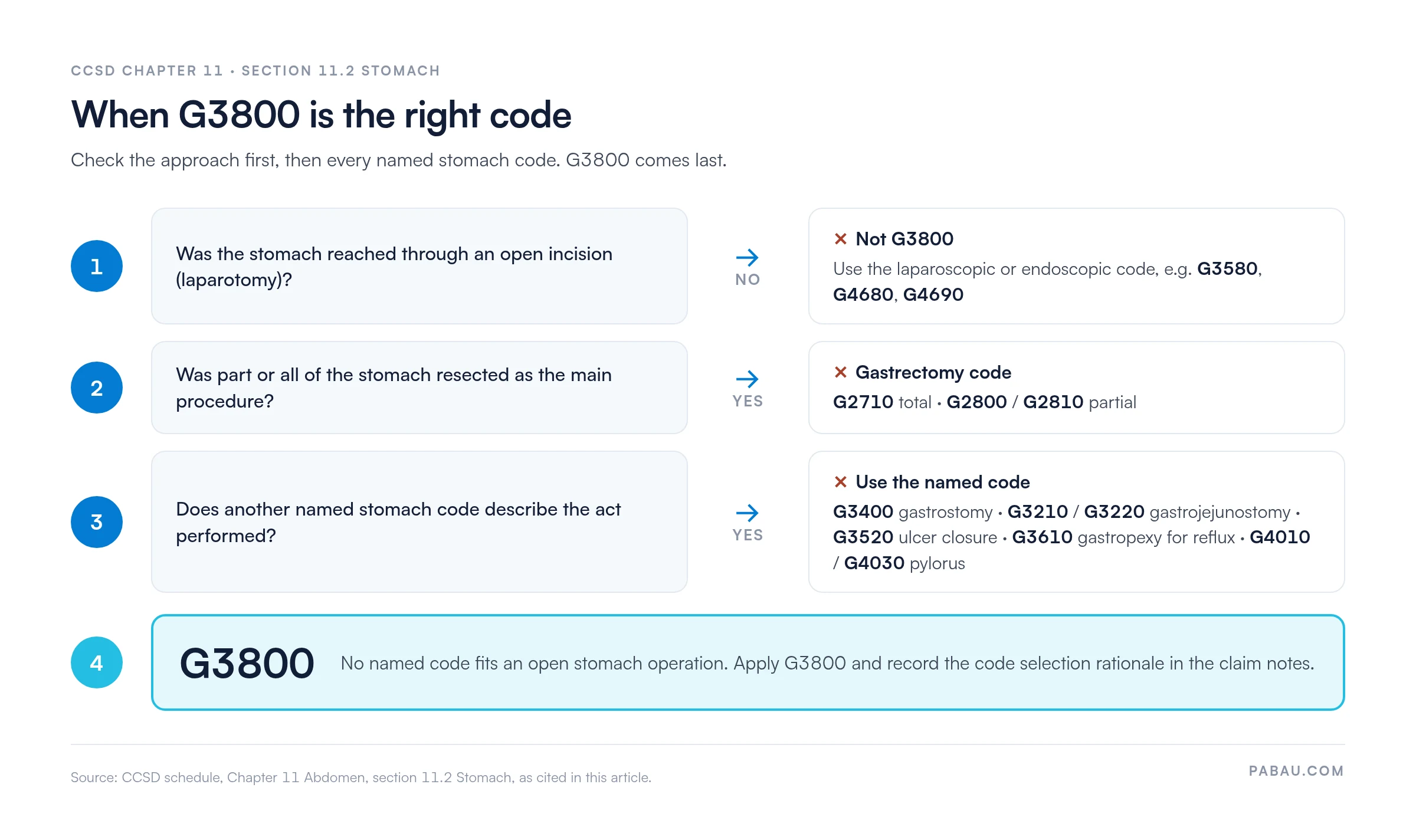
Every open stomach operation billed under G3800 begins with a laparotomy. The surgeon reaches the peritoneal cavity through a midline or subcostal incision. What follows decides whether G3800 is right or whether a more specific code exists.
The coding implication is direct. If the operative note lacks the detail to show that no dedicated code exists, the insurer can’t confirm G3800 is correct. A note that reads “open exploration of stomach” without naming the surgical act is a frequent source of G3800 denials.
Section 11.2 Stomach holds the named codes for open stomach operations, and G3800 is its residual code. In the schedule’s numbering, G3800 is followed directly by G4010 for pyloromyotomy. The table below shows how G3800 relates to nearby codes, so coders can pick the right one before submission.
G3800 vs G3610: These two are easy to confuse, because both can describe fixing the stomach in place. G3610 names reflux as the indication. Gastric fixation for another reason, such as volvulus, has no named code, so it falls to G3800. Check the indication in the operative report before selecting either code.
Nerve and duodenal procedures carry their own codes too. A highly selective vagotomy is billed as A2730, and open excision of a duodenal lesion as G5000.
Always review section 11.2 of the current CCSD schedule before defaulting to G3800. Search the CCSD coder tool for the procedure name used in the operative note. If nothing matches, confirm the approach was open, apply G3800, and record your code selection rationale in the claim notes.
Because G3800 is a residual NEC code, UK private insurers scrutinize it more closely than a named procedure code. Complete documentation is the main defense against denial.
The operative note must contain each item below for a G3800 claim to stand up to insurer review. Surgical teams using claims management software can build this checklist into the post-operative workflow.
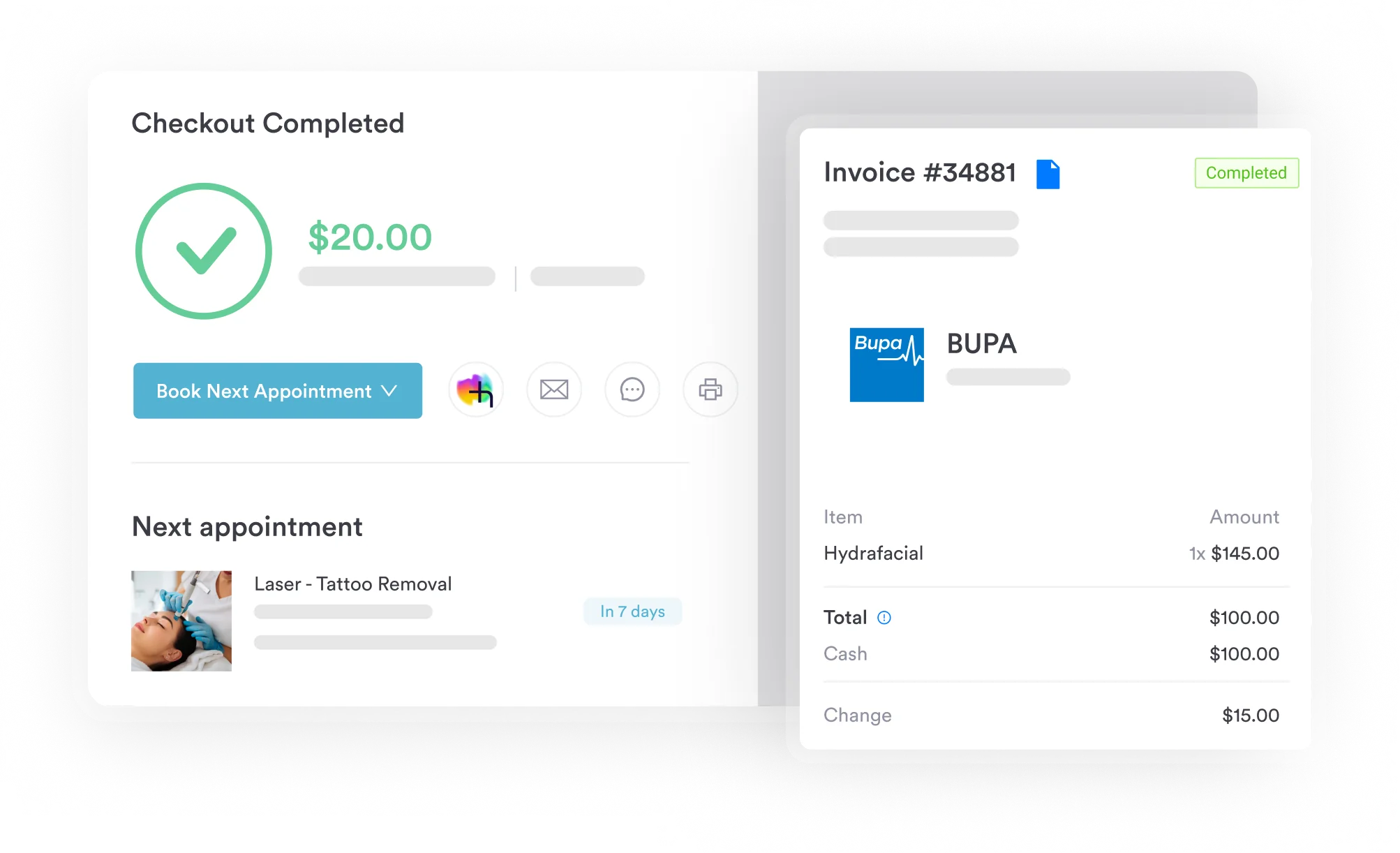
Digital operative documentation that captures each field the same way every time cuts claim preparation time and the risk of an insurer audit request. Claims go to insurers electronically through Healthcode. Its mandatory fields mirror the list above, but the free-text operative note is where the substance lives.
UK private medical insurers treat open stomach surgery as a major inpatient procedure. Most require pre-authorization before the operation, particularly for elective cases. Rules vary by payer and policy type, so treat the table below as general guidance and confirm with each insurer before surgery.
Emergency open stomach surgery, for example for acute gastric volvulus or perforation, is typically authorized retrospectively.
Retrospective authorization depends on an operative note that clearly documents the emergency clinical indication. Building payer-specific pre-authorization steps into the booking process prevents last-minute claim issues.
G3800 carries a higher denial risk than named procedure codes because it is a residual NEC code. Insurers can’t verify it from the code alone, so they rely on the documentation submitted. The most frequent denial causes are:
Resolving a G3800 denial starts with the consultant surgeon reviewing the operative note and the code selection. If the code was right but the documentation thin, submit a supplementary operative summary with the appeal. If a more specific code applied, submit a corrected claim instead.
Open stomach surgery is a major inpatient procedure. Billing G3800 alongside anesthesia and assistant surgeon codes is standard in UK private healthcare. Each clinician bills only their own part of the care.
Each insurer sets its own co-billing rules, and our guide to Bupa CCSD codes covers how the largest UK insurer handles them.
Practice billing teams should confirm co-billing arrangements with each insurer at the pre-authorization stage. Some insurers set assistant surgeon fee limits in the authorization letter, and recording them upfront prevents post-operative fee disputes.
The denial causes above share a pattern. The details a G3800 claim needs sit in different places, and someone re-keys them at billing time. The authorization number lives in an email, the diagnosis in a referral letter, and the operative note in another system.
In Pabau, the practice management platform we build, the patient’s insurer and policy sit on the patient record. When the invoice is ready, Pabau pulls the patient, treatment and insurer details into a pre-filled claim. You review it and send it straight to Healthcode.
Validation checks run before each claim goes out. If a membership number or authorization code is missing, the Send button stays disabled until someone adds it. Each claim then moves through clear stages, from pending to paid, so your team sees which G3800 claims need attention.

Pabau checks for authorization codes and membership numbers before each claim goes to Healthcode. Insurer details come straight from the patient record, so your team stops re-keying them.

Treat G3800 as the last code you reach for. Work through section 11.2 for a named code, confirm the approach was open, and only then apply the NEC code.
The trade-off is scrutiny. An NEC code invites insurer review, so the claim stands or falls on the operative note, a matching diagnosis code and the authorization number. Get those three right before submission, and most of the denial causes above no longer apply.
Book a demo to see how Pabau checks authorization details before your G3800 claims reach Healthcode.

Reconstructing with a stomach pull-up? CCSD code E2140 explains how stomach pull-up reconstruction after pharyngolaryngectomy is coded.
CCSD code G3800 is the procedure code for open operations on stomach not elsewhere classified (NEC). UK private practices use it when no more specific code in the CCSD stomach section describes the open procedure performed.
NEC stands for “not elsewhere classified.” In the CCSD schedule, an NEC code applies only when no more specific code describes the procedure performed. For G3800, the coder must first confirm the open stomach operation has no dedicated code in section 11.2.
Yes, most UK private medical insurers require pre-authorization for elective open stomach surgery billed under G3800. Bupa, AXA Health, Aviva and Vitality Health all expect prior approval for surgical admissions. Genuine emergencies, such as acute gastric volvulus, are usually authorized retrospectively.
The most frequent causes are a more specific code existing for the procedure and missing pre-authorization. Insurers also deny G3800 for an operative note that doesn’t justify the NEC selection, or a diagnosis code that doesn’t support open surgery.
G3800 is an open, laparotomy-based surgery code only. Laparoscopic stomach operations have their own codes, such as G3580 for laparoscopic closure of a peptic ulcer. If the operative note documents a laparoscopic approach, G3800 is the wrong code.
Yes. The anesthetist submits a separate claim using the relevant CCSD anesthesia code, and the consultant surgeon submits G3800 for the surgical fee. The insurer processes the two claims independently.