CPT Code 62284: Injection procedure for myelography
CPT Code 62284: official descriptor and procedure overview The American Medical ...

Last Updated: Oct 19, 2026
A2600 is the CCSD code for other intracranial destruction of cranial nerve. UK private medical insurers and hospitals use it for a procedure that permanently destroys a named cranial nerve from inside the skull.
It covers radiofrequency thermocoagulation, glycerol rhizolysis, balloon microcompression and open or chemical neurolysis, most often for trigeminal neuralgia. A2600 applies only when no more specific CCSD code names the technique. A nerve that is surgically cut is coded A2500 instead.
Let Pabau's smart automation suggest the right codes, reduce claim denials, and keep your practice compliant—effortlessly.
Automate repetitive tasks and focus on what matters most—your patients.
Reduce coding errors and ensure compliance with the latest regulations.
Clean claims, fewer denials, and faster reimbursements.
Powerful insights and reporting to help your practice thrive.
HIPAA compliant SOC 2 certified GDPR-compliant Trusted by 4,000+ clinics worldwide

CCSD A2600 is a UK private medical insurance code for intracranial cranial nerve destruction only. The surgical approach must be inside the skull.
Trigeminal neuralgia is the leading indication. Each claim needs a supporting ICD-10 diagnosis code from the current edition.
An operative report naming the specific cranial nerve, technique and approach is mandatory. Missing this detail is the top denial trigger.
Practice management software like Pabau helps neurosurgery practices track documentation and flag a missing pre-authorization number before a claim reaches the insurer.
CCSD code A2600 is the UK private-sector code for “other intracranial destruction of cranial nerve” within the neurosurgical section of the CCSD schedule. It captures procedures where a cranial nerve is permanently ablated, destroyed, or rendered non-functional using a technique applied inside the skull.
The word “other” in the descriptor separates A2600 from CCSD codes that name a specific technique or a specific nerve. It is the catch-all code for intracranial cranial nerve destruction that no more precise neighboring code describes.
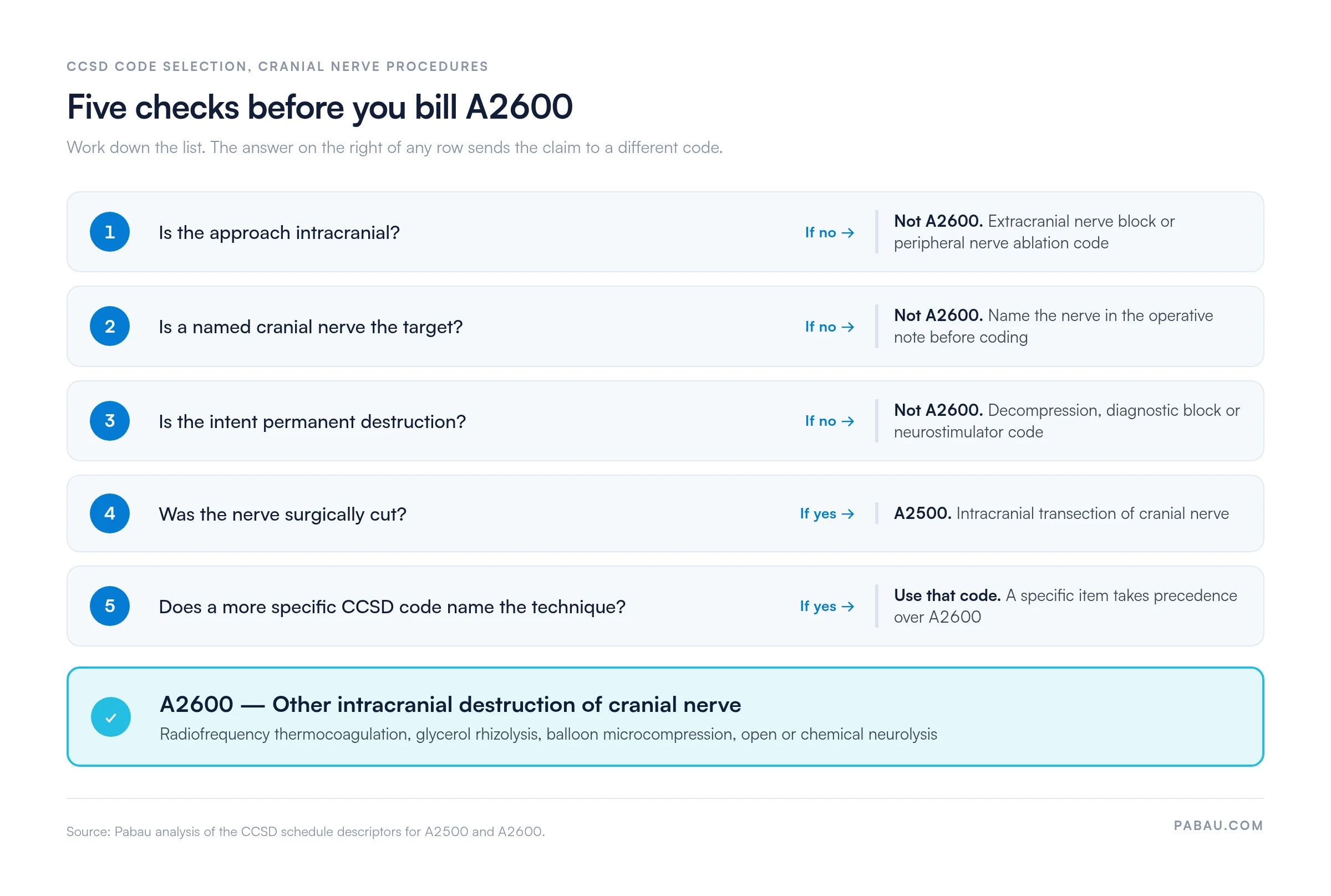
Three criteria must all be satisfied before A2600 is the correct code. The procedure must be (1) intracranial in approach, (2) targeted at a cranial nerve, and (3) destructive in intent. Destructive means it aims to interrupt nerve function permanently rather than block it temporarily.
A peripheral injection lateral to the skull base does not satisfy criterion 1. A cranial nerve block, however close to the foramen, does not satisfy criterion 3. A microvascular decompression moves the offending vessel without destroying the nerve and fails criterion 3 as well. The checklist below runs these tests in order, then adds the two neighboring-code checks.
For practices new to the CCSD schedule, A2600 sits in chapter 2, which covers the brain, cranium and other intracranial organs. The schedule is maintained by the CCSD Group, whose insurer members are Bupa, AXA Health, Aviva and Vitality. It is updated periodically, so verify the current chapter numbering and any attached notes before billing.
Other intracranial destruction of cranial nerve encompasses several distinct surgical approaches, all sharing the common end-point of permanent cranial nerve ablation within the intracranial compartment.
The nerves most often targeted in A2600 claims are the trigeminal nerve (cranial nerve V) and the glossopharyngeal nerve (cranial nerve IX). Less commonly, the facial nerve (cranial nerve VII) is treated for certain spastic conditions. The neurosurgeon’s operative report must name the specific cranial nerve targeted, which matters both for coding accuracy and for payer scrutiny.
The accepted clinical indications for procedures billed under CCSD code A2600 all involve refractory pain or motor conditions where nerve-preserving or pharmacological options have failed.
Each A2600 claim needs one of these diagnoses to support the procedure, and the pairing rules are set out in the ICD-10 section below.
The most common coding error with A2600 is selecting a neighboring code for a procedure that qualifies under A2600, or vice versa. The key differentiators are approach (intracranial vs extracranial), intent (destruction vs decompression vs stimulation), and specificity (named technique vs “other”).
The A2500 vs A2600 distinction deserves particular attention. A2500 applies when the surgeon cuts the nerve, for example a sensory rhizotomy performed through a posterior fossa craniotomy. A2600 covers destruction by other means, such as heat, glycerol, balloon compression or a chemical agent.
Billing A2600 for a documented transection, or A2500 for a thermal lesion, is a coding error and a common audit flag.
Knowing which techniques fall inside and outside A2600’s scope prevents two costly errors. One is using A2600 where a more specific code applies, and the other is coding a peripheral approach as intracranial destruction.
All five techniques described in the clinical overview fall within A2600’s scope. They are radiofrequency thermocoagulation, glycerol rhizolysis, balloon microcompression, open neurolysis via craniotomy and intracranial chemical neurolysis. Each qualifies only when the operative note ties it to an intracranial target on a named cranial nerve.
Two of those exclusions have a named CCSD item of their own. Microvascular decompression through a craniotomy is billed as A3200. Radiofrequency, cryoprobe or phenol destruction of a named peripheral nerve falls to A7300. A trigeminal branch is the exception, since its destruction by neurolytic injection, radiofrequency or cryoprobe is billed under CCSD code AA460.
An operative or procedure report is mandatory for every A2600 claim. Without it, no UK private medical insurer will process the claim. The report must contain specific elements that confirm all three coding criteria are met.
Practices using digital procedure documentation can build structured operative note templates that prompt surgeons to capture every required field. That lowers the chance of a missing element triggering a denial. The difference between a compliant note and a rejected claim often comes down to one phrase.

Build an operative note template for A2600 with six mandatory fields. They are cranial nerve name, approach, technique, temperature or chemical agent, imaging guidance and principal diagnosis. A neurosurgeon who completes all six fields every time will generate near-zero documentation-related denials for this item.
CCSD codes are used by UK private medical insurers and the private hospitals that bill them, not by the NHS. A2600 is usually a day case or short inpatient stay, so the hospital invoices the facility fee and the consultant invoices the professional fee. Both invoices carry the same CCSD code and pre-authorization number.
Bupa, AXA Health, Aviva and Vitality treat complex intracranial neurosurgery as a pre-authorization item. WPA and the corporate schemes Healix administers follow the same pattern. Requirements vary by insurer and by policy year. As a general rule for A2600 claims:
If the consultant’s fee is above the insurer’s published benefit for the code, the patient pays the shortfall. Tell the patient about any shortfall in writing before surgery, so it does not surface as a dispute after the invoice. Our guide to Bupa CCSD codes explains how Bupa sets and pays its benefit for each item.
A claim that reaches the insurer without its pre-authorization number is a straightforward denial. Practices billing several insurers avoid it with one rule: No claim leaves until the reference number from the insurer is on the patient file.
Complex neurosurgical codes are denied often relative to their claim volume. Each claim needs documentation that most billing systems do not check before submission. These are the denial reasons that appear most often on A2600 claims, and how to prevent each one.
Most of these denials trace back to the operative note or the pre-authorization request, not the code itself. For a broader view of denial categories, see our guide to denial codes for coders.
A2600 does not stand alone on most claims. Understanding which co-billed items are permissible and which trigger an unbundling flag is essential for clean claim submission.
Insurers apply their own bundling rules on top of the CCSD schedule, and those rules differ between Bupa, AXA Health, Aviva and Vitality. Check the insurer’s guidance before submitting any second code on the same A2600 claim.
Every A2600 claim requires at least one ICD-10 diagnosis code that supports the clinical indication for the procedure. Insurer systems check the diagnosis code against the procedure code, and a mismatch generates an automatic rejection before the claim reaches manual review.
ICD-10 is revised periodically, and UK private insurers expect codes from the current edition. Coders using a superseded edition risk submitting a code that has been retired or split into more specific entries. The table above lists commonly referenced entries, but always verify them against the current edition before submission.
Insurers expect the same specificity on every neurological procedure claim, so managing these code updates belongs in the billing workflow. Practice management tools that link to current code libraries reduce the risk of submitting outdated diagnosis entries.
Set a calendar reminder each year to review your ICD-10 code list for cranial nerve diagnoses against the latest edition. Trigeminal neuralgia (G50.0) has remained stable, but check the codes around it too. A 30-minute annual code audit prevents a year of avoidable automatic denials.
Without a shared system, A2600 paperwork gets chased at invoice time. The pre-authorization number sits in one inbox, the operative note in another system and the diagnosis code on a separate form.
Practice management software like Pabau keeps the patient, insurer and treatment details on one record. Its claims software for specialists pre-fills the Healthcode submission from that record. It also checks that the membership number and authorization code are in place before the claim goes out.
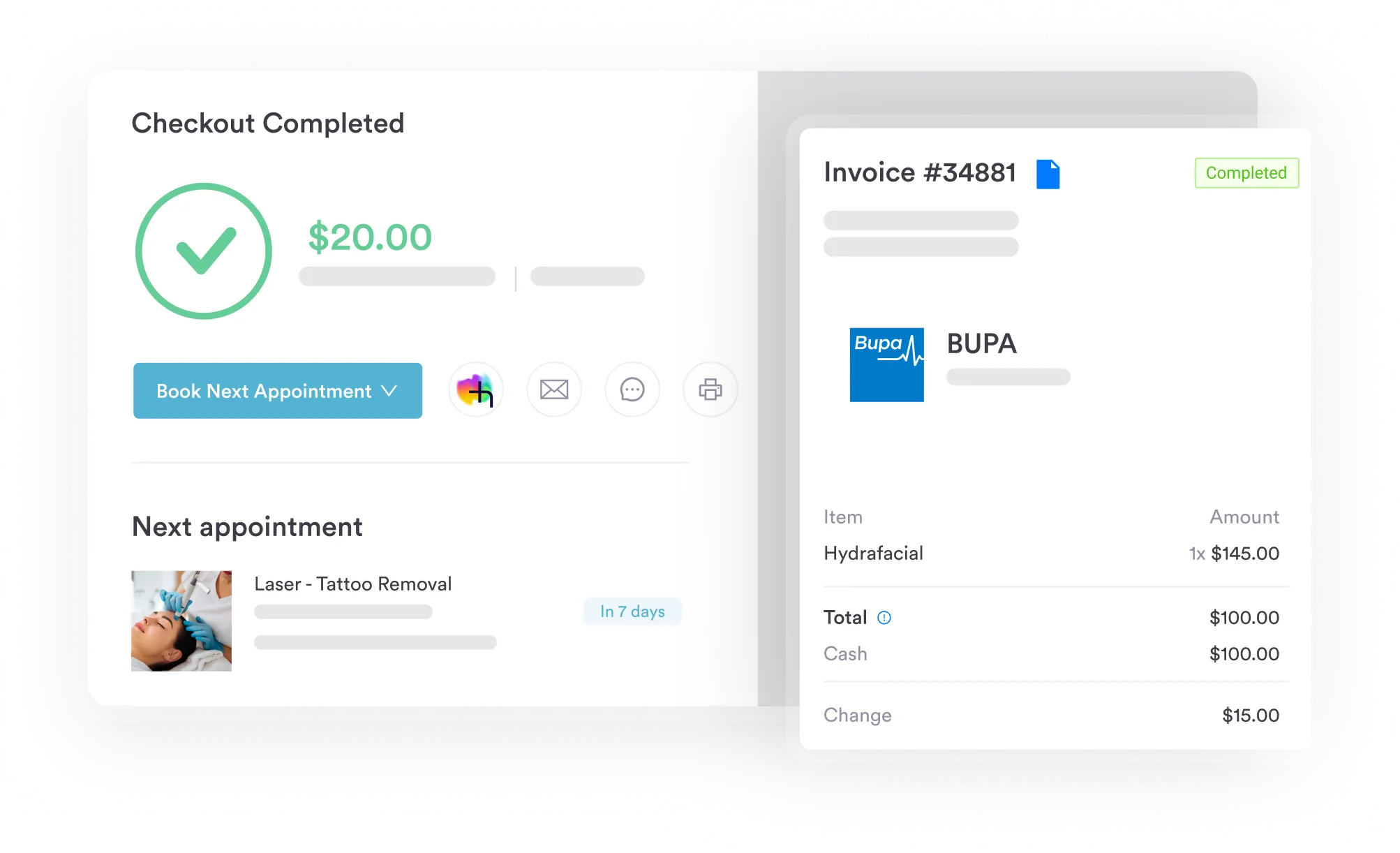
Each claim then moves through clear stages, from submitted to paid or rejected, in a single view. Your billing team sees a rejected A2600 claim the day it happens, while there is still time to add the missing detail and resubmit.

Pabau pre-fills Healthcode claims from the patient record, checks that pre-authorization codes are in place, and tracks each claim from submission to payment.

CCSD code A2600 is a high-value, documentation-sensitive item where the margin for coding error is narrow. The intracranial approach criterion is non-negotiable: Any procedure performed extracranially does not qualify, regardless of how close to the skull base the injection occurs.
A complete operative report naming the specific cranial nerve, approach, and technique is the single most effective denial prevention measure available.
Settle the choice between A2600 and A2500 at the pre-authorization stage, when the operative note can still be written to the descriptor. Book a demo to see how Pabau keeps authorization codes, operative notes and claim status on one record for your UK private insurer claims.

Need to understand how Bupa applies CCSD codes to your claims? Bupa CCSD codes and fee schedule covers how Bupa interprets and reimburses CCSD procedure items for specialist practices.
Want to reduce denied claims across your billing workflow? Common denial codes in medical billing explains the most frequent denial code categories and how to prevent them at submission.
Looking for a broader compliance framework for your specialist practice? Medical billing compliance covers the documentation, audit, and process standards that underpin clean claim rates in UK private practice billing.
Coding a repair rather than a destruction? CCSD code A3000 covers intracranial repair of a cranial nerve, the neighboring item in the same chapter.
Choosing a billing system for UK private practice? Best medical billing software in the UK compares the platforms that submit claims to UK private medical insurers.
CCSD code A2600 covers other intracranial destruction of cranial nerve. It applies to any procedure that permanently destroys a cranial nerve via an intracranial approach, when no more specific CCSD code exists for the technique. Qualifying techniques include percutaneous radiofrequency thermocoagulation, glycerol rhizolysis, balloon microcompression, and open intracranial neurolysis. Peripheral cranial nerve blocks and microvascular decompression are excluded.
A cranial nerve block uses a temporary local anesthetic injected at or near the nerve, usually extracranially, to provide short-term pain relief. A2600 requires a destructive intracranial procedure aimed at permanently interrupting nerve function. The distinctions are approach (intracranial vs extracranial), duration of effect (permanent vs temporary), and intent (destruction vs anesthesia). Billing A2600 for a temporary cranial nerve block would constitute incorrect coding.
Percutaneous radiofrequency thermocoagulation of the trigeminal ganglion via the foramen ovale usually falls within A2600. That holds when no more specific CCSD code exists for the technique. Coders should first check whether CCSD has introduced a dedicated item for percutaneous trigeminal radiofrequency rhizotomy. If a specific item exists, it takes precedence over A2600. Radiofrequency ablation of a peripheral trigeminal branch outside the skull does not qualify for A2600.
The operative or procedure report must name and number the cranial nerve targeted and confirm the approach as intracranial. It must also state the technique used (radiofrequency, glycerol, balloon, or open neurolysis), reference any imaging guidance, and link the procedure to the clinical indication. Missing any of these elements is the leading cause of A2600 claim denials. UK private medical insurers such as Bupa and AXA Health also require a pre-authorization number obtained before the procedure date.
Yes, in most cases. Bupa, AXA Health, Aviva and Vitality treat complex intracranial neurosurgery as a pre-authorization item, and A2600 falls into that category. The request should include the CCSD code, the ICD-10 diagnosis code and a consultant letter with a brief clinical summary. Retrospective authorization is rarely granted for elective procedures. Requirements vary by insurer and policy, so check with each insurer before the procedure date.
No. An operative report that refers only to “cranial nerve” without identifying which nerve is insufficient for A2600 billing. Insurers require the nerve to be named because A2600 always targets a defined anatomical structure. Without that detail, the insurer cannot confirm the procedure meets the code criteria. The coder should request an addendum to the operative note from the surgeon before submitting the claim.