

CPT Code 98981: RTM Treatment Management Billing Guide
CPT code 98981: Definition and official descriptor CPT code 98981 is an add-on c...

Last Updated: Nov 9, 2026
A2220 is the CCSD code for puncture of cistern of brain. It covers a needle puncture of a subarachnoid cistern, usually the cisterna magna, to sample cerebrospinal fluid, measure pressure or inject contrast.
The code sits in chapter 2 of the CCSD schedule, Brain, cranium and other intracranial organs. UK private medical insurers use that schedule to identify procedures on claims. Lumbar puncture (A5530) and ventricular puncture (A2080) take different codes.
Let Pabau's smart automation suggest the right codes, reduce claim denials, and keep your practice compliant—effortlessly.
Automate repetitive tasks and focus on what matters most—your patients.
Reduce coding errors and ensure compliance with the latest regulations.
Clean claims, fewer denials, and faster reimbursements.
Powerful insights and reporting to help your practice thrive.
HIPAA compliant SOC 2 certified GDPR-compliant Trusted by 4,000+ clinics worldwide

CCSD code A2220 covers puncture of cistern of brain, a needle into a subarachnoid cistern, usually the cisterna magna.
UK private medical insurers such as Bupa, AXA Health and Aviva use the CCSD schedule, but each insurer sets its own fee.
Lumbar puncture (A5530) and ventricular puncture (A2080) have their own codes, so the access site in the note decides the code.
The procedure note must say why the cisternal route was used, because reviewers expect a lumbar puncture as the default.
CCSD code A2220 carries the descriptor “Puncture of cistern of brain.”
It is one of the CCSD codes in chapter 2 of the procedure schedule, Brain, cranium and other intracranial organs, where codes start with A.
CCSD stands for Clinical Coding and Schedule Development. The group was formed to improve coding standards in UK private healthcare, and major private medical insurers sit on it. Insurers such as Bupa, AXA Health, Aviva and The Exeter use its schedule to identify what a consultant did.
The CCSD Technical Guide explains how codes are built and combined. It also makes clear that CCSD publishes no fees. The complexity band and the fee attached to A2220 are for each insurer to decide.
Three points define the billing scope of A2220:
Puncture of the cistern of the brain usually targets the cisterna magna. It is the largest subarachnoid cistern, lying between the underside of the cerebellum and the back of the medulla oblongata.
The standard route is suboccipital. The needle enters in the midline between the occipital bone and the posterior arch of the atlas, with the neck flexed.
Cisternal puncture carries more risk than lumbar puncture, because the needle passes close to the brainstem and posterior fossa vessels. That is why insurer reviewers look for a clinical reason the lumbar route was not used.
A2220 fits when CSF access is needed and lumbar puncture is unsuitable or has failed. The usual reasons are:
Record the indication in the procedure note. A note that describes the puncture but gives no reason for avoiding the lumbar route invites a query from the insurer.
Several CCSD codes sit close to A2220, and the access site in the note settles which one applies. The chart below maps each site to its code.
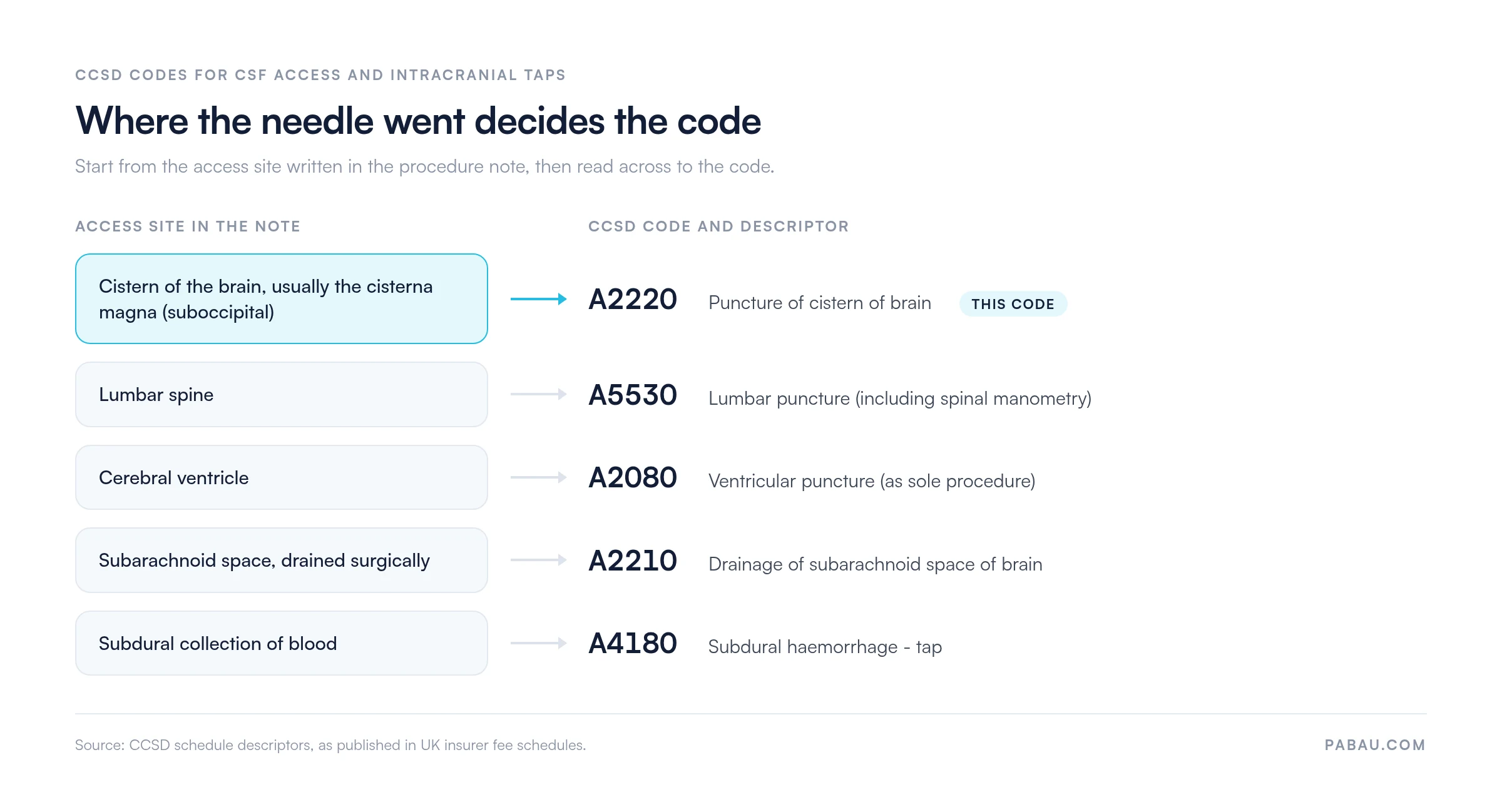
Name the access point in the note: “suboccipital” or “cisterna magna” for A2220, or the vertebral level for A5530. If a lumbar puncture failed and the cisternal route followed, say so. The table gives each code’s full descriptor and how it differs from A2220.
Sometimes a lumbar attempt and a cisternal puncture happen in one episode. Check the CCSD unacceptable-combination list and the insurer’s terms before billing both codes.
Before submitting an A2220 claim, check the note for three details. It should name the cistern, the approach, and what was collected, measured or injected. A note that stops at needle insertion gives a reviewer grounds for a query.
The CCSD unacceptable-combination rules and each insurer’s contract decide what can go on the same claim. Billing a part of the procedure as a separate line is a common reason for rejection.
The procedure note is the document that supports an A2220 claim. Insurer reviewers check that it describes the same procedure as the code and the invoice. The note should include:
UK insurers expect an ICD-10 diagnosis on the claim that matches the recorded indication. Pair the code with the reason for the puncture, not a later finding. Common pairings are below. Check each one against the WHO ICD-10 browser before submission.
UK private medical insurers generally expect pre-authorization before planned treatment. The patient usually calls their insurer for an authorization number before the procedure. The practice then puts that number on the invoice.
Each insurer runs its own process, so check its provider portal. The Bupa code search shows how Bupa treats a code. The Pabau Bupa CCSD codes guide covers what Bupa expects on a claim.
CCSD does not set fees. Each insurer publishes its own schedule, with its own complexity band and maximum benefit for each code. Fees differ between insurers and change between editions.
For example, The Exeter’s published fee schedule lists A2220 with a procedure maximum of £150 and an anesthetic maximum of £181. Bupa, AXA Health and Aviva each set their own figures. Check the schedule in force on the procedure date before you raise the invoice.
If the consultant charges more than the insurer’s maximum, the patient may have to pay the difference. Tell the patient about any shortfall before the procedure.
Keep a short code card for CSF access procedures at the booking desk. List A2220, A5530 and A2080 with the access site that separates each one. It stops the most common wrong-code rejection before the invoice is raised.
In many private practices, the authorization number sits in an email and the procedure note in another system. The invoice is then built by hand, which is how a missing GMC number or authorization slips through.
Pabau keeps the patient record, clinical notes, invoices and payments in one place. Your team records the authorization number, its dates and sessions on the patient’s case, and Pabau warns when one is missing. Its end-to-end claims management sends UK claims through Healthcode and Bupa, using the insurer list each one provides.
The result is fewer claims sent back for a missing detail, and a clear view of what each insurer still owes.

Pabau links authorizations, invoices, insurance claims and payments to the patient record, so each claim goes out with the details the insurer checks.

A2220 is a narrow code, so a claim that comes back usually lacks proof of which route was used and why. When the note names the cisterna magna and explains why a lumbar puncture was unsuitable, a reviewer has little left to query.
Do the checks before the procedure, not after a rejection. Confirm recognition and authorization, take the fee from the insurer’s own schedule, and match the diagnosis to the indication. Book a demo to see how Pabau ties authorizations, notes and claims to one patient record.

Billing CCSD codes for Bupa patients? Bupa CCSD procedure codes explains how to look up and submit codes for Bupa-recognized consultants.
Coding a lumbar puncture instead? CCSD code A5530 covers lumbar puncture, including spinal manometry.
Was the needle in a ventricle? CCSD code A2080 covers ventricular puncture as a sole procedure.
Draining the subarachnoid space surgically? CCSD code A2210 covers drainage of the subarachnoid space of the brain.
Tracking private insurance claims? Claims management software shows how Pabau handles UK insurance billing.
CCSD code A2220 covers puncture of cistern of brain. A needle enters a subarachnoid cistern, usually the cisterna magna, to sample CSF, measure pressure or inject contrast. It does not cover lumbar or ventricular puncture.
CCSD stands for Clinical Coding and Schedule Development. Its schedule of procedure codes is used by UK private medical insurers, such as Bupa, AXA Health and Aviva, to identify treatment on claims.
A2220 reaches CSF at a cistern of the brain, usually through a suboccipital approach. A lumbar puncture reaches CSF in the lower spine and is coded A5530. The access site in the note decides the code.
CCSD sets no fees, so each insurer publishes its own. The Exeter’s fee schedule, for example, lists a procedure maximum of £150 and an anesthetic maximum of £181. Check each insurer’s current schedule.
UK private medical insurers generally expect pre-authorization before planned treatment. Put the authorization number on the invoice. For an urgent procedure, tell the insurer as soon as practical.
Common reasons are a missing authorization number and a note that omits the cistern, approach or indication. Others are a lumbar or ventricular puncture billed as A2220, and a diagnosis that does not match the indication.




