CPT Code 69610: Tympanic membrane patch repair (myringoplasty)
CPT code 69610: official descriptor and procedure overview CPT code 69610 descri...

Last Updated: Oct 19, 2026
A5530 is the CCSD code for lumbar puncture (including spinal manometry). It covers the procedure from needle insertion at the L3/L4 or L4/L5 interspace through opening and closing pressure readings and CSF collection. Manometry is bundled into the code, so it is never billed as a separate item.
The code applies to diagnostic and therapeutic taps alike. CSF laboratory analysis is billed separately, and an intrathecal drug injection is coded under A5420 or A5480 instead. Bupa's February 2026 schedule grades A5530 as Minor 2.
Let Pabau's smart automation suggest the right codes, reduce claim denials, and keep your practice compliant—effortlessly.
Automate repetitive tasks and focus on what matters most—your patients.
Reduce coding errors and ensure compliance with the latest regulations.
Clean claims, fewer denials, and faster reimbursements.
Powerful insights and reporting to help your practice thrive.
HIPAA compliant SOC 2 certified GDPR-compliant Trusted by 4,000+ clinics worldwide

CCSD Code A5530 covers lumbar puncture including spinal manometry. Opening and closing pressure measurement is bundled into the code and never billed separately.
A5530 applies to diagnostic and therapeutic taps alike, as long as manometry is performed. The clinical purpose doesn’t change the code.
CSF laboratory analysis (cytology, biochemistry, microbiology) is coded separately and isn’t included in A5530.
A missing opening-pressure value in the procedure note is the most common reason A5530 claims are denied.
If a drug goes into the CSF, the claim moves to A5420 or A5480, and a pump implant or removal is A4850.
CCSD Code A5530 is the Clinical Coding and Schedule Development procedure code for lumbar puncture (including spinal manometry). It sits in Chapter 3 (Spine, Spinal Cord and Peripheral Nerves) of the CCSD schedule of procedures.
Its genuine Chapter 3 neighbors are A5420, the intrathecal injection code, and A5580, the CSF infusion study code. A5480 (intrathecal chemotherapy) is often coded alongside them, but it sits in Chapter 18 (Chemotherapy).
CCSD codes govern claims for privately insured patients, while NHS activity is paid through HRG/PbR tariffs. The two are parallel systems for different patient populations, and neither replaces the other. Our CCSD codes guide explains how the schedule’s chapters fit together.
The official descriptor is precise: “Lumbar puncture (including spinal manometry).” Two elements carry billing weight. First, the procedure is a lumbar puncture, usually performed at the L3/L4 or L4/L5 interspace.
Second, spinal manometry is written into the descriptor, so the pressure measurement is part of A5530 and can’t be billed as an extra service.
In England, independent hospitals that perform lumbar punctures are regulated by the Care Quality Commission (CQC), which expects complete clinical records. That expectation sits behind the documentation requirements later in this guide.
Lumbar puncture with spinal manometry follows a defined clinical sequence. The steps show why manometry is bundled rather than separately billable. It happens during the same needle insertion and is not a standalone intervention.
Fluoroscopy-guided lumbar puncture follows the same sequence. The radiologist may charge separately for the imaging guidance, but the proceduralist’s component remains A5530. The neurologist or neurosurgeon performing the LP bills A5530 for their work, whichever imaging method is used. A note that records each of the seven steps as it happens is what a clean claim is built on.
A5530 is appropriate whenever a lumbar puncture with spinal manometry is performed, regardless of the clinical purpose. The indication must appear in the procedure note to support the claim. Common indications include:
The list above is illustrative, not exhaustive. Clinicians should follow specialty guidance from the Association of British Neurologists (ABN) when deciding on the indication. The key billing point is that the indication must be documented. Without it, insurers can query or deny the claim at audit.
Yes, A5530 covers both diagnostic and therapeutic lumbar puncture, provided spinal manometry is performed. The CCSD descriptor does not restrict the code to diagnostic use. The billing element that decides the code is the pressure measurement, whatever the clinical purpose.
The LP may collect CSF for analysis or drain fluid to treat IIH. Either way, A5530 remains correct as long as opening and closing pressures are measured and documented.
This matters most in IIH management. Patients with IIH often need repeat therapeutic LPs, sometimes every few weeks during an acute episode. Each procedure is correctly billed as A5530, provided it includes manometry and is fully documented.
Insurers may query several LP claims in a short period. The record for each session should show the therapeutic intent, the volume of CSF removed, and both pressure readings. Notes kept to that standard protect the clinician and the patient when a query arrives.
The table below clarifies what is and is not bundled into A5530. Payer interpretation can vary, so check your insurer’s provider handbook before submitting.
Several CCSD codes involve a needle in the spinal canal, and they are easy to confuse. Picking the wrong one is a coding error that can trigger a denial or, with upcoding, a compliance concern. Confirm descriptor wording against the current CCSD technical guide before billing.
The most common error here is using A5530 when a drug goes into the CSF. Bupa’s 2026 schedule lists three separate codes for that work. A5420 covers a therapeutic substance injected into the CSF as the sole procedure, such as a one-off intrathecal baclofen dose. A5480 covers intrathecal chemotherapy, such as methotrexate for CNS lymphoma.
A4850 covers implanting or removing an intrathecal drug delivery system, such as a baclofen pump. A5540 isn’t an injection code at all. It’s the code for a spinal angiogram. The questions below settle the choice in the order a coder should ask them.
A spinal needle can also be used to destroy tissue rather than to sample fluid or deliver a drug. Percutaneous cordotomy sits under A4730, a radiofrequency lesion in the cervical cord for one-sided cancer pain.
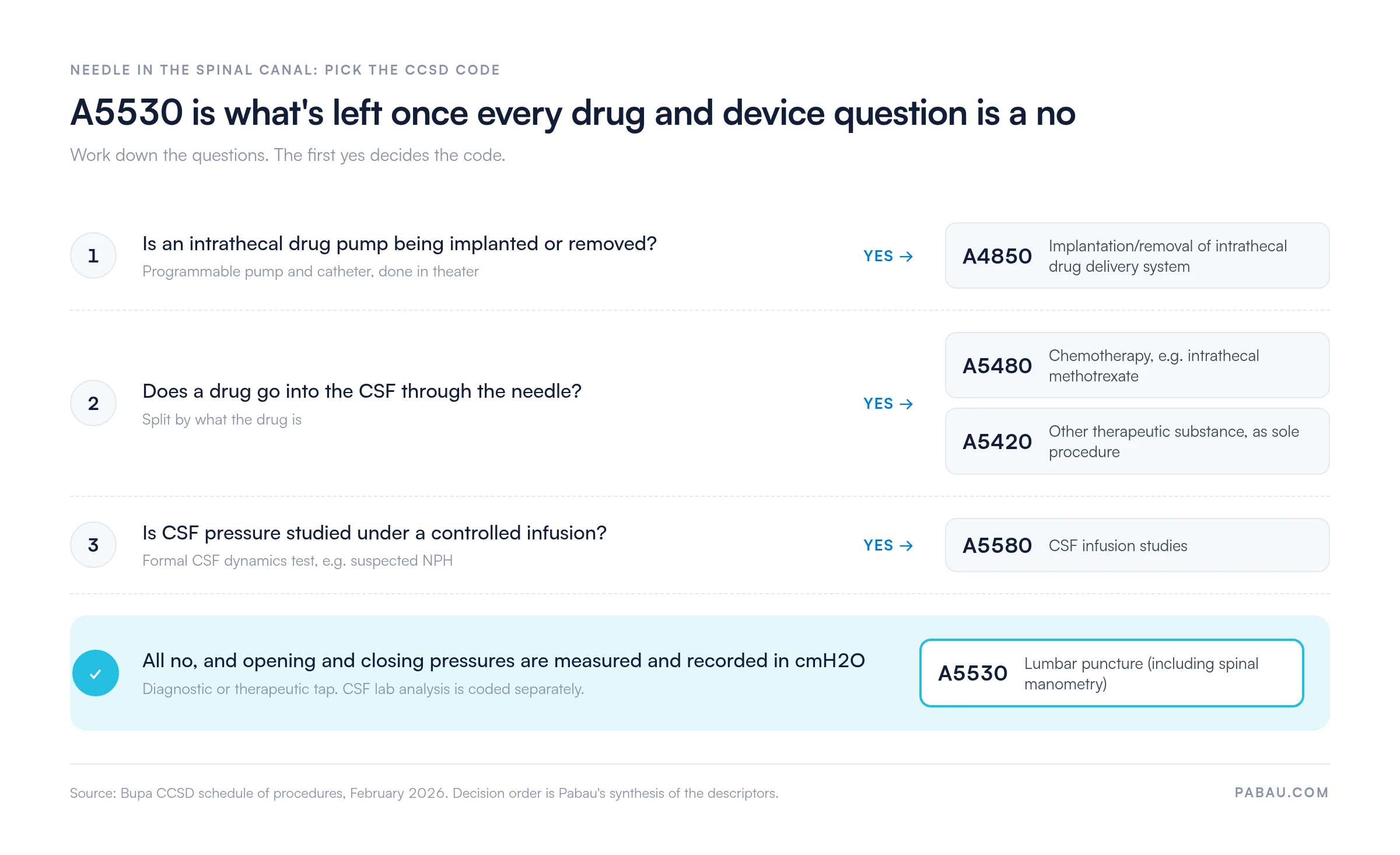
A5420 is described “as sole procedure”, so a drug given through the same needle as a diagnostic LP with manometry needs payer guidance. Ask your insurer or compliance lead which code takes precedence under their unbundling rules before you submit both. Our guide to Bupa CCSD codes covers how Bupa applies those rules across the schedule.
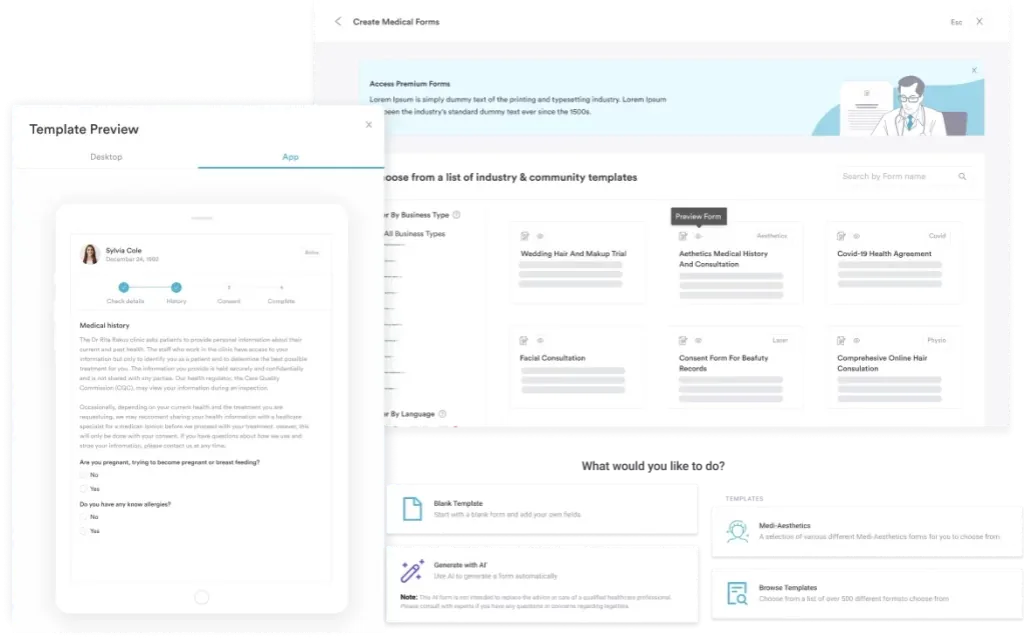
A complete procedure note is the primary defense against denial. Each element below should be in the record before the claim is submitted. A digital form built around the LP makes it much harder to skip a mandatory field.
Prior authorization requirements vary by insurer and by policy, and they change at annual schedule reviews. No single insurer’s rule for A5530 holds for every patient. Check the current provider handbook for each private medical insurer (PMI) before submitting, and log the authorization reference against the patient.
The three major UK PMIs each publish their own CCSD-based fee schedules. Fees and pre-authorization rules are reviewed periodically, so check the live insurer portal before billing. Treat the table below as a framework and confirm current figures with each insurer.
For reference, Bupa’s February 2026 CCSD schedule grades A5530 as Minor 2, with a listed fee of £123. A5420 and A5480 sit in the same band, while A4850 is graded CMO 2 at £1,144.
Healix and other smaller PMIs also use CCSD codes. Each publishes its own fee schedule, with Chapter 3 values and unbundling rules for A5530 claimed alongside other spine codes.
Most A5530 denials are preventable. The table below maps the top denial triggers to specific prevention steps. Each step works best built into booking and note-taking, where it runs before the claim goes out.
Run a 30-day audit of your A5530 claims before each insurer’s schedule review period. Check that every submitted claim has an opening-pressure value in the procedure note, a pre-auth reference number where required, and the consultant’s current recognition number. A claim missing any of these three is the one most likely to come back.
Building billing steps into the clinical workflow means the procedure note is complete before anyone assembles the claim. The seven steps below suit UK private practice administrators and consultants alike.
Most A5530 denials trace back to a detail missing at submission: a pressure value, an authorization code, or a membership number. In many practices, a secretary checks those by hand against the note and the insurer portal. A miss only surfaces when the claim comes back weeks later.
Practice management software like Pabau moves that check into the claim itself. Its claims management software keeps each patient’s insurer and membership details on the patient record. Before a claim goes out, Pabau runs validation checks and holds back any claim missing details such as an authorization code.
UK practices can then send the claim straight to Healthcode without re-keying it, or email it to insurers that aren’t connected. Each claim moves through clear stages from pending to paid, so your team can see which A5530 claims need chasing.
Pabau’s digital forms can also be built around the LP note, with fields for both pressures, CSF volume, and the indication.

Pabau checks each claim for authorization codes and membership numbers before it goes to Healthcode. Fewer A5530 claims come back for missing details.

A5530 rewards the practice that finishes the note before it builds the claim. When both pressures are on record in cmH2O and no drug went into the CSF, the code choice is settled and the claim should pay.
The trade-off is a minute or two at the bedside. A structured LP note takes longer to fill in, but it spares you rebuilding a record after an insurer query. Check pre-authorization at booking rather than at billing, because it’s the one step you can’t fix after the procedure.
Book a demo to see how Pabau keeps LP notes, authorization codes, and insurer claims together for UK private neurology practices.

Checking what Bupa pays for a procedure? Bupa procedure codes fee schedule sets out how Bupa’s CCSD-based reimbursement works across specialties.
New to the CCSD schedule? CCSD codes walks through how the schedule is organized and where each chapter’s codes sit.
Billing other spinal procedures? CCSD Code V4740 covers percutaneous spinal biopsy under CT control, another needle-based spinal procedure.
CCSD Code A5530 covers lumbar puncture including spinal manometry. That means the full procedure, from needle insertion through CSF pressure measurement and fluid collection. Spinal manometry is explicitly bundled and cannot be charged as a separate item. CSF laboratory analysis, intrathecal drug injection, and contrast myelography are not included and require separate coding.
Yes. The descriptor “Lumbar puncture (including spinal manometry)” makes this explicit. Opening and closing pressure measurements are part of A5530 and may not be billed as additional codes. If manometry was not performed or not documented, a different code may be required. Confirm with the current CCSD schedule.
Yes, provided spinal manometry is performed in both cases. The CCSD descriptor does not restrict A5530 to diagnostic use. Repeat therapeutic LPs for IIH, each with documented pressure readings, are each appropriately billed as A5530. Insurers may query multiple LP claims in a short period, so clear documentation of therapeutic intent and pressure values at each session is essential.
Yes. CSF laboratory analysis (cytology, biochemistry, microbiology, oligoclonal bands) is coded separately because laboratory codes sit in a different CCSD chapter from procedural codes. A5530 covers the collection and pressure measurement; the laboratory tests performed on the collected fluid are additional billable items. Verify with your specific insurer that the lab codes are accepted alongside A5530.
A5530 covers a lumbar puncture that measures CSF pressure and collects fluid, with no drug injected. A5420 covers a therapeutic substance injected into the CSF as the sole procedure, and A5480 covers intrathecal chemotherapy. Implanting or removing a drug pump is A4850. A5540 is a spinal angiogram, not an injection code. If a drug is given during a diagnostic LP, check the insurer’s unbundling rules before claiming both codes.
The most common reason is a missing opening-pressure value in the procedure note: insurers treat absent manometry documentation as manometry not performed. Other frequent causes include no prior authorization, an unrecognized consultant, and an undocumented clinical indication. Wrong code selection also appears, such as an intrathecal injection code submitted for an LP with no drug given. Each is preventable with pre-claim checklist discipline.