Free patient payment form template to download
A patient payment form is a signed document that records how a patient will pay ...

2
Last Updated: Oct 14, 2026

Physician AI use reached 81% in early 2026, up from 38% in 2023, according to the American Medical Association.
Automation takes scheduling, documentation, coding, and monitoring alerts first, while hands-on procedures and complex diagnosis stay human.
Roughly 14.3 million Medicare beneficiaries, about 21% of the Medicare population, now receive care through Accountable Care Organizations.
Six Qualified Health Information Networks now exchange data under TEFCA, and FHIR APIs are the expected route for sharing records.
Remote patient monitoring can add around $5,400 a month for a practice tracking 100 patients.
The Association of American Medical Colleges projects a US physician shortfall of up to 86,000 by 2036, which pushes practices toward automation.
Healthcare predictions for 2026 are only useful if they come with a decision. So each of the seven shifts below is paired with one action a private practice can take this quarter. According to the Centers for Medicare and Medicaid Services (CMS), about 14.3 million Medicare beneficiaries now receive care coordinated through Accountable Care Organizations (ACOs). ACO enrollment now covers roughly 21% of the Medicare population, up from 13.7 million in 2025.
AI has moved past administrative work into clinical decision support. The American Medical Association surveyed 1,692 physicians in early 2026 and found 81% using AI in practice. Rules on data interoperability, particularly TEFCA maturity and FHIR adoption, now reach single-location practices too.
The pressure behind these shifts is already documented. The Association of American Medical Colleges projects a US physician shortfall of up to 86,000 by 2036. The FDA authorized a record 295 AI/ML-enabled medical devices in 2025, taking cumulative authorizations past 1,450. So a software decision made this year is also a competitive one. It sets whether a practice can win value-based contracts and hold patients who expect digital-first service.
Every trend below turns into one decision a practice can book into the next 90 days. The table pairs each shift with the figure behind it and the single action worth taking now.
| Shift | The 2026 figure | One action this quarter |
|---|---|---|
| AI becomes the operational standard | 81% of physicians use AI, up from 38% in 2023 (AMA, 2026) | Pick one task, either documentation, coding, or reminders, and run AI on it for 90 days. |
| Value-based care reshapes economics | 14.3 million Medicare beneficiaries, about 21%, sit in ACOs (CMS, 2026) | Pull your last 12 months of quality-measure data and name the four you would miss today. |
| Interoperability mandates bite | Six QHINs now exchange data under TEFCA | Ask your EHR vendor in writing whether it exchanges records over FHIR APIs today. |
| Remote monitoring goes mainstream | 14 CMS billing codes, worth about $5,400 a month at 100 patients | Choose one patient cohort, price the device, and bill a single RPM code this quarter. |
| Workforce shortages force automation | Up to 86,000 physician shortfall by 2036 (AAMC) | List every task your front desk repeats daily, then automate the top three. |
| Patients expect digital-first access | 80% want to book anytime, 54% of providers allow it (Experian Health, 2025) | Switch on 24/7 online booking and delete every call to schedule prompt from your website. |
| Regulation reaches daily operations | 43 states filed 240+ health AI bills in early 2026 (Manatt Health) | Map where AI touches a patient message, then check the disclosure rule in your state. |
Emerging technology in healthcare stopped being a pilot line item in 2026. The American Medical Association surveyed 1,692 physicians between January 15 and February 2, 2026, and found 81% using AI in practice. That figure was 38% in 2023. Office of the National Coordinator (ONC) projections put adoption across all provider types nearer 68% by year-end, which is the broader and more cautious read.
Of the technology healthcare trends running into 2026, three applications dominate the working day:
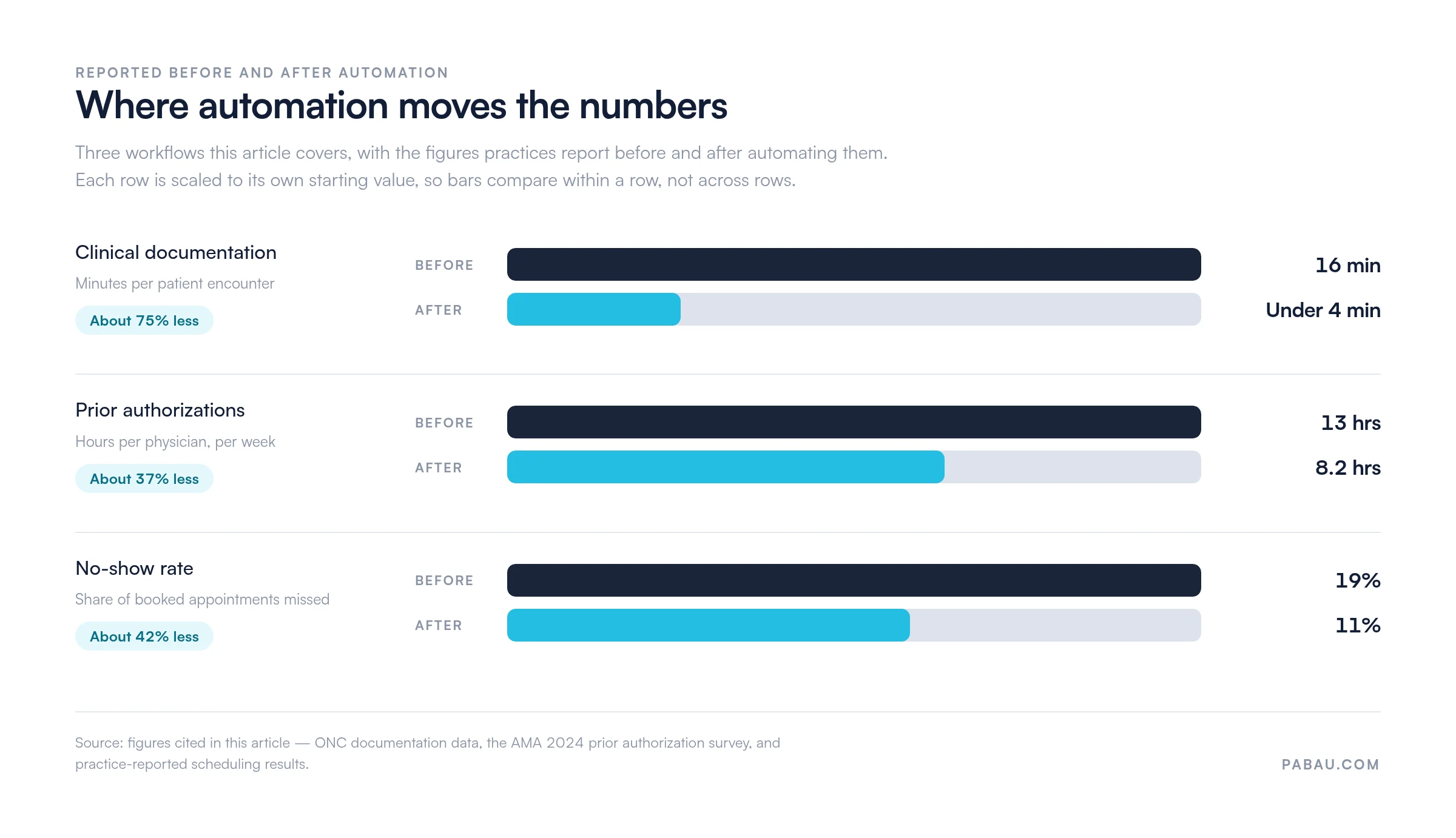
Documentation drove the early adoption. Physicians spend an average of 16 minutes per patient encounter on EHR documentation. AI scribes cut that to under four minutes by turning the consultation into a structured clinical note. Practices report saving several hours per clinician each week, and most of that time goes back into appointment capacity.
In the practices we onboard, the first AI job that sticks is almost always documentation. The payback lands in the same week, which is why it survives the initial enthusiasm. Coding and scheduling models take longer to prove because they need a few billing cycles of history first.
Predictive scheduling targets no-shows, which cost US practices $150 billion a year. Machine learning models weigh appointment type, time of day, patient demographics, and weather to score cancellation risk. Practices using them report 23-31% fewer no-shows. A baseline near 19% often falls closer to 11% once risk-scored reminder sequences are layered in.
Automated coding remains the highest-return application. Natural language processing reads clinical notes and suggests CPT and ICD-10 codes, cutting claim denials by 34% in a Healthcare Financial Management Association study. The models learn from corrections, so accuracy improves over later billing cycles. Coding error rates often drop from low double digits into low single digits within six months.
One number from the AMA survey is worth sitting with. Some 27% of physicians using AI had received no training on it from any source. Buying the tool is the easy half of the shift.
The latest AI patient-engagement trends in specialty clinics are conversational pre-visit intake, voice agents handling scheduling calls, and two-way messaging that flags follow-ups. The latest trends in AI patient-engagement tools for specialty clinics all attack the same bottleneck, which is the front desk.
Conversational intake came first. A 2025 feasibility study ran an AI agent through pre-visit intake in a hospital arrhythmia clinic. The agent worked a protocol-driven dialogue, adjusted its questions as patients answered, and handed the clinician a structured summary before the appointment started.
Voice agents took the second slot. Specialty practices point them at the routine share of inbound calls, covering booking, rescheduling, and prescription refill requests. The measurable win is the call answered at 7pm rather than left on voicemail until morning.
Two-way messaging is the third. Automated message threads now score replies for urgency and sentiment. So a patient describing swelling three days after a filler appointment surfaces ahead of a patient asking about parking.
One caveat travels with all three. California and Texas now require patients to be told when AI writes a clinical message or supports a diagnosis. So any patient-facing AI needs a disclosure line agreed before it goes live.
According to the CMS 2026 Medicare ACO Initiatives Participation Highlights, about 14.3 million Medicare beneficiaries receive care coordinated through Accountable Care Organizations in 2026. ACO enrollment now covers roughly 21% of the Medicare population, up from 13.7 million in 2025. Practices that ran on fee-for-service are now negotiating shared savings arrangements, bundled payments, and population health contracts.
Measurement is the hard part. These contracts tie reimbursement to quality metrics and cost reduction targets. A primary care practice in Medicare’s Shared Savings Program tracks 33 quality measures across prevention, chronic disease management, and patient experience. Missing four or five of them can wipe out the bonus payment entirely. That is why practice reporting software became standard infrastructure rather than a nice extra.
Care coordination needs new workflows. Value-based contracts penalize avoidable hospitalizations and emergency department visits. Practices now employ care coordinators who monitor high-risk patients between visits, book preventive screenings, and check medication adherence. Multi-location specialty practices that add the role usually see fewer post-procedure complications and fewer avoidable follow-ups.
Financial risk moves to the provider. Under shared savings, a practice absorbs the loss if its patient population runs over the cost target. Primary care groups usually have to show savings on referred specialist care. That is why many invest in chronic disease management programs, such as nutrition counseling and lifestyle support, which reduce referrals by treating the underlying problem. Those programs typically take 18-24 months to break even.
A second payment model is growing alongside ACOs, and it lands closer to elective and aesthetic work. More than 20,000 US businesses now fund an individual coverage or qualified small employer health reimbursement arrangement, known as ICHRA and QSEHRA. Those arrangements covered more than 500,000 people by January 2026, according to the HRA Council.
That shift changes who is deciding. A patient holding a defined allowance shops on published price and convenience rather than network membership. Membership and subscription care run on the same logic, where a monthly fee buys a set number of visits and unlimited messaging.
Practices already selling treatment packages have most of the billing machinery for this. What is usually missing is a published price list and a way to charge the same patient every month without re-keying a card.
Among the tech trends in healthcare that reach a single-location practice, interoperability is the one with a date attached. TEFCA (Trusted Exchange Framework and Common Agreement) reached operational maturity in 2026, with six Qualified Health Information Networks (QHINs) exchanging data nationwide. Participation stays voluntary, but hospitals, payers, and government partners increasingly treat it as a baseline during procurement. The firm deadline is January 1, 2026, and it requires QHINs, not every healthcare entity, to implement HL7 FAST security protocols for FHIR transactions.
For a private practice, the practical effect is simpler. Its EHR is expected to exchange patient data through FHIR APIs with hospitals, labs, imaging centers, and other providers, whatever software those organizations run. An ambulatory EHR built for outpatient practices differs from the inpatient systems those hospitals run internally.
The 21st Century Cures Act information blocking provisions carry consequences, but enforcement differs by entity type. Developers of certified health IT, Health Information Exchanges (HIEs), and Health Information Networks (HINs) face civil monetary penalties of up to $1 million per violation. That sits under the HHS Office of Inspector General’s information blocking enforcement rule, effective September 2023.
Healthcare providers are not subject to those penalties. Providers face “appropriate disincentives” administered through CMS programs instead, including reduced Medicare reimbursement, lower MIPS scores, and possible program exclusion. Practices that obstruct patient record access, skip FHIR APIs, or limit portal functionality risk both the financial hit and the reputational one.
FHIR also fixes how the data itself is formatted. The standard specifies structures for demographics, medications, allergies, problems, and laboratory results. Legacy systems that stored records in proprietary formats need middleware to translate into FHIR-compliant structures. Practices running clinical software eight years old or older commonly face mid-five-figure conversion projects, which still beats the cost of a full platform migration.
Patient access expectations changed too. Regulations require that patients can download their complete health record through a mobile app within 24 hours of any update. Practices used to handing out paper summaries at checkout now need patient portals with API-enabled access. Behavioral health practices that roll out compliant portals often see engagement with treatment plans rise by 30-40%. The jump comes once clients can read session notes on their phones.
Meeting these requirements usually means practice management software rather than a stack of point solutions. Wiring separate systems together for scheduling, EHR, billing, and patient communication leaves seams where records fail to move. Those seams are where interoperability standards get missed.
Remote patient monitoring (RPM) adoption grew 147% between 2024 and 2026, according to Healthcare Information and Management Systems Society (HIMSS) data. Once limited to conditions like diabetes and hypertension, RPM programs now cover post-surgical recovery, mental health check-ins, and aesthetic treatment outcomes.
Reimbursement drove that expansion. CMS added 14 new RPM billing codes in 2025 covering device setup, patient education, and monthly monitoring services. A practice monitoring 100 patients a month can generate about $5,400 in additional revenue from RPM codes alone. These codes pay for time spent reviewing patient-generated data, not only for live consultations.
Device costs fell at the same time. FDA-cleared connected blood pressure cuffs now run roughly $35 per unit in bulk. Continuous glucose monitors reached pharmacy benefits for pre-diabetic patients. Weight management programs that hand out connected scales typically see completion rates climb 15-20 percentage points, because weekly check-ins no longer need a visit.
Post-procedure monitoring cut complications. Med spas using RPM after dermal fillers or body contouring report up to 40% fewer emergency calls. Patients photograph the treatment site daily for seven days, and AI flags inflammation patterns that suggest infection or an adverse reaction. Clinical review then happens before symptoms turn severe.
Mental health applications grew fastest of all. Patients complete brief assessments two or three times a week, which builds longitudinal data on mood, anxiety, and sleep. Behavioral health practices that adjust medication and therapy on that data, rather than waiting for a monthly appointment, report lower average symptom severity scores.
The Association of American Medical Colleges projects a US physician shortfall of up to 86,000 by 2036. Primary care accounts for 20,200 to 40,400 of that figure, and surgical specialties for 10,100 to 19,900. NHS England projects a shortfall of 260,000 to 360,000 staff by 2036/37, which is the same pressure in another health system.
Both projections sit roughly a decade out. Both push practices to redesign workflows around automation rather than hiring alone, because the hiring option gets more expensive every year the shortfall widens.
Automated workflow software handles appointment confirmations, payment collection, post-visit surveys, and recall campaigns without anyone touching them. Multi-location med spas that pair check-in kiosks with online booking usually redeploy one or two front-desk roles into clinical support. Treatment room utilization tends to rise 15-25% as a result.
Inventory automation prevents stockouts and cuts waste. Practices reordering on usage patterns report roughly 34% less inventory sitting unused. Med spas with heavy injectable spend often cut expired-product waste by 10-15% of the monthly injectable budget. Predictive ordering does it by accounting for appointment volume, seasonal demand, and expiry dates.
Credentialing and compliance tracking became automated necessities. Practices verify provider licenses, malpractice insurance, controlled substance registrations, and specialty certifications across several state boards and payers. Manual tracking fails quietly when a license expires unnoticed. Automated systems query state databases monthly and flag renewals 90 days out. That catches a lapsed DEA registration before an inspector or a payer audit does.
Patient communication automation removes a large share of the admin load. Practices send an average of 11 messages per patient per year, from appointment confirmations to recall reminders. Automating those saves 6-8 hours a week per provider. For a single-clinician practice that works out to roughly 300 hours a year, or about 0.15 of a full-time role.
Healthcare jobs that will not be replaced by AI are the hands-on ones, covering procedures, physical examination, complex diagnosis, and relationship-driven care. Automation moves first on scheduling, documentation, coding, and monitoring alerts.
The dividing line is accountability. A model can draft a note, suggest a code, or rank which patient to call back first. A licensed clinician still signs the note, owns the diagnosis, and holds the conversation when a treatment plan changes.
Front-desk work is the role most often described as at risk, and that reading is too blunt. What disappears is the repetitive half of the job, meaning confirmation calls, rekeyed intake forms, and chasing deposits. What grows is the part patients notice, meaning triage judgment, insurance problem-solving, and greeting someone who is nervous about a procedure.
So the planning question is not how many roles to cut. The question is which tasks to move off people this quarter, and which people to move onto the work that keeps patients coming back.
Eighty percent of US patients want to book an appointment from home or a phone at any hour, and only 54% of providers offer self-scheduling. Those figures come from Experian Health’s 2025 State of Patient Access survey. Another 10% of providers said they planned to add self-scheduling within six months.
UK data points the same direction. A survey of 2,400 patients across UK private practices found 73% would switch providers for better digital booking and communication tools. The 73% figure is UK evidence of the pattern rather than a US figure, but the direction of travel is identical in both markets.
Self-service booking is the baseline now. Practices without 24/7 online scheduling lose patients to the ones that offer it. Conversion data shows that 42% of patients who hit a “call to schedule” message on a practice website book somewhere else. Specialty practices that add online booking commonly see new patient acquisition rise 25-35% with no extra marketing spend.
Two-way messaging replaced phone calls. Patients prefer text for non-urgent questions, prescription refills, and appointment changes. Practices using secure messaging platforms report up to 65% less phone volume. Behavioral health practices that add two-way SMS often halve front-desk call handling time, moving those hours into insurance verification and prior authorization.
Published pricing became a competitive advantage. Patients research procedure costs before booking, especially for elective and aesthetic treatments. Practices that publish prices online convert 2.3 times more website visitors into booked appointments than those requiring a consultation for an estimate. Med spas that add transparent pricing typically lift consultation-to-treatment conversion from 45-50% to 60-65%.
Payment flexibility now shapes the booking decision. Patients weigh payment options alongside clinical expertise. Practices offering payment plans, medical financing, and digital payment methods report higher case acceptance. Aesthetic and elective practices that add point-of-sale financing often lift average treatment value by 15-20%, as patients choose more comprehensive procedures.
Three regulatory changes reach a practice’s daily work in 2026, namely HIPAA enforcement, wider prior authorization, and new state rules on disclosing AI use. Each one lands on the front desk before it lands on the balance sheet.
HIPAA enforcement stayed active through 2025 and 2026. Common findings include unsecured patient communications, weak business associate agreements with vendors, and no documented risk assessment. Practices now have to document cybersecurity training, encryption protocols, and breach response procedures every year. Stolen laptops holding unencrypted patient data still drive five- and six-figure settlements with the Office for Civil Rights, even at small specialty practices.
Prior authorization requirements expanded. Insurance payers added prior authorization to 47 more procedure codes across 2025 and 2026. The American Medical Association’s 2024 prior authorization survey puts the burden at roughly 13 hours per physician per week, counting physician and staff time together. Tools that integrate with payer portals bring that closer to 8.2 hours by pre-filling clinical documentation and submitting requests electronically.
AI governance became a state matter rather than a federal one. Manatt Health’s policy tracker counted 43 states introducing more than 240 health AI bills in the opening months of 2026. The 2026 total already rivals the whole of 2025, and the rules differ from one state line to the next.
Two of those laws already bind ordinary practices. California’s AB 3030 requires a disclaimer whenever generative AI writes a patient communication about clinical information. Scheduling messages, reminders, and billing notes are exempt, and so is any message a licensed provider reads and approves first.
Texas went further. The Texas Responsible Artificial Intelligence Governance Act took effect on January 1, 2026. The Act requires practitioners to tell patients when AI is used in their diagnosis or treatment, either verbally or in writing.
The practical step is small and worth doing before an inspector asks. Write down every point where AI touches a patient message or a diagnostic decision. Then check the disclosure rule in each state your practice is licensed in.
UK practices carry two more obligations. CQC inspection frameworks added digital capability assessments in 2026, covering online booking functionality, patient portal adoption rates, and interoperability readiness. Inspectors increasingly read portal adoption well below 40% as evidence of weak digital infrastructure, so practices are building portal onboarding into their pre-inspection work.
GDPR enforcement in UK healthcare intensified alongside it. Information Commissioner’s Office fines for data breaches averaged £1.6 million per incident in 2025. Common findings include marketing emails sent without explicit consent, missed 30-day deadlines on deletion requests, and weak vendor data processing agreements. A wellness or aesthetic practice whose email platform is breached absorbs serious legal costs during an ICO investigation, even after it fixes the underlying protocols.
Competitive advantage in 2026 goes to practices that treat their software stack the way they treat clinical equipment. Three priorities show up again and again: Platform consolidation, continuous staff training, and decisions made on data. Practices still shortlisting vendors can start from our roundup of the best practice management software, then test each option against those three.
Consolidation reduces technical complexity. Practices running 8-12 separate tools for scheduling, EHR, billing, marketing, and patient communication struggle with interoperability compliance and fragmented workflows. Those that move to a connected practice management app report 40% faster onboarding for new staff. They also report 28% less duplicate data entry and no information blocking violations. Migration usually pays back within 9-14 months.
The payoff shows up in a handful of numbers this article has already covered. Documentation time, prior authorization hours, and no-show rates all move in the same direction once the workflow behind them is automated.
Training on digital tools is continuous now, not a one-time event at go-live. The AMA found 27% of physicians using AI had received no training on it at all. That is the quiet reason so many tools stall after month two. Practices allocate 2-4 hours a month per team member for software training, workflow updates, and new features.
Multi-location specialty practices on a monthly training cadence commonly see feature utilization climb from about 60% to over 85% within six months. The software rarely changes in that window. The staff’s grip on it does.
Decisions moved from intuition to data. Practices that analyze patient acquisition costs, treatment profitability, and provider productivity find opportunities that manual review never surfaces. One pattern comes up repeatedly: Weekend slots run materially higher no-show rates than their weekday equivalents. Practices that redeploy those hours into weekday demand lift weekly revenue and shorten total opening hours.
Most practices meet 2026 with a stack rather than a system. One tool holds the schedule, another holds the records, a billing platform sits beside them, and a spreadsheet holds the rest together. Every handoff between them is a manual export. Each export is a chance for a record to go missing during an audit or a payer review.
Practice management software like Pabau puts those jobs on one patient record. Appointments, clinical notes, consent forms, invoices, inventory, and patient messaging all sit against the same file. A claim, a quality measure, or a portal request then pulls from a single source. Pabau Scribe, our AI scribe, drafts the note from the consultation, and the note lands in that record without an export step.
Reporting works the same way. Outcomes, costs, and appointment data live together in one place. So quality measure tracking and cost analysis for a value-based contract come out of the platform you already run. Pabau’s automated workflows cover confirmations, recalls, deposits, and post-visit follow-up, so a smaller front desk stops being the constraint. Every Pabau subscription includes every feature, so none of this depends on which plan you pick. That reporting layer also feeds dashboard analytics, giving a live view of appointments, costs, and outcomes together.

Pabau brings scheduling, records, billing, reporting, and patient messaging onto one patient record. Interoperability requirements, value-based reporting, and workflow automation then run from a single source.

None of this arrives at once, and no practice has to solve all seven shifts in the same quarter. The order that works is straightforward. Fix the data first, then automate on top of it. Interoperability and reporting both depend on records living in one place, and automation only pays when it runs on clean data.
If you take one row from the table above, take the last one. State AI disclosure rules changed while most practices were still deciding whether to use AI at all. The compliance work is one morning spent writing down where the tools already touch patients.
The trade-off worth remembering is timing. Consolidation costs one disrupted quarter and pays back in 9-14 months. Waiting costs a little every month, in admin hours, denied claims, and patients who booked with the practice that had an online calendar. Those monthly costs compound quietly, which is exactly what makes them easy to postpone.
Book a demo to see how Pabau handles documentation, value-based reporting, interoperability, and patient messaging from one patient record.

Planning a platform move this year? EHR implementation walks through data migration, staff training, and the productivity dip to budget for.
Still building a vendor shortlist? Clinic management software buyer’s guide gives you the checklist to score each option against before you sit through a demo.
Running more than one site? Multi-location scheduling software covers shared calendars, room and staff allocation, and reporting across every location.
Want a shortlist that already includes Pabau? 10 reasons why clinics choose Pabau software lays out what tips the decision.
Not sure ambulatory and inpatient EHRs solve the same problem? Ambulatory EHR vs inpatient EHR explains where the two categories actually diverge.
The American Medical Association surveyed 1,692 physicians in early 2026 and found 81% using AI in practice, up from 38% in 2023. Office of the National Coordinator projections put adoption across all provider types nearer 68% by December 2026, which counts a broader population than physicians alone. The most common applications are clinical documentation through AI scribes, predictive analytics for appointment scheduling, and automated coding for billing workflows.
An electronic health record is the digital patient file a practice keeps. The record holds history, medications, allergies, results, consent forms, and treatment notes in one place. In 2026 that file also has to travel. FHIR APIs define how a record moves to hospitals, labs, and other providers. TEFCA sets the national exchange framework that six Qualified Health Information Networks now run on. So the question worth asking a vendor is less what the EHR system stores and more what it can send.
Value-based care ties reimbursement to quality metrics and cost reduction rather than volume of services. According to CMS, about 14.3 million Medicare beneficiaries receive care coordinated through Accountable Care Organizations in 2026, up from 13.7 million in 2025. Participating practices track 30 or more quality measures, invest in care coordination, and absorb financial risk if their patient population runs over the cost target.
Penalties depend on entity type. Developers of certified health IT, Health Information Exchanges, and Health Information Networks face civil monetary penalties of up to $1 million per violation. That sits under the HHS OIG’s information blocking enforcement rule, effective September 2023. Healthcare providers instead face financial disincentives through CMS programs, such as reduced Medicare reimbursement, lower MIPS scores, and possible program exclusion. TEFCA participation is voluntary, so non-participation carries no penalty.
CMS added 14 new RPM billing codes covering device setup, patient education, and monthly monitoring services. A practice monitoring 100 patients a month can generate roughly $5,400 in additional revenue from RPM codes alone. These codes pay for time spent reviewing patient-generated data between scheduled appointments.
Patient communication automation delivers the fastest return by removing 6-8 hours of administrative work per provider each week. Automated appointment confirmations, payment collection, post-visit surveys, and recall campaigns reduce front-desk staffing needs while improving patient engagement. Multi-location aesthetic practices commonly redeploy one or two front-desk roles into clinical support after switching.
HIPAA penalties are tiered by culpability, and they are separate from UK GDPR fines. For penalties assessed on or after January 28, 2026, the inflation-adjusted range runs from $145 to $73,011 per violation. The annual cap for repeated violations of the same provision is $2,190,294. Common findings include unsecured patient communications, weak business associate agreements, no annual risk assessment, and missing cybersecurity training records.