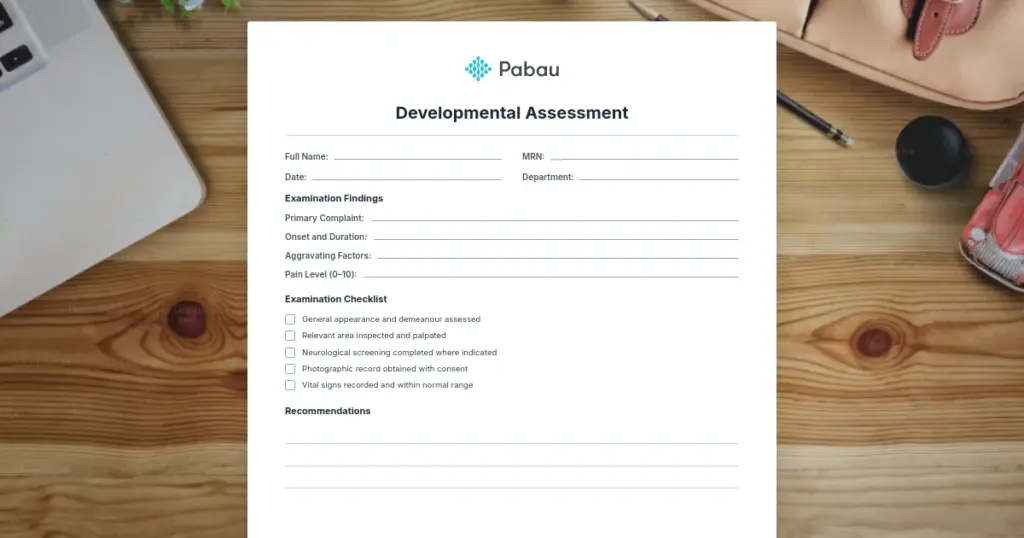










Developmental assessment template and checklist for clinicians
Download your free developmental assessment template The form covers all five do...

Last Updated: August 19, 2026


The Yocum test screens for subacromial impingement by loading the shoulder while the patient lifts the elbow against resistance.
The patient rests a hand on the opposite shoulder, and you press down on the elbow while they lift it.
Pain at the front or side of the shoulder is a positive result, but a shrug during the lift invalidates it.
Accuracy is unsettled. Sensitivity was 79% and 70% in the two published studies, while specificity ran from 40% to 92%.
The test cannot name the tissue involved, so read it alongside the Hawkins-Kennedy, Neer, and tear-specific tests.
The Yocum test is one of the fastest ways to load the subacromial space and hear what the shoulder says. With a hand resting on the opposite shoulder, your patient lifts that elbow against steady downward pressure. Pain at the front or side of the shoulder counts as a positive result.
All of it takes under a minute, and it asks for no overhead movement at all. Published specificity runs from 40% to 92%, so a positive result carries very different weight depending on which study you trust.
The test earns its place because it loads the subacromial space without asking for overhead elevation. For a patient who cannot tolerate reaching up, that is a useful trade.
Its target is the subacromial space, where the rotator cuff tendons pass under the acromion and the coracoacromial ligament. Narrow that corridor, or inflame the tendons inside it, and certain movements start to hurt.
Mechanics are what separate it from the Neer and Hawkins-Kennedy tests. Placing the hand on the opposite shoulder settles the scapula before any force goes in. The shrug patients use to escape compression is much harder to produce from there.
Nothing needs setting up, so it slots into a standard assessment in physical therapy and sports medicine practices. Run it alongside strength testing, a range of motion assessment, and whatever imaging the patient already has.
Pain shows up during the test because the position narrows a corridor that is already tight. The subacromial space sits between the head of the humerus below, and the acromion and coracoacromial ligament above.
The supraspinatus tendon, the subacromial bursa, and parts of the infraspinatus and long head of biceps all share that space. Compress them against the bony roof and you get pain, then inflammation, and over time tendon damage.
Three groups of factors show up again and again in shoulder assessment:
The Yocum position stacks two demands at once. Internal rotation with the arm across the body narrows the outlet, and the resisted lift then drives the tendons into it.
Technique decides whether the result means anything. The most common error, a shrug during the lift, unloads the very structures you are trying to provoke.
Sit or stand the patient upright and relaxed. Ask them to place the hand of the affected arm on the opposite shoulder, with the elbow bent to roughly 90 degrees and pointing forward.
That position internally rotates the glenohumeral joint and brings the arm across the body. The subacromial space is already loaded before you touch them. Check that the trunk has not rotated to help.
Stand beside or just behind the patient on the affected side. Rest one hand on top of the shoulder to block scapular elevation, and use the other to apply steady downward pressure on the elbow.
Hold that pressure and ask the patient to raise the elbow toward the ceiling, without shrugging. Their effort against your resistance is what compresses the subacromial structures.
Watch the face as much as the shoulder. Pain reported in the subacromial region during the lift is a positive test.
Five habits account for most unreliable results:
A positive Yocum test tells you the subacromial space is irritable. It does not tell you which structure in there is producing the pain.
Four points shape how much weight the finding deserves:
An example shows how much the surrounding findings matter. A 46-year-old masters swimmer arrives with six weeks of anterolateral shoulder pain. The Yocum test reproduces her familiar pain, the Hawkins-Kennedy agrees, and strength stays full and painless through mid-range.
That cluster supports an impingement-type presentation, so loading and scapular control work come first. Change one detail and the plan changes with it. If she cannot hold the arm out at 90 degrees, weakness moves to the front of the queue.
Write down which special tests you ran, how the patient responded to each, and what that response changed in your reasoning. A record of the whole battery, not just the conclusion, holds up months later when someone asks why you decided what you did.
The honest answer on accuracy is that the evidence has not settled it. Only two studies of the test appear in Hegedus et al. (2012). That review, published in the British Journal of Sports Medicine, is the most cited analysis of shoulder special tests.
Sensitivity landed in a similar place in both. Specificity did not, and the two figures sit more than 50 percentage points apart.
Here is what each study reported, with subacromial impingement as the reference condition:
Silva et al. tested 30 consecutive outpatients with shoulder pain and checked the findings against MRI within three days. A positive test there carried a likelihood ratio of 1.32, which barely moves the probability of impingement. The review rated that study low risk of bias, though 30 patients is a small sample.
Fodor et al. compared clinical tests against ultrasound in 100 painful shoulders. A positive test carried a likelihood ratio of 8.80, which is a genuine shift in post-test probability. Ultrasound is not the criterion standard for the shoulder, so the review rated that study at moderate risk of bias.
The spread itself is the useful finding. Sensitivity of 70% to 79% is fairly consistent, and negative likelihood ratios of 0.33 and 0.53 point the same way. A negative Yocum test is the more dependable of the two results.
Specificity is another matter. Plan for the less flattering number, and avoid quoting a single specificity figure in a report or a patient conversation. Two studies with different reference standards cannot settle the question between them.
The Hegedus review pooled estimates for three impingement tests only. Neer, Hawkins-Kennedy, and the painful arc each had enough studies to meta-analyze. The Yocum test had two, so any source quoting one tidy accuracy range for it is reporting something other than the primary data.
That review’s wider conclusion still stands. No single shoulder test performs well enough alone to confirm or exclude subacromial impingement, so this one does its best work inside a cluster.
Since no shoulder test diagnoses on its own, the practical question is which ones to pair. Each of the common alternatives loads the same space in a slightly different way.
The Hawkins-Kennedy flexes the shoulder and elbow to 90 degrees, then rotates the arm internally. Like the Yocum test, it drives the supraspinatus under the coracoacromial arch. It is also far better studied.
Hegedus et al. pooled seven studies and 944 patients, reporting 80% sensitivity with 56% specificity. That profile makes a strong screener that throws plenty of false positives. Agreement between the two tests therefore raises your confidence. In Silva’s MRI sample, the Yocum test was the more sensitive of the pair, at 79% against 74%.
The Neer test passively forward-flexes the arm with the shoulder internally rotated and the elbow straight, while the examiner holds the scapula down. It compresses the supraspinatus and biceps tendon under the front of the acromion. Across seven studies and 946 patients, sensitivity was 72% and specificity 60%.
Reach for it when passive elevation is comfortable enough to be informative. Switch to the Yocum test when overhead movement hurts, or when scapular control is the thing worrying you.
A full shoulder examination usually adds tests aimed at particular structures:
These answer a different question from the impingement tests. Yocum, Hawkins-Kennedy, and Neer ask whether the subacromial space is irritable. Drop arm and full can ask whether the tendon is still doing its job.
Figures show sensitivity and specificity for subacromial impingement, all as tabulated in Hegedus et al. (2012). Reading down a single study column is the fairest comparison, because the two studies used different reference standards and different patients.
A positive result cannot name the tissue, grade the damage, or stand in for imaging. Five limits are worth carrying into your reasoning:
Other diagnoses can drive a positive response too, including AC joint pathology, labral tears, and biceps tendinopathy.
Special tests work as one strand of the assessment, which is the line taken by NICE shoulder pain guidance and the wider orthopedic literature. Neither treats one test result as the gate to a diagnosis or a scan.
A positive test on its own rarely changes what happens next. Six questions turn the finding into a decision:
The first three questions keep you honest about the finding itself. A yes to the fourth moves imaging up the list, because a full-thickness tear behaves differently from an irritable bursa. Your scope of practice and local pathways decide the referral itself.
The last two are about the record. Pair the test result with the strength findings and a shoulder range of motion chart from the same visit. The next appointment then opens with evidence instead of recall.
That matters most when several clinicians share a caseload, which is normal in physical therapy practices. A consistent SOAP note structure keeps the finding in a predictable place for whoever picks the patient up next.
In most physical therapy and sports medicine practices, special test results end up scattered through free text. One clinician types “Yocum positive”. Another writes a sentence about pain on resisted elevation. Six weeks later, nobody can line the two entries up.
Practice management software like Pabau lets you build the shoulder assessment form once and reuse it at every appointment. The template can carry a field for each special test, the side tested, and the patient’s response. Because those fields are structured, the same finding lands in the same place every time.
Two things follow for a busy musculoskeletal caseload. Notes take less time, because the clinician is selecting rather than composing. Progress also becomes comparable, so you can show a patient how their response to testing has shifted across a course of treatment.

Higher consultation volumes make that consistency harder to hold, and a shared template is what protects it. Pabau’s client records keep the assessment, the notes, and the plan in one place. Digital intake forms collect the history before the patient sits down.

Pabau’s digital forms capture each special test result in the same field, so shoulder findings stay comparable from the first visit to discharge.

The Yocum test is worth keeping in your shoulder screen. Its mechanics are sound, it costs a minute, and it asks nothing of a painful overhead range. What it will not do is settle a diagnosis, and the specificity spread from 40% to 92% is why.
So treat it as one voice in a cluster. Run it with the Hawkins-Kennedy, the Neer, and a tear-specific test, then weigh the result against history, movement, and strength. When weakness or structural damage is on the table, imaging is still the next step.
Consistent records are what turn single visits into a trackable course of treatment. The right physical therapy software makes that the default rather than a habit each clinician has to keep up. Book a demo to see how Pabau keeps every shoulder assessment in the same structured record.

Assessing a different joint this week? Tight hip flexors test walks through the Thomas test, including the setup errors that produce a false result.
Need to document a special test properly? Hoover test template gives you a structured form for recording the technique, the response, and your interpretation.
Writing notes after every assessment? Medical notes template sets out a SOAP structure for examination findings, assessment, and treatment plan.
Taking a first history for a new patient? History and physical form covers demographics, presenting complaint, medical history, and examination in one document.
Returning an athlete to sport? Return to running protocol sets out phased criteria for progressing load after a musculoskeletal injury.
It carries the name of Lewis Yocum, an American orthopedic surgeon. He described the maneuver in a 1983 review of shoulder assessment in Clinics in Sports Medicine. Yocum spent decades as a team physician in professional baseball.
Yes, and testing it first is usually more informative. It shows you how this patient responds to that pressure when nothing is wrong, which makes an abnormal response easier to call. It also lets an anxious patient feel the maneuver before you use it on the sore side.
No. A positive result points at an irritable subacromial space, and most of those settle with loading, scapular work, and time. Surgical opinions follow persistent symptoms, structural findings on imaging, or failed conservative treatment, not a single positive test.
Not usefully. The result depends on controlled downward pressure and a scapula held still, and neither is possible one-handed. Reproducing pain that way is worth mentioning at the next appointment, but it is not a test result.
It rarely helps. Adhesive capsulitis restricts the cross-body position the test needs, so pain often comes from the position rather than compression. Check range of motion first, since restriction in every direction points somewhere else entirely.