ICD-10 Code Y76.0: Diagnostic obstetric and gynecological devices
ICD-10 Code Y76.0: Definition and billable status ICD-10 Code Y76.0 is a valid, ...

Last Updated: Oct 23, 2026
Billable Code Specific Code
S63.263S is the billable ICD-10-CM code for dislocation of metacarpophalangeal joint of left middle finger, sequela.
The 7th character "S" signals that the original dislocation has healed. The patient now presents for a residual condition, such as chronic instability, post-traumatic stiffness, or persistent pain at that joint. Confusing this with S63.263D (subsequent encounter) is the leading denial trigger for this code.
Let Pabau's smart automation suggest the right codes, reduce claim denials, and keep your practice compliant—effortlessly.
Automate repetitive tasks and focus on what matters most—your patients.
Reduce coding errors and ensure compliance with the latest regulations.
Clean claims, fewer denials, and faster reimbursements.
Powerful insights and reporting to help your practice thrive.
HIPAA compliant SOC 2 certified GDPR-compliant Trusted by 4,000+ clinics worldwide

S63.263S codes a condition left behind by a healed MCP dislocation of the left middle finger.
The 7th character “S” applies only once the original injury has resolved and a residual condition is being treated.
The residual condition code, such as M25.642 for left hand stiffness, is sequenced first, with S63.263S listed second.
Practice management software like Pabau runs validation checks before each claim goes out, so missing details get caught before the payer sees them.
ICD-10 Code S63.263S is the billable ICD-10-CM code for dislocation of the metacarpophalangeal joint of the left middle finger, sequela. Use it when the dislocation has healed and a residual problem, such as stiffness or instability, is the reason for the visit.
The table below confirms validity, billability, and classification before you submit a claim. The code is valid for fiscal years 2025 and 2026 with no pending revisions.
The metacarpophalangeal (MCP) joint of the left middle finger is the knuckle at the base of that finger. It connects the third metacarpal bone of the left hand to the proximal phalanx of the middle (3rd, or long) finger.
A dislocation at this joint means the joint surfaces have been forced apart, most often by hyperextension or a direct impact. S63.263S captures what that event leaves behind once it has healed, rather than the acute injury itself.
Three anatomical qualifiers are encoded directly in this code and each must be confirmed in the clinical documentation:
The ICD-10-CM tabular list and the CDC/NCHS ICD-10-CM lookup tool are the primary resources for confirming each qualifier. If the documented side or digit doesn’t match the submitted code, the claim can fail an automated payer edit.
Each character in S63.263S carries a specific classification meaning. Knowing the structure helps you catch the joint, side, and digit errors covered below.
Per ICD-10-CM Official Guidelines Section I.B.10, the 7th character “S” marks a complication or condition that arises directly from an injury after it has healed. The patient is no longer being treated for the dislocation itself, but for a problem the dislocation caused.
S63.263S (sequela) and S63.263D (subsequent encounter) describe two entirely different clinical scenarios. Submitting “D” when “S” is correct is one of the most common denial triggers for this code family.
The same 7th character slip drives denials on sequela codes for other joints. ICD-10 code S03.00XS covers a healed jaw dislocation, and “D” in place of “S” heads its denial list too.
Two scenarios show the difference. A patient returns six weeks after a left middle finger MCP dislocation. The X-ray shows the joint has stayed reduced, but the soft tissue is still healing. That is S63.263D.
A different patient arrives three months after the injury with full radiographic healing, but complains of persistent clicking and limited flexion. The provider documents “post-traumatic stiffness, left MCP joint, middle finger, sequela of prior dislocation.” That is S63.263S, and the timeline below places all three 7th characters on the same injury.
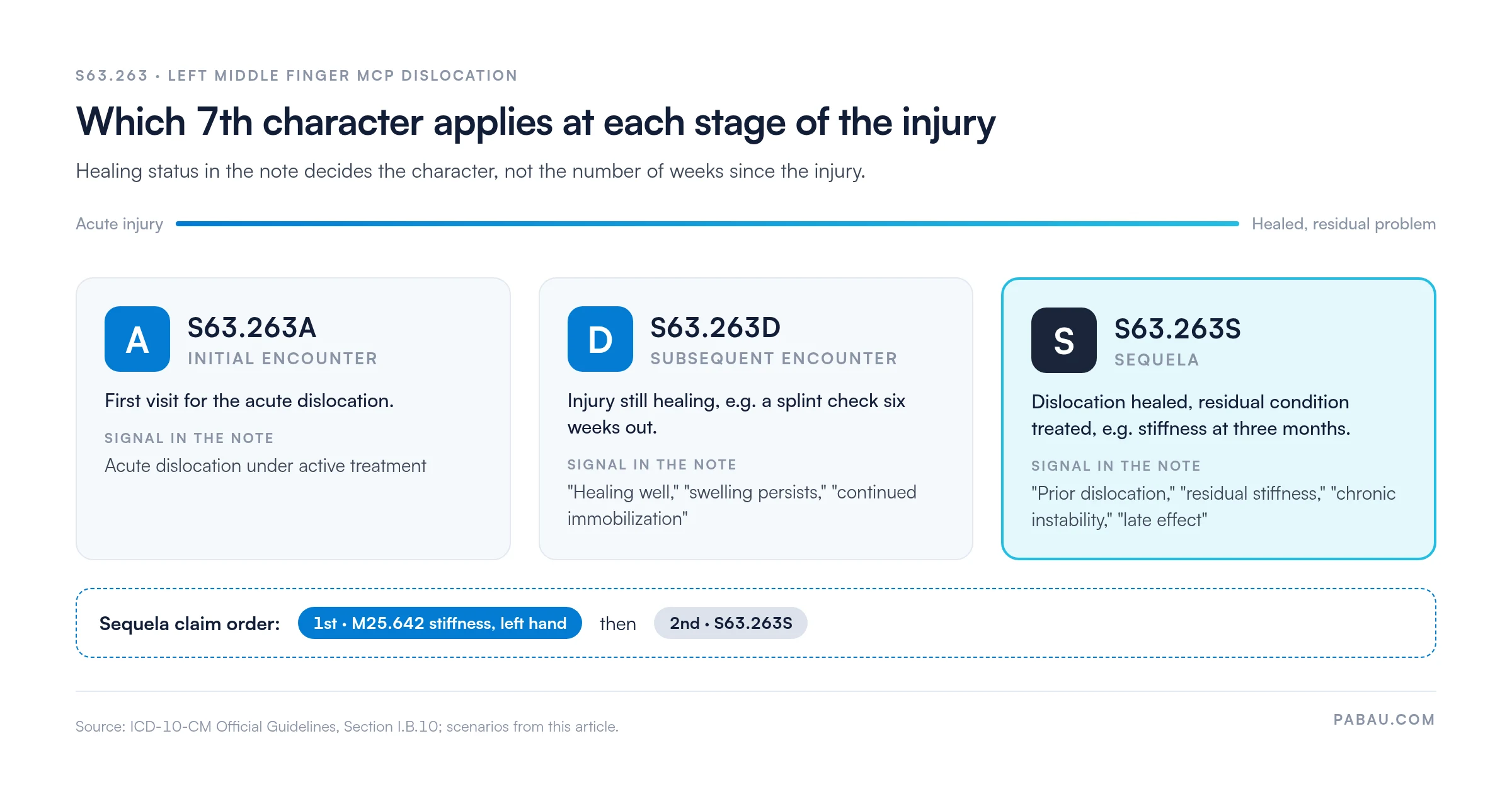
The same principle holds across Chapter 19. The healing status of the original injury decides which 7th character applies, and the passage of time alone does not.
Check the provider’s language carefully before assigning the 7th character. Words like ‘residual,’ ‘chronic,’ ‘late effect,’ or ‘post-traumatic’ in the assessment and plan are strong indicators that ‘S’ is correct. If the note describes the injury as still healing, use ‘D’ instead.
The S63 category carries tabular notes that shape how S63.263S is used, and the sequela guideline decides where it sits on the claim.
Per ICD-10-CM Official Guidelines Section I.B.10, when the sequela condition is the reason for the encounter, sequence the sequela condition code first. S63.263S is then listed as an additional code to identify the original injury. Take a patient in occupational therapy for post-traumatic stiffness after a prior left middle finger MCP dislocation. The stiffness code, such as M25.642 (stiffness of left hand), is the principal diagnosis, and S63.263S is the secondary code.
S63.263S does not cover dislocation of an interphalangeal joint of the left middle finger. Those injuries are coded under S63.27- (unspecified interphalangeal joint), S63.28- (proximal interphalangeal joint), or S63.29- (distal interphalangeal joint). When the note names no joint at all, the S63.25- group of unspecified finger dislocations applies instead. For a left little finger at the initial encounter, that code is S63.257A.
The codes most frequently confused with S63.263S share the same anatomical base but differ in encounter type, laterality, or digit. Each mismatch generates a different denial pattern. Thumb injuries fall outside S63.2 altogether, so a healing right thumb MCP subluxation uses S63.111D instead.
Verify the laterality and digit against both the operative report and the provider’s note before finalizing the code. A laterality mismatch is one of the quickest ways to trip a Medicare edit. The AAPC ICD-10-CM code search lists the full S63.26- family with official descriptors, so you can confirm the digit at a glance.
A sequela visit is usually about rehabilitation or managing the residual condition rather than acute reduction. The CPT codes below reflect that.
Billing an acute procedure code such as 26700 with S63.263S, without supporting documentation, is a CPT/ICD mismatch. Payers read the sequela code as meaning the original injury has resolved. An acute reduction CPT then implies a new acute event, which needs a new initial encounter code. That conflict invites an audit.
Missing any one of the four documentation elements below gives a payer grounds to deny or downcode the claim. Each element maps to a specific audit question.
The same rule governs every sequela diagnosis. The coder codes what is documented, not what can be inferred. A clean claim starts with documentation that supports every character in the code.
S63.263S is a valid, billable code accepted by Medicare and most commercial payers. Coverage for the associated encounter depends on what condition and service drive the visit, not on S63.263S itself.
Medicare applies the ICD-10-CM sequencing rule strictly. The sequela condition code, for example M25.642 for stiffness of the left hand, must appear as the primary diagnosis. S63.263S as the sole diagnosis will often draw a medical necessity denial.
Medicare needs the treated condition, not only the historical injury, to drive the claim. Practices can confirm current coverage policy through the CMS ICD-10 codes page.
Finger dislocation sequela codes can support home health and outpatient occupational therapy authorizations as secondary diagnoses. Check your Medicare Administrative Contractor’s local coverage determination (LCD) for the documentation it expects for skilled occupational therapy. Prior authorization rules vary by payer and plan, so confirm them at pre-certification.
Injury sequela codes are typically exempt from present-on-admission (POA) reporting requirements for inpatient admissions. Verify S63.263S against the current annual CMS POA exempt list before asserting exempt status on an inpatient claim. The list is updated each fiscal year.
Sequela codes can trigger utilization review. Document the treatment plan and functional goals clearly to support any prior authorization request for therapy services.
Most denials for S63.263S fall into six predictable categories. Each has a one-step resolution.
Tracking denial codes by code family shows whether an S63.263S denial pattern comes from thin documentation, coder training, or payer policy. A periodic audit of every sequela claim confirms correct 7th character assignment across the S63 category.
Run a quarterly audit of every claim submitted with a 7th character ‘S’ code. Filter by claim adjustment reason codes CO-4 (procedure code inconsistent with the modifier) and CO-11 (diagnosis inconsistent with the procedure). Those two codes are where CPT/ICD sequela mismatches usually surface, before they age into write-offs.
On a busy coding desk, sequela errors are easy to make. A biller picks “D” out of habit, lists S63.263S without the stiffness code, or keys the wrong digit. The mistake only shows up weeks later on the remittance.
Practice management software like Pabau keeps the treatment note, the invoice, and the claim in the same patient record. Its built-in claims management runs validation checks in the background every time you send a claim. US practices submit electronically through Claim.MD, with real-time eligibility checks and ERA remittance posting.
Every claim then moves through five visible statuses, from pending to paid or error. A rejected sequela claim surfaces the same week, so your team fixes the code while the visit is still fresh.

Pabau checks each claim for missing details before it’s sent and tracks its status through to payment. Your team spots problems on codes like S63.263S before they turn into denials.

Treat the 7th character on S63.263S as a decision the note has to make for you. Before you assign “S”, check that the provider has recorded the dislocation as healed and named the residual problem being treated.
If either piece is missing, query the provider before the claim goes out. A short query costs far less than a denial, an appeal, and a resubmission. And once “S” is right, lead the claim with the residual condition code, not with S63.263S.
Book a demo to see how Pabau keeps sequela claims moving from the treatment note to payment without the rework.

Need a structured approach to reducing billing errors? Denial management in healthcare billing covers the systematic strategies practices use to track, appeal, and prevent recurring claim rejections.
Want to understand how clearinghouse submissions work? Medical claims clearinghouse guide explains how electronic claims move from practice to payer and where coding errors are caught.
New to the billing side of injury coding? Medical billing fundamentals walks through the workflow from documentation to claim submission.
ICD-10 Code S63.263S is the billable diagnosis code for the sequela of a dislocation of the metacarpophalangeal (MCP) joint of the left middle finger. The 7th character “S” indicates the original dislocation has healed. The patient is now being treated for a residual condition, such as chronic instability, post-traumatic stiffness, or persistent joint pain.
Use “S” when the original dislocation has fully healed and the patient presents for treatment of a residual condition caused by that prior injury. Use “D” when the original dislocation is still healing and the patient returns for continued active treatment of that same injury. The key indicator is the provider’s documentation of the injury’s healing status, not simply how much time has passed since the initial encounter.
Yes, S63.263S is a fully billable and valid ICD-10-CM code for fiscal years 2025 and 2026. It is a complete 7-character code that meets the specificity requirements for claim submission. Verify the current code status using the CDC/NCHS ICD-10-CM lookup tool before each coding year begins.
S63.263D (subsequent encounter) is used while the left middle finger MCP dislocation is still healing and the patient returns for continued treatment. S63.263S (sequela) is used once that injury has resolved and the patient presents with a complication it caused, such as stiffness or instability. Submitting “D” when the injury has healed is one of the most common denial triggers for this code.
The note must reference the prior MCP dislocation of the left middle finger, with a date or prior encounter to back it up. It must also record that the original injury has resolved and name the residual condition being treated. Finally, it must confirm the left hand, the middle finger, and the MCP joint level. Missing any of these elements is grounds for denial.
The top three are using “D” instead of “S” after the injury has healed, leaving out the residual condition code, and a right-left laterality mismatch. Digit mismatches, such as middle vs. ring finger, are close behind. So is an acute reduction CPT paired with a sequela diagnosis, and thin documentation of the prior injury. Each one maps to a correctable documentation or code-selection error.