ICD-10 Code Y76.0: Diagnostic obstetric and gynecological devices
ICD-10 Code Y76.0: Definition and billable status ICD-10 Code Y76.0 is a valid, ...

Last Updated: Oct 23, 2026
Billable Code Specific Code
Y84.9 is the billable ICD-10-CM code for an abnormal reaction or later complication caused by an unspecified medical procedure, with no misadventure recorded.
It's an external cause code from Chapter 20 (V00-Y99), valid for FY 2025 and FY 2026, and always reported as a secondary code. Use it only when three conditions hold: the complication is documented, the procedure caused it, and no misadventure is noted. If the record names the procedure type, a specific Y84.0-Y84.8 code applies instead.
Let Pabau's smart automation suggest the right codes, reduce claim denials, and keep your practice compliant—effortlessly.
Automate repetitive tasks and focus on what matters most—your patients.
Reduce coding errors and ensure compliance with the latest regulations.
Clean claims, fewer denials, and faster reimbursements.
Powerful insights and reporting to help your practice thrive.
HIPAA compliant SOC 2 certified GDPR-compliant Trusted by 4,000+ clinics worldwide

ICD-10 Code Y84.9 covers abnormal reactions or later complications of an unspecified non-surgical medical procedure with no misadventure documented.
Y84.9 is always an additional or secondary code and can never be sequenced as a principal diagnosis.
Use Y62-Y69 misadventure codes instead of Y84.9 whenever the record documents a procedural error.
Query the provider for the procedure type first, because a named procedure unlocks a specific Y84.0-Y84.8 code.
Practice management software like Pabau runs validation checks each time a claim is sent, so missing details surface before the insurer sees them.
ICD-10 Code Y84.9 is the billable code for an abnormal reaction or later complication caused by an unspecified medical procedure, with no misadventure noted. The CMS ICD-10-CM annual release confirms it as valid for FY 2025 and FY 2026.
The code sits within a precise ICD-10-CM hierarchy, set out in the table below. Knowing that hierarchy is what keeps Y84.9 from becoming a habitual default.
Y83.9 covers unspecified surgical procedures, and Y84.9 covers unspecified non-surgical medical procedures. Picking the wrong one of the two creates a documentation mismatch that payers can detect during review.
Surgical procedures involve an operative intervention on the patient’s body. Non-surgical medical procedures include catheterization, injection, aspiration, dialysis, radiological procedures, shock therapy, and blood sampling. If the record doesn’t say which kind the procedure was, query the provider before assigning either code.
Y84.9 is the last-resort unspecified option in the Y84 category. Before assigning it, confirm the record does not support a more specific sibling code. According to the CDC/NCHS ICD-10-CM web tool, the full Y84.x set covers nine named procedures before the unspecified tenth.
Complication, adverse effect and misadventure sit close together in the ICD-10-CM taxonomy, and mixing them up sends a claim to the wrong code family. ICD-10 Code Y84.9 fits only a procedure’s abnormal reaction or later complication. No misadventure can have occurred, and no drug adverse effect can be involved. The four checks below rule out each alternative in turn.
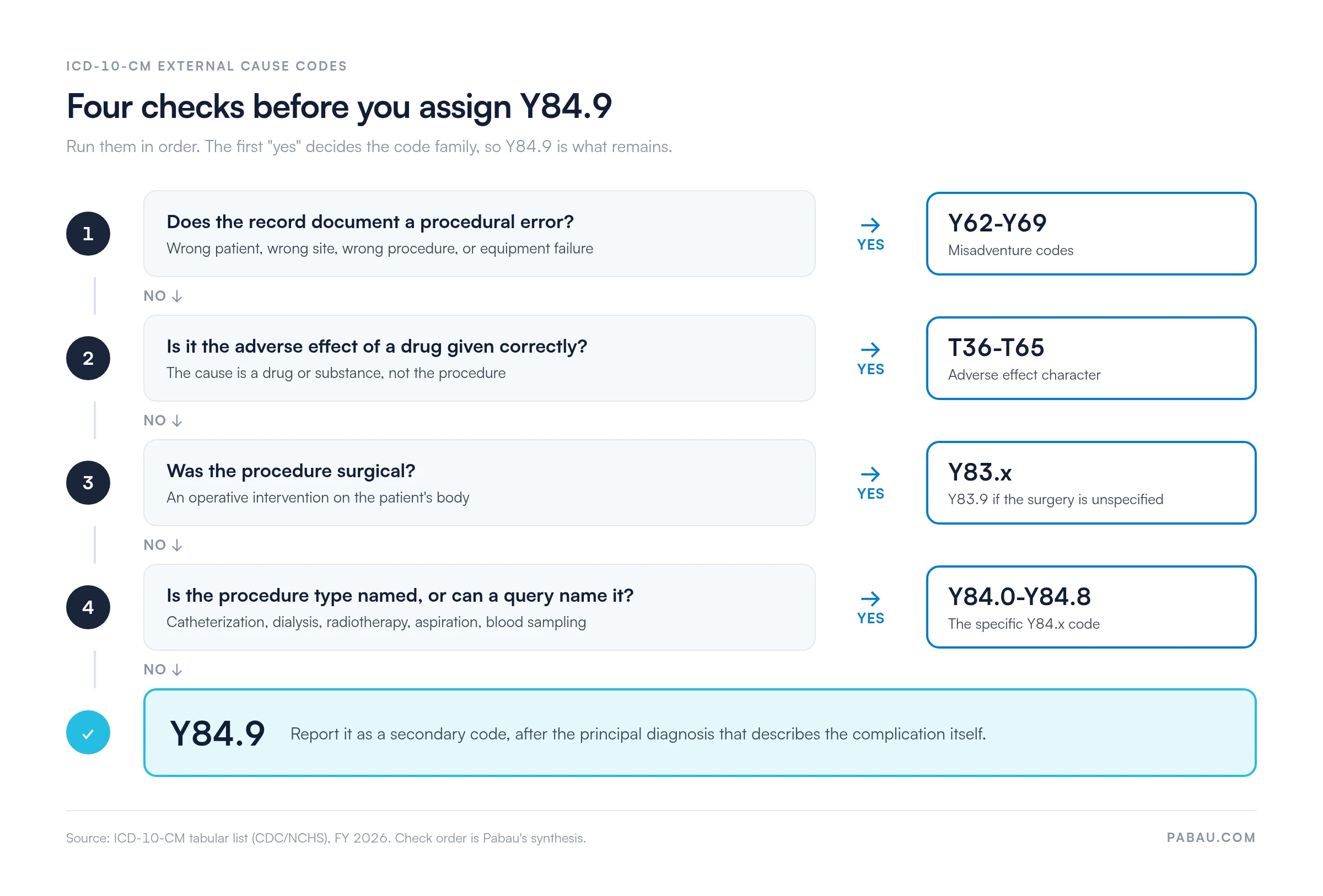
The Y84.9 descriptor explicitly states “without mention of misadventure.” If the record documents any procedural error, a misadventure code from Y62-Y69 replaces Y84.9. Where the error is documented but its type isn’t, Y69 is the unspecified misadventure code. Coding Y84.9 over a documented error also hides a quality-of-care event that facilities are required to report.
Y84.9 is never the principal diagnosis. ICD-10-CM Chapter 20 guidelines, maintained jointly by CMS and NCHS, prohibit external cause codes from being sequenced as the primary reason for an encounter. Y84.9 always follows the principal diagnosis code that describes the complication or abnormal reaction itself.
The correct sequence in practice works as follows:
For facility claims (UB-04), external cause codes are placed in the additional diagnosis fields. On professional claims (CMS-1500), they appear in Box 21 as supplementary diagnosis codes after the principal. Build a sequencing review into your pre-submission routine, so a Y84.9 listed ahead of the principal never reaches the payer. Pabau’s claims software for coders adds background validation checks each time a claim is sent.
Before defaulting to Y84.9, run a CDI (clinical documentation improvement) query asking the provider to specify the procedure type. Even a broad category, such as ‘injection’ or ‘dialysis’, unlocks a more specific Y84.x code. It also lowers the risk of a medical necessity review. Reserve Y84.9 for cases where the provider cannot be more specific after querying.
Chapter 20 of ICD-10-CM covers external causes of morbidity. The guidelines, published jointly by CMS and NCHS, establish several rules that govern Y84.9 use directly.
A defensible Y84.9 claim rests on four documentation elements. Without all four, the code is vulnerable to a medical necessity review or an audit finding.
CDI specialists should place a query whenever the procedure causing a complication is described only as “a procedure” or “the procedure” in the notes. Specificity at the Y84.x level is nearly always achievable with one clarifying question. Assigning Y84.9 without a CDI query when the procedure type is potentially identifiable is a compliance risk, particularly during post-payment audits.
Payer policies for external cause codes vary. Knowing the standard positions helps billing teams anticipate where Y84.9 creates friction.
Submitting through a clearinghouse adds a second check before a Y84.9 claim reaches the payer. In the US, Pabau connects to Claim.MD for electronic submission, real-time eligibility checks, claim status tracking, and ERA posting. The clearinghouse flags payer-specific edits at that stage, before they turn into a first-pass denial.
Y84.9 denials follow predictable patterns. Each one maps to a specific documentation or sequencing failure that can be caught before submission.
Each of these failures can be caught before submission with a sequencing and misadventure review. When a denial still comes back, match its reason code to the row above to see which fix applies. Our denial codes reference explains what each code means.
In many practices, a coder checks each Y84.9 claim by hand. They read the note, confirm the sequencing, and re-key the codes into a separate billing tool. Missing details often only show up when the remittance comes back.
Practice management software like Pabau keeps the visit, the codes, and the claim on the same patient record. Pabau runs validation checks each time a claim is sent, so details like membership numbers and authorization codes are in place. In the US, claims go to payers through the Claim.MD connection without leaving the platform.
Every claim then sits in the Claims dashboard with a live status, from pending to paid. A claim that lands in the error stage goes back to your team to fix and resubmit. A Y84.9 sequencing slip gets corrected in the same place it was coded.

Pabau checks each claim before it’s sent, submits it to payers electronically, and tracks its status until it’s paid. See how it works for your billing team.

Treat Y84.9 as the code you reach last. If the chart names the procedure, documents an error, or points to a drug, a different code applies, and the claim is stronger for it.
The habit worth building is the CDI query. One clarifying question to the provider usually turns Y84.9 into a specific Y84.x code, which removes a common trigger for a records request.
When Y84.9 is still the right code, the risk moves to sequencing. List it after the principal diagnosis every time, and confirm no misadventure language appears in the note. Book a demo to see how Pabau checks and tracks claims like these from submission to payment.

Was the procedure surgical? ICD-10 Code Y83.6 shows how the Y83 surgical block codes a complication after partial or total organ removal.
Want to understand how denials are tracked after submission? Denial management in healthcare explains how CARC and RARC codes are used to categorize and resolve claim rejections.
Looking for a guide to submitting clean claims with secondary codes? Clean claim standards outlines the elements required for first-pass acceptance on claims with additional diagnosis codes.
Preparing your coding for an audit? Medical billing compliance covers the rules and documentation habits that keep coded claims defensible.
ICD-10 Code Y84.9 is the diagnosis code for an abnormal reaction or later complication caused by an unspecified medical procedure. No misadventure can be mentioned at the time of the procedure. It is a Chapter 20 external cause code, always used as a secondary or additional code alongside a principal diagnosis that describes the complication itself.
Yes, Y84.9 is a valid billable ICD-10-CM code for FY 2025 and FY 2026. It must be verified against the CMS annual release each October 1, as code validity is updated on a fiscal-year basis.
Y83.9 covers unspecified surgical procedures as the cause of an abnormal reaction, while Y84.9 covers unspecified other medical (non-surgical) procedures. The key distinction is procedure type. Surgical interventions use the Y83.x block. Non-surgical medical procedures such as catheterization, injections, dialysis, and radiological procedures use the Y84.x block.
No. Y84.9 is an external cause code and can never be sequenced as a principal diagnosis. ICD-10-CM Chapter 20 guidelines prohibit external cause codes from being the primary reason for an encounter. The complication or abnormal reaction must be coded as principal using an appropriate condition code, with Y84.9 assigned as an additional code.
Four problems cause most Y84.9 denials. The code is placed as the principal diagnosis, or the principal diagnosis for the complication is missing. The unspecified code can also trigger a medical necessity review. Finally, Y84.9 may be used where the record documents a procedural error, which calls for a misadventure code (Y62-Y69).
Four elements are required. A provider note must explicitly link the complication to a medical procedure. The record must show the procedure is unspecified or can’t be identified more precisely. It must contain no misadventure or procedural error language. The complication also needs its own separately coded principal diagnosis. Issue a CDI query before defaulting to Y84.9 when the procedure type may be identifiable.