ICD-10 Code Y76.0: Diagnostic obstetric and gynecological devices
ICD-10 Code Y76.0: Definition and billable status ICD-10 Code Y76.0 is a valid, ...

Last Updated: Oct 23, 2026
Billable Code Specific Code
S63.230A is the billable ICD-10-CM code for subluxation of proximal interphalangeal joint of right index finger, initial encounter. It applies to a partial displacement of the middle knuckle, coded at the first visit with active treatment.
Coders confuse it most often with S63.280A, complete dislocation of the same joint, and with the S63.24- codes for distal interphalangeal subluxations. Documentation must confirm the right index finger, the PIP joint, and a partial displacement before the code goes on a claim.
Let Pabau's smart automation suggest the right codes, reduce claim denials, and keep your practice compliant—effortlessly.
Automate repetitive tasks and focus on what matters most—your patients.
Reduce coding errors and ensure compliance with the latest regulations.
Clean claims, fewer denials, and faster reimbursements.
Powerful insights and reporting to help your practice thrive.
HIPAA compliant SOC 2 certified GDPR-compliant Trusted by 4,000+ clinics worldwide

S63.230A covers subluxation of the right index finger’s PIP joint at the initial encounter, while complete dislocation of that joint uses S63.280A.
The 7th character must match the encounter: A for the first active-treatment visit, D for follow-up, and S for sequela.
Repeating A on follow-up and physical therapy visits is the leading denial trigger for this code.
Documentation must confirm right-hand laterality, the index finger, and a partial rather than complete displacement.
Practice management software like Pabau flags 7th-character mismatches and missing laterality before a claim reaches the clearinghouse.
ICD-10 Code S63.230A is the billable ICD-10-CM code for subluxation of the proximal interphalangeal joint of the right index finger, initial encounter. Use it on the first visit where the finger receives active treatment, then switch to S63.230D for follow-up care.
The table below confirms billability, hierarchy, and the valid 7th characters before you submit a claim.
S63.230A covers a subluxation of the proximal interphalangeal (PIP) joint of the right index finger at the initial encounter for active treatment. The PIP joint is the middle knuckle, between the proximal and middle phalanges. In a subluxation the joint surfaces are partly displaced but keep some contact. In a complete dislocation that contact is lost entirely.
Subluxation and dislocation are clinically and structurally distinct injuries. The ICD-10-CM tabular list gives each its own code, and payers treat them differently for medical necessity and reimbursement.
Assigning S63.280A when the record documents subluxation is upcoding. The reverse causes trouble too. If the record documents a complete dislocation and the claim carries S63.230A, the payer may deny the reduction procedure as unsupported by the diagnosis.
The 7th character in S63.230A records the episode of care, while the first six characters describe the injury itself. The ICD-10-CM Official Guidelines for Coding and Reporting require this character on every injury code. Choosing the wrong one is a frequent reason finger subluxation claims come back to the provider.
A common billing error is applying S63.230A to every physical therapy visit for the same injury. The guidelines reserve A for the active-treatment encounter. Follow-up PT sessions for that injury carry S63.230D. Repeating A on sequential dates generates duplicate-claim flags and can prompt a retrospective audit of the whole injury episode.
Subcategory S63.23 covers PIP subluxations across the fingers of both hands. ICD-10-CM requires digit-level specificity, so each finger and side has its own code. If the injury involves a different digit or hand, use the matching code below instead of S63.230A.
Every code in subcategory S63.23 needs a 7th character before it can go on a claim. For the left middle finger, for example, submit S63.233A, S63.233D, or S63.233S depending on the encounter type. The thumb sits under S63.1 rather than S63.23, so a right thumb MCP subluxation on a healing-phase visit is S63.111D.
Several codes sit next to S63.230A in the tabular list and in clinical practice. The grid below shows how the joint level and the type of displacement move a right index finger injury from one code to another.
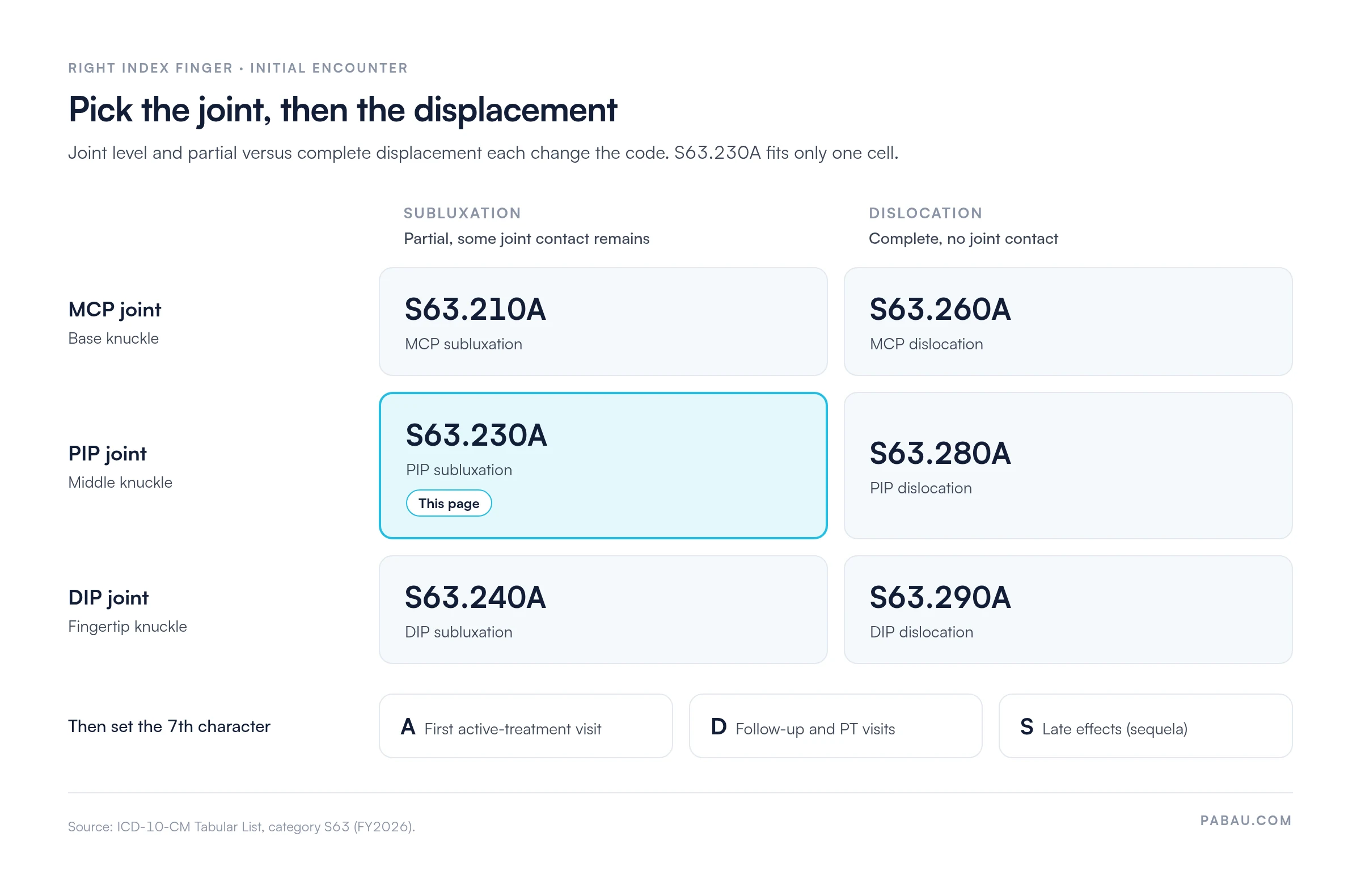
Selecting the wrong neighbor creates edit failures or medical-necessity mismatches. These are the codes most often confused with S63.230A.
Every code above names a specific joint. When a note records a complete dislocation of the left little finger without naming the joint, the correct initial-encounter code is S63.257A.
No Excludes1 note stops you from reporting S63.230A alongside a sprain code on the same encounter. Each code still needs its own support in the record. Reporting both on one visit means the note documents two distinct injuries, each with its own clinical findings.
Run a crosswalk check before submitting. Confirm the CPT code matches the anatomical site in S63.230A. A PIP closed reduction code paired with a DIP subluxation diagnosis is an automatic edit failure. Check joint, digit, and laterality for the code pair, not just the diagnosis.
CMS and commercial payers expect the medical record to support every element the diagnosis code encodes. For S63.230A, the record needs four elements before the code can be defended on audit.
Physical therapy practices billing S63.230D for follow-up visits also need the referring provider’s documentation on file. Keep the initial evaluation note alongside each subsequent encounter claim. Software that links the initial encounter record to every downstream visit makes that audit trail much easier to produce.
S63.230A is a diagnosis code, so it supports reimbursement only when paired with CPT codes that describe what was done. The table below covers the most common pairings for the initial visit and for follow-up physical therapy.
With claims software for therapists, you can build pairing rules that flag S63.230A whenever a PT-only procedure code appears. The coder then confirms that the 7th character matches the encounter type. Generating the superbill with the correct diagnosis-procedure pair at the point of care cuts downstream corrections.
When the first visit includes finger X-rays, 73140 is the imaging code that pairs with S63.230A. Imaging billed with a D-character diagnosis on a later visit needs its own documented reason.
Most payers do not require prior authorization for closed treatment of a finger subluxation at the initial encounter. Physical therapy beyond a set visit threshold usually does, so check where each payer draws that line before the claim goes out.
Verify insurance eligibility before the initial encounter and before each PT authorization renewal, so coverage problems surface before services are delivered. Practices that submit claims through Claim.MD can run real-time eligibility checks against 400+ payers at scheduling. The check confirms active coverage and flags prior authorization requirements before the patient arrives.
Tracking each authorization alongside the encounter history keeps an injury episode billable from start to finish. A practice that bills PT visit 8 without confirming authorization after visit 6 will receive a denial. Appealing it takes far more staff time than the authorization check would have.
Five errors cause most claim denials on S63.230A. Each one is preventable at the point of coding, well before the appeals process.
Review medical billing denial codes for musculoskeletal claims as a team at least once a quarter. The pattern tells you where to act. S63.230A denials clustered on 7th-character errors point to coder training, while a spread across error types points to the documentation workflow. Claim.MD returns claim adjustment reason codes (CARCs) with each remittance, so these patterns show up without claim-by-claim review.
Build a five-question coding checklist for finger subluxation encounters. Confirm right or left, which digit, and which joint (PIP, DIP, or MCP). Confirm partial or complete displacement. Then confirm whether this is the first active-treatment visit (A) or a follow-up (D). Those five answers prevent most S63.230A denials.
Without a check before submission, a wrong 7th character or a missing laterality note usually surfaces when the denial arrives. By then the claim has to be corrected, resubmitted, and tracked through a second payment cycle.
Pabau’s claims management software carries built-in ICD-10 and CPT catalogs with payer-specific rules. The coder picks S63.230A or S63.230D from the encounter, and the claim is checked for 7th-character and laterality mismatches before it leaves the practice.

Physical therapy and sports medicine practices get fewer returned claims across a finger injury episode. Their billing staff also spend less time on appeals and more time on new claims.

Pabau’s built-in ICD-10 and CPT catalog flags 7th-character mismatches before claims leave your practice. Pair the right diagnosis code with the right procedure code on every claim.

Code S63.230A only when the note names the right hand, the index finger, the PIP joint, and a partial displacement. If any one of those is missing, send the note back to the clinician before the claim goes out.
The larger revenue risk comes after the first visit. Switch to S63.230D once active treatment ends, and track PT authorizations against each payer’s visit threshold. A few seconds of checking per encounter costs far less than weeks of appeals.
Book a demo to see how Pabau keeps finger injury episodes coded correctly from the first visit to discharge.

Want to reduce claim denials across injury codes? Denial management in healthcare outlines a workflow for identifying, appealing, and preventing the most common denial patterns.
Checking coverage before a PT course starts? Insurance eligibility verification walks through what to confirm before the first visit so therapy claims are not denied for coverage.
Hitting authorization limits on therapy visits? The prior authorization process explains how to request and track approvals without delaying care.
Pairing diagnosis and procedure codes at checkout? Superbill guide covers the fields a superbill needs for clean reimbursement.
Looking for the right clearinghouse for musculoskeletal claims? Medical claims clearinghouse guide explains how clearinghouses validate claims and route them to payers.
ICD-10 Code S63.230A is the billable diagnosis code for subluxation of the proximal interphalangeal joint of the right index finger, initial encounter. Subluxation means the PIP joint, the middle knuckle, is partly displaced with some articular contact remaining. The code applies at the first active-treatment visit.
Yes, S63.230A is a billable ICD-10-CM code valid for claim submission. The parent code S63.230 is not billable without a 7th character, and payers reject it. Adding A, D, or S makes the code valid for billing.
In ICD-10-CM, subluxation is a partial joint displacement with some articular contact remaining. Dislocation is a complete displacement with no articular contact. For the right index PIP joint at initial encounter, subluxation is S63.230A and complete dislocation is S63.280A. The clinical record and imaging report must state which condition is present. Coders cannot switch between the two codes based on treatment alone.
Use A (initial encounter) only for the first visit with active treatment, such as examination, reduction, imaging, or splinting. Use D (subsequent encounter) for follow-up visits, including physical therapy sessions for the same injury. Use S (sequela) only after the acute phase resolves, for late effects such as chronic stiffness or post-traumatic arthritis.
S63.230A covers subluxation of the proximal interphalangeal (PIP) joint, the middle knuckle of the right index finger. S63.240A covers subluxation of the distal interphalangeal (DIP) joint, the fingertip knuckle of the same finger. The clinical record must specify which joint is affected.
The medical record must state right-hand laterality explicitly and identify the index finger or second digit. It must specify the PIP joint or middle knuckle and describe the displacement as partial rather than complete. If the X-ray report says “dislocation” while the note says “subluxation,” get a physician addendum before coding.