ICD-10 Code Y76.0: Diagnostic obstetric and gynecological devices
ICD-10 Code Y76.0: Definition and billable status ICD-10 Code Y76.0 is a valid, ...

Last Updated: Oct 23, 2026
Billable Code Specific Code
S63.257A is the billable ICD-10-CM code for unspecified dislocation of left little finger, initial encounter.
Coders use it most often in urgent care and emergency settings. It fits when the note confirms a traumatic dislocation of the left fifth finger, rules out fracture, and doesn't name the joint. Once the joint is documented, a joint-specific code from S63.26- to S63.29- applies instead.
Let Pabau's smart automation suggest the right codes, reduce claim denials, and keep your practice compliant—effortlessly.
Automate repetitive tasks and focus on what matters most—your patients.
Reduce coding errors and ensure compliance with the latest regulations.
Clean claims, fewer denials, and faster reimbursements.
Powerful insights and reporting to help your practice thrive.
HIPAA compliant SOC 2 certified GDPR-compliant Trusted by 4,000+ clinics worldwide

S63.257A is a valid, billable ICD-10-CM code for 2026, covering an unspecified traumatic dislocation of the left little (fifth) finger at the initial encounter.
The 7th character A marks active treatment, while subsequent encounters take D and sequelae take S.
Documentation must confirm left laterality, the fifth finger, no fracture, and a dislocation rather than a sprain before this code is assigned.
Once the note names the joint, a joint-specific code such as S63.267A for the MCP joint replaces S63.257A.
Practice management software like Pabau sends US claims through its Claim.MD integration, with eligibility checks and remittance posting in the same workflow.
ICD-10 Code S63.257A describes an unspecified dislocation of the left little finger during an initial encounter for active treatment.
“Unspecified” here means the clinical note does not identify which joint of the little finger is dislocated. The options are the MCP, PIP, and DIP joints. When the note names the dislocated joint, a joint-specific code applies instead:
The left little finger has three primary joints, any of which can dislocate traumatically. Dorsal PIP dislocations are the most common pattern clinically, but without joint-specific documentation, S63.257A is the correct assignment. Two conditions must hold for this code to apply:
Clinicians sometimes document “jammed finger” or “finger sprain.” Neither supports S63.257A. A sprain of a finger ligament codes to S63.6-. The clinical note must explicitly confirm dislocation, or the coder must query the provider before assigning this code. A note describing partial displacement points to the subluxation codes instead, such as S63.230A for a right index PIP subluxation at the initial visit.
S63.257A sits in the S60-S69 block for injuries to the wrist, hand and fingers, inside the injury chapter. Understanding the hierarchy helps coders navigate adjacent codes and apply excludes notes correctly. The full path is shown in the table below.
The parent category S63 covers traumatic dislocations and sprains at wrist and hand level. Within it, thumb dislocations (S63.1-) and wrist dislocations (S63.0-) have their own subcategories, so a little-finger code never covers them. Reviewing the hierarchy prevents miscoding to the wrong anatomical site.
ICD-10-CM requires a 7th character on all S63.257 codes to indicate the episode of care. Omitting the 7th character produces an invalid code that payers will reject at the front-end edits stage. Three valid suffixes apply.
A common error is using S63.257A at a follow-up visit two weeks after the initial reduction. Once active treatment ends and the injury enters the healing phase, the suffix moves to D for that visit. Per CMS ICD-10-CM coding guidelines, A can cover several visits while the practitioner is still actively treating the injury. Once the injury has healed and the visit addresses a residual problem, the suffix moves to S instead. The sequela claim then leads with the residual condition code, as S63.263S sets out.
Flag the visit type in your workflow before code selection. Active reduction or manipulation = ‘A’. Splint check or range-of-motion follow-up = ‘D’. Getting this wrong is one of the most common denial triggers for finger dislocation codes.
S63.257A sits within the S63.25 group, which covers unspecified dislocations of each finger on each side. Coders working with bilateral hand injuries or uncertain documentation need to distinguish these clearly.
S63.259x (unspecified finger) is a fallback of last resort. Laterality is usually determinable from the clinical note or X-ray report. Using S63.259x when the note confirms the left little finger is a documentation-based downgrade that some payers flag during audit. Query the provider before accepting unspecified finger coding.
Category S63 covers traumatic dislocations and sprains at wrist and hand level. Its notes decide which neighboring injuries you code alongside it and which you code elsewhere. Reviewing these notes before submitting ICD-10 Code S63.257A is part of a clean-claim workflow.
S63 includes:
S63 Excludes2 (both codes can be reported when both are documented):
Fractures: Fractures of the wrist and hand bones code to S62.-. A fracture-dislocation codes from the fracture category.
Pathological dislocations: Any dislocation arising from a disease process (rheumatoid arthritis, Marfan syndrome, connective tissue disorder) codes to M24.34-, not S63.257A. For the left hand, that is M24.342. The S-code range is reserved for traumatic injuries only. Confirming the mechanism of injury in the note is the fastest way to rule this distinction in or out. Review the excludes notes for every trauma code before you finalize the claim.
The clinical note must contain four specific elements before a coder can assign ICD-10 Code S63.257A with confidence. Missing any one of these elements is grounds for a provider query.
When the note says “unspecified” or names no joint, S63.257A is appropriate without a provider query for joint specificity alone. The Coding Guidelines permit unspecified coding when the information is genuinely not available.
Save provider queries for notes that are ambiguous on laterality or injury type. A missing joint name alone doesn’t justify one. Build documentation checklists into intake, so coders rarely chase missing laterality after the visit.
ICD-10 Code S63.257A most commonly pairs with closed reduction CPT codes when the treating provider performs the reduction during the same encounter. The CPT code depends on which joint was reduced. Codes 26770 to 26785 cover interphalangeal (PIP or DIP) dislocations, while MCP-joint dislocations take 26700 or 26705.
CPT 26770 is the most frequently paired code for urgent care encounters. Because S63.257A leaves the joint unnamed, check the procedure note before you choose between the interphalangeal and MCP series. Also confirm whether the payer bundles an anesthetic block into 26770 or pays it separately.
At follow-up visits with only an evaluation and management service, an E/M code replaces the reduction CPT. The diagnosis then takes the D suffix. The CPT codes reference lists the descriptors for the procedure side of each pairing.
Claims management software with built-in CPT and ICD-10 catalogs reduces selection errors at this step. For current Medicare fee schedule values, the CMS Physician Fee Schedule lookup provides RVU-based reimbursement data by code and locality.
Most closed finger dislocation reductions do not require prior authorization from commercial payers or Medicare. The service is typically considered medically necessary when supported by imaging confirming dislocation and a clinical note documenting the reduction technique. Three documentation items consistently satisfy payer audit requests.
Medicare follows the ICD-10-CM Official Guidelines without a published Local Coverage Determination specifically for finger dislocation reduction in most jurisdictions. Checking for MAC-specific LCD policies before billing is still recommended. Checking eligibility when the visit is booked surfaces specialty restrictions before the patient arrives.
Denials on S63.257A cluster around five predictable error types. Most are preventable with a pre-submission documentation review.
Tracking the CARC (Claim Adjustment Reason Code) values on each remittance shows which of these patterns drives denials at each payer. Submitting claims as 837 electronic files through a clearinghouse also runs front-end edits that catch a missing 7th character before the claim reaches the payer.
Several codes are frequently confused with S63.257A. The five checks below settle most of the mix-ups coders meet in finger dislocation notes.
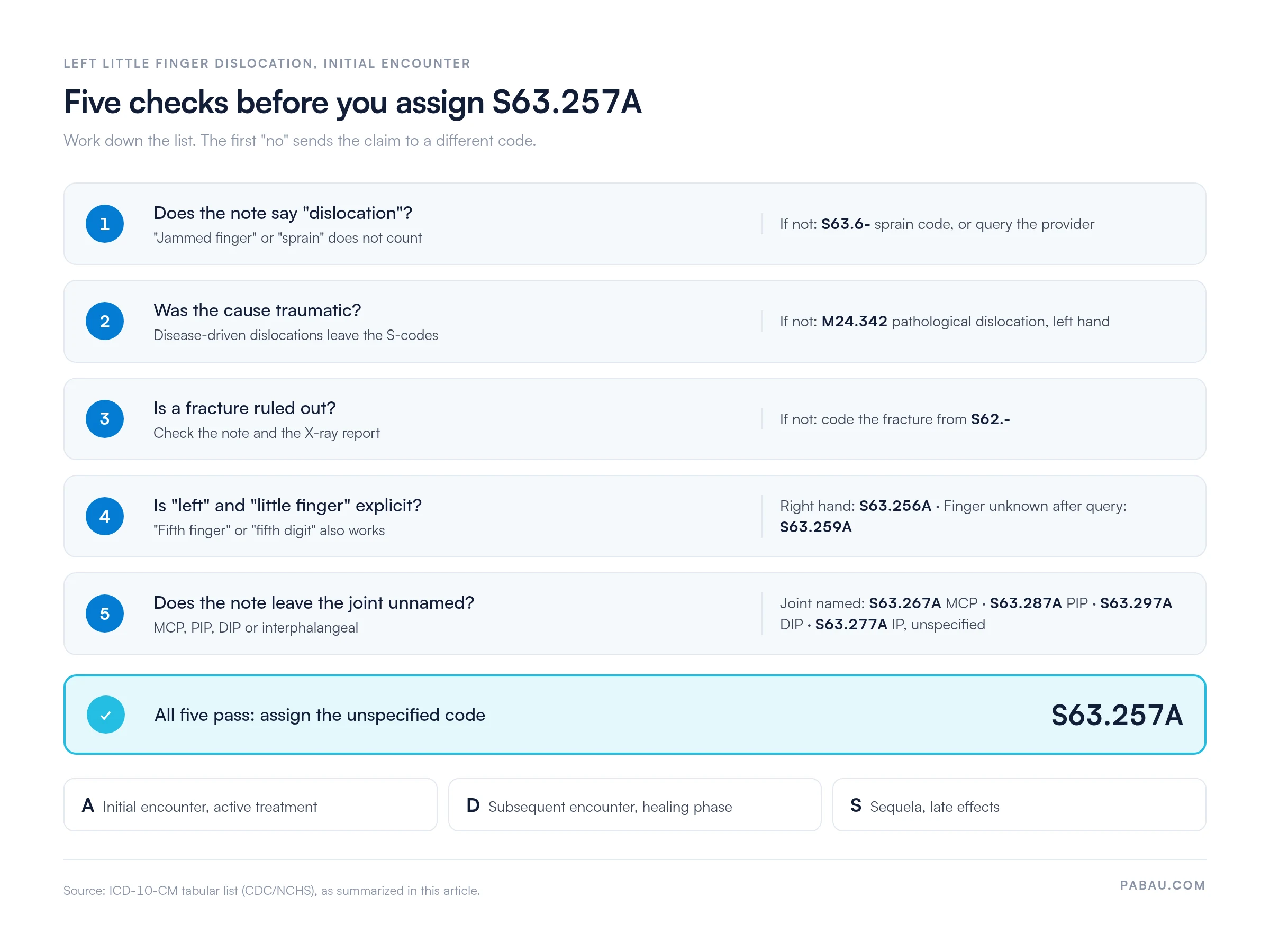
The table maps each alternative code to the documentation that points to it.
The most consequential distinction is between S63.257A and a sprain code. Coders cannot infer dislocation from sprain documentation or vice versa. “Jammed finger” is not a dislocation until a provider explicitly confirms it. When documentation is borderline, check the official descriptor and hierarchy notes first. The AAPC’s ICD-10-CM code lookup and the CDC ICD-10-CM web tool both show them. A clean claim needs a diagnosis code that matches the documented clinical picture, so a provider query beats a coding assumption.
When a note says ‘reduced finger dislocation’ but does not specify which joint, assign S63.257A rather than a joint-specific code. Specificity beyond what the note supports is upcoding. Query the provider if joint-specific coding matters for the payer contract, but do not assume it from the reduction technique alone.
The S63.257A denials above usually start with a mismatch that slipped through review. An A suffix lands on a splint check, or a left-side code goes out on a note that says right.
Practice management software like Pabau keeps the clinical note, the diagnosis code, and the invoice in the same patient record. The coder picks the 7th character while looking at the visit it describes.
US claims go out through Pabau’s Claim.MD integration, which runs eligibility checks, tracks claim status, and posts ERA remittances in the same dashboard. The Claim.MD clearinghouse guide walks through how that connection works.
Because remittances post back automatically, denial reason codes sit next to the claims they belong to. A recurring laterality or suffix error shows up across a batch, so you can fix the workflow behind it.

Pabau sends claims through Claim.MD, checks eligibility, and posts remittances back to the patient record. Track denial patterns and resubmit corrected claims from one platform.

S63.257A is a code for incomplete information, and that is its value. Assign it when the note confirms a traumatic left little finger dislocation but never names the joint, and skip the query for joint detail alone.
The risk sits at the edges. A missing suffix, a laterality slip, or a joint-specific code without documentation behind it costs more than the unspecified code ever will. Build those three checks into review before submission, so they never reach an appeal.
To see how Pabau keeps the note, the code, and the Claim.MD submission in one record, book a demo.

Need guidance on denial patterns across injury codes? Denial codes in medical billing covers the most common CARC codes and how to respond to each effectively.
Submitting 837 files to your clearinghouse? 837 electronic claims explains the EDI transaction set requirements, segment structure, and common submission errors.
Want to understand the full billing workflow? Revenue cycle management explains how ICD-10 coding, eligibility checks, and claims submission connect into one end-to-end billing process.
ICD-10 Code S63.257A is the billable diagnosis code for an unspecified traumatic dislocation of the left little finger at the initial encounter for active treatment. It applies when the note confirms a left fifth finger dislocation but does not say which joint (MCP, PIP, or DIP) is involved.
S63.257A is for initial encounters during active treatment such as the ED visit or first reduction. S63.257D is for subsequent encounters during the healing phase, including splint checks, follow-up visits, and physical therapy sessions after the dislocation has been reduced.
CPT 26770 (closed treatment without anesthesia) is the most common pairing for interphalangeal joint reductions in urgent care. CPT 26775 applies when anesthesia is required, and CPT 26785 covers open treatment. If the procedure note shows an MCP-joint dislocation, use 26700 or 26705 instead.
Category S63 carries an Excludes2 note for strains of muscle, fascia, and tendon of the wrist and hand (S66.-). Both codes can be reported when both are documented. Fractures code to S62.-, and pathological dislocations caused by disease code to M24.34-, not S63.257A.
The most frequent denial reasons are a missing 7th character, a laterality mismatch with the note, and an A suffix on a follow-up visit. A pre-submission documentation review catches all three.
Yes, when associated injuries are documented. A wound at the same site codes separately with the appropriate open wound code. An associated fracture would replace S63.257A as the principal diagnosis rather than accompanying it. Code any separately documented injuries to adjacent digits or structures with their own codes.