ICD-10 Code Y76.0: Diagnostic obstetric and gynecological devices
ICD-10 Code Y76.0: Definition and billable status ICD-10 Code Y76.0 is a valid, ...

Last Updated: Oct 23, 2026
Billable Code Specific Code
M95.5 is the billable ICD-10-CM code for acquired deformity of pelvis. It covers a structural pelvic change that developed after birth, most often after trauma, surgery, or long-term postural loading.
The code sits in category M95 (Other acquired deformities of musculoskeletal system and connective tissue) in Chapter 13 of ICD-10-CM. It has no child codes. Congenital pelvic deformities take Q-series codes instead, and maternal care for pelvic disproportion is coded in O33.
Let Pabau's smart automation suggest the right codes, reduce claim denials, and keep your practice compliant—effortlessly.
Automate repetitive tasks and focus on what matters most—your patients.
Reduce coding errors and ensure compliance with the latest regulations.
Clean claims, fewer denials, and faster reimbursements.
Powerful insights and reporting to help your practice thrive.
HIPAA compliant SOC 2 certified GDPR-compliant Trusted by 4,000+ clinics worldwide

M95.5 is a billable ICD-10-CM code for acquired, not congenital, structural deformity of the pelvis.
Congenital pelvic deformities take Q-series codes, and coding them as M95.5 is a common error.
Documentation must state the acquired cause (trauma, surgery, or postural origin) and the functional limitation that results.
Practice management software like Pabau checks eligibility in real time, flags missing insurer details, and sends claims electronically through Claim.MD.
ICD-10 Code M95.5 is the billable code for a structural pelvic deformity that developed after birth. Its official descriptor is “Acquired deformity of pelvis” in the CDC/NCHS ICD-10-CM tabular list. The code is billable as a principal or secondary diagnosis in the 2024, 2025, and 2026 code sets. It needs no seventh character, and no subcode exists under it for laterality or encounter type.
Because M95.5 has no child codes, it is always the most specific code for an acquired pelvic deformity. The CMS ICD-10-CM coding guidance requires codes at the highest level of detail the record documents. M95.5 meets that standard when the record clearly states an acquired pelvic deformity.
A record that falls short of that standard sends the coder back through the rest of category M95. M95.9 is the unspecified endpoint of that search, correct only once no sibling subcode matches the documented deformity.
M95.5 applies when the pelvic architecture changed after birth and the record documents it as non-congenital. The clinical trigger is physician documentation that an identifiable post-natal event or process caused the deformity. Physical therapy and pelvic health practices see the code most often in the scenarios below.
Pelvic tilt is the scenario most likely to raise a coding question in physical therapy, where therapists regularly record tilt as a biomechanical finding. M95.5 fits only when the therapist’s or referring physician’s notes call the tilt a structural acquired deformity. A postural habit or a transient compensatory pattern does not qualify.
M95.5 does not apply to pelvic deformities present from birth. Congenital pelvic abnormalities are classified in the Q-code range of Chapter 17 (Congenital malformations, deformations, and chromosomal abnormalities). Coding a condition the record calls congenital as M95.5 is a coding error, and it undermines the claim’s medical necessity. The WHO ICD-10 classification places congenital musculoskeletal conditions in that chapter, outside the M-code range.
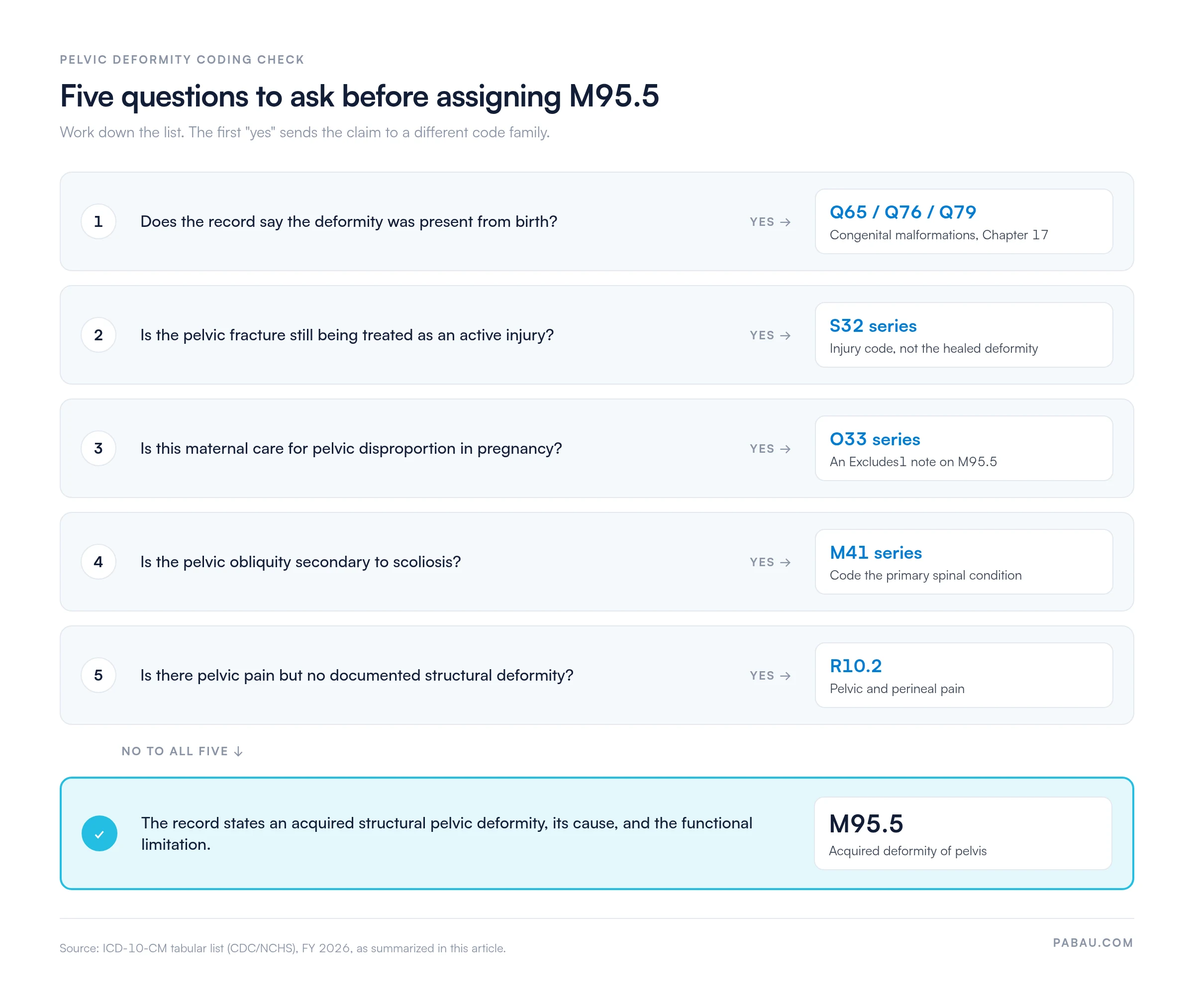
Whether a deformity is acquired or congenital is a clinical call for the treating or referring physician. Coders must not make it on their own. If the record is silent on etiology, query the provider before assigning M95.5. Pregnancy adds one more exclusion, since maternal care for pelvic disproportion is coded in the O33 series. The checklist below runs these exclusions in the order a coder should ask them.
Category M95 runs from M95.0 through M95.9, and each subcode targets a different anatomical site. There is no M95.6 or M95.7. The table below maps each code to its site and to the detail that separates it from M95.5. Each sibling has its own entry in our diagnostic codes library.
When a patient has both a chest wall deformity and a pelvic deformity, code each site the record documents separately. M95.4 and M95.5 can sit on the same claim when both are clinically relevant. Acquired curvature of the spine belongs in the M40-M43 range rather than in category M95.
M95.5 is billable, but it will not survive payer review without specific clinical documentation. Denials usually trace back to a note that mentions pelvic tilt or asymmetry without establishing the acquired origin or the functional consequence. An acquired structural diagnosis needs five elements in the clinical record.
Practices can build their clinical note templates around these five elements. Missing details then surface before the patient leaves the room, not at the billing stage.
Set up a documentation checklist in your clinical note template for any visit where M95.5 is the working diagnosis. The treating clinician confirms five items: acquired status, anatomical site, cause, functional limitation, and treatment rationale. Five fields and one confirmation step head off most denial triggers before submission.
M95.5 works as a principal or supporting diagnosis on claims for evaluating and treating an acquired pelvic deformity. Physical therapists and orthopedic practitioners are its most common billers. Check current National Correct Coding Initiative (NCCI) edits before submitting any CPT combination, because the edit tables update quarterly.
Prior authorization rules for services billed with M95.5 vary by payer, plan year, and the CPT procedure requested. No LCD or NCD governs acquired musculoskeletal deformity at the M95.5 level, so coders must check payer portals directly. Consistent patterns still emerge across commercial payers and Medicare Advantage plans.
Checking these requirements before sending an authorization request prevents the costliest delays. Most plans ask for the following before approving physical therapy or orthopedic services linked to M95.5.
A claim that is complete, correctly coded, and fully documented on first submission is far less likely to draw a review request. Building the authorization checklist into the scheduling workflow, rather than treating it as a billing step, produces the most consistent results.
Effective denial management workflows for M95.5 claims start with knowing which documentation and coding failures drive denials. The table below maps the five most consistent denial patterns to their root cause and the corrective action for each.
When a claim does deny, attach the note that documents acquired status and functional limitation directly to the appeal. Having it ready avoids the retrieval delays that push appeals past timely filing windows.
Many therapy and orthopedic practices bill M95.5 by copying the diagnosis from the clinical note into a separate billing tool or clearinghouse portal. Each hand-off is a chance to drop a membership number, an authorization code, or the note that proves medical necessity.
Pabau keeps the clinical note, the appointment, and the claim in one patient record. Its therapy practice claims software checks patient eligibility in real time and flags missing insurer details before a claim is sent. Claims then go out electronically through Claim.MD, Pabau’s US clearinghouse partner.

Claim status updates and electronic remittance advice come back into the same system. Coders still choose the codes and check NCCI edits, while Pabau handles the submission and tracking around them.

Pabau checks patient eligibility in real time, flags missing insurer details before submission, and tracks every claim through Claim.MD. See how it works for musculoskeletal billing teams.

M95.5 is rarely the wrong code for an acquired pelvic deformity. When these claims fail, the note usually failed first. It never stated the acquired origin, the functional limitation, or why the service was needed.
So the fix sits upstream of billing. Build the five documentation elements into the note template, query the provider whenever etiology is missing, and confirm prior authorization at scheduling. The trade-off is a slightly longer note, and the payoff is a claim that holds up on first submission.
Book a demo to see how Pabau keeps notes, eligibility checks, and claim tracking together for your musculoskeletal billing team.

Want to understand how claim denials are managed systematically? Denial codes in medical billing breaks down the most common CARC codes and how to respond to each one.
Planning therapy for an acquired pelvic deformity? The prior authorization process walks through what payers ask for before they approve a service.
Checking coverage before the first visit? Insurance eligibility verification explains what to confirm with the payer before treatment starts.
Aiming for first-pass approval? What makes a clean claim covers the fields and documents a claim needs to clear payer edits.
ICD-10 Code M95.5 is the billable diagnosis code for acquired deformity of the pelvis. It covers a structural pelvic change that developed after birth, from trauma, surgery, postural mechanics, or a systemic condition. It sits in category M95 in Chapter 13 of ICD-10-CM.
The ICD-10-CM code for acquired deformity of the pelvis is M95.5. It is billable as a principal or secondary diagnosis and has been valid in the US code set since October 2015. No subcodes exist under M95.5, so it is always the most specific code for this condition.
Yes. M95.5 is billable as a primary diagnosis when the acquired pelvic deformity drives the encounter and the documentation supports medical necessity. It can also serve as a secondary diagnosis when another condition is the main reason for the visit. Either way, the claim needs documented functional limitation and treatment rationale.
Yes, but only when the therapist’s or referring physician’s documentation describes the tilt as a structural acquired deformity. A transient postural pattern or compensatory movement habit does not meet the threshold for M95.5. When the note is ambiguous, query the clinician before coding.