ICD-10 Code Y76.0: Diagnostic obstetric and gynecological devices
ICD-10 Code Y76.0: Definition and billable status ICD-10 Code Y76.0 is a valid, ...

Last Updated: Oct 23, 2026
Billable Code Specific Code
M95.9 is the billable ICD-10-CM code for acquired deformity of musculoskeletal system, unspecified. It applies when the deformity developed after birth but the record names neither a site nor a type that fits M95.0 through M95.8.
The code sits in Chapter 13, Diseases of the musculoskeletal system and connective tissue (M00-M99), as the last-resort fallback in the M95 category. Assignment turns on two documented facts: acquired etiology, and why no more specific subcode applies.
Let Pabau's smart automation suggest the right codes, reduce claim denials, and keep your practice compliant—effortlessly.
Automate repetitive tasks and focus on what matters most—your patients.
Reduce coding errors and ensure compliance with the latest regulations.
Clean claims, fewer denials, and faster reimbursements.
Powerful insights and reporting to help your practice thrive.
HIPAA compliant SOC 2 certified GDPR-compliant Trusted by 4,000+ clinics worldwide

M95.9 is a billable ICD-10-CM code for an acquired musculoskeletal deformity when no site-specific or type-specific M95 subcode applies.
Use M95.9 only when documentation confirms the deformity is acquired, not congenital, and no code from M95.0 to M95.8 can be assigned.
M95’s exclusions are Excludes2 notes, so a congenital, dentofacial or postprocedural code can sit alongside M95.9 when the record documents both conditions.
Common denial triggers include thin documentation of acquired etiology and using M95.9 when a more specific subcode was available.
Practice management software like Pabau checks eligibility and required claim fields before M95.9 claims go out through the Claim.MD clearinghouse.
ICD-10 Code M95.9 represents acquired deformity of the musculoskeletal system, unspecified. According to the CMS ICD-10-CM tabular list, M95.9 is a valid, billable code for the current fiscal year. It is the unspecified variant within the M95 parent category, which covers other acquired deformities of the musculoskeletal system and connective tissue.
The term “acquired” is the critical axis here. It separates M95.9 from congenital deformities, which are coded in the Q chapter of ICD-10-CM. A deformity is acquired when it develops after birth, typically through trauma, disease, surgery, or prolonged biomechanical stress.
Coders in chiropractic and orthopedic settings meet M95.9 most often. It shows up when the provider hasn’t documented a deformity with enough site detail to assign a more precise M95 subcode.
M95.9 covers musculoskeletal deformities that are acquired rather than congenital. It fits when the documentation identifies no site or type that maps to another M95 subcode. The WHO ICD-10 browser classifies M95 as a residual category for deformities not captured elsewhere in the musculoskeletal chapter.
Clinical presentations that may be coded M95.9 when site documentation is absent or ambiguous include:
Because M95.9 is unspecified, it should never be the first coding choice. ICD-10-CM Official Guidelines Section I.B.2, Level of Detail in Coding, requires the most specific code the documentation supports. M95.9 is appropriate only after confirming that no subcode from M95.0 through M95.8 fits.
The M95 category carries Excludes2 notes, which apply to M95.9 as well. Each one names a condition that sits outside M95 and is coded elsewhere, though a patient can have both.
Excludes2 means these codes may be reported together with M95.9 when both conditions are clinically documented. A patient with a congenital hip deformity and a separate acquired deformity can carry a Q code and M95.9 on the same claim. The excluded condition itself still codes to its own range. A postprocedural disorder belongs in M96, even when the underlying deformity was pre-existing.
M95.9 is the unspecified fallback within the M95 family. Before assigning it, coders must review every sibling subcode. The table below shows the full M95.x hierarchy and when each code applies.
M95.8 vs. M95.9: This is the most common coding decision in the category. M95.8 applies when the type of deformity is identifiable but matches none of the site codes M95.0 through M95.5. M95.9 applies when neither the type nor the site is documented. If the record names a deformity type, even a rare one, M95.8 is the correct code.
The decision path below runs those checks in the order a coder should work them.
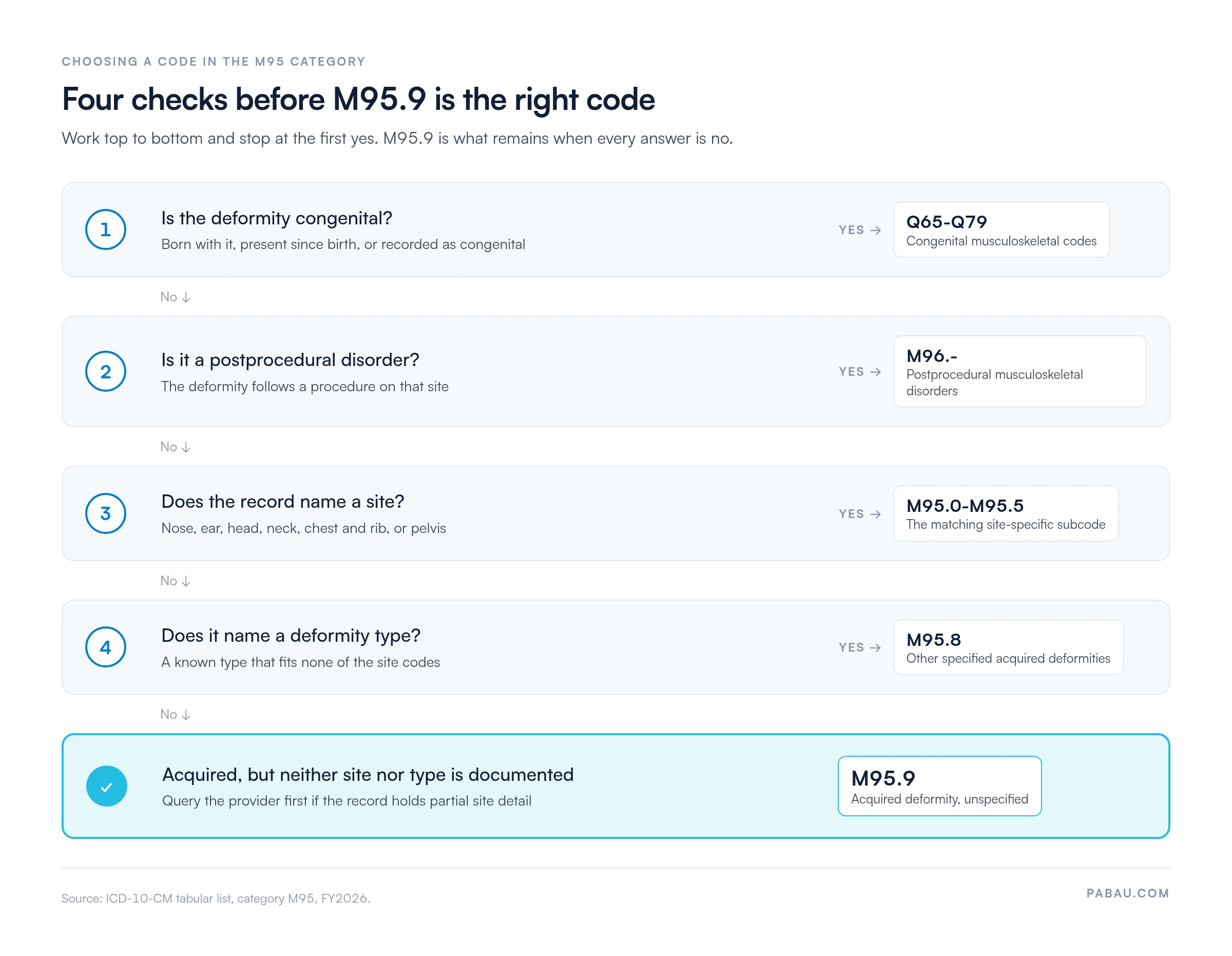
Run the M95 subcode hierarchy top-to-bottom before defaulting to M95.9. Ask yourself: does the record name a specific anatomical site? Use M95.0-M95.5. Does it describe a deformity type without a site? Use M95.8. Only when both answers are no does M95.9 apply.
The ICD-10-CM Official Guidelines require coders to assign codes to the highest level of specificity the documentation supports. For M95.9, that creates a two-part documentation burden. The record must confirm the deformity is acquired, and it must show why a more specific code cannot be assigned.
The treating provider’s note should contain all of the following for M95.9 to hold up under audit.
When documentation is ambiguous, the correct step is a physician query, not a code assignment based on inference. Per the AAPC ICD-10-CM coding guidance, coders should never select an unspecified code to avoid a query. Querying the provider is a coding best practice, not an inconvenience.
M95.9 is a billable code, but payer acceptance is not automatic. Coverage for musculoskeletal deformity diagnoses varies by Medicare Administrative Contractor (MAC) jurisdiction and by commercial payer Local Coverage Determination (LCD). Coders should treat M95.9 as a flag for additional review rather than a rubber-stamp submission.
M95.9 appears most often in outpatient orthopedic, rehabilitation, and sports medicine settings, and physical therapy practices see these pairings routinely. The CPT codes below are common procedure-to-diagnosis combinations. Validate each one against the patient record and payer policy before submission.
Note that M95.9 will rarely serve as the sole diagnosis on a surgical claim. For procedure codes in the 27xxx range, a more specific anatomical diagnosis is almost always available and expected.
Claims carrying M95.9 draw extra payer scrutiny because “unspecified” is itself an edit trigger. Our guide to medical billing denial codes explains the remittance codes that accompany each denial type below.
If M95.9 denials keep coming back, group a quarter’s worth by CARC code. The most frequent code usually points to one root cause, whether that is thin site detail, missing etiology, or a weak CPT pairing.
Most M95.9 coding errors share one root cause. The code gets used as a default instead of a last resort. Run the checklist below for any encounter where M95.9 is under consideration.
Flag every M95.9 assignment in your coding log with a one-line rationale: which M95 subcodes were considered and why each was ruled out. If a payer denies the claim, this log entry is the fastest path to a successful appeal. It shows the coding decision was deliberate.
An M95.9 problem usually surfaces late, when a CO-4 or CO-50 remittance arrives and the claim comes back for rework. By then the provider has moved on, and a query about site or etiology can take days to answer.
Practice management software like Pabau moves the routine checks ahead of submission. Its claims software for practices sends claims through Claim.MD, a US clearinghouse that reaches thousands of payers. Before each claim goes out, Pabau runs a real-time eligibility check and confirms required fields, such as member ID and authorization number, are complete.
Those checks cover claim completeness. Whether M95.9 is clinically right for the procedure is still settled by the coder’s subcode review and, where needed, a physician query. Claim status and remittance advice post back into Pabau, so a denied claim sits next to the note that needs an addendum.


Pabau sends M95.9 claims through Claim.MD after a real-time eligibility check and a required-field review. Denials post back beside the note, so rework starts in the right place.

M95.9 is a legitimate code, but it only holds up as a deliberate last resort. Treat it as a default and its unspecified scope invites the denials covered above.
The fix sits upstream of billing. Work the M95 subcodes in order, confirm the deformity is acquired, and query the provider when site detail is thin. A one-line rationale in the coding log then turns any denial into a short appeal.
The trade-off is a few minutes at the front of the claim to save rework at the back. Book a demo to see how Pabau checks eligibility and required claim fields before an M95.9 claim reaches the payer.

Unsure whether a named deformity type moves you off M95.9? ICD-10 code M95.8 covers the other-specified sibling code and the documentation that supports it.
Need a structured approach to musculoskeletal billing compliance? Medical billing compliance covers the documentation and audit standards that protect practices billing Chapter 13 codes.
Want fewer claims bounced back for missing details? What makes a clean claim walks through the pre-submission checklist payers expect.
Working through a backlog of M95.9 denials? Denial management in healthcare shows how to track, appeal, and prevent recurring denials.
Want to understand how clearinghouse submissions work? 837 file formatting explains the electronic claim format used to submit M95.9 and other ICD-10 diagnosis codes to payers.
ICD-10 Code M95.9 is the billable diagnosis code for acquired deformity of the musculoskeletal system, unspecified. It sits in Chapter 13, Diseases of the musculoskeletal system and connective tissue. Coders use it when a deformity is confirmed as acquired but the record supports no more specific M95 subcode.
Yes, M95.9 is a billable ICD-10-CM code valid for FY2025 and FY2026 submissions. Billable status means it can be submitted on a claim. Payer coverage still depends on the accompanying CPT code, medical necessity documentation, and any applicable LCD or NCD.
Most denials come from three causes. The record supported a more specific subcode, acquired etiology was not established, or the CPT code and diagnosis did not match on medical necessity. Missing laterality or procedure modifiers are a secondary but frequent trigger. Each denial type maps to a specific CARC code that directs the correct remedy.
Use M95.9 only after ruling out every M95.0 through M95.8 subcode. If the record documents any anatomical site (nose, ear, head, neck, chest, pelvis) or names a deformity type, a specific subcode applies. M95.9 is appropriate solely when documentation is genuinely site-agnostic and no deformity type can be identified from the clinical record.