ICD-10 code S61.201A: Open wound of left index finger without nail damage
ICD-10 code S61.201A covers a left index finger wound of unstated type ICD-10 co...

Last Updated: Oct 16, 2026
Billable Code Specific Code
Y63.5 is the billable ICD-10-CM code for inappropriate temperature in local application and packing. It records a misadventure in which a hot or cold application was applied at the wrong temperature during medical care. Hot packs, heating pads, ice packs and paraffin baths are typical examples.
Y63.5 sits in category Y63 (Failure in dosage during surgical and medical care) inside Chapter 20 of ICD-10-CM, which covers external causes of morbidity. It never stands alone. The resulting injury, such as a burn, is coded first, and Y63.5 follows to explain its cause.
Let Pabau's smart automation suggest the right codes, reduce claim denials, and keep your practice compliant—effortlessly.
Automate repetitive tasks and focus on what matters most—your patients.
Reduce coding errors and ensure compliance with the latest regulations.
Clean claims, fewer denials, and faster reimbursements.
Powerful insights and reporting to help your practice thrive.
HIPAA compliant SOC 2 certified GDPR-compliant Trusted by 4,000+ clinics worldwide

Y63.5 is a billable ICD-10-CM external cause code for a hot or cold local application or packing given at the wrong temperature during medical care.
Typical triggers include hot packs, heating pads, cold packs, ice packs and paraffin baths that burn or chill the skin during treatment.
It is always an additional code, listed after the injury code that describes the harm, such as a burn or cold injury.
Drug dosing errors do not belong here. Use Y63.6, Y63.8 or Y63.9, or T36-T50 for an accidental overdose or wrong drug.
The record must name the application, show that its temperature was inappropriate, and link that misadventure to the documented injury.
ICD-10 code Y63.5 is the Chapter 20 external cause code for inappropriate temperature in local application and packing. It records that a local application or pack was too hot or too cold when used during medical care. According to the CDC/NCHS ICD-10-CM tabular list, Y63.5 is valid and billable in the United States.
The code sits in category Y63, Failure in dosage during surgical and medical care. That title can mislead coders, because “dosage” here also covers the thermal dose of a local application. Y63.5 never describes the amount of a drug a patient received.
Clinical notes rarely use the official descriptor. Coders are more likely to see the event described in one of these ways.
Y63.5 covers harm caused when a provider applies heat or cold to a local area of the body at an unsafe temperature. The application has to happen as part of medical care, under the oversight of a clinician, therapist or nurse.
Clinical scenarios that support this code include the following situations.
The documentation must describe the temperature of the application as the problem. An unexpected skin reaction to a correctly applied pack is a different coding question, covered in the next section.
Most Y63.5 errors come from its category title, which leads coders to treat it as a medication error code. These situations belong elsewhere, and the decision flow after the list puts them in the order a coder should test them.
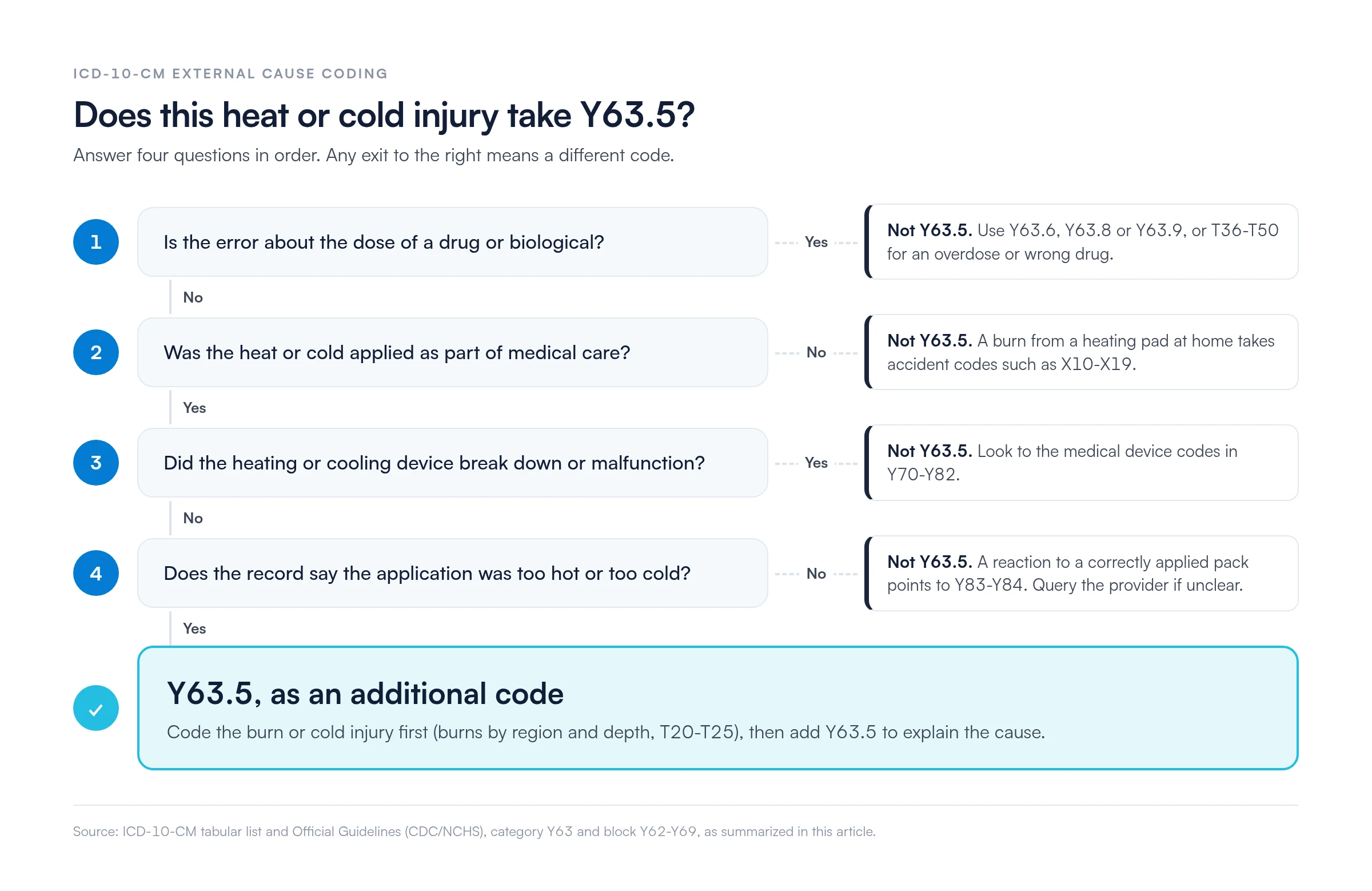
Category Y63 holds nine billable codes, and each one describes a different kind of failure in dosage. The table sets out how each one differs from Y63.5.
For coders working across complex encounters, the AAPC Codify ICD-10-CM lookup provides a searchable index of the full Y63 category. It helps confirm the right subcode before submission.
Before assigning any Y63 subcode, write down in one line what went wrong: volume, dilution, radiation, shock therapy, temperature or drug. If the answer is temperature of a local application, Y63.5 is the code. If it involves a drug, it never is.
Y63.5 is never the first code on a claim. The ICD-10-CM Official Guidelines for Coding and Reporting state that external cause codes are supplementary and cannot be the principal or first-listed diagnosis.
The correct sequencing follows a three-step logic.
Example encounter: During a physical therapy session, a moist heat pack leaves a second-degree burn on the patient’s right thigh. The provider documents that the pack was applied too hot. The coding sequence is T24.211A (burn of second degree of right thigh, initial encounter), followed by Y63.5.
For full guidance on the Official Guidelines, CMS publishes the annual ICD-10-CM update files and coding guidelines on its coding portal.
Y63.5 needs clear provider documentation to hold up in an audit. The record should contain these elements before the code is assigned.
If the record describes a burn but never says the application was at the wrong temperature, query the provider before assigning Y63.5. The same rule holds for every external cause code. Coders translate documented events into codes and never assume the event happened.
There is no national rule requiring external cause codes on every claim, though they are encouraged. Individual state programs and commercial payers vary on whether a code like Y63.5 must appear.
For inpatient claims, confirm any state reporting mandates in your payer contracts. Keep a note of which payers expect external cause codes, so your team adds Y63.5 wherever a contract requires it. Claims management software then tracks each claim from submission to payment.
Before submission, check that the burn or cold injury code comes first and that Y63.5 follows it. A missing injury code or a Y63.5 listed first is far cheaper to fix before the payer sees it. The clean claim standards set out the other checks that help Y63.5 encounters pass on the first attempt.
Y63.5 rejections usually trace back to one of five coding errors. Each one has a straightforward fix.
Practices that see repeat rejections can match each one to the payer’s denial codes to find its root cause.
When Y63.5 claims come back denied, pull five of them and look for a shared cause. If three or more were medication errors coded as Y63.5, retrain on the category title. If they lack an injury code, fix the charge capture step.
Temperature misadventures usually surface in therapy notes, nursing notes and incident reports that sit in separate places. Coders then have to piece together what was applied, how hot it was and what injury followed.
Practice management software like Pabau keeps clinical notes, custom forms and billing in one patient record. Your team can add application type and temperature fields to treatment templates. That way, the documentation Y63.5 needs is captured at the point of care.
When the claim is built, the diagnosis codes come from that same record. Pabau runs validation checks before a claim goes out and submits it through Claim.MD in the US. Your billing team spends less time querying providers and chasing rejected claims.

Pabau keeps treatment notes, diagnosis codes and claims in one patient record, and checks claim details before submission. Your team codes misadventure encounters from complete documentation.

Y63.5 answers one narrow question: did a hot or cold local application or pack harm the patient because its temperature was wrong? When the answer is yes, and the record says so, the code explains an injury that would otherwise look unexplained on the claim.
Treat the category title as a warning rather than a guide, and keep drug errors out of Y63.5 entirely. Book a demo to see how Pabau captures the documentation Y63.5 needs at the point of care, before the claim is built.

Need to understand how denials on Y63.5 and similar codes are tracked? Denial management in healthcare covers how to build a systematic denial review workflow for external cause code encounters.
Coding complex multi-code encounters for billing? Medical billing fundamentals explains how external cause codes interact with principal diagnosis codes in the claim lifecycle.
ICD-10 code Y63.5 means inappropriate temperature in local application and packing during medical care. It records that a hot or cold application was used at an unsafe temperature. Examples include a hot pack, heating pad, ice pack or paraffin bath. It describes the cause of an injury, not the injury itself. The code sits in block Y62-Y69 of Chapter 20.
Yes, Y63.5 is a billable ICD-10-CM code valid for HIPAA-compliant claim submission. The parent code Y63 is not billable and will be rejected for insufficient specificity.
No, Y63.5 does not cover medication dosing errors, despite its category title. Underdosing or nonadministration of a necessary drug is Y63.6, and other or unspecified dosage failures are Y63.8 or Y63.9. An accidental overdose or a wrong drug given in error is coded with the poisoning codes in T36-T50.
Use Y63.5 as a secondary code when the provider documents that a local hot or cold application or pack caused harm because of its temperature. It follows the injury code, such as a burn by body region and depth. The application must have happened as part of medical care.
Yes, Y63.5 always requires a principal or first-listed diagnosis code. External cause codes in Chapter 20 are supplementary and cannot stand alone on a claim. The principal code describes the resulting injury, such as a burn or cold injury.
To support Y63.5, the record should name the application used and state that its temperature was inappropriate. It should also describe the resulting injury by site, depth and laterality, and link that injury to the application during care. Without a temperature statement, query the provider before coding.
The most frequent mix-ups are with Y63.6, Y63.8 and Y63.9 for drug dosing failures, and with T36-T50 poisoning codes. Coders also confuse it with Y83-Y84 for reactions without a misadventure and X10-X19 for heat injuries outside medical care. The non-billable Y63 parent code is another common error.