ICD-10 code S61.201A: Open wound of left index finger without nail damage
ICD-10 code S61.201A covers a left index finger wound of unstated type ICD-10 co...

Last Updated: Oct 16, 2026
Billable Code Specific Code
Y72.0 is the billable ICD-10-CM code for diagnostic and monitoring otorhinolaryngological devices associated with adverse incidents. It's an external cause code, so it always follows a principal diagnosis that describes the injury or complication the device caused.
It sits in category Y72, which covers ear, nose and throat (ENT) devices only. Therapeutic ENT devices go to Y72.1, implants to Y72.2, and surgical instruments to Y72.3.
Let Pabau's smart automation suggest the right codes, reduce claim denials, and keep your practice compliant—effortlessly.
Automate repetitive tasks and focus on what matters most—your patients.
Reduce coding errors and ensure compliance with the latest regulations.
Clean claims, fewer denials, and faster reimbursements.
Powerful insights and reporting to help your practice thrive.
HIPAA compliant SOC 2 certified GDPR-compliant Trusted by 4,000+ clinics worldwide

Y72.0 is an ICD-10-CM external cause code, so it always accompanies a principal diagnosis code and never stands alone.
The code covers diagnostic and monitoring ENT devices specifically; therapeutic devices fall under Y72.1, not Y72.0.
Claims submitted with Y72.0 as the only code will be denied; correct sequencing places the injury or complication code first.
Claims management software like Pabau flags missing companion codes before submission, which cuts Y72.0 sequencing denials.
ICD-10 Code Y72.0 identifies an adverse incident caused by a diagnostic or monitoring ENT device. It’s always reported after the code for the injury the device caused. Use the table below to confirm its key attributes before assigning it to a claim. Every field reflects the current ICD-10-CM tabular list maintained by the CDC/NCHS ICD-10-CM web tool.
Y72.0 applies when a diagnostic or monitoring otorhinolaryngological (ENT) device is causally linked to an adverse incident affecting a patient. Under category Y72, an “adverse incident” means a device malfunction, failure, or misuse that causes harm. An expected side effect of a correctly working device doesn’t qualify.
Devices within scope for Y72.0 include:
The .0 subcategory designation across the Y70-Y82 block consistently identifies diagnostic and monitoring devices as distinct from therapeutic or prosthetic ones. Anesthesiology follows the same pattern, so an adverse incident with an anesthesia monitoring device, such as a capnograph, is coded to ICD-10 code Y70.0. A device is diagnostic or monitoring if its main purpose is to examine, assess, or track a physiological parameter. Treating or replacing a body structure puts it elsewhere.
An otoscope, a diagnostic endoscope, or a monitoring electrode placed during ENT examination all qualify. A cochlear implant or a surgical laser used therapeutically does not. That split repeats across the Y70-Y82 block, so an adverse incident with a therapeutic neurological device is coded to Y75.1. A device matching no specialty category in the block falls to ICD-10 Code Y82.8.
These scope rules decide when Y72.0 applies and when a neighboring code fits better. Misreading them is a common audit trigger.
A useful rule of thumb is to ask where the harm came from. If it came from how the surgeon used a device, rather than a malfunction, the T-code complication block fits better than Y72.0. Documentation must clearly support device causation for Y72.0 to withstand audit.
Y72.0 is one of five subcategories in category Y72. The table below maps each subcategory to its device class, so coders can confirm correct selection before submission. Fourth characters carry the same meaning in the other device categories, so a surgical instrument incident in obstetrics or gynecology takes Y76.3.
Gastroenterology and urology devices follow the same rule, so a surgical instrument incident in that specialty is coded to Y73.3.
Y72.0 is never a principal diagnosis. ICD-10-CM Official Guidelines Section I.C.20 treats external cause codes as additional codes. They’re sequenced after the code for the injury, condition, or complication the adverse incident produced. Payers validate that sequencing before they adjudicate payment, so the order decides whether the claim pays.
Correct sequencing follows three steps:
Side by side, the clean order and the two orders payers reject look like this.
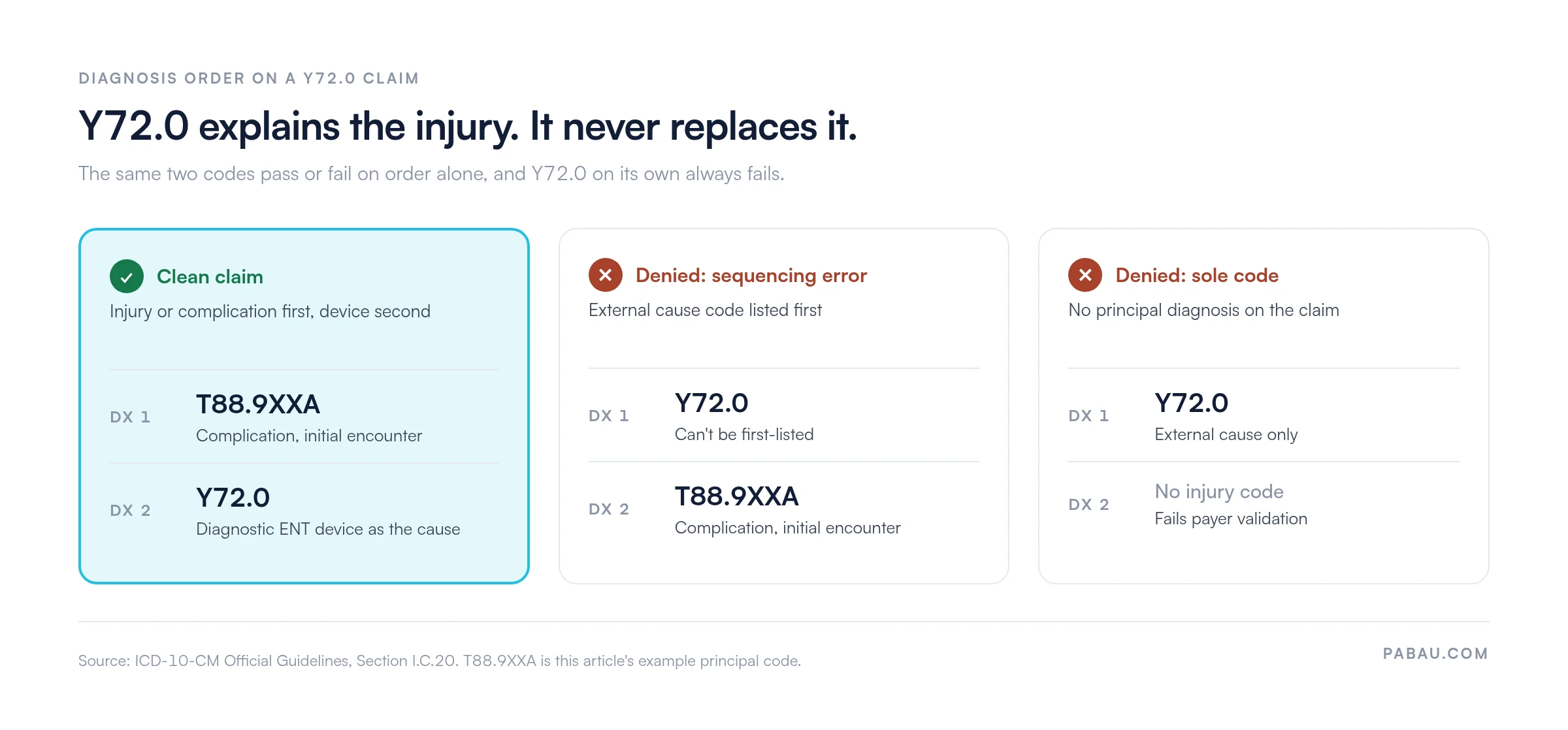
Check your EHR’s code editor before finalizing any Y72.0 claim. Many systems accept Y72.0 as the first code without a validation error, but the payer’s claims system will reject it. Flag Y72.0 as additional-code-only in your billing system to stop sequencing mistakes at entry.
Auditors reviewing Y72.0 claims look for three things in the record. They want the device named, the adverse incident documented, and a clear causal link between the two. Weak documentation in any of these areas is grounds for denial or post-payment recoupment.
Strong documentation also gives the billing team enough detail to assign both the principal diagnosis and Y72.0 accurately. Nobody has to query the physician after the encounter closes.
Medicare and most commercial payers treat Y72.0 as a supplementary code that provides context for the principal diagnosis claim rather than triggering independent reimbursement. Payer logic validates that at least one principal diagnosis code precedes Y72.0 on the claim. Claims that arrive with only Y72.0 listed fail this validation automatically.
For procedures linked to ENT device incidents, prior authorization attaches to the procedure CPT code rather than to Y72.0. Even so, Y72.0 on a claim can prompt a payer’s clinical review team to request the procedure note. Practices running ENT practice claims software catch missing companion codes before submission, so fewer claims reach that review.
Device-incident claims attract a predictable set of denial patterns, and each one is preventable before submission. Every rejection arrives with a reason code, and our guide to medical billing denial codes explains what each one means.
Corrected claims sent through a clearinghouse that supports clean claim submission carry the original claim reference and the CARC denial code. That speeds adjudication on resubmission.
Tracking Y72.0 denials by reason code on your electronic remittance advice (ERA) also shows whether the practice has a documentation problem or a sequencing problem. Each one needs a different fix.
Several codes sit close to Y72.0 in both structure and clinical scenario. The table below provides decision rules for correct selection.
Sometimes a diagnostic scope and a separate therapeutic device each cause an adverse incident in one ENT encounter. Assign Y72.0 and Y72.1 as separate additional codes. ICD-10-CM guidelines permit multiple external cause codes on one claim when separate device categories cause separate adverse events.
Without a pre-submission check, a Y72.0 claim goes out exactly as it was keyed. If the external cause code lands first, or the injury code is missing, the payer’s edit rejects it days later.
Practice management software like Pabau runs those checks before the claim leaves your desk. Pabau integrates with Claim.MD, its US clearinghouse partner, which runs real-time eligibility checks and validates claim structure before the payer sees it.
For ENT practices billing device-incident claims alongside routine procedures, that validation flags a sequencing error while it’s still a 30-second fix. Your team corrects the order once, instead of working a denial and resubmitting.

Pabau’s built-in claims management and Claim.MD clearinghouse integration catch missing companion codes and sequencing errors before your claims reach the payer. See how ENT practices use Pabau to keep device-incident claims clean.

Y72.0 denials trace back to two avoidable mistakes. The claim goes out without a principal diagnosis, or it carries the wrong Y72 subcategory because nobody confirmed the device’s purpose.
Both are settled at charge entry. Confirm what the device was for in the procedure note, put the injury code first, and Y72.0 becomes routine context on the claim. That check costs seconds per claim, against weeks spent on an appeal.
Book a demo to see how Pabau validates external cause codes before your ENT claims go out.

Want to understand how clearinghouses validate claims before submission? Medical claims clearinghouse covers how 837P transactions are validated and what payers check at intake.
Coding an ENT device that fits none of the named subcategories? ICD-10 Code Y72.8 covers miscellaneous otorhinolaryngological devices and when the residual code applies.
ICD-10 Code Y72.0 is an external cause of morbidity code for adverse incidents caused by diagnostic and monitoring otorhinolaryngological (ENT) devices. It is always assigned as an additional code, alongside a principal diagnosis that describes the resulting injury or complication.
Y72.0 falls under category Y72, otorhinolaryngological devices associated with adverse incidents. That category sits in block Y70-Y82, medical devices associated with adverse incidents in diagnostic and therapeutic use, within Chapter 20 (External causes of morbidity).
Y72.0 is always a secondary code. ICD-10-CM Official Guidelines Section I.C.20 require all external cause codes to be assigned as additional codes after the principal diagnosis. Submitting Y72.0 as the first-listed or sole code on a claim will result in a payer denial.
Y72.0 covers diagnostic and monitoring devices, and Y72.1 covers therapeutic (nonsurgical) and rehabilitative devices. Y72.8 is the residual code for ENT devices that fit none of the diagnostic, therapeutic, prosthetic, or surgical subcategories. The deciding factor is the device’s primary purpose at the time of the incident.
The medical record must name the diagnostic or monitoring device and describe the adverse incident, such as a malfunction, breakage, or failure. It must also link that device failure to the patient’s resulting condition. Vague documentation such as “equipment issue noted” is insufficient for audit purposes.
The most common denials are Y72.0 sent without a principal diagnosis, or Y72.0 listed first. Coders also pick the wrong subcategory, or the note documents the device incident too thinly. Each has a distinct fix at the pre-submission stage.