ICD-10 code S61.201A: Open wound of left index finger without nail damage
ICD-10 code S61.201A covers a left index finger wound of unstated type ICD-10 co...

Last Updated: Oct 16, 2026
Billable Code Specific Code
Y65.8 is the billable ICD-10-CM code for other specified misadventures during surgical and medical care. It covers a documented, specific misadventure that none of the subcategories Y65.0 through Y65.5 describes. It is always reported as an additional code, never as the principal diagnosis.
The code sits in category Y65 (Other misadventures during surgical and medical care), within block Y62-Y84 of the external causes chapter. It appears in both the WHO ICD-10 classification and the US ICD-10-CM tabular list.
Let Pabau's smart automation suggest the right codes, reduce claim denials, and keep your practice compliant—effortlessly.
Automate repetitive tasks and focus on what matters most—your patients.
Reduce coding errors and ensure compliance with the latest regulations.
Clean claims, fewer denials, and faster reimbursements.
Powerful insights and reporting to help your practice thrive.
HIPAA compliant SOC 2 certified GDPR-compliant Trusted by 4,000+ clinics worldwide

ICD-10 Code Y65.8 covers specified surgical and medical misadventures that none of the subcategories Y65.0 through Y65.5 describes.
It is always a secondary code, and the principal diagnosis must be the injury or complication the misadventure caused.
When the record lacks detail on the event, Y69 applies instead, and a device failure belongs in Y70-Y82.
Denials most often follow a record with no physician attestation naming the specific misadventure type.
Claims management software like Pabau validates each claim before it goes out, so missing details are fixed before a payer sees them.
ICD-10 Code Y65.8 covers a documented, specific surgical or medical misadventure that none of the subcategories Y65.0 through Y65.5 describes.
It is an external cause code, so it supplements a principal diagnosis and never stands alone on a claim. Coders sometimes reach for Y65.8 as a catch-all, but the rules point the other way. Use the most specific code available, and assign Y65.8 only when the documented event falls outside the named subcategories.
Y65.8 sits at the bottom of a four-level hierarchy in ICD-10-CM. Chapter 20 of the CMS ICD-10-CM Official Guidelines for Coding and Reporting sets out this structure. It’s worth knowing before you assign any Y65 code.
Coders must work through the more specific subcategories before landing on a residual code like Y65.8. In ICD-10 terminology, “other specified” means the record documents a specific misadventure that no subcategory from Y65.0 through Y65.5 describes precisely. That differs from “unspecified” (Y69), where the record lacks the clinical detail to code the misadventure more precisely.
The Y70-Y82 block covers a different fault. When the record shows the device itself failing rather than the technique, the code comes from that block instead. A surgical instrument, material, or suture used in gastroenterology or urology falls under Y73.3.
A frequent coding mistake in this family is assigning Y65.8 when a more specific Y65 subcategory already covers the documented event. Before finalizing Y65.8, check each sibling code in the table below against the operative note or incident report.
The most common confusion in this code family is using Y65.8 when Y65.5 applies. If the operative record documents that the wrong procedure was performed, Y65.5 is required and Y65.8 would be the wrong code.
The table below covers the four codes most likely to be confused with one another. The decision path after it shows the order to check them in.
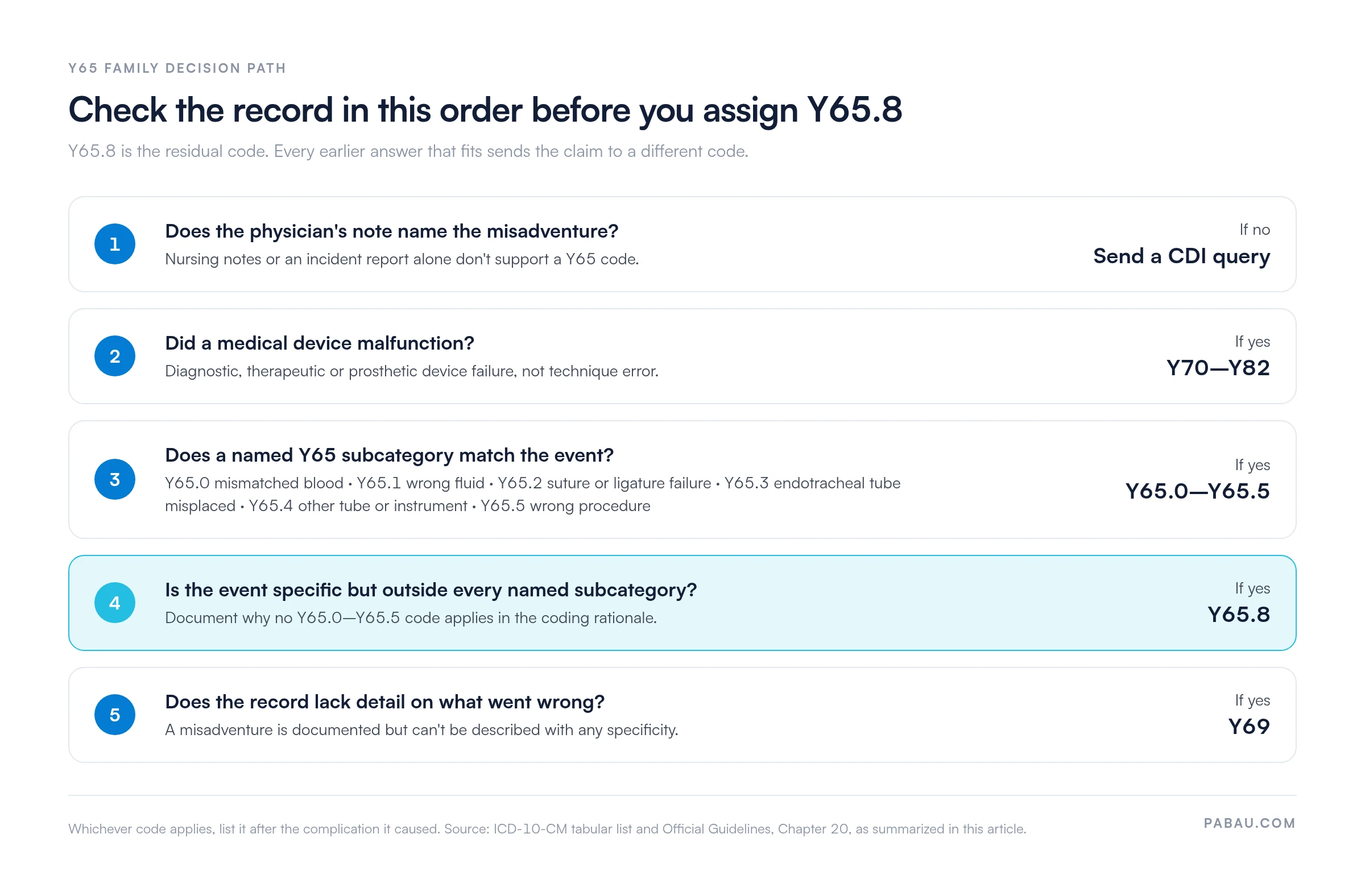
Chapter 20 of the ICD-10-CM Official Guidelines says external cause codes are never sequenced as the principal diagnosis. Every code in the Y65 family follows that rule, Y65.8 included. Before placing it on a claim, work through these four steps.
The sequencing rule has no exceptions. Most payers, Medicare included, reject a claim that lists Y65.8 in the principal diagnosis position.
Coders cannot assign Y65.8 from their own interpretation of clinical events. The medical record must contain explicit physician attestation of the misadventure before the code is applied. The following elements are required.
When the note doesn’t describe the event, coders should send a CDI query rather than assume. Assigning Y65.8 without adequate physician documentation is a compliance risk, whatever appears to have happened clinically.
Before assigning Y65.8, ask: does the operative note name the specific misadventure in the attending physician’s own words? If the documentation only says something went wrong without describing the event type, initiate a CDI query first. An ambiguous note cannot support Y65.8 or any other specific external cause code.
External cause code reporting rules vary by payer and setting, and knowing them prevents denials that have nothing to do with the code itself. Practice management software like Pabau helps on the submission side. Its claims tools for practices check each claim for missing details before it goes out.
Practices submitting through a clearinghouse such as Claim.MD get another layer of checking. The clearinghouse validates ICD-10 codes across the 837P and CMS-1500 formats before the claim reaches the payer.
Y65.8 denials cluster around a small set of repeatable errors. The table below maps each denial type to its root cause and its fix, following the usual approach to denial management in healthcare.
Reviewing medical billing denial codes alongside your Y65.8 rejections shows whether sequencing, documentation, or payer rules are driving the volume. Tracking patterns across a quarter of claims often narrows the problem to one or two repeating root causes.
Y65.8 has a second life beyond claims processing as a quality surveillance tool. A peer-reviewed study in PubMed Central (PMC5797717) shows Y65-family codes, Y65.8 included, being used to identify adverse events in hospital datasets. That supports population-level patient safety analysis, which individual incident reports can’t provide at scale.
Several oversight programs draw on Y65.x codes in their analytics.
Accurate assignment of Y65.8 matters beyond the single claim. Under-coding or miscoding this family of events understates complication rates in quality databases, which skews risk-adjusted metrics for the facility. Consistent coding supports both accurate revenue cycle management and honest quality reporting.
US coders remain on ICD-10-CM and will continue doing so until CMS and HHS set a formal transition date. No US transition timeline to ICD-11 has been announced as of the date of this article. International coders on WHO ICD-11 should look up the Y65.8 equivalent in the WHO ICD-11 browser.
ICD-11 reorganizes the external cause chapter significantly, so don’t assume a direct code mapping. The AAPC ICD-10-CM lookup remains the practical reference for US coders checking current fiscal year validity for Y65.8 and related codes.
The denials covered above all start before submission. Y65.8 lands in the principal position, or no complication code sits beside it. Catching those by hand means rereading every surgical claim before it goes out.
Pabau keeps insurer details on the patient record, so each claim routes to the right payer automatically. Validation checks run in the background every time a claim is sent. If a required detail is missing, the Send button stays disabled until someone fixes it.
For US practices, Pabau’s Claim.MD connection adds real-time eligibility checks, claim status tracking, and electronic remittance advice (ERA) posting. Every claim sits on one dashboard as pending, submitted, processing, paid, or error. A rejected Y65.8 claim is easy to spot, correct, and resubmit.

Pabau checks each claim for missing details before it goes out and tracks every claim from submission to payment. See how it works for your practice.

Reach for Y65.8 only after the operative note has been checked against Y65.0 through Y65.5 and none of them fits. When the note names no specific event, send a CDI query before any Y65 code goes on the claim.
That discipline pays off at review. The complication sits in the principal position, Y65.8 follows it, and the physician’s own words back both codes. The cost is a short wait while a query comes back, which is easier to absorb than a denial and a resubmission.
Book a demo to see how Pabau checks surgical complication claims for missing details before they reach a payer.

Need a broader overview of medical billing workflows? What is medical billing walks through the end-to-end claims process from encounter to payment posting.
Want to understand clearinghouse submission for ICD-coded claims? How the Claim.MD clearinghouse works explains 837P file validation, payer routing, and ERA processing for US practices.
ICD-10 Code Y65.8 is the external cause code for other specified misadventures during surgical and medical care. It applies when a documented procedural misadventure is specific enough to code but matches none of the named subcategories Y65.0 through Y65.5. It must always be paired with a principal diagnosis code that describes the resulting complication or injury.
Y65.8 is always a secondary (additional) code. ICD-10-CM Official Guidelines Chapter 20 prohibits sequencing any external cause code as the principal diagnosis. The principal diagnosis must describe the clinical condition or complication that resulted from the misadventure.
Y65.5 describes the performance of the wrong surgical procedure on the patient and must be used whenever that specific event is documented. Y65.8 covers misadventures that are documented and specific but do not match any of the named Y65.0 through Y65.5 subcategories. Using Y65.8 when Y65.5 applies is a specificity error that can trigger a denial or an audit.
The medical record must include physician attestation of the specific misadventure type, typically in the operative or procedure note. It also needs a clinical link between the misadventure and the coded complication, plus a rationale for why no more specific Y65 subcategory applies. Nursing notes or incident reports alone are insufficient. Physician documentation is required.
Yes, Y65.8 can appear on outpatient claims, but external cause code reporting is generally optional for outpatient Medicare claims under standard CMS guidance. Some state Medicaid programs and commercial payers require external cause codes on outpatient surgical complication claims. Always check the relevant payer’s provider manual before assuming reporting is optional.
US coders remain on ICD-10-CM with no announced transition date to ICD-11. International coders using WHO ICD-11 should verify the direct equivalent through the WHO ICD-11 browser. The external cause chapter was restructured significantly in ICD-11, so direct code-number mapping should not be assumed.