ICD-10 code S61.201A: Open wound of left index finger without nail damage
ICD-10 code S61.201A covers a left index finger wound of unstated type ICD-10 co...

Last Updated: Oct 16, 2026
Billable Code Specific Code
H49.9 is the billable ICD-10-CM code for unspecified paralytic strabismus.
Let Pabau's smart automation suggest the right codes, reduce claim denials, and keep your practice compliant—effortlessly.
Automate repetitive tasks and focus on what matters most—your patients.
Reduce coding errors and ensure compliance with the latest regulations.
Clean claims, fewer denials, and faster reimbursements.
Powerful insights and reporting to help your practice thrive.
HIPAA compliant SOC 2 certified GDPR-compliant Trusted by 4,000+ clinics worldwide

ICD-10 code H49.9 is a billable diagnosis code for unspecified paralytic strabismus, valid for 2026 claims under ICD-10-CM Chapter 7 (H00-H59).
Use H49.9 only when the specific cranial nerve involved cannot be determined. Specific codes (H49.0-H49.4) should be used whenever documentation supports them.
The ICD-9 equivalent is an approximate mapping only. Codes 378.50 and 378.9 are the closest ICD-9-CM predecessors, but GEMs classify the crosswalk as non-exact.
Pabau’s claims management software helps ophthalmology and neurology practices capture the correct H49.x code at the point of care, reducing claim denials tied to unspecified diagnoses.
ICD-10 code H49.9 is the billable code for unspecified paralytic strabismus — the diagnosis used when a paralytic strabismus has been identified but the specific cranial nerve responsible for the misalignment has not. When the nerve is known, the more specific H49.0 through H49.4 codes apply instead.
H49.9 sits within the H49 category (Paralytic strabismus) in ICD-10-CM Chapter 7: Diseases of the Eye and Adnexa (H00-H59), maintained by the National Center for Health Statistics (NCHS) under CMS ICD-10 guidelines.
The code describes a strabismus of paralytic origin where the specific cranial nerve responsible for the misalignment has not been identified or documented. It is valid and billable for fiscal year 2026.
Paralytic strabismus differs from concomitant (non-paralytic) strabismus in how it originates. It results from paresis or paralysis of one or more of the extraocular muscles due to cranial nerve dysfunction, rather than a structural imbalance between muscles.
When the nerve involved is known, coders should assign the corresponding specific code. H49.9 is reserved for presentations where that determination has not been made.
H49.9 is a valid, billable ICD-10-CM diagnosis code for 2026. It is confirmed as billable by the CDC/NCHS ICD-10-CM web tool and multiple authoritative coding references.
Understanding where H49.9 sits in the code hierarchy helps coders select the right level of specificity:
| Code level | Code | Description |
|---|---|---|
| Chapter | H00-H59 | Diseases of the eye and adnexa |
| Block | H49-H52 | Disorders of ocular muscles, binocular movement, accommodation and refraction |
| Category | H49 | Paralytic strabismus |
| Code | H49.9 | Unspecified paralytic strabismus (billable) |
CMS Medicare Coverage Database LCD policy covers the ICD-10 range H49.00 through H51.9, which encompasses H49.9. Practices billing Medicare or Medicaid for ophthalmology services should verify active Local Coverage Determinations (LCDs) against this range. For ophthalmology billing workflows.

CMS coding guidelines require coders to assign the most specific code supported by clinical documentation. Among the paralytic strabismus ICD-10 codes, that means reaching for the H49.0 through H49.8 range whenever the underlying nerve palsy has been identified.
The full H49 category, drawn from the AAPC Codify ICD-10-CM reference, breaks down as follows:
For practices coding ICD-10 diagnostic codes for neurological conditions affecting the eye, the same specificity principle applied to other neurological ICD-10 diagnostic codes applies here: document the nerve, document the side, and only fall back to unspecified when the clinical picture genuinely cannot support a more granular code.
A notable characteristic of H49.9 is that it carries no laterality subcode. The specific H49.0 through H49.4 codes each include right eye, left eye, unspecified eye, and bilateral variants. H49.9 by definition lacks that granularity, which is itself a reason payers may scrutinize it more closely.
When the affected eye is documented but the specific nerve is not, coders should check whether H49.8 or another category better fits the clinical picture before defaulting to H49.9.
Review the ophthalmologist’s documentation for any mention of which cranial nerve is affected before assigning H49.9. Notes referencing ptosis and dilated pupil suggest CN III (H49.0). Vertical diplopia with head tilt suggests CN IV (H49.1). Lateral gaze restriction suggests CN VI (H49.2). Accurate nerve identification at the point of care allows the coder to bypass H49.9 entirely.
Submitting H49.9 without adequate documentation supporting the unspecified status is a common source of claim denials. Payers expect to see evidence that a more specific diagnosis was not determinable, not simply undocumented.
For ophthalmology and neurology practices. The following documentation elements strengthen H49.9 claims:
The American Academy of Ophthalmology (AAO) Neuro-Ophthalmology ICD-10-CM Quick Reference Guide is the specialty-specific resource for this code category. Ophthalmology practices should cross-reference their documentation workflows against the AAO’s reference to ensure alignment. Good patient record documentation at the point of encounter is the most effective preventive measure against downstream coding disputes.
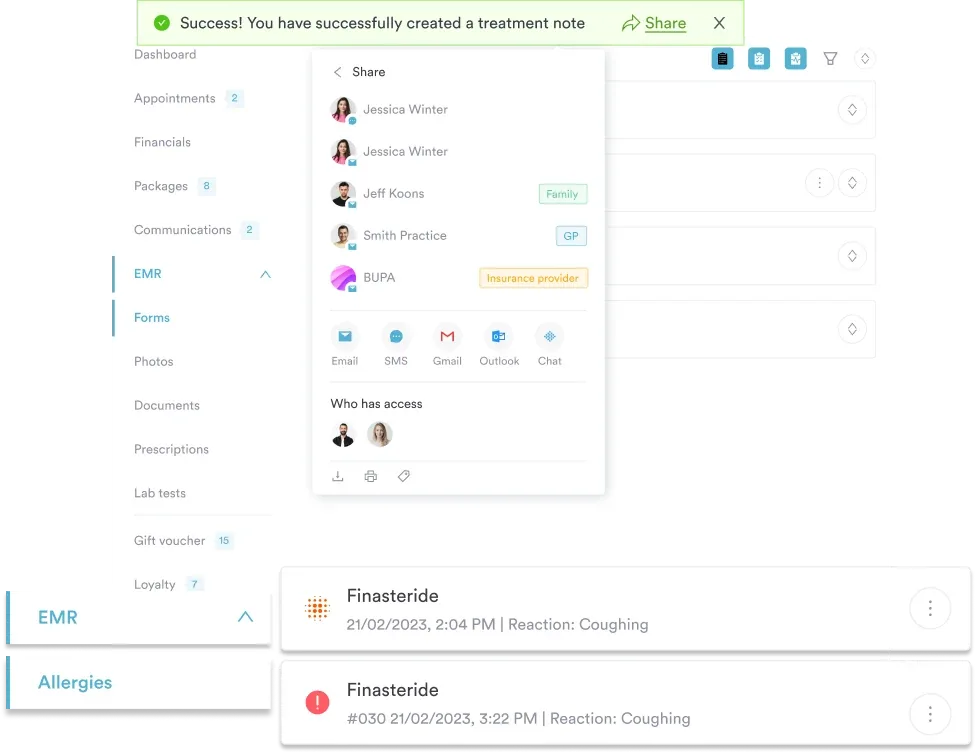

Pabau helps clinical practices capture the correct diagnosis code at the point of care, with structured clinical forms and integrated claims management that flags missing documentation before submission.

Good practice management software for medical teams keeps hearing and vision follow-ups booked and coded correctly.
Practices still maintaining legacy data or reconciling older claims need to understand how H49.9 maps back to ICD-9-CM. The General Equivalence Mappings (GEMs) identify this as an approximate, not exact, crosswalk.
The closest ICD-9-CM predecessors for H49.9 are:
| ICD-9-CM code | Description | Mapping type |
|---|---|---|
| 378.50 | Paralytic strabismus, unspecified | Approximate (forward map) |
| 378.9 | Unspecified disorder of eye movement | Approximate (broader) |
Because GEMs classify both mappings as approximate, coders should not rely on a direct one-to-one conversion for claims audits or research purposes. The CrossCoder bidirectional crosswalk tool and the ICD List ICD-9 to ICD-10 conversion reference both flag the non-exact nature of this mapping.
When reviewing historical H49.9 claims originated under ICD-9 as 378.50, auditors should treat the documentation requirements as equivalent rather than assuming the older code carried the same clinical specificity threshold.
For practices that transitioned from ICD-9 to ICD-10 and are now auditing older encounter data. Understanding the GEMs flag prevents over-reliance on automated conversion outputs.
H49.9 as a primary diagnosis code is most frequently paired with evaluation and management (E/M) and ophthalmology-specific CPT codes. The pairing must demonstrate medical necessity: the procedure code performed should be supported by the clinical picture captured in H49.9.
Common CPT code pairings include:
Payers matching CPT to ICD-10 codes flag misaligned pairs. A strabismus surgery CPT paired with H49.9 will receive closer scrutiny than if paired with a specific nerve palsy code.
Where EHR integration for accurate code capture exists at the point of care, the system can prompt providers to confirm whether a more specific H49.x code should replace H49.9 before a surgical procedure is scheduled.
Before pairing H49.9 with a surgical CPT code, confirm with the treating ophthalmologist that documentation explicitly supports an unspecified etiology. Surgical payers generally expect a specific nerve palsy code for strabismus correction procedures. If the nerve has been identified by that point, upgrade the diagnosis code to the appropriate H49.0-H49.4 before submitting the claim.
The practical challenge with H49.9 is less about understanding the code and more about building workflows that catch missing specificity before a claim goes out the door. Most denials linked to unspecified codes are preventable at the point of documentation, not at the billing stage.
For practices managing ophthalmology or neurology encounters. When structured encounter templates prompt clinicians to record ductions results, prism test findings, and cranial nerve assessment outcomes, coders receive the information they need to assign the most specific code in the H49 range.
Practices using digital intake and clinical forms that capture extraocular movement findings systematically are better positioned to avoid defaulting to H49.9 unnecessarily. A structured neuro-ophthalmology intake form that includes a cranial nerve field can reduce the “unspecified” rate for paralytic strabismus encounters significantly.

For billing teams handling medical billing compliance across ophthalmology claims, establishing a pre-submission audit for H49.9 appearances is a practical quality control measure. Any claim with H49.9 as a primary diagnosis should trigger a documentation review before submission, particularly when paired with a surgical or high-value diagnostic CPT code.
Practices that handle ICD-10 coding for unspecified conditions across multiple specialties will recognize a consistent pattern: unspecified codes increase audit exposure and reduce clean-claim rates. The same discipline applied to other unspecified diagnosis codes applies directly to H49.9.
H49.9 is a valid billing code, but its value in a claim is limited to situations where the paralytic strabismus genuinely cannot be attributed to a specific cranial nerve palsy. When documentation supports a more specific H49.x code, that code should always be used.
Pabau’s claims management software helps ophthalmology and neurology practices reduce unspecified-code claims by integrating structured clinical documentation with diagnosis code capture at the point of care. To see how Pabau handles this workflow in practice, book a demo.

Coding combined language comprehension deficits? Mixed language disorder coding guide explains why F80.2 gets replaced with F80.9 or F80.1, causing avoidable claim rejections.
Documenting developmental coordination disorder claims? Developmental motor disorder coding guide covers F82 for developmental coordination disorder and the documentation payers require to avoid denial.
Coding intraparenchymal hemorrhage cases? Intraparenchymal hemorrhage coding guide covers the I61.x code series with documentation tips and coding best practices.
ICD-10 code H49.9 is a billable diagnosis code for unspecified paralytic strabismus, valid under ICD-10-CM 2026. It belongs to Chapter 7 (H00-H59: Diseases of the eye and adnexa) and is used when a paralytic strabismus diagnosis cannot be attributed to a specific cranial nerve palsy.
H49.9 is used when the causative cranial nerve has not been identified. Codes H49.0 through H49.4 identify the specific nerve involved and include laterality subcodes. H49.9 does not.
No. Pseudostrabismus is the appearance of eye misalignment without true muscle or nerve involvement, so it does not fall under the H49 paralytic strabismus category at all. The American Academy of Ophthalmology recommends Q10.3 (other congenital malformations of eyelid) for pseudostrabismus, since assigning a strabismus code would document a condition the patient does not actually have.
Yes. H49.9 is a valid, billable ICD-10-CM diagnosis code for 2026, confirmed by the CDC/NCHS ICD-10-CM tabular list and AAPC Codify. It can be submitted on claims as a primary or secondary diagnosis when documentation supports the unspecified designation.
The closest ICD-9-CM code is 378.50 (Paralytic strabismus, unspecified), with 378.9 as a broader alternative. Both are approximate mappings only. GEMs do not classify them as exact equivalents of H49.9.
Use H49.9 only when clinical documentation does not identify the causative cranial nerve and no more specific H49.x code is supported. If the nerve is identified at any point during the encounter or workup, the more specific code should be assigned, even at a follow-up visit.
H49.9 is commonly paired with ophthalmological exam codes (92004, 92014, 92012, 92002) and E/M visit codes (99202-99215). When strabismus surgery (67331, 67332) is pursued, payers may require a more specific H49.x code at the surgical claim stage.