Sulcus Test: Shoulder Instability Assessment
The sulcus test is an orthopedic special test that checks for inferior glenohume...

3
Last Updated: Oct 22, 2026

A working memory test measures how well someone holds information while manipulating it, which a short-term memory test does not capture.
The three instruments used most in clinical practice are the digit span test, the n-back task, and the Corsi block test.
The difference between forward and backward digit span points to a specific component, which one span score on its own cannot do.
Norms are age-stratified, so a raw score read against an unadjusted adult mean will mislead you.
Practice management software like Pabau keeps assessment scores, administration notes, and follow-up tasks in one client record.
Cognitive complaints are among the least well documented findings in outpatient practice. A patient describes forgetting conversations mid-sentence, or losing track of multi-step instructions. The clinician nods, records “memory concerns,” and moves on. A structured working memory test turns that complaint into a number you can compare at the next visit.
This guide is written for clinicians, neuropsychologists, and practice managers. It covers the three instruments used in clinical settings, how to score them against age-adjusted norms, and when a formal battery beats a brief screen.
It also covers the reading a single score cannot give you. The relationship between two spans on the same patient is where most of the diagnostic detail sits.
A working memory test measures the brain’s ability to hold information while processing or manipulating it. A patient who repeats a seven-digit phone number back to you may still show a significant deficit. The test is whether they can reverse those digits, or do arithmetic while holding them in mind.
That distinction matters clinically. Short-term memory is storage. Working memory is storage plus computation. The two systems are related but neurologically separable. That is why deficits show up in ADHD, traumatic brain injury, early dementia, and post-COVID cognitive syndrome even when basic recall looks intact.
According to the peer-reviewed working memory test battery literature on PubMed Central, working memory comprises several separable components. Each one is measurable through a different instrument, and that is what gives the assessment its diagnostic specificity.
Alan Baddeley’s multicomponent model remains the dominant framework for what these tests measure. It was first published in 1974 and substantially revised through 2000. Four components are clinically relevant.
Knowing which component is impaired changes the recommendation. A phonological loop deficit in a school-age child points toward different support than a central executive deficit in an adult with suspected ADHD.
Where the visuospatial component is the main concern, a visual-spatial test run alongside the Corsi block gives you a second read on the same system.
The two terms get used interchangeably in conversation, which creates problems in clinical documentation. A referral that says “short-term memory impairment” tells the receiving clinician nothing about whether working memory was tested at all.
Three instruments dominate clinical and research use. Each targets different components of Baddeley’s model and needs different administration conditions. A fourth, the NIH Toolbox List Sorting Working Memory Test, is used increasingly in research and standardized screening.
The digit span test is the most widely administered working memory test in neuropsychological batteries. It appears as a subtest of the Wechsler Adult Intelligence Scale (WAIS-IV) and the Wechsler Memory Scale (WMS-IV), and takes 5 to 10 minutes.
Forward digit span tests phonological loop capacity. The examiner reads single digits at one per second, and the examinee repeats them in the same order. Sequences start at two digits and grow until the examinee fails two consecutive trials at one length.
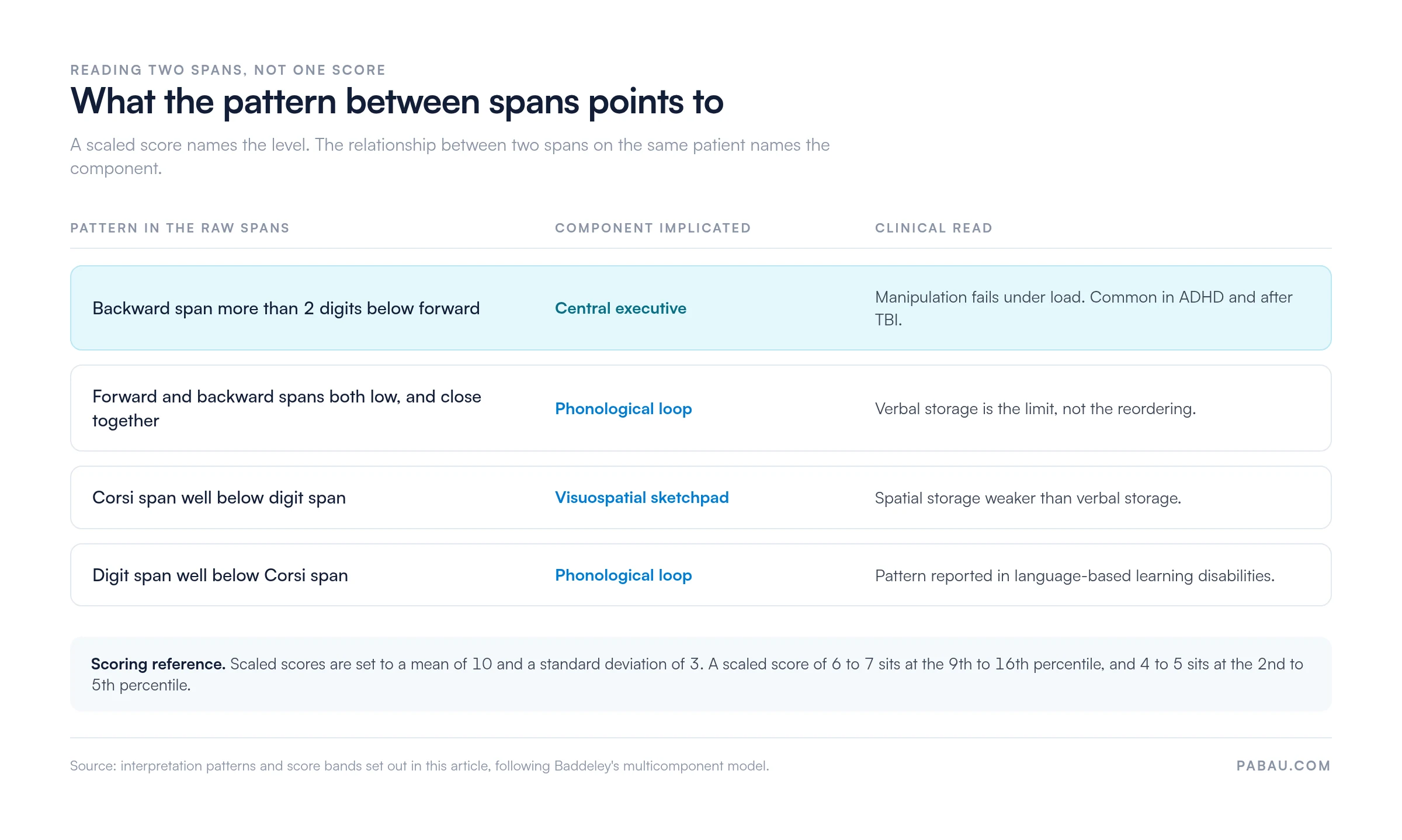
Backward digit span tests central executive function. The examinee repeats the sequence in reverse, so they hold it and reorder it at the same time. A difference of more than two digits between the two spans points to central executive impairment rather than a storage problem.
Record these results alongside the intake data. A psychiatric evaluation template holds the clinical context that explains the score, rather than the number on its own.
The n-back task is the dominant research instrument for working memory capacity and its link to fluid intelligence. Published cognitive neuroscience research finds that n-back performance correlates with general working memory capacity across populations.
The examinee sees or hears a continuous stream of stimuli, such as letters, numbers, or shapes. At each point, they indicate whether the current stimulus matches the one presented n steps back.
In a 1-back task, they compare the current item to the one immediately before it. In a 2-back task, they compare it to the item two positions back. The dual n-back variant adds a simultaneous visuospatial stream, which makes it one of the most demanding tasks available.
Most clinical applications use 2-back as a practical ceiling. A 3-back condition is usually reserved for research.
The Corsi block-tapping test measures visuospatial working memory span, targeting the visuospatial sketchpad. The examiner taps a sequence of blocks on a board, or on its digital equivalent. The examinee then replicates the sequence in the same order, or in reverse.
The Corsi span means most when you compare it to the digit span. A Corsi span well below the digit span suggests a specific visuospatial processing difficulty. The reverse pattern shows up in some language-based learning disabilities.
Recording both spans at every visit is what makes that comparison possible a year later. Digital forms that carry the previous scores forward save you from reading back through the notes.
The NIH Toolbox List Sorting Working Memory Test asks examinees to sequence stimuli from smallest to largest, first across one category and then across two.
It is validated from ages 3 to 85-plus, which makes it one of the few instruments with lifespan norms. Its published normative data makes it popular in multi-site research, and increasingly in clinical practice.
Poor administration is the main source of measurement error in working memory testing. Standardized instructions, consistent pacing, and a distraction-free room are not optional.
Deviations belong in a structured field rather than a free-text box. Clinicians tend to leave out whatever felt unremarkable at the time. The reviewer three months later then cannot tell a quiet room from a noisy one.
Run at least one practice administration with a colleague before using a new working memory test instrument with patients. Pacing errors, script deviations, and discontinuation mistakes are far more common in the first five administrations than in later ones. A single practice session catches most of them before they affect patient data.
Raw scores mean very little without normative context. A forward digit span of 7 is unremarkable in a healthy 30-year-old. In a patient recovering from a moderate TBI, the same score can mark a good recovery. Age-adjusted scaled scores and percentile ranks are the interpretable outputs.
Most standardized batteries (WAIS-IV, WMS-IV, CANTAB) convert raw scores to scaled scores with a mean of 10 and a standard deviation of 3. Broad interpretation bands by scaled score:
The band tells you the level. The comparison between two spans tells you which component is carrying the deficit, and that is the part a single scaled score hides.
Age is the most important norm variable. Working memory capacity peaks in early adulthood, roughly between ages 20 and 30. It then declines gradually through middle age, and more markedly after 60.
Comparing a 65-year-old against a young adult sample will overestimate impairment. Use the age-stratified tables in the test manual, or a battery like the NIH Toolbox that was normed across the full lifespan.
Education is a secondary moderator. Higher educational attainment correlates with better performance, probably through rehearsal strategy rather than underlying capacity. Use education-corrected norms where the manual provides them, and match the normative group as closely as your data allows.
A working memory test is rarely administered on its own. It is usually one component of a broader neuropsychological assessment, ordered when cognitive complaints could point to one of several conditions.
Practices can also run the Conners rating scale alongside the working memory result. It scores inattention, hyperactivity-impulsivity, oppositional behavior, and learning problems across parent, teacher, and self-report forms.
Some referrals for cognitive complaints also note slowed movement or handwriting that shrinks across a line. A motor slowing assessment records those observations with a score, so the working memory result is read in context.
The growth of digital cognitive testing raises a practical question for referring clinicians. When is an online working memory test adequate, and when do you need a clinician-administered battery? The answer depends on what the result will be used for.
Online tests do a legitimate job. A patient who completes a brief screen before the appointment arrives with a concrete reference point for the conversation, and that improves the interview. The screen result should still not drive a diagnostic conclusion.
The American Psychological Association’s guidelines on psychological testing and assessment are explicit that standardized administration conditions are a prerequisite for valid score interpretation. A test that cannot guarantee those conditions produces data for awareness, not for diagnosis.
Most practices record a span score in a free-text note. It sits in the chart, but nobody can pull it back out three visits later to see whether the number moved. The comparison the test was ordered for gets lost in the prose.
Practice management software like Pabau stores each span as its own field on a digital form. You build the form once for your battery, then reuse it at every reassessment. Pabau’s therapy practice management software holds the score, the appointment, and the follow-up task in one client record.
So today’s scaled score sits next to the last two, with the administration conditions attached to each. When a score drops, the recall for a repeat assessment is already on the schedule instead of on a sticky note.
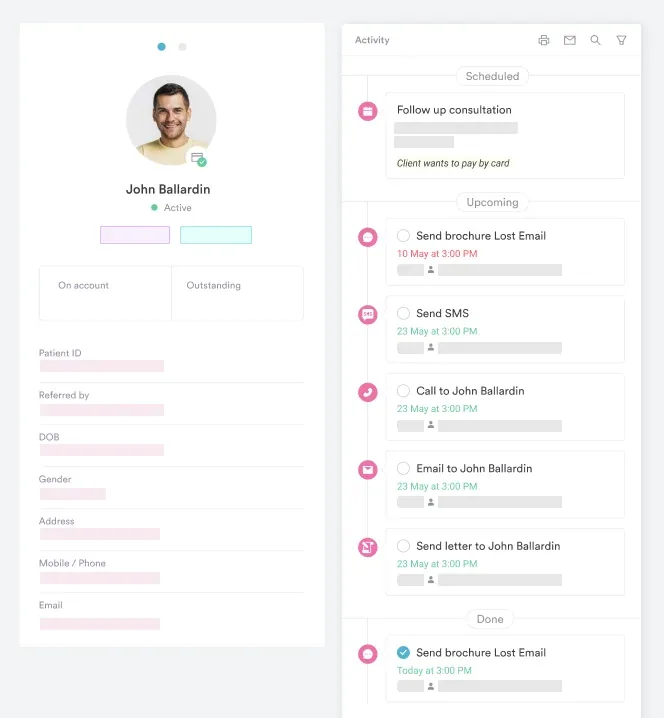

Pabau lets psychology and psychiatry practices capture structured assessment results and track score changes across appointments. Evaluation notes attach straight to the client record, so there is no second system to update.

A working memory test earns its 15 minutes when the result changes what you do next. That rests on three decisions. Pick the instrument that matches the component you suspect, hold administration to the standard, and score against the right normative group.
One scaled score names a level. The relationship between two spans names a component, which is what a referral letter can act on. Collect both spans even when the presenting complaint points clearly at one of them.
Record both spans, and record how you got them. Book a demo to see how Pabau tracks assessment scores across appointments for psychology and psychiatry practices.

Working with ADHD patients between assessments? ADHD therapy activities for focus and self-control covers activities clinicians can use alongside formal working memory testing.
Running a psychology practice on scattered records? Psychology practice software shows how Pabau handles structured documentation, recalls, and client records.
A working memory test is a standardized cognitive assessment instrument that measures the brain’s ability to hold and actively manipulate information simultaneously. Unlike simple recall tests, it requires the examinee to process or reorder information while holding it in mind. The components involved are the phonological loop, the visuospatial sketchpad, and the central executive.
A scaled score of 8-12 (25th to 75th percentile) is considered average on standardized batteries such as the WAIS-IV digit span. Scores are always interpreted against age-adjusted norms. What is average for a 25-year-old counts as above average for a 70-year-old, because capacity declines with age.
A clinician-administered standardized working memory test is the only reliable way to determine whether a deficit is present. A scaled score below 7 (below the 16th percentile) on an age-adjusted instrument typically warrants clinical attention. Online self-tests can raise awareness but are not diagnostic tools, and they do not replace a formal neuropsychological assessment.
The same core instruments (digit span, Corsi block test) are used across age groups, but with age-appropriate norms and adapted instructions. The NIH Toolbox List Sorting Working Memory Test is validated from age 3 through 85-plus. Children’s results are compared against developmental norms rather than adult population norms, and administration is paced more slowly with extra practice trials.
Working memory capacity refers to the amount of information an individual can hold and process simultaneously under cognitive load. It is measured through span tasks (digit span, Corsi block), complex span tasks (operation span), and continuous performance tasks (n-back). Capacity is not fixed. It varies with age, fatigue, anxiety, and practice, which is why standardized conditions matter.
The evidence is mixed and depends on the intervention and the population. Targeted cognitive training tasks, particularly n-back training, show some near-transfer effects in research settings. Whether those effects transfer to everyday functioning remains debated. Treating an underlying condition such as ADHD often improves test performance indirectly, by improving attentional regulation.