Health appraisal form
A health appraisal form is a record a licensed provider signs to document someon...

2
Last Updated: Oct 13, 2026

Timely’s US plans start at $26, $39, and $47 per month for one bookable staff member on Build, Elevate, and Innovate.
Extra staff cost less than the first one, so multiplying the headline rate by your headcount overstates the bill.
From eight bookable staff the price goes flat at $241 a month on Elevate and $300 on Innovate, with Build capped at seven.
Payments are included in every plan, but card processing fees and SMS above your monthly allowance are billed on top.
Timely is built for hair, beauty, and wellness, so it carries no treatment notes, consent forms, or clinical records.
Timely’s pricing page shows three plans and a 14-day free trial. What you pay depends on how many bookable staff you add, and the math is not a simple multiplication.
Most pricing round-ups multiply the headline rate by headcount. Run Timely’s own calculator and the totals come out lower, then stop moving altogether at eight staff.
This guide works through what each plan costs at every team size and the fees that sit outside the subscription. At the end there’s a look at how practice management software like Pabau prices up, in case your business has outgrown a booking-first tool.
Before getting into the plan tiers, here’s a snapshot of the Timely booking system. What it is, who it’s built for, and where it sits in the salon and wellness software market.
One quick note on the name. This guide covers the salon and beauty booking Timely from EverCommerce (gettimely.com). It is not the identically named time-tracking app or events platform.
Timely is an appointment booking and business management platform built for hair, beauty, and wellness businesses. Its design priorities are a smooth client-facing booking flow and a calendar that non-technical staff can pick up quickly. Point-of-sale tooling covers product retail and service payments.
Owned by EverCommerce, it sits in the same software category as Fresha, Vagaro, and Booksy.
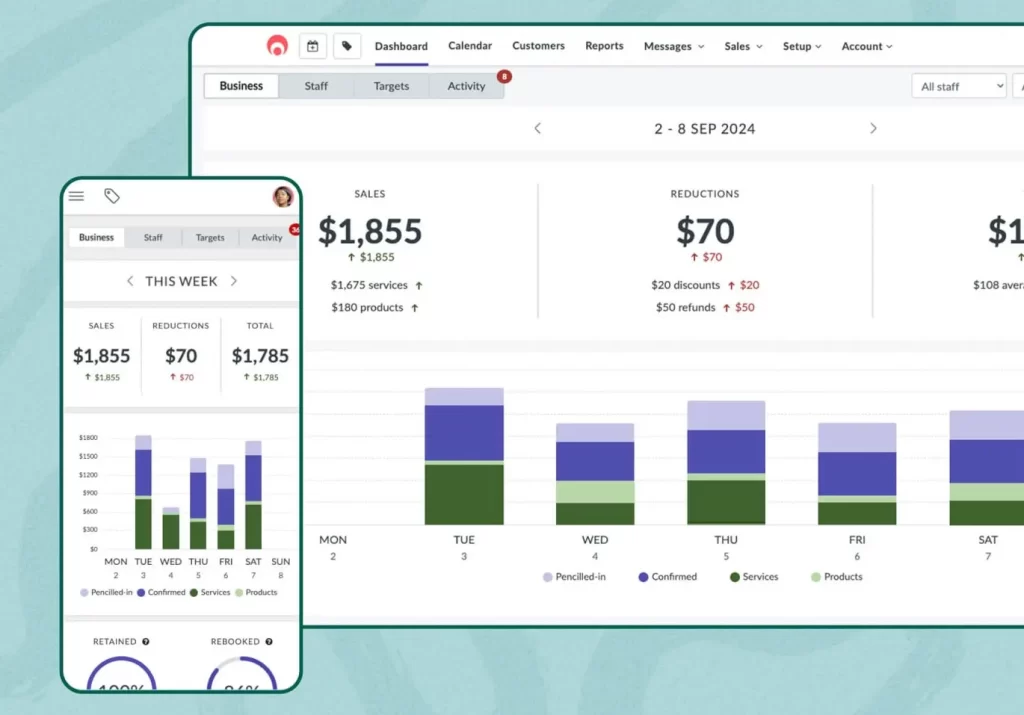
The platform’s natural users are solo beauty operators, small salon teams, barbers, and wellness studios. The workflow is essentially: client books an appointment, attends, pays. Owners who need to track inventory, run loyalty programs, and accept deposits or gift cards find a coherent toolkit in Timely.
The platform was not designed for regulated clinical environments, and its absence of treatment notes, structured medical history, or consent capture reflects that. For a deeper look at how Timely positions against another booking-first tool, see the Fresha vs Timely breakdown.
Timely sells three plans in the US: Build, Elevate, and Innovate. All three are priced per bookable staff member. A single-staff account pays $26, $39, and $47 a month.
| Plan | Price, 1 staff | Price, 8 to 19 staff | Included SMS per staff |
|---|---|---|---|
| Build | $26 / month | Not offered above 7 staff | 100 per month |
| Elevate | $39 / month | $241 / month, flat | 200 per month |
| Innovate | $47 / month | $300 / month, flat | 350 per month |
Every figure here comes from Timely’s own pricing calculator at gettimely.com/pricing, checked in August 2026. Rates vary by region, and Timely quotes New Zealand, Australian, and British prices separately.
Add a second staff member and Timely does not double the bill. The first bookable staff member pays the plan rate. Each one after that costs less, at $24 on Build, $29 on Elevate, and $36 on Innovate.
From eight bookable staff the per-seat math stops entirely. Elevate becomes a flat $241 a month and Innovate a flat $300, whether the team is eight people or 19. Build is not offered above seven staff.
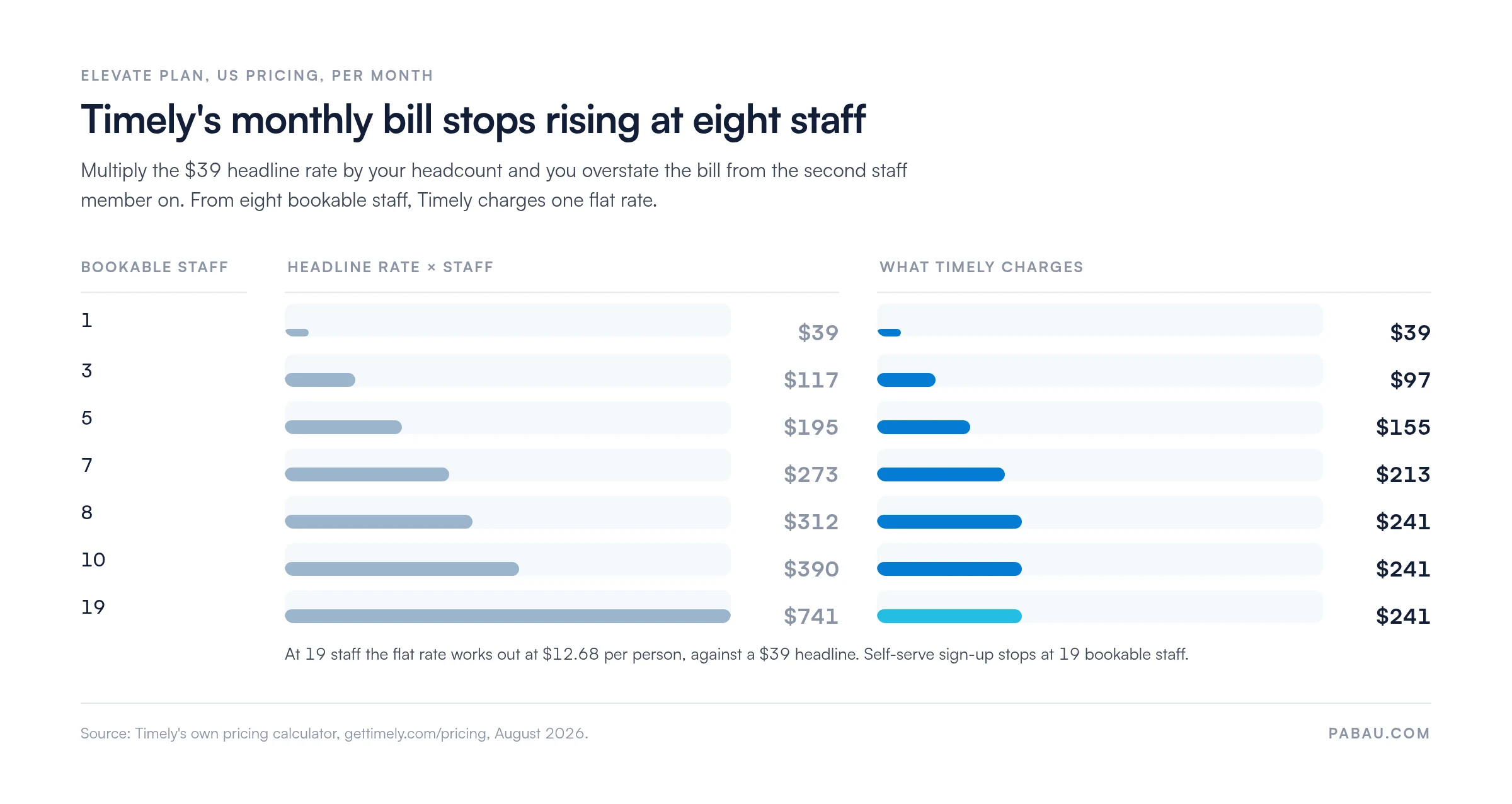
The practical effect is that Timely gets cheaper per person as you hire. On Elevate a solo operator pays $39 a head, a seven-person salon pays $30.43, and a 19-person salon pays $12.68. Above 19 bookable staff the sign-up flow stops quoting a price, so larger groups have to talk to Timely directly.
Not every per-seat platform behaves this way, so it pays to run each vendor’s own calculator rather than assume. Our AestheticsPro pricing breakdown runs the same exercise for a clinical platform.
Timely publishes its plan prices openly, and five costs sit outside them. Each one is easy to miss when you’re comparing headline rates across vendors.
Salons that outrun the SMS allowance every month sometimes price up a dedicated messaging platform instead. Podium is the name that usually comes up, and Podium’s monthly cost arrives as a private quote on an annual contract.
Model your bill at the headcount you expect in 12 months, not today’s. Timely’s own calculator does the math for any team size up to 19. If you plan to cross eight bookable staff, the flat rate can make Elevate cheaper per person than a five-person salon pays.
Timely reviews are strong across the major B2B software directories. Reviewers consistently call out ease of use, the client-facing booking flow, and customer support. Common limitations center on what the bill does as a small team grows, reporting depth, and the absence of clinical features.
For current sentiment, see Timely’s listings on Capterra, G2, and GetApp. Verify ratings and review counts directly on those pages, as they update continuously.
The recurring praise themes across Capterra and G2 reviews cluster around a small set of strengths.
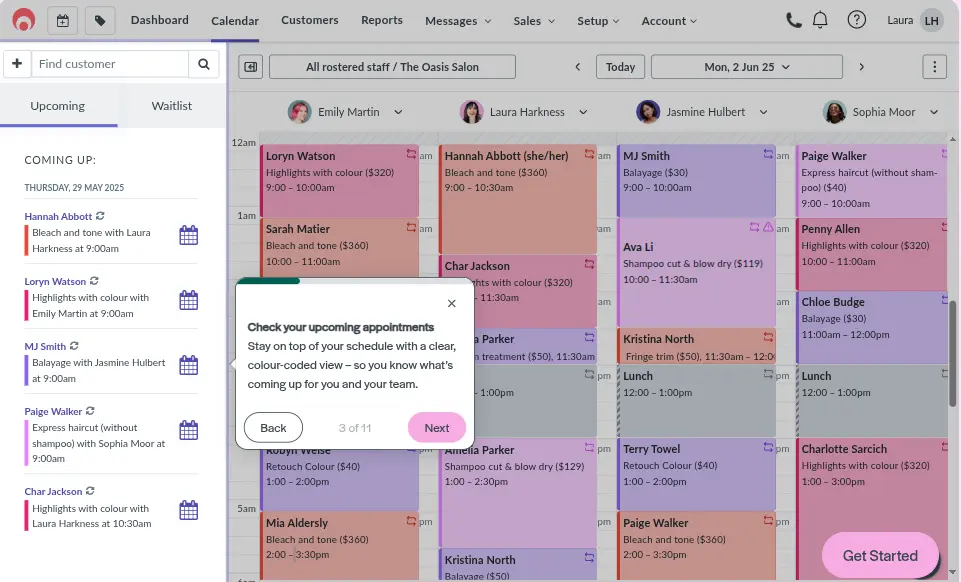
Onboarding speed and interface clarity. Reviewers describe the calendar and booking screens as among the cleanest in the salon-software category. Solo operators report being live within an afternoon. That reduces training overhead for front-desk staff and takes the friction out of bringing new team members onto the platform.
Client-facing booking experience. The public booking page is praised as smooth and conversion-friendly. Salons report stronger online booking-to-attend rates compared with clunkier predecessors. For businesses where most new customers arrive through a Google search or a social link, that is a meaningful revenue lever.
Inclusive feature updates. According to reviewer feedback, new features ship into existing plans rather than arriving as paid add-ons. Owners avoid the ratcheting cost increases that plague some competitor platforms where every new capability sits behind a pricier tier.
Customer support responsiveness. Email and help-center support are both well-rated. Live support varies by plan, but small operators describe the response times as adequate to good.
The same review platforms surface a recurring set of limitations. Most are structural to the per-staff, beauty-focused product design rather than fixable bugs.
Cost as a small team grows. Every hire between two and seven staff adds $24 to $36 a month. That is the steepest stretch of the curve, and it lands on the salons least able to absorb it. Build also closes above seven staff. A growing team on the cheapest plan has to move up to Elevate rather than pay for one more seat.
No clinical documentation. Treatment notes, structured medical history, digital consent forms, and before-and-after photo workflows are absent. Salons and beauty studios do not need these. Aesthetic and wellness practices do, and Timely is consistently flagged in reviews from clinical users as not built for that work.
Reporting depth. Several reviewers note that reporting beyond basic financial summaries means exporting data to spreadsheets or third-party BI tools. For an owner who wants cohort retention analysis, treatment-line profitability, or staff-utilization breakdowns, the in-platform tooling is limited.
SMS beyond the allowance. A busy salon running reminders and campaigns can outrun its included SMS, and the extras are billed on top of the subscription. The integration list is also built around general business tools like Xero, Stripe, and calendar sync rather than clinical systems.
Anyone evaluating Timely is usually doing so against a shortlist. On the booking-first end of the market, the most common alternatives are Fresha, Vagaro, Booksy, and Square Appointments. All are built around the same salon-and-beauty workflow, with pricing that lands close to Timely’s.
The right pick there usually comes down to marketplace reach, payment fees, and how the booking page looks to your clients. Because the billing models differ more than the headline rates suggest, run each one’s numbers at your own headcount. Our Vagaro pricing breakdown does that for the closest alternative on the list.
The other reason people leave Timely is a category mismatch rather than a price gripe. Sometimes the driver is clinical depth, which means treatment notes, consent capture, and before-and-after photo management. In that case the shortlist shifts toward medical spa software and clinical practice management tools.
That’s the group Pabau sits in, and the section below covers how its pricing stacks up against Timely’s.
Some businesses outgrow booking and payments. If yours runs treatments that need consent forms, treatment notes, and patient records, a clinical platform is the comparison that matters.
Pabau sits in a different category. It’s built for aesthetic, wellness, and medical practices rather than hair and beauty salons, so the price reflects a wider feature set. Here’s how the two line up.
Three points worth pulling out of that table:
The decision comes down to whether your business needs booking and payments or documented clinical care. If it’s booking, Timely is a clean, affordable fit, and it gets cheaper per person as you hire. If it’s injectables, laser, or IV therapy, a platform built for clinical workflows saves you stitching separate tools together later. For the feature-level view rather than the price view, our side-by-side software comparisons put Pabau next to Timely and its rivals.
Pabau also holds a 4.7/5 rating from over 600 verified reviews on Capterra, if you want to sense-check that fit.

Pabau gives every user the full platform on every plan, so scheduling, patient records, consent forms, treatment notes, and payments arrive in one subscription. Book a walk-through to see what that costs for your team.

Price Timely at the headcount you’ll have next year, not the one you have today. Between two and seven staff the bill climbs fastest, and that’s the range where switching is cheapest to do.
Past eight staff the flat rate turns Timely into one of the better-value booking tools on the market. The question then stops being what it costs. It becomes whether booking, payments, and a light client record cover the whole job.
If your treatments need consent capture and treatment notes, the answer is no, and bolting those on separately will pass Timely’s flat rate quickly. Book a demo to see what a single clinical subscription covers for a team your size.

Evaluating Timely against another booking-first tool? Fresha vs Timely covers how the two compare on pricing model, marketplace reach, and feature depth.
Looking for a Timely alternative? Timely alternatives rounds up the platforms worth shortlisting if Timely’s pricing or feature set doesn’t fit.
Comparing Timely with an allied-health tool? Timely vs Cliniko breaks down how the two platforms differ on clinical depth and pricing.
Weighing up another salon platform’s bill? Vagaro pricing works through the plans, the per-user math, and the fees that sit outside the subscription.
Timely’s US plans cost $26, $39, and $47 a month for one bookable staff member on Build, Elevate, and Innovate. From eight bookable staff the price goes flat at $241 on Elevate and $300 on Innovate.
Yes, though not at a flat per-head rate. The first bookable staff member pays the plan price, and each extra one costs less. From eight staff, Timely charges a single flat rate for the whole team.
Timely does not offer a permanent free plan. A 14-day free trial is available with no credit card required, giving full feature access before you commit to a paid subscription.
Payments are included in every plan, so the extras are card processing fees and any SMS above your monthly allowance. Part-time staff are billed at the full-time rate, and connected tools such as Xero charge their own subscription.
A 10-person team pays $241 a month on Elevate or $300 on Innovate, because both plans switch to a flat rate at eight bookable staff. Build is not offered above seven staff, and self-serve sign-up stops at 19.
Timely is optimized for hair, beauty, and wellness businesses rather than regulated clinical settings. It carries no clinical documentation, medical consent forms, treatment record management, or claims workflows. Practices that need those features usually evaluate purpose-built clinical platforms.
Common alternatives in the salon and wellness booking category include Fresha, Vagaro, Booksy, and Square Appointments. Buyers in the health, wellness, or aesthetic space also evaluate clinical practice management platforms such as Pabau. That happens once their needs run past booking into treatment documentation.