Head to toe assessment cheat sheet: Printable nursing guide
A head to toe assessment cheat sheet gives you one fixed order at the bedside, s...

2
Last Updated: Oct 23, 2026

The sign of the buttock test compares the range of a straight leg raise against passive hip flexion with the knee bent.
A positive result means passive hip flexion is more restricted than the straight leg raise, which signals serious pathology in or behind the hip.
Causes include septic arthritis, osteomyelitis, bone tumors, ischiogluteal bursitis, gluteal abscess, and pelvic fracture, and all of them need urgent investigation.
Pabau’s clinical notes and client records let physical therapy clinicians document a positive finding and start the referral in one place.
The sign of the buttock test is a red-flag screen used across musculoskeletal and physical therapy practices. Described by orthopedic physician James Cyriax, it detects serious pathology in or behind the hip joint.
It works by comparing two passive movements. One is a straight leg raise (SLR). The other is passive hip flexion with the knee bent. When passive hip flexion is the more restricted of the two, the test is positive and needs urgent attention.
Most hip special tests screen for joint degeneration or impingement. This one screens for infection, tumor, and fracture. A positive result does not confirm a diagnosis. It signals that serious pathology may be present, and that imaging and blood work are warranted without delay.
The test itself takes less than a minute at the treatment table. What follows is the technique, the interpretation, the differential diagnosis, and how to record the finding so the referral holds up.
Understanding why this test works takes a basic grasp of the posterior hip anatomy. The structures in and behind the hip joint are:
Two movements load those structures differently. The SLR stretches the sciatic nerve and the posterior thigh soft tissues. It puts little compressive load on the posterior hip and gluteal structures.
Passive hip flexion with the knee bent does the opposite. It compresses and loads the posterior hip capsule and the structures directly behind the joint. Serious pathology in that region creates pain and restriction in the second maneuver, not the first.
The patient lies supine on the treatment table, as relaxed as possible, with no pillow under the head. The clinician stands on the side being tested. The two maneuvers run in sequence, and the ranges are then compared.
Place one hand under the patient’s heel and the other on the anterior thigh just above the knee. Keep the knee fully extended throughout. Raise the leg slowly by flexing at the hip, through the patient’s comfortable range. Note the angle at which restriction or pain begins. That angle is the SLR endpoint.
Record whether the restriction feels muscular (a gradual, elastic end-feel), neural (sharp or radiating), or hard (a sudden bony or capsular block). The character of the restriction matters as much as the degree.
Lower the leg back to the table. Support the same leg under the heel and behind the knee, letting the knee flex freely. Flex the hip again slowly, this time with the knee bent.
The sciatic nerve is now slack. Any restriction that appears in this position cannot be blamed on neural tension or hamstring tightness. Note the angle at which restriction or pain appears.
The end-feel difference between a benign and a positive finding is usually clear. A hard, painful capsular block that appears at a smaller range than the SLR is the hallmark of a positive test.
The comparison is the test. Three outcomes are possible, and each one sends the appointment in a different direction.
The third outcome is the one that changes the rest of the appointment. The chart below sets each finding against what it points to and what you do next.
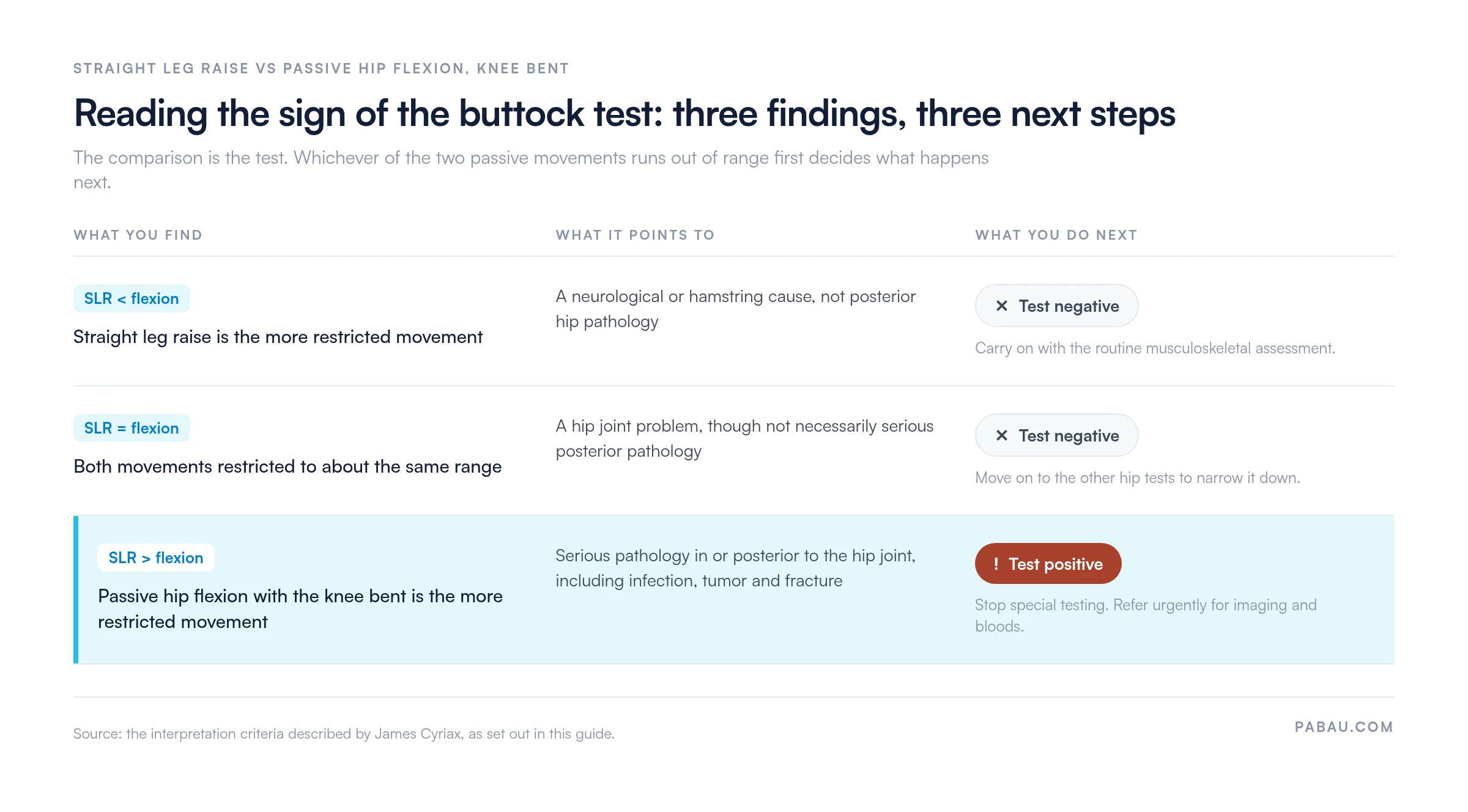
A positive sign of the buttock test means passive hip flexion with the knee bent is more restricted than the SLR. That reverses the expected pattern. The structure limiting movement sits in or directly behind the hip joint, where it resists compression and capsular loading. Neural tension and hamstring tightness cannot produce that pattern.
Cyriax rated this among the most important signs in orthopedic medicine. Posterior hip pain is usually nerve tension, muscle tightness, or joint degeneration. A positive test points away from all three and toward pathology that can be life-threatening.
Acting on the sign is a governance duty as well as a clinical one. Physical therapy compliance rules set out the documentation and referral pathways that apply in exactly this situation.
A positive test does not confirm a specific diagnosis. It is a screening indicator, and it calls for four things:
A negative sign of the buttock test does not rule serious pathology out. The history, the other examination findings, and clinical judgment all have to line up before anyone is reassured.
Several serious conditions produce the reversal this test detects. The differential is broad, which is why the test works as a screening prompt rather than a diagnostic one.
Piriformis syndrome appears in some versions of this differential, though the restriction pattern it produces does not usually reverse the two ranges. Its inclusion is contested. Treat any positive test as serious pathology first, then refine the differential through investigation.
A positive sign of the buttock test is itself a red flag. Some accompanying features escalate the urgency further, and they call for same-day referral to an emergency department or urgent physician review. NICE indexes its hip conditions guidance under musculoskeletal conditions, which is worth a look before you write the referral letter.
Recognizing red flags and starting the referral is part of the physical therapist’s professional duty. The Chartered Society of Physiotherapy sets that expectation in the UK through its scope of practice guidance. The American Physical Therapy Association publishes clinical practice guidelines that cover screening and differential diagnosis.
Deferring referral after a positive test, without a documented reason, is a governance risk. It is also the point at which someone other than you will read the chart.
The sign of the buttock test sits inside a broader hip examination battery. Knowing when to use it, and how it differs from the rest, prevents both under-referral and unnecessary alarm. The table below compares it with the hip tests most often performed in the same appointment.
The FADIR and Thomas tests screen for common mechanical hip conditions. The sign of the buttock test screens for the conditions none of the others address.
Run it before the FADIR and the other loading tests, because a positive result changes the direction of the whole appointment. It makes further special testing inappropriate and moves the priority to referral.
Identifying a positive sign of the buttock test only helps the patient if the finding reaches the next clinician. The ranges, the decision, and the follow-up pathway all have to be traceable in the record.
A complete clinical note for this test covers all of the following:
Physical therapy practice software built for allied health makes that level of structure straightforward. Practice management software like Pabau lets you build custom assessment templates and record findings in structured fields. Referral correspondence attaches to the same client record, so the paperwork sits with the assessment that prompted it.

Timestamped, structured records are not optional in a regulated practice. They form the audit trail if a complaint, a governance review, or a malpractice claim follows. Good documentation is, in that context, as clinically important as the assessment.
Document both the SLR range and the passive hip flexion range in degrees, not just the binary positive or negative result. If a patient returns or is reviewed by a colleague, quantified findings allow meaningful comparison and prevent ambiguity in the referral letter.
A red-flag finding usually ends up in three places at once. The ranges go in the chart, the referral letter goes out by email, and the follow-up sits on a sticky note.
Pabau keeps them together. Custom assessment forms capture the SLR and hip flexion ranges as structured fields. A colleague reading the chart later sees numbers rather than prose, and any reply from the referral attaches to the same client record.
Pabau Scribe, our AI scribe, writes up the clinical reasoning while you talk it through. That keeps the detail that usually gets lost at the end of a busy afternoon.
The outcome is an audit trail you can hand to a governance review without rebuilding it from memory. Every Pabau subscription includes every feature, so the structured forms are there from day one.

Pabau gives physical therapy and musculoskeletal practices structured assessment forms and referral correspondence on the client record. The audit trail is there when a review asks for it.

The sign of the buttock test earns its place by catching what the other hip tests cannot. One reversed comparison, and the appointment stops being a rehab appointment.
So run it early, before the loading tests, and record both ranges in degrees rather than a bare positive or negative. The trade-off worth remembering is that a negative result proves very little on its own. The history and the rest of the examination still have to agree.
Getting the documentation right is the part you still control once the referral leaves your desk. Book a demo to see how Pabau structures assessment notes and referral records for physical therapy practices.

Running a physical therapy practice and need compliance support? Mandatory compliance for physiotherapy clinics covers the documentation and governance standards practitioners must meet.
Working through a full hip assessment? Hip examination walks through the sequence the sign of the buttock test belongs to.
Need the Thomas test alongside it? Thomas test template gives you a recording form for the hip flexor assessment.
Screening for lumbar nerve root involvement? Crossed straight leg raise test covers the companion test for radicular pain.
Opening or growing a practice? Opening a physiotherapy clinic walks through the setup, staffing, and compliance steps for allied health practices.
The sign of the buttock test compares two passive hip movements. It screens for serious pathology in or behind the hip joint. James Cyriax described it. The test is positive when passive hip flexion with the knee bent is more restricted than a straight leg raise on the same side.
With the patient supine, first perform a straight leg raise with the knee extended and note the range achieved. Then lower the leg and perform passive hip flexion with the knee bent on the same side. Compare the two ranges. If passive hip flexion is the more restricted movement, the test is positive.
A positive result indicates serious pathology in or behind the hip joint that needs urgent investigation. It does not confirm a specific diagnosis. It signals that conditions such as septic arthritis, osteomyelitis, a bone tumor, or a gluteal abscess may be present. Urgent referral and imaging are required.
James Cyriax, a British orthopedic physician and pioneer of orthopedic medicine, described the sign of the buttock in his Textbook of Orthopaedic Medicine. He considered it one of the most important clinical signs in musculoskeletal assessment, because it screens for serious posterior hip pathology.