Sulcus Test: Shoulder Instability Assessment
The sulcus test is an orthopedic special test that checks for inferior glenohume...

3
Last Updated: Oct 22, 2026

No single pain scale suits every patient, so pick one that fits how your patients report and use it at every visit.
The numeric rating scale, visual analog scale, Wong-Baker FACES scale and patient-specific functional scale all have published validation behind them.
A drop of 2 points or 30% on the numeric rating scale is the smallest change patients reliably notice.
Named pain scales circulate online with no published source, so look for a validation study before you adopt one.
Practice management software like Pabau captures each score on a digital form, so the trend builds itself inside the client record.
The right pain scale for your practice is a validated one that your whole team administers the same way at every visit.
Consistency does more for your records than picking the most detailed instrument available. A pain score only becomes useful once you have a second score to compare it against.
That leaves two practical questions. Which scales have published evidence behind them, and how much does a score have to change before the change means something? This guide answers both, then shows how to capture the answers so they trend without anyone rekeying a paper form.
It also covers a problem that surfaces more often than it should. Search for pain scales and you will find named instruments with tidy level-by-level tables and no source anywhere behind them. Knowing how to spot one protects both your notes and your clinical reasoning.
A pain assessment scale is a standardized way of turning a patient’s pain into a number or a category you can record, repeat and compare. It doesn’t make pain objective. Pain stays self-reported, and the scale’s job is to make that self-report comparable from one visit to the next.
Scales fall into two groups. Single-dimension scales measure intensity only, which is why they take seconds to administer. Multidimensional scales add the parts intensity misses: where the pain sits, what it feels like, and how much of the patient’s day it takes away.
Most therapy practices need one of each. An intensity scale gives you a number at every visit. A function or interference measure tells you whether that number is buying the patient anything.
The scales below are all published instruments with peer-reviewed psychometric work behind them. Each one answers a slightly different question, so the choice depends on your patients and on how long you can spend asking.
The numeric rating scale is the workhorse. You ask the patient to rate their pain from 0 to 10, and you need no paper, no props and no translation. That makes it the sensible default for every visit in a busy practice.
The visual analog scale asks the patient to mark a point on a 100 mm line running from no pain to the worst pain imaginable. You then measure the mark in millimeters. It picks up smaller shifts than a whole-number scale, but it needs a printed line or a screen every time.
The Wong-Baker FACES scale was developed by Donna Wong and Connie Baker for children, and it works for patients aged 3 and up. Six faces run from a smile at 0 to tears at 10. It also helps adults who find abstract numbers difficult, including patients with cognitive impairment.
The PEG scale takes three items from the Brief Pain Inventory: average pain intensity, interference with enjoyment of life, and interference with general activity. Each is scored 0 to 10 and the three are averaged. Krebs and colleagues developed and validated it in 2009 for exactly this problem, and it fits on a single intake line.
The short-form McGill Pain Questionnaire asks the patient to rate 15 pain descriptors from none to severe. Eleven of those words are sensory and four are affective. The original questionnaire runs to 78 words in 20 groups, which is why the short form is the one you see in practice.
The patient-specific functional scale inverts the usual approach. Instead of asking about pain, you ask the patient to name three activities their problem has taken away, then rate each from 0 to 10. It’s the only measure on this list where the patient chooses what gets tracked.
A single point of movement on a 0 to 10 scale is usually noise. Each validated measure has a published threshold for the smallest change a patient actually notices. It’s called the minimal clinically important difference, and it’s what turns two scores into a finding.
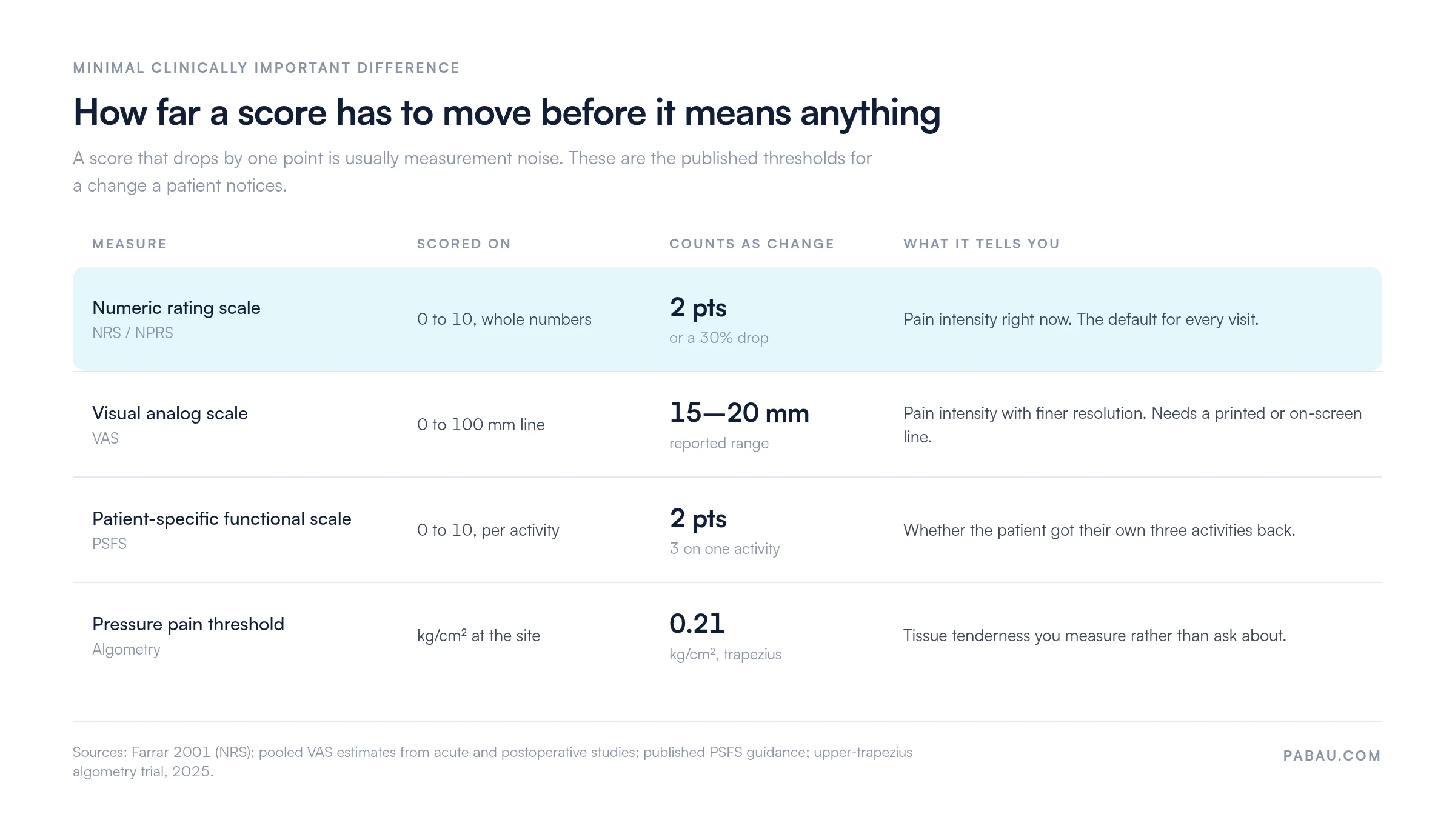
On the numeric rating scale, Farrar and colleagues put the threshold at about 2 points, or about 30%. That was the point at which chronic pain patients reported feeling meaningfully better. Both forms of the threshold are worth keeping, because a patient starting at 9 needs a larger raw drop than one starting at 4.
Reported thresholds for the visual analog scale vary far more widely, and they move with baseline pain. Postoperative studies commonly land around 15 to 20 mm on the 100 mm line, while emergency department work has reported figures closer to 12 mm. Treat any single number as a guide rather than a rule.
For the patient-specific functional scale, published guidance puts meaningful change at roughly 2 points on the average score, or 3 points on a single activity. That difference matters in practice. A patient can gain 3 points on the one task they care about while their average barely moves.
Soft-tissue work asks more of a pain measure than an intensity number can give. A patient can report the same 6 at two visits while their tissue tenderness and their range of motion have both improved. So the standard approach pairs an intensity score with something that tracks tissue or function.
Pressure pain threshold is the measure most specific to this work. Using a handheld algometer, you press at a defined site and record the pressure at which the sensation changes from pressure to pain. Reliability for trigger points in the upper trapezius has been reported at an intraclass correlation around 0.97 for manual algometry.
It also responds to treatment. A 2025 trial measured upper trapezius trigger points across six physical therapy sessions. Pressure pain threshold rose by roughly 0.20 kg/cm², against a minimal clinically important difference of 0.21. Changes in threshold tracked improvements in the Neck Disability Index.
A workable combination for a manual therapy caseload looks like this. Score the numeric rating scale at every visit. Run the patient-specific functional scale at intake, at discharge and monthly in between. Take a pressure pain threshold reading at the treated site if you own an algometer. A record built for therapists holds all three in the same client file, so the three curves sit side by side.
Some named pain scales that look authoritative online have no clinical origin at all. They arrive with a level-by-level table, a confident description of who uses them, and nothing you can trace. Five checks separate a real instrument from one of these, and they take about ten minutes.
A scale that fails these checks isn’t necessarily useless. Its descriptors may still help a patient put words to what they feel. Borrow the wording if it helps the conversation, then record the score itself on a validated scale so your notes stay defensible.
Collecting pain scores is the easy half. Pulling one patient’s trend without opening six notes is the half that needs a system. These five steps build it.
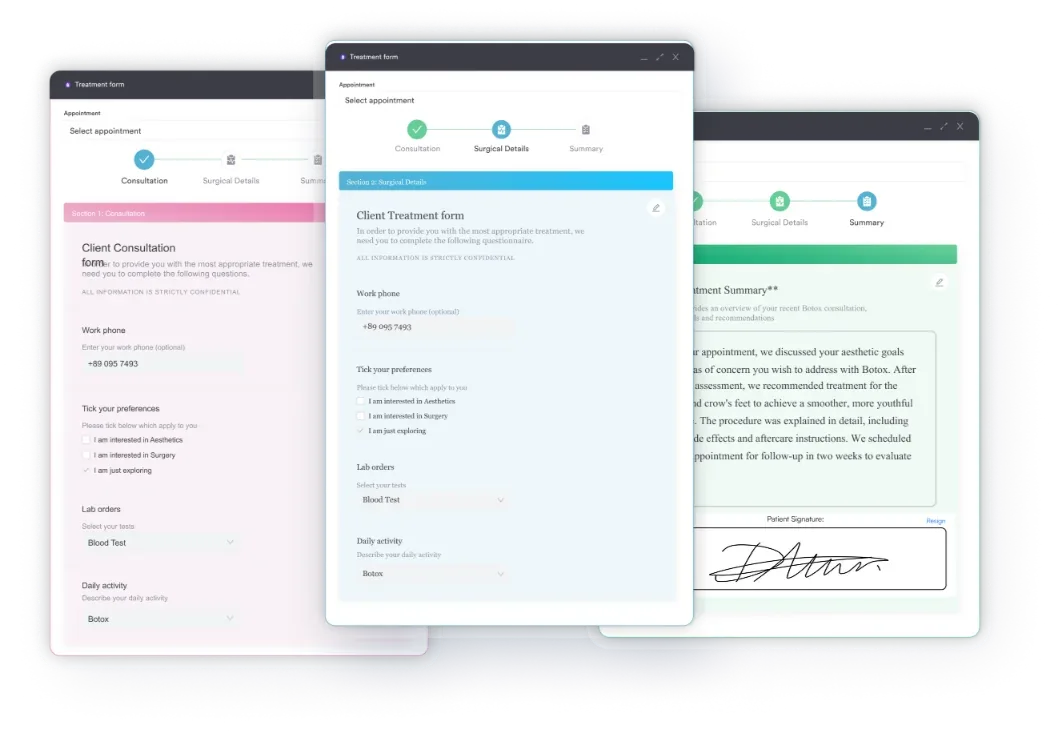
Digital intake forms handle the first four steps by design. The patient answers the scored question on their own device before the appointment. The number then lands in a field on the client record, not in a therapist’s handwriting.
The fifth step is where software earns its place. A threshold you never act on is just a number in a chart, so the rule has to fire on its own. Automated workflows can flag a patient whose score has not moved by the review point and route them to a senior clinician.
If your assessment questions still live on paper, start with one scale rather than the whole form. Our numeric pain rating scale gives you the wording and the 0 to 10 anchors on a single page. Score it the same way for a month, then add a function measure once the habit holds.
In most practices, a pain score is typed into the visit note. It’s technically recorded, but it can’t be charted. Answering “is this patient improving” means reading six notes in order, and trusting your memory of the wording each therapist used.
Practice management software like Pabau handles it differently. You build the scale once as a scored field on a digital form, and every patient answers the same question in the same words. The score saves to the client record as data, so the history is already a series rather than a set of paragraphs.
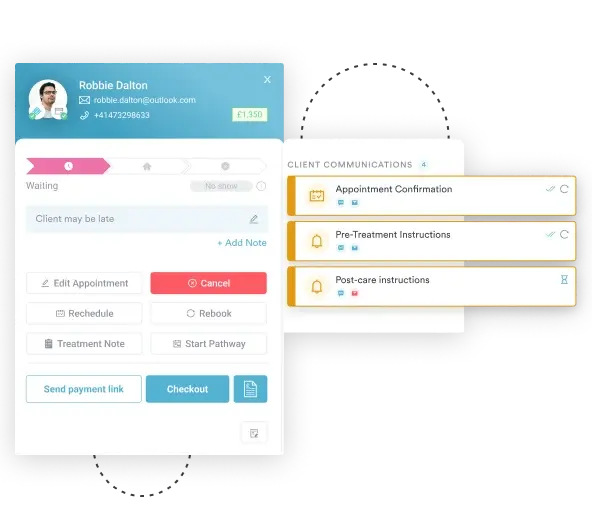
From there the review rules run on their own. Scores that stall past your chosen threshold raise a flag. Follow-up messages go out to the patients who need another visit. A discharge summary for a referring physician takes a few clicks instead of an afternoon. Your team spends the saved time on treatment rather than on transcription.

Pabau captures every pain and function score as a scored field on a digital form, so each patient’s history charts itself. Review rules and follow-ups then fire automatically, which keeps stalled cases from slipping past a busy week.

Choosing a pain scale is the easy part, and it matters less than most practices assume. The numeric rating scale plus a function measure will serve almost any therapy caseload. What separates a useful record from a merely full one is narrower than that. It comes down to identical wording each time, and a threshold your team knows by heart.
The trade-off worth remembering is resolution against habit. A more detailed instrument tells you more per visit, but it only pays off if your team completes it every single time. A shorter scale, scored consistently for a year, beats a thorough one that lapses after a month.
Pick your scale this week, script the question, and decide now what you’ll do when a score refuses to move. Book a demo to see how Pabau records pain scores as structured data and trends them across every visit.

Need a ready-made form for the scale itself? Pain assessment intake form gives you the scored question and the fields to file the answer in.
Want to capture where the pain sits and what provokes it? PQRST pain assessment form structures the parts an intensity number leaves out.
Treating a patient whose pain has cost them their confidence? Falls efficacy scale is a validated measure of how much fear of falling limits daily activity.
Rebuilding your paperwork as fields you can chart? Physical therapy intake form shows what a structured intake looks like end to end.
The numeric rating scale is the most widely used, because it needs no paper, no props and no translation. You ask the patient to rate their pain from 0 to 10, which takes seconds and works over the phone.
The numeric rating scale asks for a whole number from 0 to 10. The visual analog scale asks the patient to mark a 100 mm line, which you then measure in millimeters. The line picks up smaller changes but needs a printed form or a screen.
On the numeric rating scale, about 2 points or about 30% is the smallest change chronic pain patients reliably notice. Use the percentage form for patients who start high, since a drop from 9 to 7 means less than a drop from 4 to 2.
The Wong-Baker FACES scale, which uses six faces scored 0 to 10, works from about age 3. It also suits adults who find abstract numbers difficult, including patients with cognitive impairment or a language barrier.
Both, because they move separately. Pair the numeric rating scale at every visit with the patient-specific functional scale at intake, discharge and monthly. Add pressure pain threshold readings at the treated site if you own an algometer.
Search PubMed for the scale’s name and look for the original publication, with named authors, a year and a journal. A validated instrument also reports reliability, validity and a minimal clinically important difference. No trace of any of these means no validation.