

PQRST Pain Assessment Form
Free PDF 1 page, print-ready Clinician-reviewed
 Kate Tarrant

A PQRST pain assessment form is a one-page sheet for recording how a patient's pain presents. PQRST stands for Provocation and Palliation, Quality, Region and Radiation, Severity, and Timing, worked through in the same order at every visit.
Pain has long been framed as the fifth vital sign, though current guidance favors individualized assessment over a single numeric score. Asking the same five questions each time makes findings comparable between clinicians and across appointments.
- Template type
- Assessment
- Format
- Printable PDF, 1 page
- Fields to complete
- 11 fields
- Best for
- Guides
Download your free PQRST Pain Assessment Form
This one-page form has prompts for provocation, quality, region and radiation, and timing, plus a 0 to 10 severity row. It also has fields for the patient's name, the date, the health concern and additional notes.
- Patient name, date and health concern fields at the top of the sheet
- Provocation prompt for what triggers the pain, such as movement or pressure
- Quality prompt for describing the pain as stabbing, burning or dull
- Region and radiation prompt for whether pain stays put or spreads
- Severity rating on a 0 to 10 number row, from no pain to worst
- Timing prompt for how long pain has lasted, plus an additional notes box
Turn this template into a Smart Form
Start from scratch, or upload this PDF or any form you already use, and Pabau's AI Form rebuilds it with tick boxes, text fields and a signature. Attach it to the treatment once, and every patient gets it on time.
- Generate with AI from a PDF, Word file or photo
- Precare before the visit, aftercare after checkout
- Signed forms saved to the patient record
Why practices run their forms on Pabau
AI Form rebuilds the consent, history and aftercare forms you already use. You review each one, then publish.
Patients complete forms on their phone before they arrive, so the front desk stops retyping paper.
Every signed form is versioned and attached to the treatment record, ready when you need it.
Set how long a consent stays valid. Returning patients skip forms they have already signed.
Supports HIPAA and GDPR compliance AES-256 encryption 4.8 on G2 4.7 on Capterra Trusted by 4,000+ practices worldwide

Key takeaways
PQRST covers five pain domains: provocation and palliation, quality, region and radiation, severity, and timing.
Asking the five questions in the same order makes pain findings comparable across visits and between clinicians.
The form’s 0 to 10 severity row gives you a number to track, while the other prompts capture the patient’s own words.
SOCRATES adds onset and associated symptoms, which suits acute settings better than routine outpatient visits.
Pabau, the practice software we build, can send the form before the visit and save the answers to the patient record.
What is the PQRST pain assessment form?
The PQRST pain assessment form is a one-page sheet that walks a clinician through five questions about a patient’s pain. Pain has long been framed as the fifth vital sign, though current guidance favors individualized assessment over a single numeric score. Pain still gets documented unevenly, and the form fixes that by putting the same questions in the same order every time.
PQRST stands for Provocation/Palliation, Quality, Region/Radiation, Severity, and Timing. The mnemonic is a staple of nursing pain assessment and physical therapy history-taking. It is also a common teaching tool. In a 2023 randomized trial, medical students trained on PQRST improved their chronic pain assessment scores, and adding a second mnemonic made no significant difference.
A completed form becomes part of the patient’s medical record. In England, the Care Quality Commission (CQC) expects an accurate, complete and contemporaneous record for every patient. The Nursing and Midwifery Council (NMC) asks nurses to complete records at the time of care or as soon as possible afterward. A vague “patient reports pain” note meets neither standard, while five answered prompts do.
How to fill it out, one domain at a time
The form takes a few minutes and needs little training. Work through the five prompts in order, writing down the patient’s own words wherever you can.
- Provocation and palliation: Ask “What triggers your pain?” (movement, pressure, touch, activity) and “What makes it better?” (rest, ice, medication, position). Record both under the provocation prompt. Aggravating factors shape the treatment plan and any changes to the patient’s work or activity.
- Quality: Let the patient describe the pain in plain language. Sharp, stabbing, burning, dull, aching, throbbing and cramping are the usual descriptors. If they struggle, ask them to compare it to something familiar (“Does it feel like a knife, or like pressure?”). Quality helps narrow the differential diagnosis.
- Region and radiation: Note where the pain sits using anatomical landmarks, such as the right shoulder, lower lumbar spine or medial ankle. Then ask whether it stays in one place or travels. A referred pain map helps when the spread doesn’t match the source. Radiation can point to nerve involvement and guide imaging or referral.
- Severity: Ask the patient to circle a number on the form’s 0 to 10 row, the same format as a numeric pain rating scale. Some practices use a 0 to 100 visual analogue scale (VAS) instead. Add the worst and best levels since onset in the notes, so you can tell whether treatment is working.
- Timing: Record when the pain started, whether it is constant or intermittent, and how it changes through the day. Timing often hints at the cause. Inflammatory pain tends to peak in the morning, while mechanical pain usually worsens with activity.
Complete the form at the first appointment and again before each new intervention. Use the additional notes box for anything that doesn’t fit the five prompts.
Which practices use it
PQRST works anywhere a clinician needs a quick, consistent pain history:
- Physical therapy and sports medicine practices use it to separate acute from chronic pain and to pace rehabilitation. The severity and timing answers set how much load a patient can take.
- Chiropractic and osteopathy practices use it to tell mechanical pain, which changes with movement or position, from referred pain that radiates. The provocation answers feed directly into manipulation decisions.
- Mental health and psychology services use it when pain complicates treatment, such as pain alongside anxiety or depression. A structured record keeps physical symptoms from being overlooked.
- Primary care practices use it as a first screen before imaging or specialist referral. A clear PQRST history can save the patient an unnecessary investigation.
- Palliative care and pain management services rely on it to track how well medication works and when to adjust it. For frail or older patients, uncontrolled pain often erodes independence. Teams there pair it with a functional measure such as the Katz Index of Independence.
Benefits of a structured pain record
Inspection readiness: Inspectors look for assessments that follow a recognized method. A file of completed PQRST forms shows that your practice assesses pain the same way for every patient.
Faster intake: Clinicians know which questions to ask and in which order. The 0 to 10 row takes seconds to complete, and the free-text prompts stay short.
Clinical accuracy: Working from memory, clinicians skip domains. The form makes sure severity is scored, the region is noted and timing is recorded before anyone reaches a diagnosis.
Clearer handovers: When a physical therapist hands a patient over to a physician, the pain summary is already complete. “Patient has pain” becomes “sharp right knee pain on weight-bearing, rated 6/10, easing with ice and rest.”
Patient safety: Repeated severity and timing scores show when pain is escalating or changing pattern. A patient reporting worsening pain at night may need investigation or an oncology referral, and the form makes that change visible.
Pro Tip
Adapt the form to your specialty without dropping any of the five domains. A physical therapy practice will lean on provocation and region. A mental health service will spend longer on timing and emotional triggers.
PQRST vs SOCRATES and OPQRST
PQRST is one of several pain mnemonics, and they overlap more than their names suggest. The grid below lines up what each one asks about.
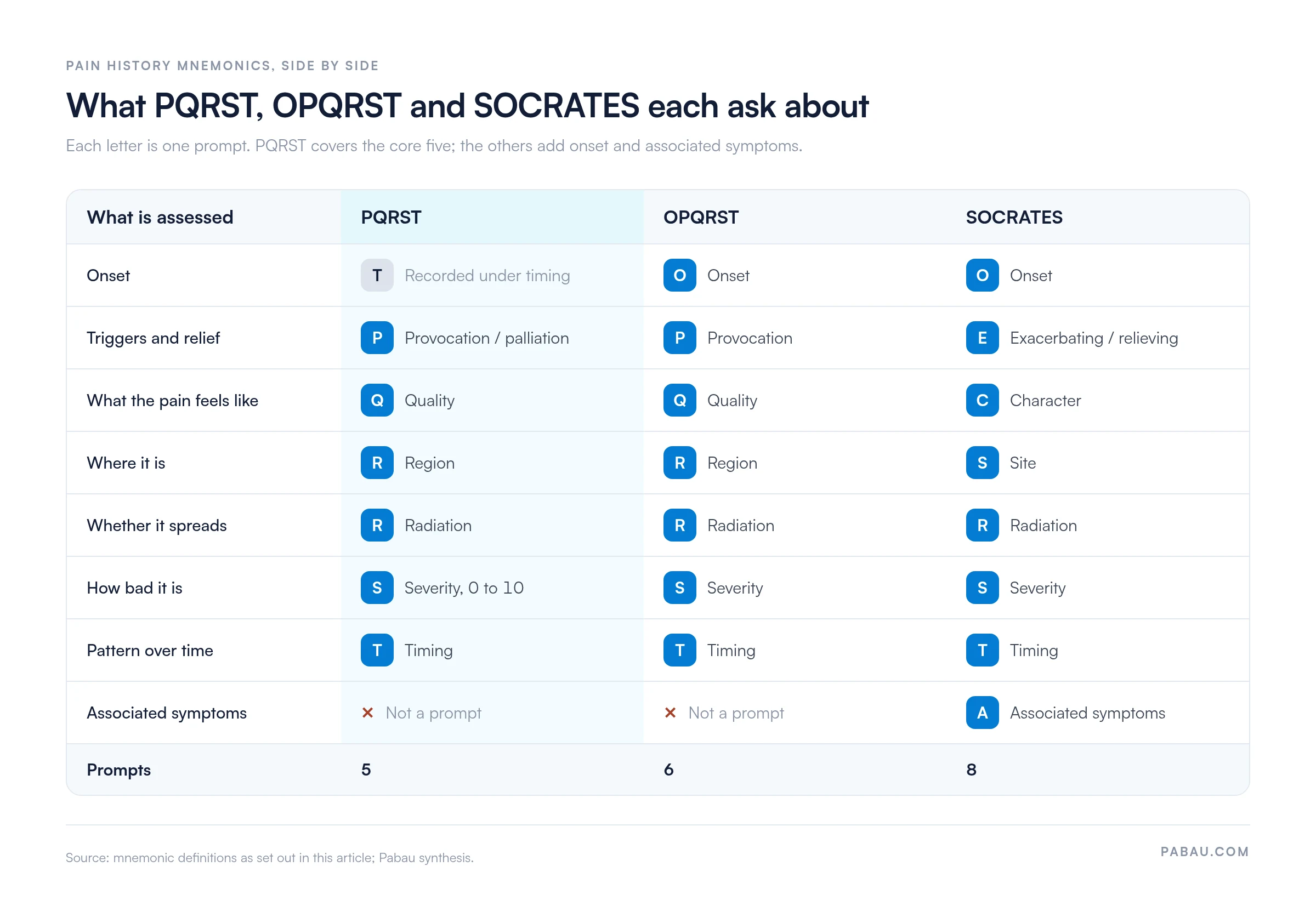
- PQRST (Provocation/Palliation, Quality, Region/Radiation, Severity, Timing): A general-purpose mnemonic used across physical therapy, chiropractic and primary care. Its five domains cover the main dimensions of pain, which makes it a good fit for outpatient visits.
- SOCRATES (Site, Onset, Character, Radiation, Associated symptoms, Timing, Exacerbating/relieving factors, Severity): Eight domains, including associated symptoms such as nausea, sweating or weakness. It suits emergency and acute hospital settings, where those symptoms change how urgently a patient needs care.
- OPQRST (Onset, Provocation, Quality, Region/Radiation, Severity, Timing): PQRST with an explicit onset question at the start. It helps in medico-legal work and workers’ compensation claims, where the exact time of injury matters.
For routine outpatient visits, PQRST’s five prompts are usually enough, and few practices need all eight SOCRATES domains. The five-part structure also maps neatly onto the fields of an intake form.
Running PQRST as a digital form
Paper forms work, but they have to be retyped, and they get lost. A time-saving physical therapy EMR lets patients answer the PQRST prompts at intake, with the answers landing straight in the clinical note.
Conditional logic makes a digital version more useful than the paper one. A score of 7/10 or higher can flag the answer as high severity and prompt the clinician to note their reasoning. A “yes” to radiation can open a body diagram.
Tablet access matters too. Clinicians who record answers during the consultation don’t have to reconstruct them from memory afterward. In occupational therapy software, pain ratings then sit alongside functional scores in the same progress note.
Common mistake: Treating the form as a replacement for clinical judgment. It guides the conversation, and the clinician still interprets it. If a patient’s pain doesn’t fit the five domains, as with phantom limb pain, record the mismatch and refer as needed.
What regulators look for in pain records
Regulators read pain documentation as a marker of clinical quality. NICE guideline NG193 recommends a person-centered assessment of how chronic pain affects each patient’s life. In the US, Joint Commission standards revised in 2018 ask accredited organizations to assess pain with methods suited to the patient’s age and condition.
When CQC inspectors review patient records, consistent PQRST entries across files show a systematic approach to care. Ad hoc notes that vary from clinician to clinician show the opposite.
Structured records also help in a dispute. If a patient claims treatment harmed them, your PQRST record shows their baseline severity, the provocation factors you noted and how timing changed. That contemporaneous evidence carries weight in any complaint or claim.
How Pabau runs PQRST assessments before and during the visit
On paper, a PQRST form gets filled in at the front desk, read once and filed. Last month’s severity score sits in a folder that nobody opens before the next session.
Pabau, the practice management platform we build, turns the form into a digital questionnaire attached to the appointment. Patients complete it on their own device before they arrive, and their answers save to the patient record. Your clinician opens that record and finds earlier forms in the same place, so changes in severity are easy to spot.
During the session, Pabau Scribe, our AI scribe, can draft the consultation note while you talk. Your PQRST findings end up in the note without anyone retyping them, and you finish the day with your notes done.

Collect PQRST answers before the patient arrives
Pabau sends your pain assessment form ahead of the visit and saves every answer to the patient record. Your clinician starts the session with the pain history already on screen.

Conclusion
Start using the PQRST form at your next new-patient appointment, and repeat it before each change in treatment. One form tells you little. A run of them shows whether your plan is working.
The trade-off is the questions PQRST leaves out. If your patients often arrive with nausea, sweating or weakness alongside their pain, SOCRATES will serve you better. For most outpatient practices, five prompts asked the same way every time beat a longer form that nobody finishes.
Want PQRST answers in the patient record before the session starts? Book a demo to see how Pabau collects and files pain assessments for your practice.

Continue your research
Need a deeper pain inventory for chronic cases? Brief pain inventory adds pain interference scores across daily activities.
Comparing pain scales for your practice? Pain assessment scales covers the common scales and when each one fits.
Prefer a line over a number for severity? Visual analogue scale (VAS) gives patients a 100 mm line to mark their pain.
Want patients to track pain between visits? Pain journal lets them log pain, triggers and relief at home.
Writing up the visit afterward? SOAP notes for physical therapy gives you a structure for the treatment note that follows the assessment.
Frequently asked questions
What does PQRST stand for in pain assessment?
PQRST stands for Provocation/Palliation, Quality, Region/Radiation, Severity, and Timing. They cover what triggers and relieves the pain, how it feels, where it is and whether it travels. They also cover its intensity on a 0 to 10 scale, and when it started and recurs.
How do you use the PQRST method to assess pain?
Ask each question in order during patient intake. Have patients rate severity on a numerical scale, note where the pain sits and whether it spreads, and describe quality in their own words. Document all five domains in the patient record before treatment planning begins.
What are the five components of the PQRST pain assessment?
Provocation/Palliation, Quality, Region/Radiation, Severity, and Timing. Each domain answers a distinct clinical question and together they create a complete pain picture for diagnosis and treatment.
How is the PQRST pain assessment different from SOCRATES?
PQRST has five domains and suits outpatient practices. SOCRATES has eight domains, including associated symptoms such as nausea and sweating, and is more common in emergency medicine. Both are valid, so choose the one that fits your setting.
Can the PQRST pain assessment form be used digitally?
Yes. Digital PQRST forms integrate into patient intake workflows, auto-populate clinical notes, and store data in the EHR. This eliminates paper handling and improves documentation speed and accuracy compared to handwritten forms.