Sulcus Test: Shoulder Instability Assessment
The sulcus test is an orthopedic special test that checks for inferior glenohume...

2
Last Updated: Oct 22, 2026

A neurocognitive test is a standardized, objective measure of brain function across six cognitive domains.
Scores are read against age- and education-matched norms, never against a universal pass or fail mark.
A score below the 16th percentile in two or more domains is the usual threshold for concern.
Digital tools cut administration time, but complex diagnostic questions still need a full neuropsychological battery.
Practices lose more time to the admin around the assessment than to the assessment itself.
Practice management software like Pabau moves the admin load into digital intake forms, linked session scheduling, and automated reminders.
About 1 in 10 US adults aged 45 and older report worsening memory loss or confusion, according to the CDC. Many of them go years without a formal diagnosis.
For clinicians in neuropsychology, psychiatry, or integrated wellness, the neurocognitive test is the tool that catches the change early. It turns a patient’s report of forgetfulness or “brain fog” into measurable data.
This guide covers what neurocognitive testing measures and how scores are interpreted. It also covers which batteries clinicians reach for, and how assessment teams run the workflow around the test. It is written for psychologists, neuropsychologists, practice managers, and clinical team leads.
A neurocognitive test is a standardized, objective measure of brain function. The terms “neurocognitive testing” and “neuropsychological testing” are used interchangeably in clinical settings.
Both Cleveland Clinic and Yale Medicine treat them as the same procedure in their clinical documentation. The assessment scores performance in specific cognitive domains against normative data from matched population groups.
Unlike neuroimaging or blood panels, a neurocognitive test involves no needles, radiation, or invasive procedures. The patient works through a series of tasks on paper or on a screen while a trained clinician observes and scores performance. Results describe functional brain capacity rather than structural anatomy.
The American Psychological Association treats neuropsychological assessment as a core clinical tool for evaluating the cognitive effects of neurological and psychiatric conditions.
Every major battery covers the same core cognitive domains. The specific tasks used to probe each domain vary by instrument. Knowing what each domain measures is what lets a clinician match the battery to the referral question.
Memory assessment covers three systems. Short-term memory handles immediate recall, long-term memory handles delayed recall after an interval, and working memory holds and manipulates information during the task itself. A typical memory subtest presents a word list or a story, then re-tests recall 20 to 30 minutes later without warning. Working memory tasks might ask the patient to repeat digit strings in reverse order.
Attention tasks measure three things. Sustained attention is how long a patient holds focus, and selective attention is how well they filter distraction. Divided attention is how quickly they switch between tasks. Processing speed is usually measured with timed symbol-matching or cancellation tasks. Slowed processing speed is one of the earliest measurable changes in traumatic brain injury and early dementia.
Executive function covers planning, problem-solving, cognitive flexibility, and impulse control. It reflects frontal lobe integrity. Common tasks include card-sorting tests, where the patient infers the rule from feedback.
Verbal fluency tests ask for as many animals as possible in 60 seconds. Trail-making tests require the patient to alternate between numbers and letters. Executive dysfunction appears early in frontotemporal dementia and is a core feature of ADHD.
Language assessment evaluates naming, verbal comprehension, reading, and writing. A clinician might show an image and ask the patient to name the object. Another task asks the patient to follow instructions that get progressively more complex.
Visuospatial tasks assess how well the patient perceives and reproduces spatial relationships, through copying geometric figures or assembling visual puzzles. Both domains are highly sensitive to stroke and to Alzheimer’s pathology.
No single instrument covers every cognitive domain. Clinicians select from a menu of validated tools based on the referral question, the patient’s age, and the time available. The table below covers the batteries and screening tools in widest use.
Test selection follows the referral question. A primary care physician screening for early dementia picks the MoCA for its brevity. A neuropsychologist assessing occupational capacity after a head injury runs a full battery, including the WAIS-IV, memory tests, and executive function measures. Practices that administer the Wechsler regularly can standardize the write-up with a WAIS-IV template.
Most major instruments ship with normative manuals from publishers such as Pearson Assessments and Psychological Assessment Resources. Those manuals set the administration and scoring rules, and departing from them invalidates the norms.
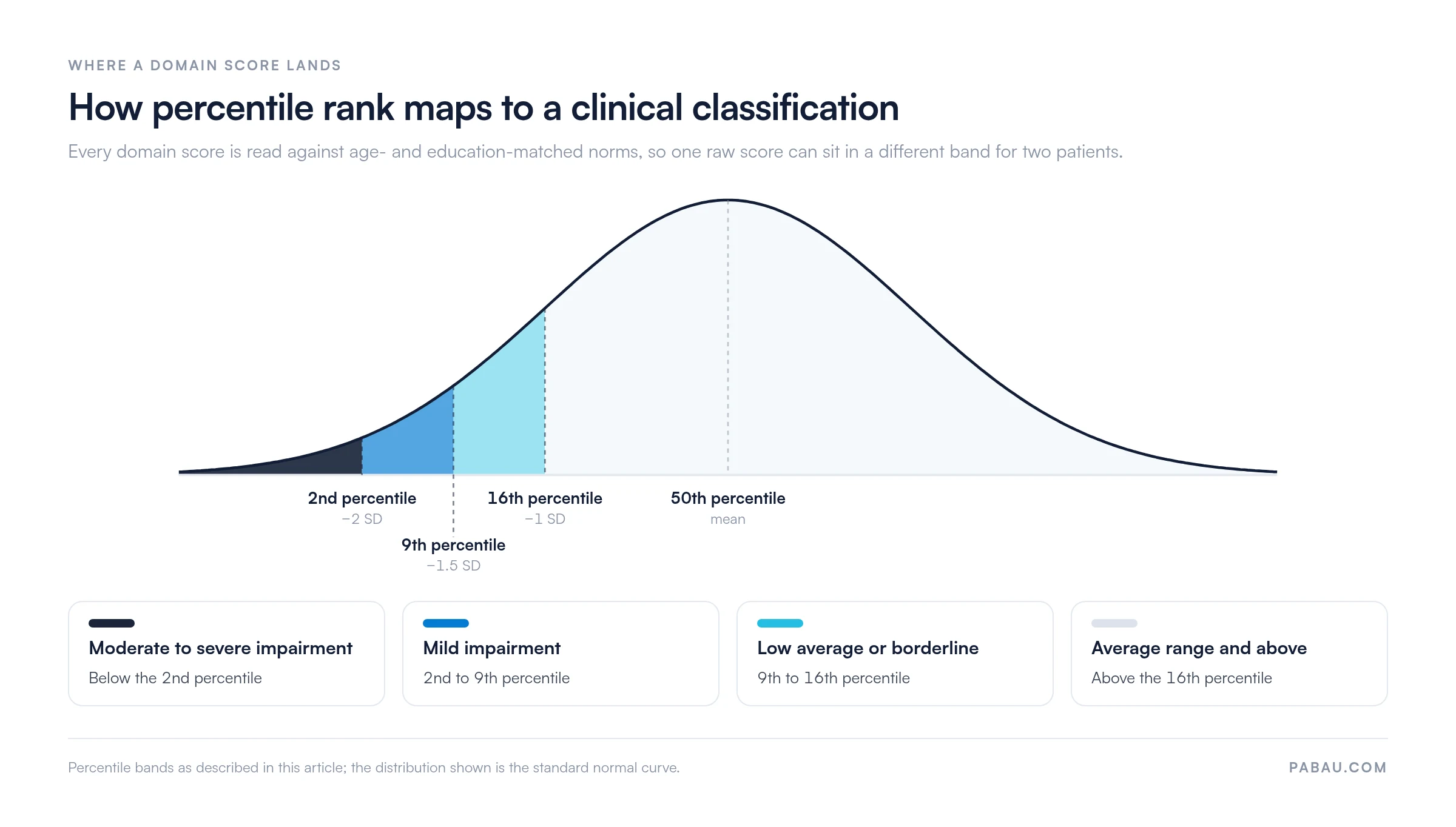
Raw scores mean little on their own. A 24 out of 30 on the MoCA reads one way for a 35-year-old with 16 years of education. It reads very differently for a 78-year-old who left school at 14. Interpretation converts raw performance into a clinical profile by anchoring it to population norms.
Those bands are easier to hold in your head as positions on the normal curve than as a list of cut-offs.
Documenting these profiles takes a consistent template that captures domain-by-domain scores alongside the normative reference group used. A psychiatric evaluation template is one way to formalize how results enter the permanent record.
MoCA results carry their own quirks, and the education adjustment is the step most often skipped. Our guide to MoCA score interpretation covers that adjustment and the standard cut-off.
Flag a score below the 16th percentile in at least two domains before you conclude cognitive impairment. A single low domain can reflect test anxiety, fatigue, or a pre-morbid learning difference rather than acquired decline. Cross-domain pattern analysis is where clinical judgment adds what an automated scoring report cannot.
A cognitive test profile is not a diagnosis. It is clinical evidence that informs the diagnosis, shapes rehabilitation planning, and sets a baseline for tracking change.
The decisions that follow include starting pharmacotherapy and referring to cognitive rehabilitation. They also include adjusting occupational or educational accommodations, and setting realistic expectations with the patient and family about prognosis.
Referral suits a wider range of patients than routine practice suggests. The groups below see consistent clinical benefit. Guidance from the National Institute on Aging on cognitive health in older adults covers the first of them.
The field has shifted toward computerized and app-based tools over the past decade. Both formats have a place in practice, and they serve different purposes.
Digital tools cut the administration burden considerably. The clinical evidence base behind traditional instruments is still substantially deeper.
For complex diagnostic questions, a full battery administered by a trained clinician remains the standard of care. Digital tools work best as a screening layer that triggers referral when scores fall below threshold.
FDA clearance status varies by product. Do not assume a digital cognitive testing application is cleared for diagnostic use until you have read the manufacturer’s regulatory documentation.
The assessment itself may take 45 minutes. Scheduling, intake paperwork, results documentation, and follow-up coordination usually take longer, and that is where an assessment program leaks time.
Practices running cognitive assessment programs get the most back from tightening five stages.
Those five stages sit outside the clinical work, but they decide how long a referral takes to become a delivered report. Centralizing them in one system is the difference between a program that scales and one that stalls at two assessments a week.
Practices that run assessments alongside ongoing care usually handle this inside their therapy practice management system rather than a separate tool. Teams working mainly on cognitive and behavioral testing may prefer dedicated psychology practice software.
Most assessment practices run those five stages across separate tools. Referral letters live in email and intake forms come back on paper. The report is written in Word, and the recall date sits in someone’s head.
Practice management software like Pabau puts them in one place. Patients complete medical history and referral questions on a digital form before they arrive, and the answers land straight in the client record. Two-part batteries can be booked as a linked pair, with automated reminders at 48 and 24 hours.
Domain scores go into a structured clinical note on the same record, so the next clinician reads the profile rather than reconstructing it. Recalls are set at the point of reporting, which means the 12-month retest is booked before anyone leaves the room. Every subscription includes every feature, so none of this sits behind a higher tier.

Pabau brings digital intake, linked session scheduling, structured clinical notes, and automated recall into a single patient record. Assessment teams spend their time evaluating patients instead of chasing paperwork.

Informal clinical impression misses slow cognitive change, and it misses the pattern across domains that separates one condition from another. Standardized measurement turns a patient’s complaint into a scored profile you can act on and repeat.
The trade-off worth remembering is time. A brief screener buys speed and loses behavioral observation, while a full battery buys depth at four to eight hours of clinician time. Pick the instrument the referral question needs, then hold the same one for serial retesting.
Getting the assessment right is half the job. The workflow around it decides whether the result reaches the record and the referrer on time. Book a demo to see how assessment practices run intake, scheduling, and recall in one place.

Need the MoCA broken down in full? Montreal Cognitive Assessment test covers the subtests, the 30-point scoring, and the education adjustment.
Scoring the MMSE instead? Mini-Mental State Examination gives you the printable form and the staging cut-offs.
Staging dementia for a care plan? 7 stages of dementia chart maps each stage to the functional changes families ask about.
Planning treatment after an ADHD profile? ADHD therapy activities turns attention and working memory findings into session content.
A neurocognitive test is a standardized, objective assessment of brain function. It measures memory, attention, executive function, processing speed, language, and visuospatial skills. Scores are compared against age- and education-matched normative data to identify strengths and areas of impairment.
Six core domains are assessed: memory, attention, executive function, processing speed, language, and visuospatial skills. Memory covers short-term, long-term, and working memory. Attention covers sustained, selective, and divided attention. Comprehensive batteries assess all six, while brief screeners focus on memory, attention, and orientation.
Traditional neuropsychological testing is administered in person by a trained clinician. A full battery takes 2 to 8 hours and includes direct behavioral observation. Digital tests can be administered remotely and return automated scores within minutes. They suit screening and serial monitoring better than complex diagnostic evaluations.
Raw scores are converted to scaled or standard scores, then compared to a reference group matched for age and education. A score at the 16th percentile, one standard deviation below the mean, falls in the borderline range. Below the 2nd percentile generally indicates significant impairment. Clinicians read domain patterns rather than single scores.
Brief tools like the MoCA and MMSE are the standard starting point for older adults. They take 10 to 15 minutes and are sensitive to mild cognitive impairment and dementia. When results are borderline or the picture is complex, a full battery with age-appropriate norms gives a more complete profile.
Brief screeners such as the MoCA take 10 to 15 minutes. Mid-length batteries such as the RBANS take 20 to 30 minutes. A full neuropsychological exam covering all domains takes 4 to 8 hours, often split across two sessions.