Antipsychotic medication list
An antipsychotic medication list is a structured reference that organizes psychi...

2
Last Updated: Oct 13, 2026

The mini-mental state examination is a 30-point screen covering orientation, registration, attention, recall, language, and visuospatial ability.
Scores of 25 to 30 suggest normal cognition, 21 to 24 mild impairment, 10 to 20 moderate impairment, and below 10 severe impairment.
Education, hearing, vision, and first language all move a score, so read the number against the patient in front of you.
One score on its own is weak evidence. Repeat testing against the same patient’s earlier result is what makes the tool useful.
Practice management software like Pabau stores each score in the client record, so the trend sits alongside the rest of the history.
A print-ready 30-point form carrying every scripted question with its point value beside it. It leaves space for the pentagon drawing, notes on anything that affected the result, and a scoring summary at the foot.
Download templateThe mini-mental state examination is a brief 30-point screen for cognitive impairment and dementia. Folstein and colleagues published it in 1975, and it is still the most widely used standardized cognitive test in clinical practice.
This guide covers how to administer the test and how to score it. It also covers how to read a result against the patient’s education, hearing, and earlier scores. Download the form above and work through the steps below.
The mini-mental state examination is a standardized screening tool that scores six areas of cognitive function out of 30. It screens, it does not diagnose. A low score tells you to investigate further, but says nothing about the cause.
The test has held its place for over 45 years. It is short, it needs no equipment, and it has been validated across a wide range of populations. Research from PubMed Central documents that validation work in detail. Most patients finish in 5 to 10 minutes.
It is a scored screen rather than a narrative assessment. Clinicians who also need a written picture of mood, thought.
The test covers six domains, each worth a fixed number of points. Knowing what every domain measures helps you administer it accurately and read the result in context.
The six domains add up to 30 points. Record the breakdown rather than the total alone. Two patients scoring 24 can fail entirely different sections, and that difference shapes what you do next.
A patient who loses points only on delayed recall is a different clinical picture from one who loses them on attention.
Accurate administration comes down to the room, the pacing, and sticking to the scripted wording. Work through these five steps in order.
Telehealth tools make it easy to review this resource with clients face to face online.
Scores fall into four severity bands. Age and education shift what those bands mean for an individual patient, so treat the table below as a starting point rather than a verdict.
Education-level adjustment matters here. Lower cut-offs suit patients with limited formal schooling, while higher thresholds apply to university-educated patients. Healthdirect Australia makes the same point about age and baseline function.
Record what you did with the score as well as the number. A screen that raises concern without a confirmed diagnosis is usually coded R41.82.
When you refer on, the receiving clinician will usually open with a full diagnostic interview billed under 90791. Sending your domain breakdown with the referral saves them repeating work you have already done.
Before you interpret the number, check that the test measured what you think it measured. Several things depress a score with no cognitive decline behind them at all.
Write these observations on the form itself. A score of 22 with “profoundly deaf, no hearing aid” beside it means something completely different from a bare 22.
A single result is weak evidence. The number earns its value through comparison, either against a population norm or, far better, against the same patient’s earlier score.
Untreated Alzheimer’s disease typically costs a patient two to four points a year on this test. Measured against that, a two-point drop between annual reviews is ordinary noise. A six-point drop is a reason to act. Without a baseline you cannot tell the two apart.
That is an argument for screening early, while the patient still scores normally. A 28 in a healthy 68-year-old looks like a wasted appointment on the day. Eight years later it can be the most useful number in the chart.
Storing results where you can see them side by side matters as much as running the test. Practices on mental health EMR software can chart every score against its visit date. Filing the same results as scanned paper turns each comparison into a manual hunt.
Whoever sees the patient next also needs to know what was decided. A case management note captures the referral, the family conversation, and the review date in one place.
The test is quick and well validated, but it has known blind spots. Understanding them keeps you from leaning on it harder than it can bear.
Score bands are also not disease stages. Where a diagnosis is already in place, a dementia staging chart describes day-to-day function far better than a number does.
The Montreal Cognitive Assessment (MoCA) is the usual alternative. Both take about the same time and both score out of 30, but they are tuned for different questions. Our guide to MoCA score interpretation covers its bands, domain scores, and education adjustment.
For routine primary care screening the mini-mental state examination is still the default. It is quick, it needs nothing but a pen, and every clinician who reads the note already knows the scale.
Where the question is early decline, the Montreal cognitive assessment catches more.
No specialist qualification is required. Primary care physicians, practice nurses, mental health nurses, clinical psychologists, occupational therapists, and allied health professionals can all run the test competently after basic training.
What matters is correct administration and sound interpretation, not job title. Some practices train non-clinical staff to administer it under supervision, which works as long as a clinician reads the result.
In an older patient, cognition rarely travels alone. Many practices pair the screen with a functional reach test for balance, so falls risk and cognitive risk are captured at the same visit.
Running the test on paper and typing the total into the record afterward costs a few minutes per patient. The domain breakdown usually never makes the journey, and neither do the notes on hearing or fatigue.
Practice management software like Pabau lets you build the form once and complete it in the client record during the appointment.
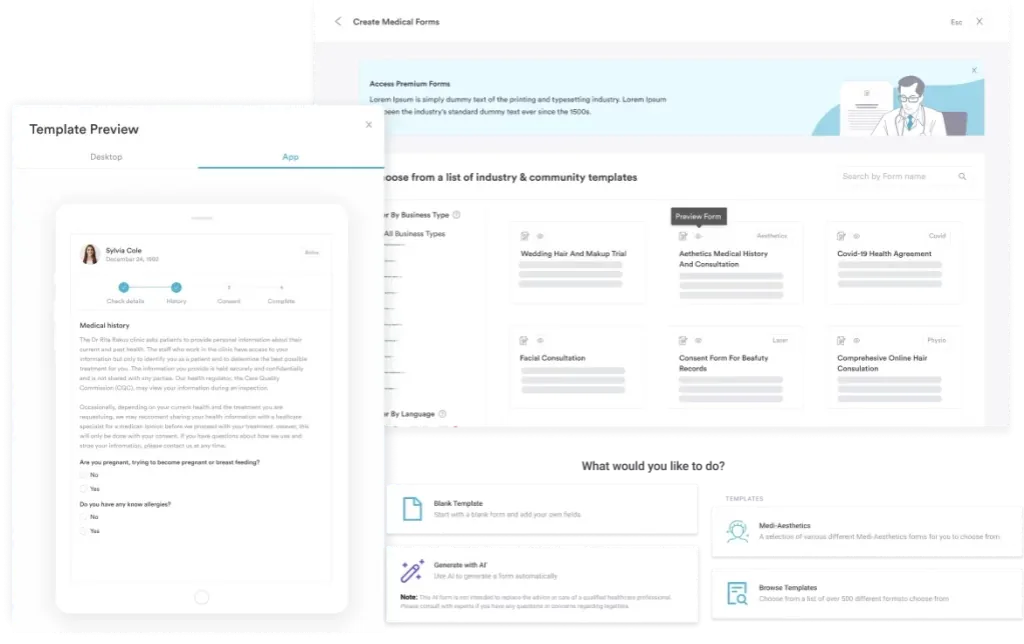
Once the result sits in the record it becomes searchable. You can pull every patient screened in the past year and set a recall for the next review. Putting this year’s score beside the one from two years ago takes seconds.
That is what turns a snapshot into a trend line, so you can act on a six-point slide instead of noticing it three appointments late.

Record MMSE results in Pabau as you run the test, compare them against earlier scores, and set the next review date. No retyping, no scanned paper to hunt through.

The mini-mental state examination earns its place because it is fast, needs no equipment, and is understood by everyone who will read the note. It will not catch subtle decline, and it will penalize a patient for poor hearing or thin schooling if you let it.
So run it, but record it properly. Note the domain breakdown, note anything that could have depressed the score, and set the date for the next one.
A first score is a baseline, not a finding. The second one is where the clinical value shows up. Book a demo to see how Pabau keeps cognitive scores, forms, and review dates in one client record.

Working with a family in conflict? Parallel parenting plan template covers custody schedules, communication methods, decision-making domains, and a dispute resolution process.
Supporting a patient after diagnosis? Dementia worksheets offer structured activities and orientation exercises you can send home with the family.
Assessing a minor and need consent first? Parental consent form authorizes treatment for minors and creates a documented record of parental authorization.
Ruling out low mood behind a low score? Depression self-assessment helps separate depressive symptoms from cognitive decline before you refer.
Building a mental health review from scratch? Psychiatric review of systems covers the symptom checklist that belongs alongside a cognitive screen.
It scores six cognitive domains. Those are orientation to time and place, registration of three words, attention and calculation, delayed recall, language, and visuospatial ability.
A 24 sits at the top of the mild impairment band, which runs from 21 to 24. It is not evidence of severe dementia, but it does warrant a retest or a referral, depending on the patient’s baseline and education.
Anything below 24 suggests cognitive impairment: 21 to 24 is mild, 10 to 20 is moderate, and below 10 is severe. Age and education move those lines. A 24 can be normal for a patient with little formal schooling and concerning for a graduate.
Orientation to time is 5 points and orientation to place another 5. Registration is 3, attention and calculation 5, and delayed recall 3. The language and visuospatial tasks carry the remaining 9, for a total of 30.
The template above is free to download. The instrument itself is copyrighted by PAR Inc. Check that your use fits your licensing agreement and your organization’s policy before reproducing it at scale.
Most patients finish in 5 to 10 minutes. Allow up to 15 if the patient needs slower pacing, an interpreter, or communication support.
Primary care physicians, nurses, psychologists, occupational therapists, and other allied health professionals can all administer it. No specialist qualification is needed, but familiarity with the scripted wording and the scoring rules is essential.