The best EHR for solo practice depends on specialty: aesthetics and wellness providers get the deepest feature set from Pabau, therapists from SimplePractice or TherapyNotes
Total cost of ownership varies widely: some platforms charge add-ons for billing, telehealth, and reminders that appear free at base pricing
Pabau includes built-in telehealth, digital consent forms, and AI-assisted documentation without requiring costly add-ons for solo providers
Most solo practitioners spend more time evaluating EHR software than they budgeted for their first month of clinical operations. The market is crowded, the pricing is opaque, and the “best” option on any given roundup was usually written for hospital systems or large group practices, not someone running a one-person clinic. As a result, choosing the best EHR for solo practice comes down to three factors that rarely get enough space in generic comparisons: specialty fit, total cost of ownership, and how quickly you can actually get up and running without a dedicated IT team.
This guide evaluates seven platforms across scheduling, clinical documentation, billing, telehealth, pricing, and ease of setup, covering solo providers across aesthetics, wellness, therapy, primary care, and allied health. You’ll also see these systems called EMR (electronic medical record) software, since EMR and EHR are used interchangeably, so this comparison applies whether you’re searching for the best EHR or the best EMR for solo practitioners. Because the right EHR for private practice looks different depending on whether you’re a nurse injector, a solo therapist, or a direct primary care physician, this comparison reflects those differences directly.
Found our content helpful?
Best EHR for solo practice: Quick comparison
Before diving into the full reviews, here’s how the seven platforms stack up at a glance across the criteria solo providers care about most.
Name
Best For
Standout Feature
Starting Price
Rating
Pabau
Aesthetics, wellness, and allied health solo providers
AI scribe, injection plotting, consent forms, telehealth
Solo mental health practitioners with insurance billing needs
Behavioral health documentation and ERA processing
From around $49/month (verify current pricing)
4.7/5
Jane App
Solo allied health: physiotherapy, massage, chiropractic
Intuitive scheduling and patient booking portal
Check jane.app for current pricing
4.8/5
Elation Health
Solo primary care and direct primary care physicians
Physician-grade charting and longitudinal records
Higher price point; contact for rates
4.5/5
Tebra
Solo medical practices with complex insurance billing
Integrated RCM and medical billing tools
Contact for pricing
3.9/5
DrChrono
Solo providers needing highly customizable charting
Customizable EHR templates and iPad-native design
Contact for pricing
3.9/5
1. Pabau – best EHR for solo aesthetics, wellness, and allied health
Solo providers in aesthetics, medical spa, wellness, and allied health need something different from a behavioral health EHR or a primary care chart. Specifically, they need consent workflows, before-and-after photo management, injection plotting, private-pay billing, and documentation that reflects what they actually do in the treatment room. Because of that, Pabau is built for exactly that segment, and it shows in the feature set from day one.
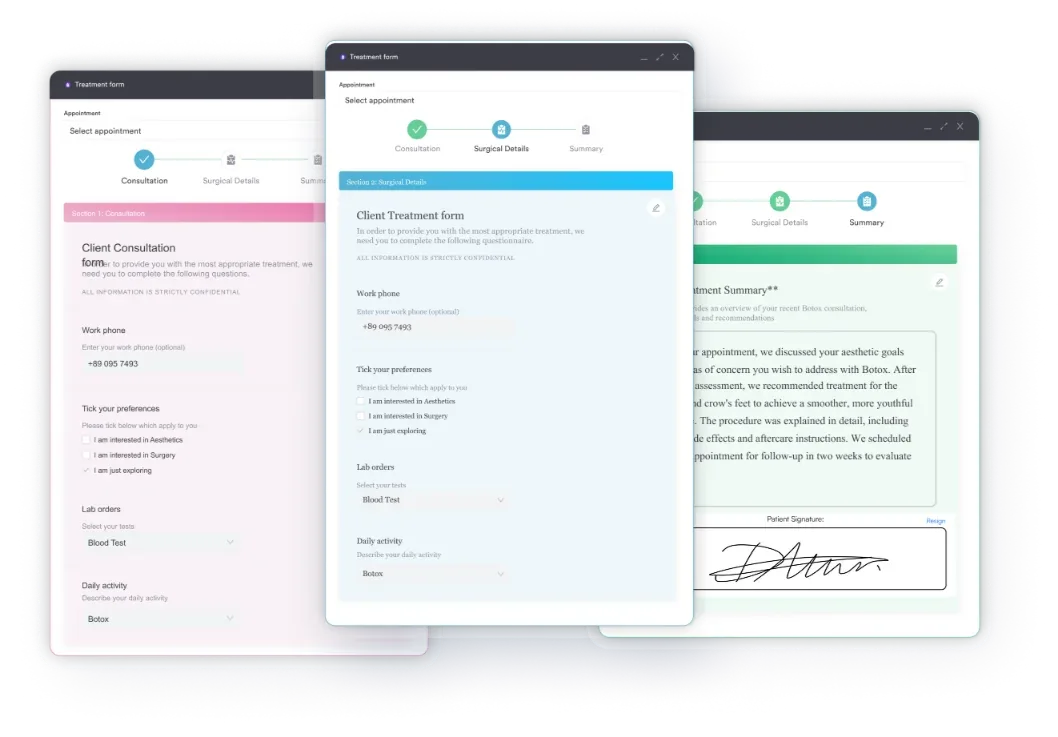
In practice, the platform covers the full solo practice workflow: digital intake and consent forms that clients complete before they arrive, a visual calendar with resource-based booking, invoicing and prepayment collection, and AI-assisted clinical note generation via Pabau Scribe. As a result, for a nurse injector, dermatologist, or physiotherapist running alone, that breadth removes the need to stitch together three or four separate tools.
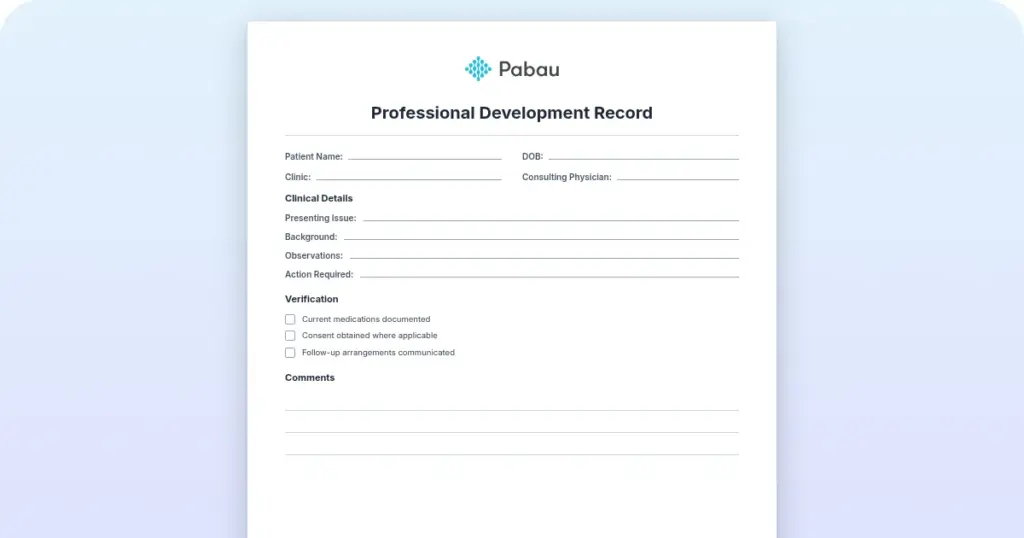
Customizable consent and intake forms.
Key features
Pabau Scribe:AI medical scribe generates clinical notes from consultation audio, reducing post-session documentation time
Injection plotting: annotate body diagrams directly in the client record with product, dosage, and placement data
Digital consent forms: customizable, sent automatically before appointments, signed electronically
Telehealth: built-in video consultations integrated into the booking workflow, with no third-party app required
Before-and-after photos: capture and compare treatment images within the client record
Online booking: client self-booking portal with deposit collection and automated reminders
Private-pay billing: invoicing, package management, memberships, and Klarna buy-now-pay-later integration
Automated workflows: pre-care and post-care instructions sent automatically by appointment type
Pricing
Plan
Price
Who It’s For
Key Features
Starter
From $65/month
Solo practitioners, new clinics
Scheduling, digital forms, client records, online booking
Higher tiers
Scales with location and user count
Growing practices, multi-location
All features included; pricing scales on location/users, not feature gating
Where Pabau shines
Specialty-specific documentation: treatment note templates, image annotation, and consent workflows built for aesthetics and wellness, not adapted from a generic primary care format
No feature gating: every tier includes scheduling, forms, billing, and client records; pricing scales with location and user count rather than locking core functionality behind upgrades
AI documentation: Pabau Scribe reduces note-writing time after procedures, which matters more when you’re the only person in the clinic
Private-pay billing depth: packages, memberships, deposits, Klarna, and invoicing built in, without requiring a separate billing module purchase
Onboarding support: structured onboarding for solo providers who don’t have a dedicated IT team or implementation budget
Where Pabau falls short
Insurance billing: Pabau submits US insurance claims through its built-in Claim.MD clearinghouse integration alongside private-pay billing; solo providers who want a fully outsourced revenue-cycle service should still evaluate dedicated RCM platforms
Setup curve: the breadth of customization means initial configuration takes time, particularly for treatment templates and automated workflows
Customer reviews
According to Capterra reviewers, Pabau earns 4.7 out of 5 from 600-plus verified reviews, with consistent praise for its all-in-one functionality for aesthetic and wellness practices and for the responsiveness of its support team. In particular, common feedback highlights the strong customization of treatment notes and consent forms. However, the most frequent criticism is the initial setup investment required to configure templates and workflows.
Who Pabau is best for
Solo nurse injectors and aesthetic practitioners who need injection plotting and consent management
Dermatologists and skin clinics running private-pay appointment models
Solo physiotherapists, osteopaths, and allied health providers who want scheduling, notes, and billing in one place
Wellness and functional medicine practitioners who need flexible documentation without a rigid primary-care chart format while growing a functional medicine practice
2. SimplePractice — best EHR for solo therapists and behavioral health
SimplePractice is the dominant EHR in the solo therapy and behavioral health market in the US. Built from the ground up for licensed mental health clinicians, it covers the full session-based workflow: scheduling recurring appointments, writing DAP, SOAP, and BIRP notes, billing insurance with ERA processing, and running a client-facing portal where patients can book, pay, and complete paperwork. Moreover, if you’re a solo therapist, counselor, social worker, or behavioral health clinician, it’s the platform most of your peers are already using.
Key features
Therapy-specific note templates: DAP, SOAP, BIRP, and treatment plan formats built for behavioral health documentation
Insurance billing: claims submission, ERA and EOB processing, and superbill generation for self-pay clients
Integrated telehealth: video sessions with HIPAA-compliant waiting room and session note integration
Client portal: self-booking, paperwork completion, and messaging in one client-facing interface
Appointment reminders: automated SMS and email reminders (available on higher-tier plans)
Mobile access: iOS and Android apps for scheduling and note-writing on the go
Pricing
Plan
Price
Who It’s For
Key Features
Starter
Check simplepractice.com for current rates
Solo practitioners new to practice management software
Notes, scheduling, basic billing
Essential
Per clinician; check simplepractice.com
Solo therapists in full practice
Telehealth, insurance billing, client portal
Plus
Higher per clinician rate
Practitioners who want reminders and analytics
Appointment reminders, advanced analytics
Note: SimplePractice charges separately for appointment reminders on lower tiers. Verify current plan inclusions at simplepractice.com before comparing total cost.
Where SimplePractice shines
Therapy-optimized documentation that matches how behavioral health clinicians actually write notes
Insurance billing with ERA processing, making it viable for solo therapists billing insurance directly
Clean, intuitive interface praised consistently by users who are not technically experienced
Where SimplePractice falls short
Appointment reminders and some billing features sit behind higher-tier plans, raising the effective monthly cost
Not well suited for non-therapy specialties: aesthetic, medical, or allied health solo providers will find the templates too session-focused
Pricing increases at higher tiers can feel steep for a truly solo practice with limited client volume
Customer reviews
According to Capterra reviewers, SimplePractice holds a 4.6 out of 5 rating, with high marks for its interface and therapy-specific feature set. However, G2 reviewers score it at 4.1 out of 5, with some feedback pointing to the per-tier pricing model as a frustration for solo providers managing costs carefully.
Who SimplePractice is best for
Solo licensed therapists, counselors, psychologists, and social workers in private practice
Behavioral health clinicians who bill insurance and need ERA and superbill functionality
Practitioners who want a recognized, community-supported platform with extensive third-party integrations
Running a solo practice shouldn’t mean running three different software tools
Pabau combines scheduling, clinical documentation, consent forms, billing, and telehealth in one platform built for aesthetic, wellness, and allied health solo providers. See how it works for practices like yours.
3. TherapyNotes — best for solo mental health billing and documentation
TherapyNotes is a behavioral health EHR built specifically for psychologists, social workers, counselors, and psychiatrists in solo and small group practice. While SimplePractice competes on breadth and interface polish, TherapyNotes instead competes on depth of behavioral health documentation and billing accuracy. As a result, solo mental health providers who prioritize getting their notes and insurance submissions right, rather than a slick design, consistently rate it highly.
Key features
Behavioral health templates: progress notes, treatment plans, and intake forms built specifically for mental health practice standards
Insurance billing: electronic claims, ERA processing, and batch billing for insurance-heavy solo practices
Patient portal: client self-scheduling, secure messaging, and paperwork completion
Scheduling: calendar management with recurring appointments and waitlist functionality
Telehealth: available on higher-tier plans; video sessions with notes integration
Pricing
Plan
Price
Who It’s For
Key Features
Solo plan
Reported from around $49/month; verify at therapynotes.com
Individual mental health practitioners
Notes, scheduling, billing, patient portal
Higher tiers
Per clinician rate; check therapynotes.com
Practices with telehealth and additional clinical needs
Telehealth, additional billing features
Where TherapyNotes shines
Depth of behavioral health documentation that rivals what hospital-based clinicians use
Insurance billing support strong enough for solo therapists who handle all their own claims
High user satisfaction among solo mental health practitioners, reflected in its Capterra score
Where TherapyNotes falls short
Telehealth is not included on all plans, which adds cost for practitioners who offer video sessions
Limited functionality outside mental health: medical, aesthetic, or allied health providers will find it too narrow
Interface has a more utilitarian feel than SimplePractice; less polished for practitioners who value design
Customer reviews
According to Capterra reviewers, TherapyNotes earns 4.7 out of 5, with consistent praise for its behavioral health documentation quality and billing accuracy. In particular, solo therapists frequently cite it as reliable and predictable — two qualities that matter especially when you’re managing billing without administrative support.
Who TherapyNotes is best for
Solo psychologists, social workers, and counselors who prioritize documentation depth over interface aesthetics
Mental health practitioners billing insurance who want robust ERA processing
Solo providers who want a purpose-built behavioral health platform rather than a general-practice EHR
4. Jane App — best EHR for solo allied health practitioners
Jane App is the preferred EHR among solo physiotherapists, massage therapists, chiropractors, and occupational therapists, particularly in Canada, Australia, and the UK, with strong and growing adoption in the US. Notably, its reputation is built on scheduling simplicity: the booking experience is genuinely easy for both practitioners and patients, and the platform manages to feel accessible without sacrificing clinical depth for allied health workflows.
Related reading: solo allied health providers charting musculoskeletal exams can see how the Finkelstein test fits a clinical workflow.
Key features
Scheduling: visual calendar, online booking portal, recurring appointments, and waitlist management
Clinical documentation: customizable chart templates for allied health disciplines
Online booking portal: clean patient-facing interface with self-scheduling and intake form completion
Payments: integrated payment processing, insurance billing support, and receipt generation
Telehealth: built-in video appointments linked to the booking workflow
Patient portal: secure messaging and appointment management for clients
Pricing
Plan
Price
Who It’s For
Key Features
Solo plans
Check jane.app for current pricing
Individual allied health practitioners
Scheduling, notes, online booking, payments
Where Jane App shines
Scheduling and booking experience rated among the most intuitive in the market by allied health practitioners
Strong community support with Jane-specific resources for physiotherapy, massage, and chiropractic workflows
Clean patient-facing portal that reduces the administrative friction of intake and booking
Where Jane App falls short
Insurance billing tools are less robust for the US market, where claims complexity is higher
Limited functionality for aesthetics, medical prescribing, or injection-based treatments
Fewer AI or automation features compared to newer platforms entering the same market
Customer reviews
According to Capterra reviewers, Jane App scores 4.8 out of 5, the highest in this comparison. Reviewers frequently highlight the booking experience and the quality of the patient portal. That said, the most common criticism is around US insurance billing limitations for practitioners in that market.
Who Jane App is best for
Solo physiotherapists, chiropractors, massage therapists, and occupational therapists
Allied health providers in Canada, Australia, and the UK where Jane has strong market presence
Practitioners who want the cleanest scheduling and booking experience in the market
Pro Tip
Compare total cost of ownership, not just the advertised monthly rate. Add up what each platform charges separately for telehealth, appointment reminders, insurance billing, and credit card processing. A $35/month base plan that charges $15 extra for reminders and $25 for telehealth costs more than a $65/month platform that includes all three.
5. Elation Health — best EHR for solo primary care physicians
Elation Health occupies a specific niche in this comparison: it’s built for physician-grade primary care documentation, and it does that job exceptionally well. For solo physicians running direct primary care (DPC) models or independent family medicine practices, Elation provides longitudinal patient records, clinical decision support, and charting depth that general-purpose EHRs don’t match. It earns its place on this list because, unlike allied health or aesthetics providers, solo primary care physicians have documentation needs that most general-purpose platforms simply don’t address.
Key features
Physician-grade charting: longitudinal problem lists, medication management, and structured clinical documentation
Clinical decision support: alerts and reminders built into the charting workflow
Direct primary care support: billing models and patient engagement tools designed for DPC practice structures
Patient record management: comprehensive patient history across visits, conditions, and medications
Referral management: structured referral documentation and tracking
Pricing
Plan
Price
Who It’s For
Key Features
Solo physician
Higher price point; contact Elation for rates
Solo primary care physicians and DPC providers
Full physician EHR, longitudinal records, clinical decision support
Where Elation Health shines
Physician-grade clinical documentation that meets the depth requirements of primary care practice
Strong longitudinal patient record management, which matters when you’re the only provider and the sole custodian of a patient’s full history
Good fit for direct primary care (DPC) models where billing structures differ from insurance-heavy practices
Where Elation Health falls short
Higher price point than alternatives in this comparison, which matters for solo providers managing costs without support staff revenue
Not suited for non-physician allied health or aesthetics providers
Limited aesthetics and wellness functionality for practices that blend clinical and cosmetic services
Customer reviews
According to Capterra reviewers, Elation Health holds a 4.5 out of 5 rating, with strong praise from physicians for clinical documentation quality. Similarly, G2 reviewers score it at 4.3 out of 5. In both cases, primary care solo physicians consistently highlight the longitudinal record management as a key differentiator from more general-purpose platforms.
Who Elation Health is best for
Solo family medicine and internal medicine physicians in independent practice
Direct primary care (DPC) practitioners who need a physician-grade EHR with DPC billing support
Physicians transitioning from hospital employment to independent solo practice who need full clinical depth from day one
6. Tebra — best for solo medical practices with insurance billing
Tebra (formerly Kareo) is a practice management and EHR platform targeting small independent medical practices in the US, with particular strength in medical billing and revenue cycle management. However, the rebrand from Kareo to Tebra is relatively recent, and as a result, some confusion around features and support exists during that transition. Nevertheless, for a solo physician or nurse practitioner running an insurance-heavy practice, Tebra’s billing tools are the primary reason to consider it.
Key features
Medical billing and RCM: claims submission, denial management, and revenue cycle tools for insurance-billing practices
Scheduling: appointment management and patient self-scheduling
EHR charting: clinical documentation with ICD-10 and CPT code integration
Patient engagement: automated reminders, patient portal, and intake form management
Reporting: financial and clinical reporting dashboards
Pricing
Plan
Price
Who It’s For
Key Features
Custom pricing
Contact Tebra for rates
Small to solo medical practices in the US
RCM, EHR charting, scheduling, patient engagement
Where Tebra shines
Medical billing and RCM tools that are more developed than most EHRs in this price range
Good fit for solo primary care physicians and nurse practitioners in insurance-based US practices
Integrated patient engagement features alongside the billing and charting workflow
Where Tebra falls short
Customer support response times have been flagged as slow by reviewers, which is particularly painful for a solo provider with no admin staff to escalate issues
The billing module has a learning curve that can be steep for new solo practitioners without billing experience
The recent rebrand from Kareo has caused some feature and support confusion during transition
Customer reviews
According to Capterra reviewers, Tebra holds a 3.9 out of 5 rating, with positive feedback for its billing tools and mixed feedback on support responsiveness. Similarly, G2 reviewers score it at 3.8 out of 5. Therefore, the support frustrations are worth weighing seriously for a solo practice where there’s no one else to handle a billing outage or technical issue.
Who Tebra is best for
Solo physicians and nurse practitioners running insurance-heavy US practices who need full RCM support
Primary care solo providers transitioning from a larger group practice who need a familiar billing structure
Practices where billing complexity justifies the additional learning investment
7. DrChrono — best EHR for solo providers needing customizable charting
DrChrono is one of the more flexible EHRs in this comparison, built around a highly customizable charting environment and an iPad-native design that suits practitioners who work primarily from a tablet at the point of care. For a solo provider who needs to adapt the EHR to a specific workflow rather than adapt their workflow to the EHR, DrChrono’s template customization is a genuine differentiator. However, that flexibility comes with a trade-off: setup complexity and a higher cost to access the full feature set.
Key features
Customizable EHR templates: highly adaptable charting forms for almost any specialty
iPad-first design: native iOS app optimized for tablet use at the point of care
Medical billing: built-in billing and RCM with claims management tools
Scheduling: appointment calendar with patient self-scheduling and reminders
Speech-to-text: dictation capability integrated into note-writing workflow
Pricing
Plan
Price
Who It’s For
Key Features
Custom pricing
Higher cost for full-feature access; contact DrChrono for rates
Solo providers willing to invest in setup for a customized EHR
Template customization depth that lets a solo provider build charting exactly to their specialty workflow
iPad-native design is genuinely better for providers who chart at the bedside or treatment table rather than at a desk
Speech-to-text dictation reduces typing burden during and after appointments
Where DrChrono falls short
Steep learning curve for full configuration: solo providers without IT support should budget significant setup time
Higher cost for access to the full feature set, with some capabilities sitting behind premium tiers
Customer support inconsistencies have been flagged in user reviews, a meaningful concern for a solo operator
Customer reviews
According to Capterra reviewers, DrChrono holds a 3.9 out of 5 rating, with strong marks for template flexibility and iPad functionality. Meanwhile, G2 reviewers score it at 3.6 out of 5. Overall, feedback highlights the power of the charting customization alongside frustration with the time required to unlock that power.
Who DrChrono is best for
Solo providers in non-standard specialties who need a charting system they can build from scratch
Practitioners who work primarily from an iPad and want a genuinely native tablet experience
Solo providers with some technical confidence and willingness to invest time in initial setup
How to choose the best EHR for solo practice
The comparison matrix and product reviews above help narrow the field. Nevertheless, before making a final decision, here are the six criteria that separate the right choice from a costly mistake for solo providers.
Specialty fit first: no EHR is best for every solo practice. Therapists should look at SimplePractice or TherapyNotes. Allied health providers at Jane App or Pabau. Aesthetics and wellness providers at Pabau. Primary care physicians at Elation Health or Tebra. Starting with specialty alignment eliminates most of the noise.
Total cost of ownership: add up what each platform charges beyond the base subscription. Telehealth, appointment reminders, insurance billing modules, and credit card processing are common add-on costs that can double an advertised monthly rate. Pabau and Jane App bundle more features at the base level than platforms like SimplePractice or Tebra.
Billing model compatibility: private-pay practices need different tools than insurance-heavy practices. Pabau covers both – private pay plus US insurance claims through its built-in Claim.MD integration – while SimplePractice, TherapyNotes, and Tebra are built primarily around insurance billing. Choosing the wrong billing model forces workarounds that cost time every month.
Setup complexity relative to your time budget: as a solo provider, you have no IT team. DrChrono and Tebra offer powerful configurations but require meaningful setup investment. SimplePractice and Jane App are faster to launch. Pabau offers structured onboarding support specifically for solo providers. As HIPAA Journal notes, choosing an EHR that requires scale to be viable is a common mistake for independent practices.
HIPAA compliance and data security: every platform on this list maintains HIPAA-compliant infrastructure, but confirm specifics directly with each vendor. The HHS HIPAA Security Rule requires covered entities to evaluate and select security measures appropriate to their practice size and risk.
Data portability and exit terms: as a solo provider, you have no IT team to run a future migration, so confirm how each platform exports your patient records before you sign. Every ONC-certified system must support electronic record export, but the file format, the cost, and how long access lasts after you cancel all vary by vendor. Ask to see the export in a demo. The best EHR for solo practice is one you can also leave without losing your charts.
Best EHR for solo practice by specialty
Specialty fit is the fastest way to shortlist. Solo practitioners can use this table to jump straight to the right platform, because the best EHR for a mental health solo practice isn’t the same system a solo aesthetics injector or primary care physician should choose.
Your solo specialty
Best pick
Why it wins for that specialty
Aesthetics, wellness & medical spa
Pabau
Deepest treatment-based private-pay tooling: digital consent forms, injection plotting, AI documentation, and telehealth with no add-on fee
Therapy & mental health
SimplePractice or TherapyNotes
Behavioral-health note templates, superbill and insurance claim submission, and a built-in client portal
Allied health (physio, chiropractic, dietetics)
Jane App or Pabau
Discipline-specific charting with fast online booking and simple private-pay checkout
Solo primary care
Elation Health
Clean physician charting built for independent direct-care panels
Insurance-heavy medical
Tebra
Built-in clearinghouse and claim scrubbing for volume insurance billing
iPad-first or custom charting
DrChrono
Configurable templates and native iOS charting for tech-forward providers
Conclusion
Solo practitioners in aesthetics, wellness, and allied health have been underserved by EHR comparisons that default to therapy-focused or primary-care-focused platforms. Ultimately, therefore, the best EHR for solo practice isn’t a single answer: it depends on your specialty, your billing model, and how much setup time you have before your first patient appointment.
For aesthetics, wellness, medical spa, and allied health solo providers, Pabau offers the deepest feature set built specifically for treatment-based private-pay workflows, including digital consent forms, injection plotting, Pabau Scribe for AI documentation, and telehealth without add-on fees. So if you’re a solo nurse injector, dermatologist, physiotherapist, or wellness practitioner, it’s worth seeing how it fits your specific workflow. Book a demo and bring your most frustrating current workflow to the conversation.
Continue your research
Running a medical spa as a solo provider?Medical spa software covers what solo med spa operators need from scheduling through treatment documentation.
Considering a multi-specialty or hybrid solo practice?Private practice management breaks down the operational decisions that determine whether a solo practice runs smoothly or bogs down in admin.
Frequently Asked Questions
What is an EHR for solo practice?
An EHR (electronic health record) for solo practice is a digital system that manages patient records, clinical documentation, scheduling, and billing for a one-provider clinic. Unlike hospital or group-practice EHRs, solo-practice platforms are designed to be operated without IT staff or a dedicated billing team, combining clinical and administrative functions in a single interface. The right platform for a solo provider depends on specialty: aesthetics, wellness, and allied health providers have different documentation and billing needs than therapists, primary care physicians, or mental health clinicians.
What is the best EHR for solo practice?
The best EHR for solo practice depends on your specialty. Pabau is the strongest option for aesthetics, wellness, and allied health solo providers. SimplePractice and TherapyNotes lead for solo therapists and behavioral health clinicians. Elation Health is the best choice for solo primary care physicians, and Jane App is preferred by solo physiotherapists and allied health practitioners. Specialty alignment is the single most important selection factor for solo providers.
What EHR do most solo practitioners use?
SimplePractice has the largest market share among solo mental health and therapy practitioners in the US, based on community consensus across practitioner forums and third-party reviews. Outside of therapy, Jane App is widely used by allied health solo providers, and Pabau is increasingly adopted by solo aesthetics and wellness practitioners, particularly in the UK and internationally.
What features should a solo practitioner look for in an EHR?
Solo practitioners should prioritize scheduling with online booking, clinical documentation templates built for their specialty, integrated billing (private-pay or insurance depending on their model), HIPAA-compliant telehealth, and automated patient reminders. Total cost of ownership matters too: platforms that charge separately for reminders, billing, and telehealth often cost more than those with bundled pricing. Setup time and available onboarding support are critical for solo providers without IT staff.
What is the most affordable EHR for a solo practice?
Affordability depends on what’s included in the base price. TherapyNotes is reportedly among the lower-cost options for mental health practitioners (around $49/month, though pricing changes; verify at therapynotes.com). Pabau starts from $104/month with core features bundled, avoiding the add-on costs that inflate the effective price of lower-advertised platforms. Always calculate total cost including telehealth, reminders, and billing modules before comparing headline prices.
Do solo practitioners need an EHR?
Yes. Solo practitioners need an EHR for HIPAA-compliant patient record management, accurate billing documentation, and defensible clinical notes. Without structured documentation, solo providers face audit risk, billing errors, and liability exposure that increases without the safety net of a larger practice’s compliance infrastructure. The ONC CHPL database lists certified EHR products that meet federal interoperability and security requirements.
Is SimplePractice good for solo medical providers?
SimplePractice is excellent for solo therapists, counselors, and behavioral health clinicians, but it is not well suited for solo medical providers outside mental health. Physicians, nurse practitioners, aesthetics practitioners, and allied health providers will find its documentation templates too therapy-focused for their clinical workflows. Solo medical providers should evaluate Elation Health (primary care), Tebra (insurance billing focus), or Pabau (aesthetics and wellness).
What is the best EHR for mental health solo practice?
For a mental health solo practice, SimplePractice and TherapyNotes are the strongest options. Both are built around behavioral health documentation, with therapy note templates, insurance claim submission, and built-in telehealth. SimplePractice suits solo therapists who want the smoothest client portal experience, while TherapyNotes is preferred by clinicians who want notes that enforce a consistent intake-to-progress structure. Providers who offer wellness or aesthetic treatments alongside therapy often get a better all-in-one fit from practice management software like Pabau.
Is an EMR for solo practice the same as an EHR?
In everyday use, yes. EMR (electronic medical record) and EHR (electronic health record) are used interchangeably when you shop for solo-practice software, so a search for the best EMR for solo practice returns the same platforms compared here. The selection logic stays the same: match the system to your specialty, add up the total cost of ownership, and confirm you can set it up without IT staff.