Behavioral Health Marketing: Strategies That Fill Your Practice
Most behavioral health practices lose more patients between first contact and fi...

May 6, 2026


Buy now, pay later is now available in Pabau

Behavioral health marketing requires HIPAA compliance and APA ethics guidelines at every channel – from Google ads to patient testimonials.
SEO and Google Business Profile optimization are the highest-ROI digital channels for solo and group behavioral health practices.
Patient retention marketing (recalls, follow-ups, reviews) costs far less than new patient acquisition and drives sustainable growth.
Practice management software turns marketing touchpoints into booked appointments by connecting online booking, intake automation, and recall workflows.
Most behavioral health practices lose more patients between first contact and first appointment than they realize. A prospective patient finds the practice online, clicks through, hits a wall of PDF intake forms or a phone-only booking process, and disappears. According to SAMHSA’s Behavioral Health Barometer data, the gap between people who need behavioral health services and those who actually receive them remains one of the most stubborn problems in US healthcare. Effective behavioral health marketing closes that gap – not just by attracting attention, but by removing every friction point between awareness and a booked appointment. This guide covers how practice owners and clinicians can build a marketing for clinics strategy that is ethical, HIPAA-compliant, and built for sustainable growth.
This guide is written for clinic owners, practice managers, and clinicians running behavioral health practices ranging from solo therapy offices to multi-provider group practices. It covers digital channels, referral networks, ethical boundaries, patient retention, and the operational systems that turn marketing spend into actual revenue.
Behavioral health marketing operates under constraints that general consumer marketing does not. Three layers of regulation govern every campaign decision a practice makes.
These constraints narrow the playbook. But they do not eliminate it. Practices that understand the rules can build compliant campaigns that are more trustworthy precisely because they do not overpromise.
The real differentiation problem: Most behavioral health practices now offer telehealth, online scheduling, and digital intake. As Cardinal Digital Marketing noted in their 2025 industry analysis, convenience and access are no longer differentiators – they are baseline expectations. The practices growing fastest are those that define a clear patient population and build their entire marketing message around that specificity.
Digital channels deliver the highest measurable ROI for behavioral health practices, but only when implemented correctly. Here is where to focus.
When someone types “therapist near me” or “anxiety treatment [city],” the Google Business Profile (GBP) determines whether your practice appears in the local map pack – the three results that capture the majority of clicks. Claiming and optimizing a GBP profile is free and consistently ranks as the highest-return activity for local behavioral health practices. Key actions: complete every field, upload photos of the physical space (not staff or patients), respond to every review professionally, and post updates at least twice per month.
Beyond GBP, on-site SEO matters. Practices should create individual service pages for each condition treated (anxiety, depression, ADHD, trauma, etc.) rather than a single generic “services” page. Each page targets a specific search query and signals clinical depth. A group practice running eight clinicians across two specialties needs eight to sixteen service pages, not one. Read more on building patient acquisition strategies that combine SEO with intake optimization.
Google Ads and Meta Ads can drive fast volume for new practices or practices launching new service lines. The compliance risks are real: retargeting ads (which show ads to people who visited a specific page, such as “addiction treatment”) can violate HIPAA if the tracking pixel collects health information. Practices using PPC should work with a HIPAA-compliant marketing agency and use server-side tracking rather than standard browser-based pixels. Budget ranges vary widely by market, but practices in competitive urban areas typically spend $1,500 to $5,000 per month on paid search to generate a meaningful new patient volume.
Educational blog content, guides, and condition-specific resources serve two purposes simultaneously: they rank in organic search for long-tail queries (“how to find a trauma therapist in [city]”) and they demonstrate clinical credibility to prospective patients evaluating multiple providers. Content written by the clinicians themselves – or clearly attributed to them – signals expertise that AI-generated content cannot replicate. Practices that publish one substantive clinical article per month consistently build search authority over 12 to 18 months.

Pabau connects online booking, automated intake forms, and patient recall workflows in one platform – so every marketing click becomes a scheduled appointment, not a lost lead.

Social media is where behavioral health marketing creates the most compliance risk and, when handled correctly, the most authentic connection with prospective patients. The APA’s guidance is clear: social media posts should provide general mental health education, not individual clinical advice. Practices should never respond to clinical inquiries in public comments.
What works on social for behavioral health:
Before running any paid social campaign, review the platform’s special ad category rules. Both Meta and Google classify mental health and addiction services as sensitive categories with additional restrictions. Read Pabau’s detailed guide on HIPAA and social media for behavioral health before launching any social campaign.
For broader clinic social media strategy and channel-specific tactics, see social media marketing for clinics.
Audit your social profiles quarterly for any comments that mention specific patient names, symptoms, or treatment outcomes. If a follower tags someone in a post about depression symptoms, delete the tag immediately. Under HIPAA, acknowledging a person’s status as a patient – even indirectly in a public reply – constitutes a breach.
Referrals from primary care physicians, pediatricians, school counselors, employee assistance programs (EAPs), and other community providers remain the highest-conversion new patient source for most behavioral health practices. A referred patient arrives with existing trust in the clinical relationship and a significantly higher likelihood of completing intake and attending their first session.
Building referral networks is not a passive process. It requires deliberate outreach, consistent follow-through, and a referral experience that makes it easy for referrers to send patients. Key elements of a strong referral program:
For a broader framework on practice growth through referrals and community positioning, see how to grow a medical practice sustainably.
Most behavioral health marketing guides focus entirely on new patient acquisition. Retention marketing – keeping current patients engaged, reducing dropout, and encouraging appropriate treatment completion – delivers better economics and better clinical outcomes.
The data supports this prioritization. Acquiring a new patient costs five to seven times more than retaining an existing one, regardless of specialty. For behavioral health specifically, treatment dropout is a documented clinical and operational challenge: many patients disengage after three to five sessions, well before reaching their treatment goals.
| Retention Tactic | Implementation | Impact Area |
|---|---|---|
| Automated appointment reminders | 48-hour SMS + 24-hour email | Reduces no-shows by 20-30% |
| Post-session follow-up messages | Automated 24-hour check-in (general wellness, not clinical) | Increases re-booking rate |
| Session recall for recurring patients | Automated outreach when a patient goes 30+ days without booking | Reduces passive dropout |
| Outcome monitoring surveys | PHQ-9 or GAD-7 at set session intervals | Demonstrates clinical progress |
| Seasonal wellness campaigns | Email campaigns around seasonal affective disorder periods | Re-engages lapsed patients |
Each of these tactics is most effective when automated. A practice relying on administrative staff to manually send reminders or follow-up messages will see inconsistent execution. This is where practice management software becomes a direct marketing tool, not just an operational one.
Strong patient engagement systems are what convert a first-time visitor into a long-term patient relationship. Practices using automated recall workflows report measurable improvements in appointment frequency and patient lifetime value.
The operational gap between a marketing click and a booked appointment is where most behavioral health practices leak the most revenue. A prospective patient who discovers the practice through an SEO article or a referral from their GP still has to navigate the intake process. If that process involves a phone call during business hours, a faxed form, or a week-long wait for a callback, a meaningful percentage will not complete it.
Practice management platforms designed for behavioral health address this gap at three specific points:
Self-service online booking embedded directly into the practice website and linked from the Google Business Profile turns a marketing touchpoint into a confirmed appointment without any staff intervention. For behavioral health practices, this means a prospective patient who finds the practice at 9pm on a Sunday can book their first session immediately rather than waiting until Monday. Practices using self-service booking report that a significant portion of new patient bookings happen outside of standard office hours.

After booking, intake friction is the second biggest dropout point. Sending automated digital intake forms immediately after a patient books – capturing consent, insurance information, presenting concerns, and safety screening – reduces the administrative burden at the first appointment and signals to the patient that the practice is organized and modern. Pabau’s mental health EMR includes automated intake form delivery as part of its post-booking workflow, with forms completed digitally before the first session.
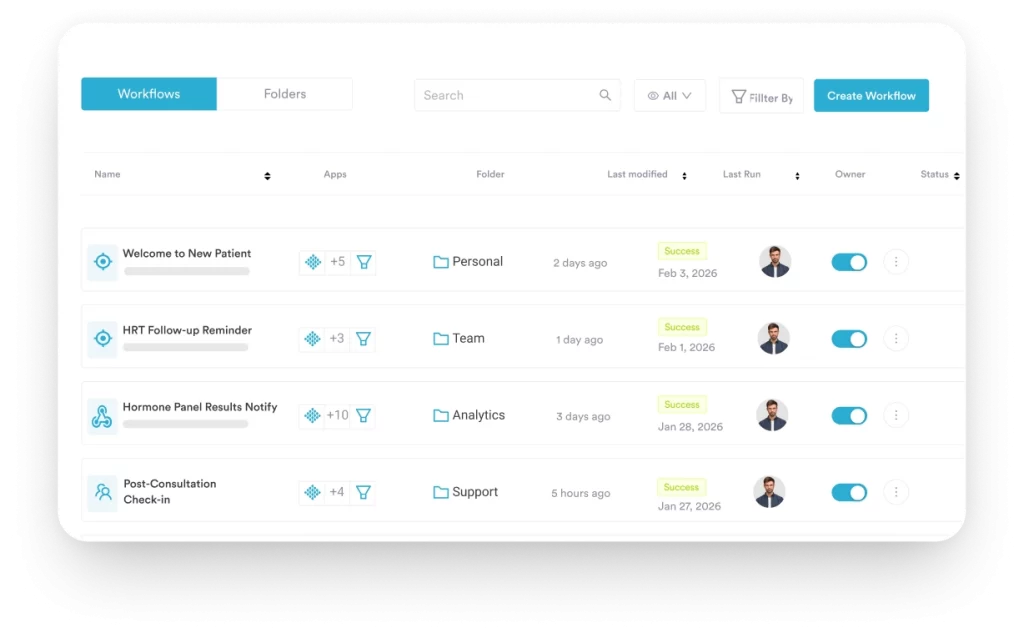
Behavioral health practices can use email and SMS campaigns to re-engage lapsed patients with seasonal wellness content, service announcements (new clinician joining, new telehealth availability), or general mental health awareness content tied to awareness months. These campaigns require explicit patient consent under HIPAA and should be sent from a HIPAA-compliant platform, not a standard consumer email service. For campaign templates and tactics, see email marketing for health practices.
Review your practice’s review collection process before launching any digital marketing campaign. Google Business Profile rankings are heavily influenced by review volume and recency. Set up an automated post-appointment review request through your practice management software – a system that sends a review link via SMS 24 hours after each completed appointment consistently generates 3x more reviews than manual requests.
Marketing spend without measurement is overhead, not investment. Behavioral health practices should track a small set of metrics consistently rather than chasing a long list of vanity numbers.
Pabau’s review management tools let practices automate review requests and track response rates without manual follow-up. This keeps the review pipeline active without consuming clinical staff time.

Need a structured approach to tracking clinical outcomes alongside your marketing metrics? Psychiatric Evaluation Template provides a standardized framework for intake documentation that supports both clinical quality and reporting.
Want to understand how patient portal features support retention and re-engagement? Benefits of Patient Portals covers how digital access tools reduce dropout and improve the patient experience between sessions.
Building a broader marketing plan for your clinic? Aesthetic Clinic Marketing Plan outlines a channel-by-channel marketing framework adaptable to behavioral health practice settings.
Behavioral health marketing works when it closes the distance between a person who needs care and a provider who can deliver it – without creating compliance exposure or eroding clinical trust. The practices growing fastest are not spending the most on advertising. They are building systems that convert every marketing touchpoint into a completed appointment: fast online booking, automated intake, consistent follow-up, and review collection that runs without staff intervention.
Pabau brings these systems together in one platform built for multi-provider behavioral health practices. From online booking linked to your Google Business Profile through to automated intake forms and recall campaigns, the full patient acquisition and retention workflow runs without manual administration.
Book a demo to see how Pabau supports behavioral health marketing from first click to long-term patient relationship.
Effective behavioral health marketing combines local SEO, Google Business Profile optimization, referral network development, and automated patient retention workflows. The most important operational step is connecting marketing channels (website, GBP, directories) directly to self-service booking so prospective patients can schedule immediately without a phone call.
Local SEO targeting condition-specific search terms (anxiety, depression, ADHD) consistently delivers the highest ROI for outpatient practices. Paid search (Google Ads) can accelerate volume for new practices but requires a HIPAA-compliant tracking setup. Content marketing builds long-term authority. Social media works best for psychoeducational content and clinician visibility rather than direct patient conversion.
Ethical behavioral health marketing follows APA ethics guidelines: no false or misleading claims, no testimonials that exploit the therapeutic relationship, honest representation of qualifications and licensure, and no guarantees of treatment outcomes. Patient testimonials require explicit written consent and should not reference specific conditions or treatment details. The FTC additionally requires that any outcome claims reflect typical results, not exceptional cases.
Industry guidance from behavioral health marketing firms suggests allocating 5-12% of gross revenue to marketing for established practices and up to 15-20% for new practices building initial patient volume. Solo practitioners typically spend $500 to $1,500 per month on a combination of directory listings, local SEO, and occasional paid search. Group practices with multiple clinicians to fill benefit from larger, more diversified budgets spanning paid search, content, and referral development activities.
The terms are often used interchangeably, but behavioral health marketing is the broader category – it encompasses marketing for mental health services, addiction treatment, substance use recovery, and related services. Mental health marketing typically refers to outpatient therapy and psychiatry specifically. Both operate under the same HIPAA and APA ethical frameworks, but addiction treatment marketing faces additional FTC scrutiny and state-level advertising regulations.