Pabau vs SimplePractice: AI Patient Scheduling Compared
AI Patient Scheduling: How Pabau and SimplePractice Compare Missed appointments ...

May 4, 2026


Buy now, pay later is now available in Pabau

AI patient scheduling automates booking, reminders, and waitlist management – freeing clinic staff from manual coordination.
Pabau’s scheduling automation covers the full booking workflow including deposits, multi-location calendars, and configurable SMS/email sequences.
SimplePractice’s AI (Care Aide) focuses on session documentation rather than scheduling automation – a key distinction for high-volume clinics.
Pabau suits multi-practitioner and multi-service clinics; SimplePractice is optimised for solo and small-group therapy practices.
Both platforms are HIPAA-compliant, but only Pabau also supports GDPR and international clinic workflows.
Missed appointments are estimated to cost the US healthcare system around $150 billion annually, according to widely cited industry estimates originally published by SCI Solutions and frequently referenced by the Medical Group Management Association (MGMA), with peer-reviewed analyses such as Bates et al. (2023) documenting the same magnitude of impact at the specialty level. No-shows disrupt clinical flow, waste practitioner time, and quietly erode revenue month after month. AI-driven scheduling exists to fix exactly that – automating the booking workflow so clinics spend less time chasing confirmations and more time delivering care. The question is which platform actually delivers on that promise for your practice type.
This guide compares Pabau and SimplePractice head-to-head on AI-driven scheduling capabilities – covering automation depth, online booking logic, no-show reduction tooling, compliance, integrations, and pricing. If you run a multi-practitioner clinic, medspa, or private GP practice, you’ll find a clear answer here. If you’re a solo therapist or counsellor, you’ll find that too. For the intake and forms side of the workflow, see our companion Pabau vs SimplePractice AI patient intake comparison.
Before the deep dive, here’s how both platforms stack up across the criteria that matter most for patient scheduling software evaluation.
The term “AI patient scheduling” covers a wide range of capabilities – from basic online booking pages to genuine machine-learning models that predict demand and fill gaps. Understanding where each platform sits on that spectrum matters before you commit to one.
Pabau’s approach to scheduling automation is built into the core operational layer of the platform. The system handles the booking workflow end-to-end: patients book via a branded online booking page, the platform checks real-time availability across practitioners and rooms, confirmation messages fire automatically, and reminder sequences run on configurable schedules via SMS and email.
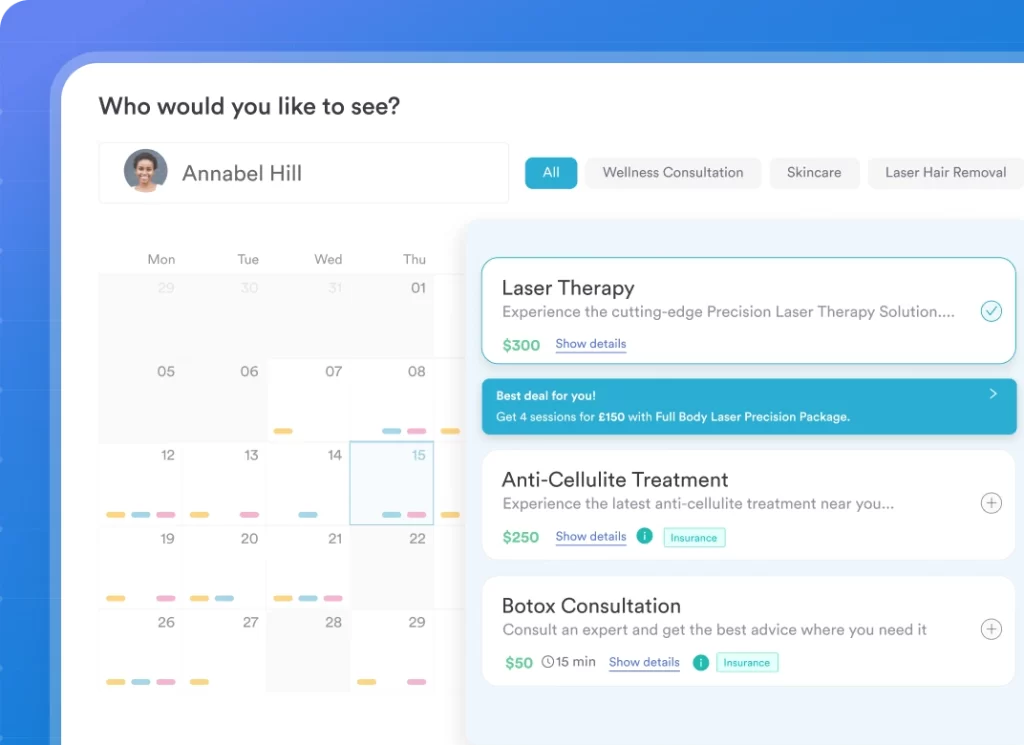
What separates Pabau from basic booking tools is the depth of its automated workflows. Reminders are not just a single confirmation email – clinics can configure multi-step sequences with different timing and channels per appointment type. A Botox appointment might trigger a 48-hour SMS, a 24-hour email with pre-care instructions, and a 2-hour text. A consultation might trigger only a single email. Each sequence runs without staff involvement.
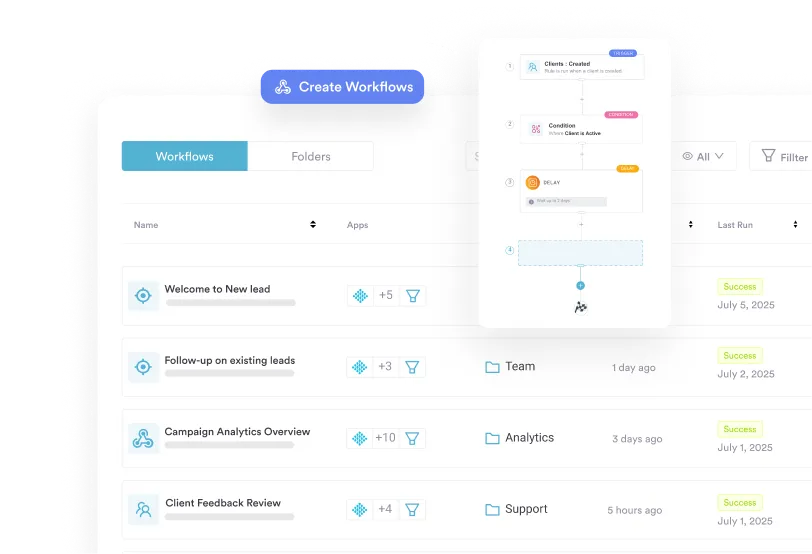
The appointment management layer also supports multi-location scheduling, class bookings, and resource allocation across rooms and equipment – capabilities that matter for aesthetic clinics running laser treatments, IV therapy suites, or multi-practitioner rosters. This is where Pabau’s scheduling automation pulls clearly ahead of what SimplePractice offers at the scheduling automation level.
SimplePractice offers online booking with client-controlled appointment requests and Google/iCal/Outlook calendar sync. Clients submit requests that align with the practitioner’s set availability, and the system can screen potential clients through intake forms before confirming. Reminders are available, though the configuration options are less granular than Pabau’s.
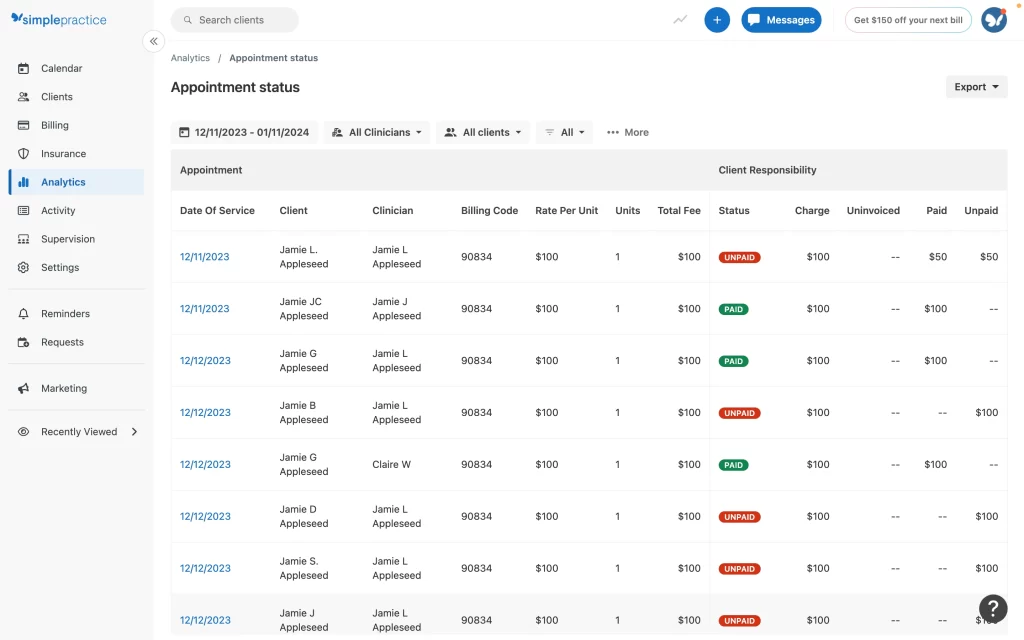
Where SimplePractice has invested in AI is its Care Aide feature – a set of AI-powered tools built into the platform that help practitioners prepare for sessions, track agenda items during telehealth appointments, and reduce documentation work afterward. According to SimplePractice’s own support documentation, Care Aide is focused on session preparation and clinical note reduction, not scheduling automation. For a solo therapist who wants AI-assisted clinical documentation, this is genuinely valuable. For a clinic operator prioritising scheduling efficiency, it addresses a different problem entirely.
Both platforms offer patient-facing booking, but the underlying logic differs in ways that become visible quickly when appointment volume grows.
| Capability | Pabau | SimplePractice |
|---|---|---|
| 24/7 self-booking page | Yes – branded, embeddable | Yes – client portal |
| Multi-practitioner scheduling | Yes – across all team members | Limited – primarily solo-focused |
| Multi-location support | Yes – unified calendar view | No |
| Intake forms before booking confirmation | Yes | Yes |
| Configurable reminder sequences | Yes – multi-step, per appointment type | Basic reminders |
| Deposit collection at booking | Yes | No |
| Waitlist management | Yes | No |
| Calendar sync (Google/iCal/Outlook) | Yes | Yes |
| AI clinical documentation | Pabau Scribe | Care Aide |
Pabau’s booking layer supports streamline appointment booking across complex clinic configurations – multiple rooms, multiple practitioners, and multiple service types all managed through a single calendar interface. SimplePractice’s booking is cleaner and simpler, which is exactly right for a solo therapist but insufficient for a clinic running 80+ appointments per week across five treatment rooms.
Research published on ScienceDirect (2023 metanarrative review) confirms that AI and predictive modelling in healthcare scheduling can meaningfully reduce no-show rates in real-world settings. The practical question is how each platform translates that into actual clinic tooling.
Pabau’s no-show toolkit combines two distinct mechanisms that work together. The first is automated reminders – configurable SMS and email sequences that can be set per appointment type, per service, and per timing. The second is financial deterrence through deposit enforcement at the point of booking. Patients who pay a deposit to secure an appointment show up at significantly higher rates than those who booked at no cost.
Pabau’s cancellation policy feature enforces terms automatically – if a patient cancels within the restricted window, the deposit is retained according to the clinic’s rules. There is no manual intervention required. For clinics with high-value appointment slots (laser treatments, injectables, surgical consultations), this financial layer is a genuine revenue protection mechanism. Evidence-based strategies to reduce no-shows consistently point to financial commitment at booking as the strongest behavioural deterrent.
Pabau also supports waitlist management, so that when a cancellation occurs, the slot can be automatically offered to patients on the waiting list. This minimises revenue loss from last-minute gaps without staff needing to phone through a list manually.
SimplePractice offers appointment reminders and a client portal through which patients can request to reschedule. There is no documented deposit enforcement feature, and predictive no-show scoring is not currently part of the platform’s offering. For a solo therapist managing a modest caseload, reminder-based deterrence may be sufficient. For clinics where a single no-show costs $200 to $500 in lost treatment revenue, the absence of financial enforcement is a meaningful gap.
Configure your AI patient scheduling reminders to send at three intervals: 72 hours before (SMS with a rescheduling link), 24 hours before (email with pre-care instructions if applicable), and 2 hours before (SMS confirmation prompt). Clinics using all three touchpoints typically see no-show rates drop below 8% compared to 15-20% with a single reminder.
Any platform handling patient appointment data must meet the relevant regulatory standards. Both Pabau and SimplePractice are HIPAA-compliant, but their compliance scope diverges significantly for international practices.
SimplePractice is designed for the US market with strong HIPAA compliance built in. Its data infrastructure, BAA provisions, and security architecture are aligned with US healthcare regulations. For US-based solo practitioners and small group practices, this is entirely sufficient.
Pabau supports HIPAA compliance for US-based clients and also operates under GDPR for UK and EU clinics, with multi-currency and multi-jurisdiction functionality built into the platform. UK clinics operating under CQC oversight and ICO data protection requirements need a platform that acknowledges both frameworks – Pabau handles this natively, while SimplePractice’s international footprint remains limited. For UK private practices, aesthetic clinics, and wellness centres, this distinction alone may settle the comparison.
Scheduling does not exist in isolation. How a platform connects its booking layer to clinical records, payments, and marketing determines whether AI patient scheduling reduces admin burden or simply moves it elsewhere.
Pabau integrates scheduling directly with clinical documentation, treatment records, payment processing, and marketing automation within a single platform. Booking a patient also creates or updates their client record, triggers pre-care communications, and logs the appointment against their full treatment history. There are no separate data silos that require manual reconciliation. Pabau also connects to external payment processors and marketing tools, and supports scheduling automation software workflows including multi-location scheduling under a single account.
SimplePractice integrates scheduling with its billing and insurance claims layer, Google and iCal calendar sync, Stripe for payment processing, and its native telehealth functionality. For a therapist managing a full caseload with insurance billing, this integration set is well-suited to the workflow. The platform does not offer the same depth of clinic operations tooling – inventory management, clinical photography, injection plotting, or multi-room resource allocation – because those capabilities are irrelevant for its target user.
The practical implication: if your clinic’s scheduling workflow connects to treatment records, clinical photography, deposits, and multi-room management, Pabau’s integrated approach eliminates the friction that comes from stitching together separate tools. If your workflow is appointment, session note, insurance claim, and telehealth link, SimplePractice handles that loop cleanly.

Pabau automates the full booking workflow for multi-practitioner clinics – from online booking and deposit collection to multi-step reminders and waitlist management. Book a demo to see how it handles your clinic's specific scheduling complexity.

According to Capterra reviewers, Pabau earns strong marks for its all-in-one clinic management capabilities and automated reminder features, with a rating of 4.7 out of 5 based on over 600 verified reviews. Reviewers specifically highlight multi-practitioner scheduling and the platform’s depth of features for complex clinic operations.
According to Capterra reviewers, SimplePractice holds a 4.6 out of 5 rating from over 2,800 verified reviews, with consistent praise for its clean interface and strong telehealth capabilities. It is one of the most reviewed platforms in the therapy practice management space.
Pricing models reflect each platform’s target user base. SimplePractice is structured per clinician, which suits individual practitioners and small groups. Pabau scales with clinic size rather than headcount, which becomes more cost-effective as teams grow.
The per-clinician model works well for individual practitioners but accumulates quickly. A 5-clinician group practice on SimplePractice Essential pays around $395/month before any add-ons ($79 per clinician multiplied across the team). For the same practice, Pabau’s team pricing – which bundles the full feature set including medical spa scheduling software capabilities – may represent better value at scale, though exact pricing requires a direct quote from Pabau. Check Pabau’s current pricing page for up-to-date figures.
Review platform data provides a useful signal on where each platform delivers and where it creates friction in day-to-day use.
According to Capterra reviewers, Pabau earns consistent praise for its all-in-one approach to clinic management, with automated reminders and multi-practitioner scheduling highlighted as standout strengths. Areas flagged for improvement include the initial learning curve and occasional integration sync behaviour. Pabau holds a 4.7 out of 5 rating from over 600 verified reviews on Capterra and a 4.7 on G2.
SimplePractice is one of the most-reviewed therapy practice platforms online, with 4.6 out of 5 from over 2,800 Capterra reviews and a 4.2 on G2. Reviewers praise its ease of use for solo practitioners, clean client portal experience, and strong telehealth integration. Recurring criticism focuses on limited support for multi-location or high-volume clinic workflows, and some reviewers note that the AI features (Care Aide) address documentation rather than scheduling efficiency – which aligns with what the feature actually does.
When evaluating scheduling platforms, ask vendors to demonstrate two things specifically: how the system handles a cancellation at short notice (does it auto-fill from a waitlist?), and how deposit rules apply when a patient rebooks. These two scenarios reveal more about actual automation depth than any feature checklist.
If your evaluation started as a SimplePractice vs Pabau comparison, it is worth stepping back to ask what problem you are actually solving. SimplePractice is an excellent platform for its target user: solo and small-group therapy, counselling, and allied health practitioners in the US who need clean scheduling, telehealth, and insurance billing in one place. For that user, it delivers.
Pabau is built for a different clinical context. Aesthetic clinics, private GP practices, medspas, wellness centres, physiotherapy teams, and multi-specialty private practices all share scheduling complexity that SimplePractice was not designed to handle: multiple treatment rooms, varied appointment durations, high-value bookings where no-shows carry real revenue consequences, and regulatory environments that span HIPAA, GDPR, and CQC frameworks simultaneously.
Pabau’s scheduling automation layer addresses that complexity directly. The combination of configurable reminder sequences, deposit enforcement, automated waitlist management, and multi-location calendar views operates as an integrated system rather than a set of separate features. Pabau Scribe (available at pabau.com/features/ai-medical-scribe/) handles AI-assisted clinical documentation for practices that need both scheduling automation and note efficiency. And because the scheduling data flows into the clinical record, invoice, and marketing layer without manual re-entry, the efficiency gain compounds across the full clinic workflow – not just at the point of booking.
For practices considering alternatives in this space, how Pabau compares to other private practice software is worth reviewing alongside this comparison.
The right choice depends entirely on your clinic’s structure, appointment volume, and operational requirements.

Need a deeper look at Pabau’s scheduling capabilities? Appointments feature overview covers how Pabau handles multi-practitioner booking, resource allocation, and automated workflows.
Exploring no-show reduction strategies for your clinic? How to improve patient no-show rate outlines the evidence-based approaches that work best for private practices.
Running a medical spa and comparing scheduling tools? Best medical spa scheduling software covers the full landscape of options for aesthetic and medspa clinic environments.
Want to understand how automation reduces clinic admin? Automated workflows software explains how Pabau’s automation layer connects scheduling, reminders, and clinical records.
No-shows, manual booking management, and fragmented scheduling workflows cost clinics time and revenue that compound quietly over months. AI patient scheduling addresses that directly – but only when the platform’s automation depth matches your clinic’s operational reality.
For multi-practitioner clinics with complex scheduling needs, Pabau’s integrated approach – combining deposit enforcement, configurable multi-step reminders, automated waitlist filling, and multi-location calendar management – delivers scheduling automation that goes well beyond what basic booking tools or documentation-focused AI can offer. If you want to see how Pabau handles your clinic’s specific scheduling workflow, book a demo and walk through it with the team.
AI patient scheduling automates availability matching, sends configurable reminder sequences, fills cancellation slots from a waitlist, and enforces booking policies like deposits – all without staff involvement. The result is fewer no-shows, less manual coordination, and more consistent appointment fill rates. Platforms vary significantly in how much of this they actually automate versus requiring manual configuration or staff follow-up.
Traditional scheduling requires staff to check availability, book appointments manually, send reminders individually, and manage cancellations by phone. AI patient scheduling automates availability management, confirmation, reminders, waitlist filling, and policy enforcement. The difference in admin burden for a 10-appointment-per-day clinic can amount to 1 to 2 hours of recovered staff time daily.
Yes – a 2023 metanarrative review published in ScienceDirect found that AI and predictive modelling in healthcare scheduling measurably reduce no-show rates in real-world clinical settings. The most effective mechanisms combine automated multi-step reminders with financial deterrents at the booking point (deposits and cancellation policies). Reminder-only systems reduce no-shows; deposit enforcement combined with reminders reduces them further.
It depends on the platform. Both Pabau and SimplePractice are HIPAA-compliant for US practices. Pabau additionally supports GDPR for UK and EU clinics. Before selecting any AI scheduling platform, confirm the vendor offers a signed Business Associate Agreement (BAA) under HIPAA and ask specifically about data residency, encryption standards, and compliance documentation relevant to your jurisdiction.
Setup typically involves: (1) configuring your service menu with appointment types and durations, (2) setting practitioner availability and room resources, (3) activating your patient-facing booking page or widget, (4) configuring reminder sequences per appointment type, and (5) enabling deposit rules for high-value bookings. Most platforms complete this in a guided onboarding session. Pabau’s onboarding team can walk through the configuration for multi-practitioner clinics with complex scheduling requirements.