The best multi-location scheduling software puts every provider, room and patient on one calendar, so a booking at one site never collides with another. We scored seven tools against the cross-location stress test, five scenarios that break a single-calendar tool the moment you open a second site.
Pabau, the practice platform we build for healthcare and aesthetic groups, is the best software for multi-location scheduling in clinical settings. Pabau is the only tool here to pass all five scenarios. Square Appointments is the budget pick for multi-site service businesses at $49 per location a month.
Connecteam is the one to add when the job is staff shifts rather than patient booking. Opening another site soon? The next-site setup sequence further down gives the seven steps to configure it before its first booking.
Key takeaways
1. Pabau — best for multi-location healthcare and aesthetic practices that need one patient record, per-site pricing and per-site reporting.
2. Zenoti — the enterprise option for medspa, spa and salon chains running at franchise scale.
3. Square Appointments — the cheapest route to shared multi-location booking for service businesses, priced per location.
4. SimplyBook.me — flexible online booking with a dedicated multiple-locations feature for smaller multi-site teams.
5. Acuity Scheduling — simple calendar-based booking for teams that can model each site or provider as a calendar.
6. Connecteam — staff shift scheduling across sites, free for up to 10 users, with no patient booking.
7. Setmore — the free starting point for small teams, with linked accounts instead of one shared multi-site calendar.
Once you run three or four sites, the pricing model matters more than the headline price. The table below shows how each tool charges as well as what it costs.
Tool
Best for
Pricing model
Starting price (checked September 2026)
Multi-location standout
Pabau
Multi-location healthcare and aesthetic practices
By locations and users
Custom quote
One patient record, room rules and reporting across every site
Zenoti
Medspa, spa and salon chains
Custom, by footprint
Custom quote
One guest profile visible at every location
Square Appointments
Budget multi-site service businesses
Per location
$49 per location a month (Plus)
Multi-location management from Plus, room resources from Premium
SimplyBook.me
Smaller multi-site teams
Per account, by bookings and providers
€11.9 a month (Basic, billed annually)
Location is the first step on the booking page
Acuity Scheduling
Calendar-first teams
Per account, by calendar count
$16 a month (Starter, billed annually)
Up to 36 calendars and per-location time zones on Premium
Connecteam
Staff shifts across sites
Flat fee for the first 30 users
Free up to 10 users, $29 a month (annual)
GPS clock-in and geofenced job sites
Setmore
Small teams starting free
Per user
Free up to four users, Pro $5 per user a month (annual)
Separate location accounts linked under one login
Found our content helpful?
1. Pabau: Best for multi-location healthcare and aesthetic practices
Rating4.7/5★★★★★Top pick
The bottom line
The only tool here that passed all five scenarios of the cross-location stress test.
Who it’s for
Med spas and aesthetic groups with two or more sites
Multi-provider medical and wellness practices
Owners who need per-location reporting from one login
One patient record follows the patient to every branch
Rooms and equipment are linked to locations and services
Every subscription includes every feature
What doesn’t
Setup takes structured onboarding, not an afternoon
More platform than a single-site salon needs
Pabau is an all-in-one practice management app that runs every location from one account. Staff schedules, rooms, services, prices and patient records all sit in the same system, so multi location booking management happens in one place. The front desk at one site sees exactly what the front desk at another sees.
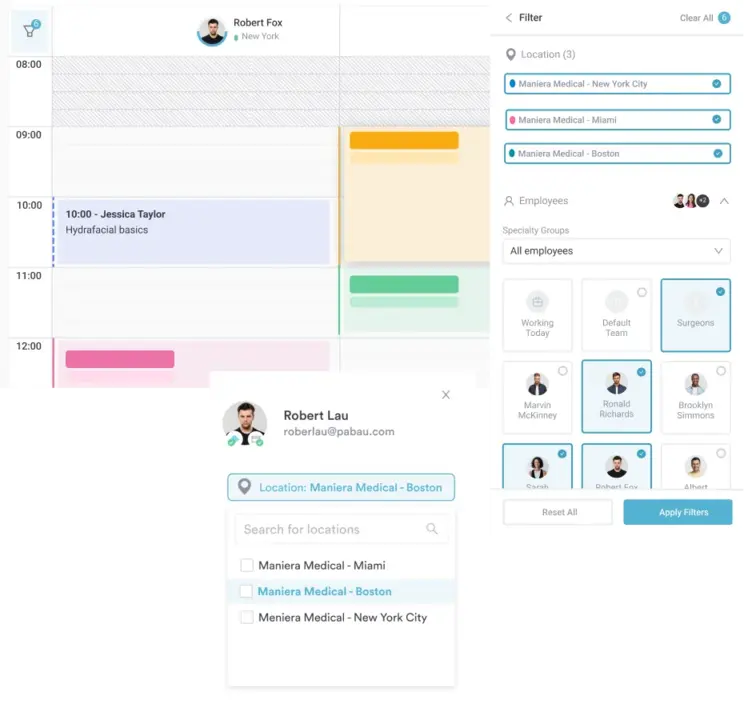
Pabau’s location filter shows which providers work at each site today, so managers catch cross-site clashes before a patient books into one.
Key features
Centralized calendar and scheduling: Pabau shows every location in one calendar, and you switch sites with the Location button instead of logging in again.
Rooms and equipment per location: Each room is linked to the locations and services it supports. Pabau warns you when an overlapping booking would double-book it.
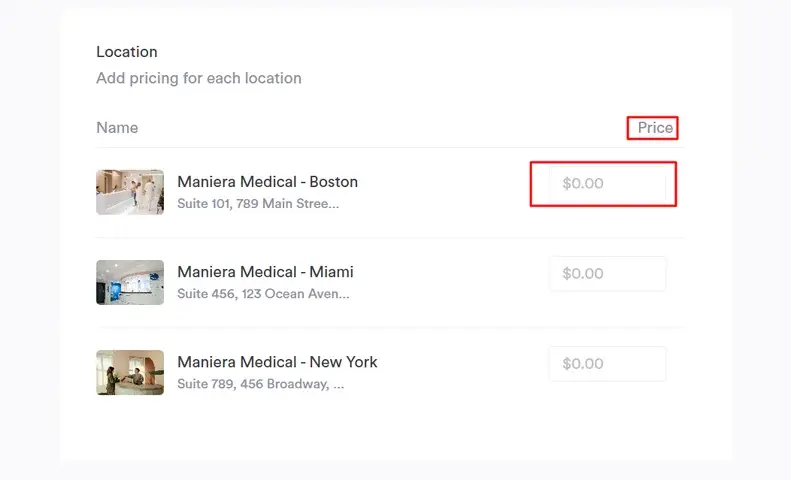
Location-based pricing and services: Set a different price or service list for each site from the same service record.
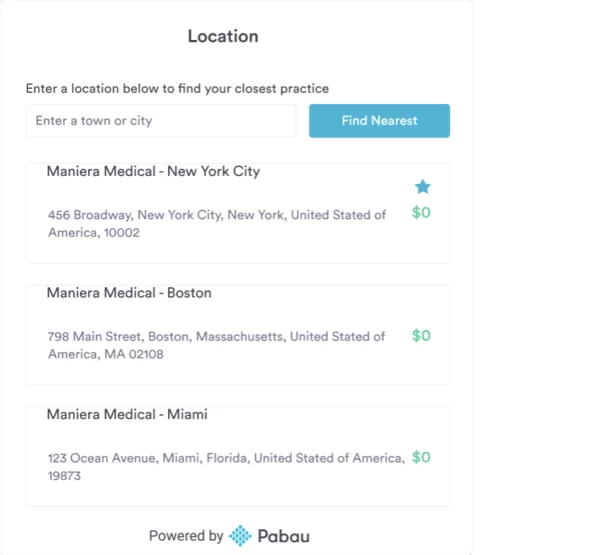
Online booking with location choice: Patients pick their nearest or usual location before they choose a treatment and time.
Reporting per location and as a whole: Compare revenue and bookings site by site, or roll them up for the group.
Stock per location: Track inventory levels at each site, so one branch does not run out while another overorders.
Where Pabau shines
One patient record, everywhere: Medical history, consent forms and treatment notes follow the patient to any branch they book.
Permissions by location: Pabau restricts who can view payments, reports or patient files, so staff see only what their role needs.
No feature gating: Every subscription includes every feature, so a second or third location never forces a plan upgrade.
Where Pabau falls short
Setup takes planning: Pabau uses structured onboarding rather than a free trial, because rooms, services and rules per site need configuring first.
Built for healthcare depth: A single-site salon or barber will pay for clinical tools it never opens.
Credits for some features: SMS, telehealth and Pabau Scribe, our AI scribe, run on top-up credits alongside the subscription.
Who Pabau is best for
Pabau is best for healthcare and aesthetic groups where providers, rooms and patients move between sites. It suits med spas, dermatology and wellness practices, and multi-provider medical groups that report on each branch separately.
Pricing
Plan
Price
Users or limits
What it means for multiple locations
All plans
Custom quote
Scales with locations and users
Every feature at every location, with no tier locks
Enterprise groups
Custom quote
Large multi-site teams
Onboarding support for multi-location setup
Pabau prices by the number of locations and users, and every subscription includes the full platform. A demo gives you a quote for your exact mix of sites and staff.
2. Zenoti: Best for enterprise spa, salon and medspa chains
Rating4.5/5★★★★★Best for franchise scale
The bottom line
A strong enterprise platform for large spa and medspa networks, with pricing set per footprint.
Sized for large networks rather than a two-site practice
Zenoti is enterprise software for salons, spas, medspas and fitness businesses, and its multi-location tools are built for networks rather than single sites. Zenoti says a single account manages unlimited locations with centralized reporting and shared guest profiles.
Zenoti markets its medspa product on running operations at scale, which fits groups with many locations more than a two-site practice.
Key features
Network-wide guest profile: Service history, forms and membership balances are visible at any location, according to Zenoti.
Credential-aware booking: MDs, NPs, PAs, RNs and aestheticians each get a calendar limited to the treatments they are qualified to perform.
Room and equipment checks: Zenoti checks provider, room and equipment availability before a booking is confirmed.
Where Zenoti shines
Franchise operations: Zenoti for Franchise is designed for standard menus and settings across many owners.
One calendar view: Real-time availability across providers and locations sits in a single calendar.
Where Zenoti falls short
Opaque pricing: Zenoti publishes no prices, so you cannot compare cost before a sales call.
Enterprise weight: A practice with two or three sites may find the rollout heavier than the problem it solves.
Who Zenoti is best for
Zenoti is best for spa, salon and medspa chains with many locations, or franchise groups that need the same menu and rules across owners.
Pricing
Plan
Price
Users or limits
What it means for multiple locations
Multi-location
Contact sales / no published pricing
Unlimited locations on one account
Price is set by your footprint and needs
Zenoti does not publish prices and states that multi-location pricing is customized to each footprint, checked on zenoti.com in September 2026.
3. Square Appointments: Best budget pick for multi-site service businesses
Rating3.5/5★★★★★Best budget pick
The bottom line
Transparent per-location pricing and multi-location management from Plus, with room booking held back for Premium.
Who it’s for
Salons, spas and service businesses with two to five sites
Owners who already take payments with Square
Teams that want published prices
Pricing$49/location/monthPlus plan, multi-location included
Square Appointments is the booking side of Square, and its pricing is the easiest in this list to model. As scheduling software for multi site service businesses, Square Appointments charges a monthly fee for each location on Plus and Premium. Multi-location management starts on Plus.
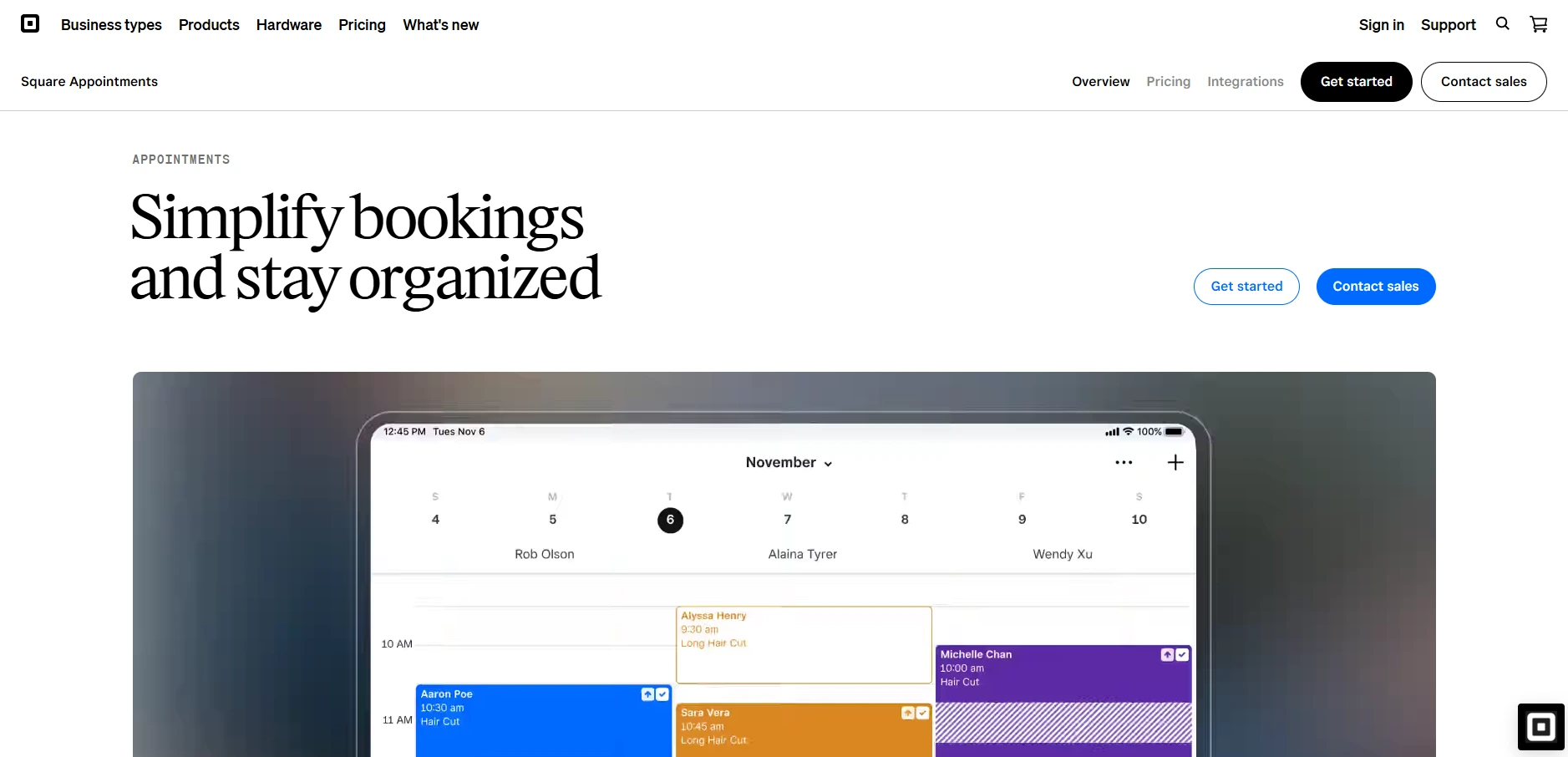
Square Appointments shows staff calendars side by side, and every Square plan allows unlimited calendars with no employee limit.
Key features
Multi-location management: Square lets you manage calendars, staff and online bookings across locations on Plus and Premium.
Resource management: Premium assigns rooms, chairs, stations and other resources to the services that need them.
Deposits and no-show fees: Appointment deposits come on every plan, and cancellation fees start on Plus.
Where Square Appointments shines
Predictable cost: The per-location fee makes a new site a known monthly number.
Payments built in: In-person card rates fall from 2.6% + 15¢ on Free to 2.4% + 15¢ on Premium.
Where Square Appointments falls short
Rooms cost triple: Room booking needs Premium at $149 per location, three times the Plus fee.
Retail-first records: Square keeps customer profiles for sales and bookings, not medical histories or consent forms.
Who Square Appointments is best for
Square Appointments is best for non-clinical service businesses, such as salons and spas, that want published per-location prices and payments in the same account.
Pricing
Plan
Price
Users or limits
What it means for multiple locations
Free
$0 per location a month
Unlimited staff calendars
No multi-location management
Plus
$49 per location a month
Unlimited staff calendars
Multi-location management, waitlist and Google Calendar sync
Premium
$149 per location a month
Unlimited staff calendars
Adds room and resource management
Square Pro
Custom pricing
Businesses processing over $250,000 a year
Custom processing rates
Prices come from Square’s own appointments pricing page, checked in September 2026, and the monthly fee applies to each location you run.
4. SimplyBook.me: Best for smaller multi-site teams on a budget
Rating2.5/5★★★★★Most flexible booking
The bottom line
A flexible booking page with location as its first step, but the cross-site view is an Enterprise feature.
Multi-location cluster interface only on Enterprise
SimplyBook.me is an online booking system for service businesses, and its Multiple Locations custom feature puts location first on the booking page. You link service providers to each location, and their working hours then apply there.
SimplyBook.me builds its product around custom features, so multi-location booking is switched on as an add-on inside your plan.
Key features
Multiple Locations: Locations appear as the first booking step and connect to the providers who work there.
Related Resources: Rooms or equipment attach to a service, and slots disappear when a resource runs out.
Plan-based limits: Each tier caps monthly bookings and providers, from 50 bookings on Free to 2,000 on Premium.
Where SimplyBook.me shines
Low entry cost: The Free plan covers one provider and 50 bookings a month.
Classes and packages: SimplyBook.me handles group sessions as well as one-to-one appointments.
Where SimplyBook.me falls short
Service-to-location limits: SimplyBook.me relates locations only to providers, so a service follows whoever performs it.
Enterprise-only group view: The Cluster Interface for multi-location access sits on the custom-priced Enterprise plan.
Who SimplyBook.me is best for
SimplyBook.me is best for small multi-site teams with moderate volume that want a configurable booking page without a sales call.
Pricing
Plan
Price
Users or limits
What it means for multiple locations
Free
€0 a month
1 provider, 50 bookings a month
Testing only
Basic
€11.9 a month annually, €13.9 monthly
5 providers, 100 bookings a month
Three premium custom features
Standard
€24.9 a month annually, €29.9 monthly
15 providers, 500 bookings a month
Eight custom features, plus HIPAA
Premium
€49.9 a month annually, €59.9 monthly
30 providers, 2,000 bookings a month
Unlimited custom features
Enterprise
Custom pricing
Custom
Cluster Interface for multi-location access
SimplyBook.me lists its plans in euros on its own pricing page, checked in September 2026.
5. Acuity Scheduling: Best for calendar-first teams
Rating4.8/5★★★★★Simplest setup
The bottom line
Clean self-service booking where each staff member or site becomes a calendar.
Acuity Scheduling, owned by Squarespace, handles multiple sites by giving each employee or location its own calendar. That works well for self-service booking, but the location lives in the calendar setup rather than in the system itself.
Acuity Scheduling sells on self-service booking, which is its strength when each site can live in its own calendar.
Key features
Calendars per employee or location: Acuity suggests separate calendars for each staff member or site.
Resources: Rooms or equipment cap how many appointments run at once across calendars.
Intake forms: Custom forms collect details and terms before the appointment.
Time zones per location: Premium gives each staff member or location its own time zone, so a site in another state books in local time.
Where Acuity Scheduling shines
Fast to launch: A single-calendar Starter plan is live in minutes.
HIPAA on Premium: Acuity signs a business associate agreement, known as a BAA, on Premium and above.
Where Acuity Scheduling falls short
Calendar math: 10 staff calendars exceed Standard’s six, which pushes a small group onto Premium.
Thin clinical depth: Intake forms are not a treatment record, so clinical notes still live somewhere else.
Who Acuity Scheduling is best for
Acuity Scheduling is best for wellness, coaching and small service teams that book mostly online and can treat each site as a calendar.
Pricing
Plan
Price
Users or limits
What it means for multiple locations
Starter
$16 a month annually, $20 monthly
1 calendar
Single site, single provider
Standard
$27 a month annually, $34 monthly
Up to 6 calendars
A small team at one or two sites
Premium
$49 a month annually, $61 monthly
Up to 36 calendars
Multiple time zones per staff member or location
Prices come from Acuity Scheduling’s own plans page, checked in September 2026.
6. Connecteam: Best for staff shift scheduling across locations
Rating1.0/5★★★★★Best for staff shifts
The bottom line
Strong shift scheduling and time tracking for staff who move between sites, with no patient booking.
Who it’s for
Deskless teams split across several sites
Practices that rota support staff separately
Businesses with 10 or fewer staff wanting a free tool
Connecteam is shift scheduling software with time tracking built in, so it covers multi location staff scheduling rather than patient booking. Pick Connecteam when your headache is planning which staff member works at which site, because patients cannot book through it.
Connecteam puts shifts, tasks and clock-ins in one staff app, which suits teams that rotate between sites.
Key features
Shift scheduling: Build, repeat and share shifts, with jobs to represent each location or role.
Time clock: GPS clock-in, with geofence sites from the Advanced plan.
Multiple schedules: Up to six schedules on Advanced and up to 12 on Expert.
Where Connecteam shines
Free for small teams: The Small Business plan covers up to 10 users at no cost.
Flat pricing: Paid plans cover the first 30 users for one monthly fee.
Where Connecteam falls short
No patient-facing tools: Connecteam has no booking page, patient records or payments.
Two systems to maintain: Practices still need a separate booking tool, so the rota and the calendar can drift apart.
Who Connecteam is best for
Connecteam is best for businesses whose multi-location headache is staff rostering, and for practices that rota support staff outside their booking system.
Pricing
Plan
Price
Users or limits
What it means for multiple locations
Small Business
$0
Up to 10 users
Single schedule and time clock
Basic
$29 a month annually, $35 monthly
First 30 users, then $0.80 to $1.00 each
Single schedule, unlimited jobs
Advanced
$49 a month annually, $59 monthly
First 30 users
Up to 6 schedules and 10 geofence sites
Expert
$99 a month annually, $119 monthly
First 30 users
Up to 12 schedules and unlimited geofence sites
Enterprise
Custom pricing
Custom
Unlimited schedules and time clocks
Prices are for the Operations Hub on Connecteam’s own pricing page, checked in September 2026.
7. Setmore: Best free starting point for small teams
Rating0.5/5★★★★★Best free plan
The bottom line
A generous free plan, but each location is a separate account, so nothing is shared across sites.
Who it’s for
Solo providers and teams of up to four
Businesses opening a second site on a tight budget
Setmore is free for up to four users, with unlimited appointments, payments and a branded booking page on its Free plan. That plan is the closest you will get to multi location scheduling software free of charge.
The catch is structure. Setmore handles multiple locations by linking separate accounts under one login. Setmore says each account keeps its own appointments, staff, customers, billing and settings, and only the login is shared.
Setmore leads with its free plan, which covers up to four users before Pro pricing applies.
Key features
Free plan: Unlimited appointments, payments and a branded booking page for up to four users.
Linked location accounts: Owners and admins switch between locations with one login, a Pro feature in early release.
Pro upgrades: SMS reminders, two-way calendar sync, deposits and recurring appointments.
Where Setmore shines
Zero cost to start: A small team can take online bookings without a subscription.
Low per-user price: Pro costs $5 per user a month on annual billing.
Where Setmore falls short
No shared calendar: A provider working at two locations sits in two unlinked accounts, so double-booking stays possible.
Setmore is best for solo providers and small teams who want free online booking today and can live with separate accounts per site.
Pricing
Plan
Price
Users or limits
What it means for multiple locations
Free
$0 per user a month
Up to 4 users
One account per location
Pro
$5 per user a month annually, $12 monthly
Unlimited users
Linked location accounts, early release
Enterprise
Contact sales / no published pricing
Custom
Custom booking setup
Prices come from Setmore’s own pricing page, checked in September 2026, and Pro is charged for each user in each account.
The cross-location stress test: How each tool handles more than one site
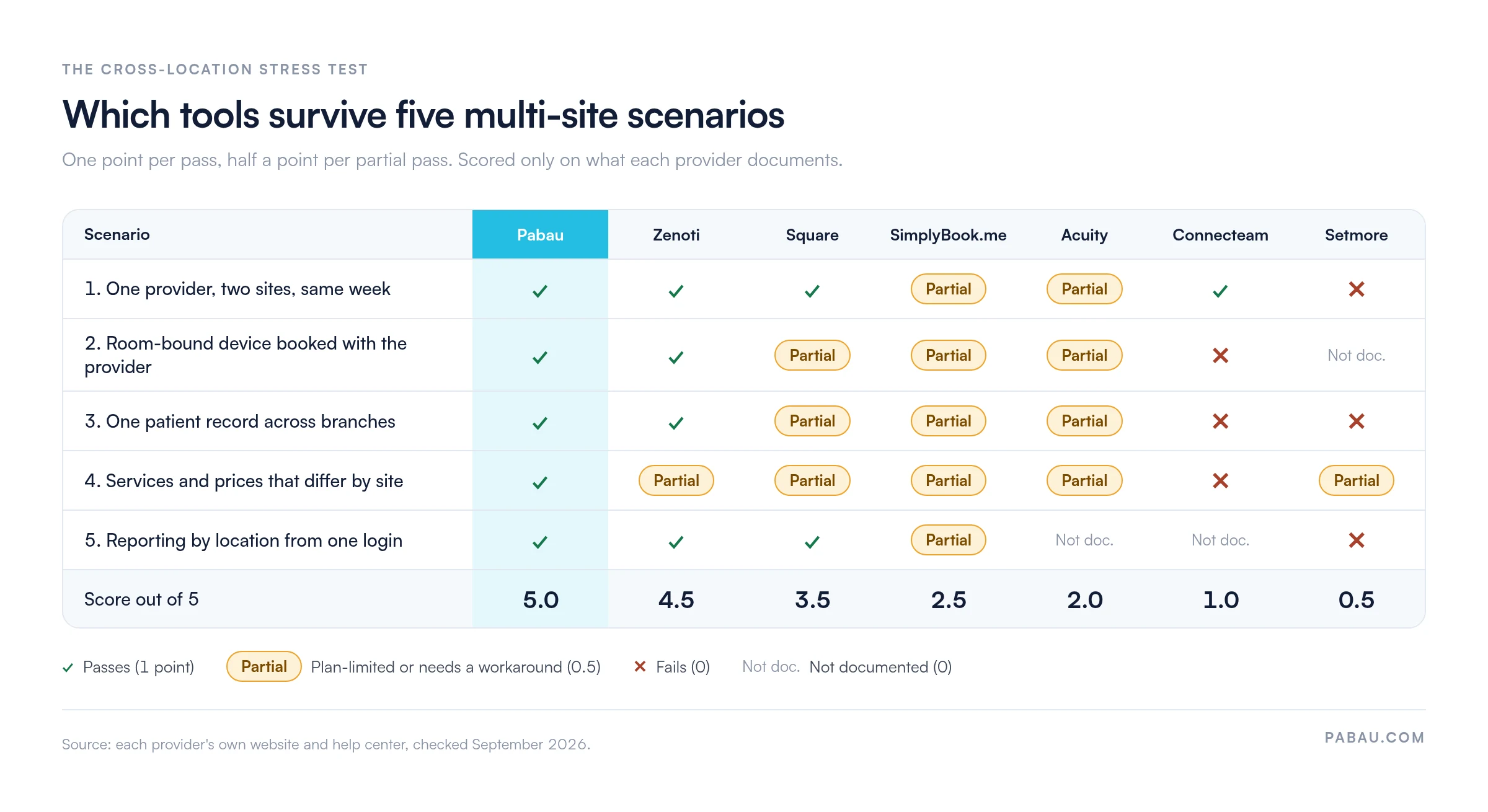
The cross-location stress test checks five scenarios that break single-calendar tools. They cover shared staff, room-bound equipment, one patient record, per-site pricing and per-site reporting. Each one is a question worth asking in a demo, with a live example rather than a slide.
One provider at two locations in the same week. Separate calendars per site cannot see each other. A provider booked downtown on Tuesday can still show as free at the suburban site. In a demo, book the same provider at both sites in overlapping slots and watch whether the second booking is blocked.
A room-bound resource booked with the provider. A laser that lives in one treatment room is a second constraint on top of the provider. Ask the vendor to book two providers for laser treatments at the same time, and check that the second slot disappears.
A patient who books at a second site with history recorded at the first. If records are stored per site, the second provider treats without the consent form or notes from the first visit. Open the patient at the second site and confirm the earlier forms are there.
Services, prices and deposit rules that differ by location. A downtown site may charge more, or skip a service another site offers. Change one price at one site and check that the online booking page shows each site its own price.
Reporting by location from one login. Owners need revenue, utilization and no-shows per site without exporting from three accounts. Ask for a site-by-site revenue report and a group total from the same screen.
The table scores each pick on what its own website or help center documents. A partial pass means the tool needs a higher plan or a workaround, and “not documented” scores zero.
Tool
Shared provider
Room-bound device
One patient record
Per-site services and prices
Per-site reporting
Score
Pabau
✓
✓
✓
✓
✓
5.0
Zenoti
✓
✓
✓
Partial (location-specific settings)
✓
4.5
Square Appointments
✓ (Plus and up)
Partial (Premium only)
Partial (customer profiles, no clinical record)
Partial (items assigned per location)
✓ (sales by location)
3.5
SimplyBook.me
Partial (providers linked to locations)
Partial (Related Resources feature)
Partial (one customer list, no clinical record)
Partial (services follow providers)
Partial (Enterprise only)
2.5
Acuity Scheduling
Partial (one calendar per site or person)
Partial (resources)
Partial (intake forms only)
Partial (appointment types per calendar)
Not documented
2.0
Connecteam
✓ (shift scheduling)
✕ (no booking)
✕ (no patient records)
✕ (no services)
Not documented
1.0
Setmore
✕ (separate accounts)
Not documented
✕ (customers kept per account)
Partial (each account set separately)
✕ (accounts do not merge)
0.5
Plotted as a matrix, the scores follow one pattern. Appointment tools pass the first scenario easily, and most start to slip at rooms and records.
Only Pabau and Zenoti pass the patient-record scenario outright, and it is the one that matters most for clinical care. Scores use provider documentation checked in September 2026.
The rating on each provider card above is that tool’s stress-test score, so the stars and the matrix always agree.
When you need dedicated multi-location software
You need dedicated multi-location software once a provider works at two sites in one week, or a room-bound device must be booked with the provider. Before that point, one shared calendar with a location field usually copes.
After it, separate per-site calendars start to double-book, because neither calendar knows what the other has sold. When we onboard a multi-site practice, we map rooms and devices to each location before a single appointment is imported. That order exposes the clashes a shared calendar would have hidden.
What is multi-location scheduling software?
Multi-location scheduling software books patients, staff, rooms and equipment across several sites from one account, so each location’s calendar stays separate but visible.
The difference from single-site booking is that location becomes a booking dimension, like provider or service. Every appointment belongs to a site, and each site carries its own rooms, prices, opening hours and staff permissions.
Location-based scheduling software also checks availability across sites, so a provider booked at one branch drops off another branch’s calendar for those hours. Reporting then works at two levels, per site and for the whole group.
Multi-location scheduling without that cross-site check is several calendars sharing a login. Setmore’s linked accounts work this way, which is why Setmore scores lowest on the stress test.
Multi-location healthcare scheduling software: What practices need
Multi-location healthcare scheduling software must match each patient to a qualified provider, the right room and one shared record at whichever site they book. Salon-style booking tools handle the first job and usually stop there.
To judge which patient scheduling tools handle multi-provider calendars best, test these six requirements. They apply to a doctor’s office and a med spa group alike.
Credentials by site: An NP may inject at one location but not at another, so services should attach to the provider and the site together.
Room-bound devices: A laser or HIFU machine in one treatment room must block that room as well as the provider.
One patient record across branches: Centralized records carry consent forms, photos and notes to every site, so care picks up where the last visit ended.
Deposit and no-show rules per location: A high-demand site may need a deposit that a quieter site does not.
Calendar privacy: Patients should see open slots, never internal staff calendars, lunch blocks or other patients’ bookings.
Reminders from the right site: Confirmations and reminders should carry that location’s address and deposit terms. A patient who drives to the wrong branch becomes a no-show.
That list is also why the best scheduling software for multi-location practices is rarely a pure booking app. Multi-location appointment scheduling software that stores records per site fails the third requirement, however good its booking page looks. For single-site comparisons, see our roundup of medical practice scheduling software.
HIPAA compliant scheduling software across locations
HIPAA compliant scheduling software signs a business associate agreement with your practice, limits staff to the sites and records they need, and logs every access.
Role-based permissions matter more with every new site, because more staff can reach the same records. A receptionist at one branch rarely needs another branch’s payments or clinical notes, and the audit trail should show who opened which file.
The BAA has to cover every location as well. Here is what each vendor’s own documentation confirms for the tools reviewed above:
Acuity Scheduling: HIPAA features and a BAA from the Premium plan, and each Acuity account needs its own BAA.
Setmore: A signed BAA on Pro, though Setmore says HIPAA accounts cannot use multi-location linking yet.
SimplyBook.me: A HIPAA option from the Standard plan, so confirm the BAA terms with SimplyBook.me directly.
Pabau: Encryption and detailed audit logs are documented on Pabau’s HIPAA compliance page, so ask for the BAA terms in your demo.
Zenoti, Square Appointments and Connecteam: Confirm BAA availability with each vendor before any patient data goes in.
Employee scheduling software for multiple locations
Employee scheduling software for multiple locations, such as Connecteam, Deputy, When I Work or Homebase, plans which staff member works at which site and when. Appointment software then sells those hours to patients, and many practices need the two to agree.
Take an injector who works Monday and Tuesday downtown and Thursday at the suburban site. The staff rota must place her at each site. The booking calendar must then offer her treatments only where she is working that day.
If the rota lives in one tool and the booking calendar in another, a swapped shift reaches the rota but not the booking page. Patients then book a provider who is at the other location. That clash is the argument for keeping the rota inside the booking system.
Four shift tools come up most for multi-site teams, and they price and organize locations differently. Prices come from each vendor’s own pricing page.
Shift tool
How it handles multiple locations
Pricing model
Starting price (checked September 29, 2026)
Connecteam
Jobs stand for each location or role, with geofenced clock-in sites from Advanced
Flat fee for the first 30 users
Free up to 10 users, Basic $29 a month (annual)
Deputy
Open shifts offered to eligible staff across locations, plus a location-based time clock
Per user
$5 per user a month (Lite)
When I Work
Unlimited job sites and departments from one account
Per user
$2.50 per user a month for one site, $5 for multi-location businesses
Homebase
Each physical address is billed as its own location
Per location
Free for one location and 10 employees, Essentials $24 per location a month (annual)
Homebase is the one to model carefully, because its bill grows with every address you open. Deputy and When I Work grow with headcount instead, and Connecteam stays flat until your 31st user.
Beyond price, compare shift swaps between sites, the staff mobile app, GPS clock-in, payroll export and a labor cost view per location. Deputy, for example, compares labor costs against POS sales data across locations.
The verdict for practices is simple. These tools schedule staff shifts, not patient appointments, rooms or records. A multi-site practice either pairs one with its booking system and reconciles the two each week, or replaces both.
Replacing both is what Pabau’s staff rota does. Pabau assigns each shift to a location inside the same calendar patients book from, so a swapped shift updates the booking page too.
How to add a new location: The next-site setup sequence
The next-site setup sequence configures a new location in seven ordered steps, from creating the site to checking its reports, before anyone books there.
Each step depends on the one before it, so run them in this order in any multi-location system:
Create the location. Add the site with its address, opening hours and contact details, so confirmations and reminders carry the right address.
Assign rooms and equipment to it. Link each treatment room and room-bound device to the new site, and to the services it supports.
Map which services and prices run there. Switch on only the services the site offers, and set its price on the existing service record.
Attach providers and their site-specific hours. Add each provider to the site and set the days they work there, so their hours appear only at that site.
Switch it on in online booking. Add the location to the booking page, so patients can choose it before they pick a treatment.
Set per-location permissions. Decide which staff can see the site’s calendar, payments, reports and patient files.
Check that reporting splits it out. Book a test appointment and confirm it lands in the new site’s report as well as the group total.
Online booking comes fifth on purpose. Patients never see a site whose rooms, prices or providers are still half configured.
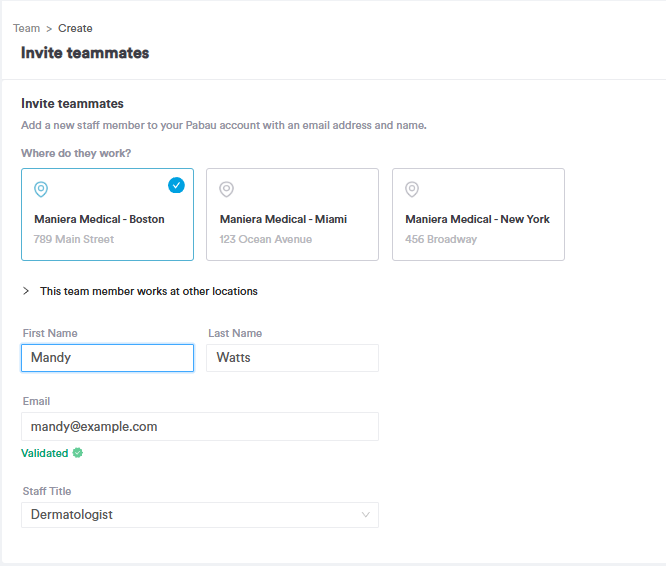
Pabau asks which locations a new team member works at, so step four of the sequence puts their bookable hours only at those sites.
In Pabau the sequence runs from one account. You add the location, link rooms to locations and services, set a price per site, and choose which sites each team member works at.
Adding the new site to Pabau’s online booking is step five, and patients can then choose it before they pick a treatment and time.
The new site then appears in Pabau’s online booking portal, and Pabau’s reports show it alongside your other locations and in the group total.
How to choose scheduling software for multiple locations
Choose scheduling software for multiple locations by testing six things: one shared calendar, location-aware booking, per-site pricing, a scalable pricing model, permissions and integrations. The sections below cover what each one should look like.
Centralized scheduling software with one calendar across sites
Centralized scheduling software keeps every location’s providers, rooms and appointments in one calendar, filtered by site rather than split into separate accounts. That single source is what lets the system block a clash between sites.
Check two things in a demo. First, can a manager see every site at once and then filter to one? Second, does a change at one site, such as a sick day, update availability everywhere that provider works?
Online booking software for multi-location businesses
Online booking software for multi-location businesses asks patients to choose a location first, then shows only the services, providers and prices offered there. Without that step, patients book the right treatment at the wrong site.
Good multi location booking software also applies each site’s own deposit rules and reminders. Test multi-location booking from a phone, because that is where most patients book. The system should also put the correct address in every confirmation and reminder.
Location-based pricing and services
Location-based pricing lets each site charge its own price for the same service, and hide services it does not offer. A practice in a city center often charges more than a suburban branch for the same treatment.
The setting should live on one service record with a price per site. Duplicating every service per location doubles the admin and splits your reporting.
Pabau’s service settings hold a price for each location on one record, so a price change never means editing three copies of a service.
Pricing models that scale per location
Pricing models decide the bill more than the headline price does. Per-location plans rise with each new site, per-user plans rise with headcount, and per-account plans rise with volume.
The worked example below prices a realistic group: three locations, 10 staff, and about 1,200 bookings a month. That volume assumes six appointments per staff member a day across 20 working days. It uses only prices each provider publishes, checked in September 2026.
Tool
Plan needed
Monthly cost
Why that plan
Pabau
Quote
Not published
Priced by three locations and 10 users
Zenoti
Quote
Not published
Customized to your footprint
Square Appointments
Plus for three locations
$147 ($447 on Premium)
$49 per location, and room booking needs Premium at $149 per location
SimplyBook.me
Premium
€49.9 billed annually
1,200 bookings exceeds Standard’s 500 a month
Acuity Scheduling
Premium
$49 billed annually ($61 monthly)
10 staff calendars exceed Standard’s six
Connecteam
Small Business
$0
10 users is the free limit, and the 11th user moves you to Basic
Setmore
Pro for 10 users
$50 billed annually ($120 monthly)
$5 per user, plus a seat for each extra account a provider works in
The cheapest line is rarely the cheapest outcome. A tool that fails the room or record scenario still needs a second system to cover the piece it lacks. Groups weighing a full platform can compare records, billing and reporting in our guide to clinic management software for multi-location practices.
Permissions and integrations per location
Permissions should follow the location as well as the role. A branch manager then sees that site’s calendar, payments and reports, while the owner sees every site.
Integrations need the same test. Check that card payments, POS, accounting and calendar sync keep each appointment and transaction tied to its site. Otherwise someone rebuilds the site split by hand every month.
Pabau connects natively to Stripe, Xero, Google Calendar and Outlook, and native integrations are included in every subscription.
How Pabau runs scheduling across every location
Most multi-site practices start with a calendar per branch and a spreadsheet to reconcile them. The front desk phones the other site before booking a shared provider, and the owner builds the monthly report by hand.
Pabau replaces that with one account for every location. The calendar blocks cross-site clashes, rooms and devices are tied to their site, and patients book online at the location they choose. Patient records, consent forms and treatment notes travel with the patient to any branch.
Owners get multi-location management with reporting per site and for the whole group. You can see which location needs more staff, and which has too many empty slots. Because every subscription includes every feature, opening another site never means upgrading your plan.
Pabau’s structured onboarding configures your current sites before go-live. Each site you add later follows the same next-site setup sequence, from the same account.
Run every location from one calendar
Pabau keeps providers, rooms, prices and patient records in step across every site, so a booking at one location never clashes with another. Online booking lets patients pick their site first.
If a provider or a device moves between your sites, judge each system on the cross-location stress test before you compare booking pages. For healthcare and aesthetic groups, that system is Pabau, because the patient record matters as much as the slot.
Square Appointments earns its place for non-clinical businesses that want published per-location prices. Connecteam covers the staff rota when patient booking lives elsewhere. The trade-off to remember is that every tool that fails a scenario hands that job back to your front desk.
Book a demo to see how Pabau stops cross-site double-booking and keeps one patient record across every location you run.
Losing slots to no-shows at one branch?Appointment reminder software compares tools that confirm and remind patients automatically.
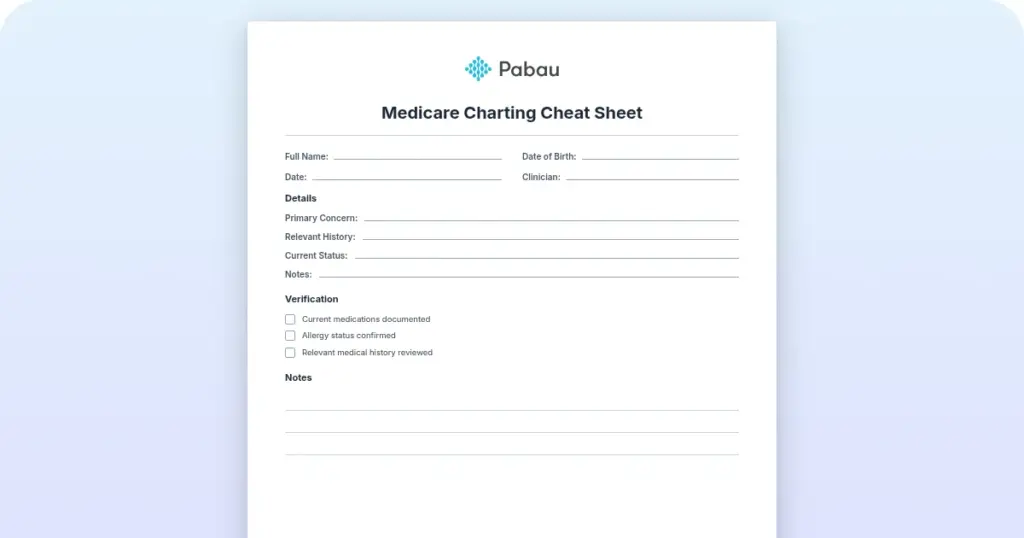
Need a rota template before you switch systems?Practice schedule template gives you a ready layout for planning staff and rooms by day.
Frequently asked questions
What is the best scheduling app for multiple locations?
Pabau is the best scheduling app for multiple locations in healthcare and aesthetics, because one calendar, room rules and patient record cover every site. Among the best scheduling tools for managing multiple locations and teams outside healthcare, Square Appointments wins on published per-location pricing.
What is the best appointment scheduling software with multi-location support?
For healthcare and aesthetic groups, Pabau is the strongest multi location appointment scheduling software, and it passed all five stress-test scenarios. Zenoti suits large spa and medspa chains, and Square Appointments suits budget service businesses.
What are the best patient scheduling tools for managing multi-provider clinic calendars?
Pabau and Zenoti are the best patient scheduling tools for multi-provider calendars, because both check provider and room availability at booking. If you need the best custom scheduling software for multi-location clinics, test whether each service can attach to a provider and a site together.
What is a good multi-user scheduling app?
Connecteam is a good multi-user scheduling app for staff rotas, and it is free for up to 10 users. Deputy, When I Work and Homebase are the other strong picks for employee scheduling across several locations. Pabau puts staff shifts and patient bookings in one calendar.
Can you get multi location scheduling software free?
Yes, but no free plan here shares one calendar across sites. Setmore is free for up to four users, SimplyBook.me for one provider and 50 bookings a month, and Square Free has no multi-location management. Connecteam is free for up to 10 users, for staff shifts only.
Is Setmore really free?
Yes. Setmore’s Free plan costs nothing for up to four users and includes unlimited appointments, payments and a branded booking page. SMS reminders, two-way calendar sync, deposits and linked location accounts need Pro, at $5 per user a month billed annually.
Does Microsoft 365 have a scheduling tool?
Yes. Microsoft Bookings is included in Microsoft 365 Business Basic, Business Standard and Business Premium, plus several enterprise, education and frontline plans. Its Shared Bookings pages let customers book time with a team. Each page has its own services, staff and business hours, so a multi-site business can run one page per location.
How do you prevent double-booking across locations?
Keep every location in one calendar, so a provider booked at one site is automatically unavailable at the others. Then tie rooms and devices to their site, so the system also blocks a second booking for a machine that is already in use.