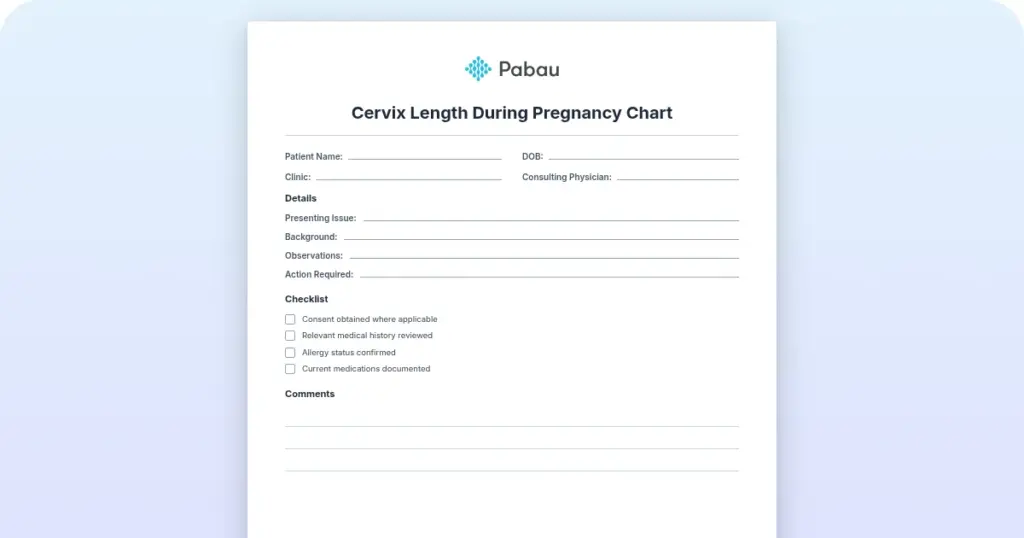
Cervix length during pregnancy chart
A cervix length during pregnancy chart records cervical length in millimeters ag...

Last Updated: Oct 14, 2026

A VBAC birth plan documents your labor and delivery preferences for a trial of labor after cesarean, helping your care team understand your priorities and concerns.
Essential sections include labor environment, pain management, fetal monitoring, emergency cesarean contingency, and postpartum care — all verified against ACOG guidelines.
Continuous electronic fetal monitoring during VBAC labor is a clinical requirement to detect uterine rupture early, not a patient preference option.
Practice management software like Pabau lets clinics capture, store, and access patient birth preferences within each patient’s care record through integrated digital forms.
A ready-to-use birth plan template covering labor preferences, pain management options, fetal monitoring choices, emergency cesarean contingency, and postpartum care preferences.
Download templateA VBAC birth plan helps women who have had a previous cesarean communicate their preferences to their obstetric care team. Whether you are pursuing a trial of labor after cesarean (TOLAC) or preparing for another cesarean, this template .
A VBAC birth plan is a structured document that outlines your labor and delivery preferences for attempting vaginal birth after a previous cesarean section. Also called a birth preference sheet, it serves as a communication tool between you and your obstetric care team.
It documents your choices across five domains: labor environment, pain management, fetal monitoring, emergency cesarean contingency, and postpartum care.
The document goes beyond general birth plans because VBAC carries specific clinical considerations. According to ACOG Practice Bulletin 205, a VBAC birth plan must address the heightened need for emergency preparedness, continuous fetal monitoring, and clear decision-making protocols if labor does not progress as hoped.
This template is designed for pregnant women planning a trial of labor after cesarean, their midwives, and obstetric teams.
A comprehensive VBAC birth plan covers five critical areas. This template structures each one as a checklist, helping you and your care team agree on preferences before labor begins.
Specify your preferences for the physical space, freedom of movement, and comfort measures during labor.
Document your approach to labor pain relief, from unmedicated strategies to pharmacological options.
VBAC labor requires careful fetal heart rate monitoring due to the risk of uterine rupture. Document your understanding and preferences around this clinical necessity.
ACOG guidelines specify continuous EFM during TOLAC to detect early signs of uterine rupture. This is not a preference but a clinical safety standard in facilities offering VBAC.
Advance planning for an unexpected cesarean normalizes it as a safety measure, not a failure. Pre-agree on key decisions so your care team can act quickly if needed.
Articulate your priorities for the immediate postpartum period and newborn care in the first hours and days.
Knowing how practice management software works helps you decide which forms to digitize first.
Complete this template over two to three weeks before your expected due date, ideally during a dedicated prenatal appointment with your obstetrician or midwife. Bring any related pregnancy documents to that appointment, such as a completed gestational diabetes diet plan, so your care team sees them together.
Clinics offering VBAC care. Pabau’s integrated system allows midwives and obstetricians to document the VBAC consent discussion, capture the completed birth plan, and reference patient preferences during labor without printing and re-filing paper documents.
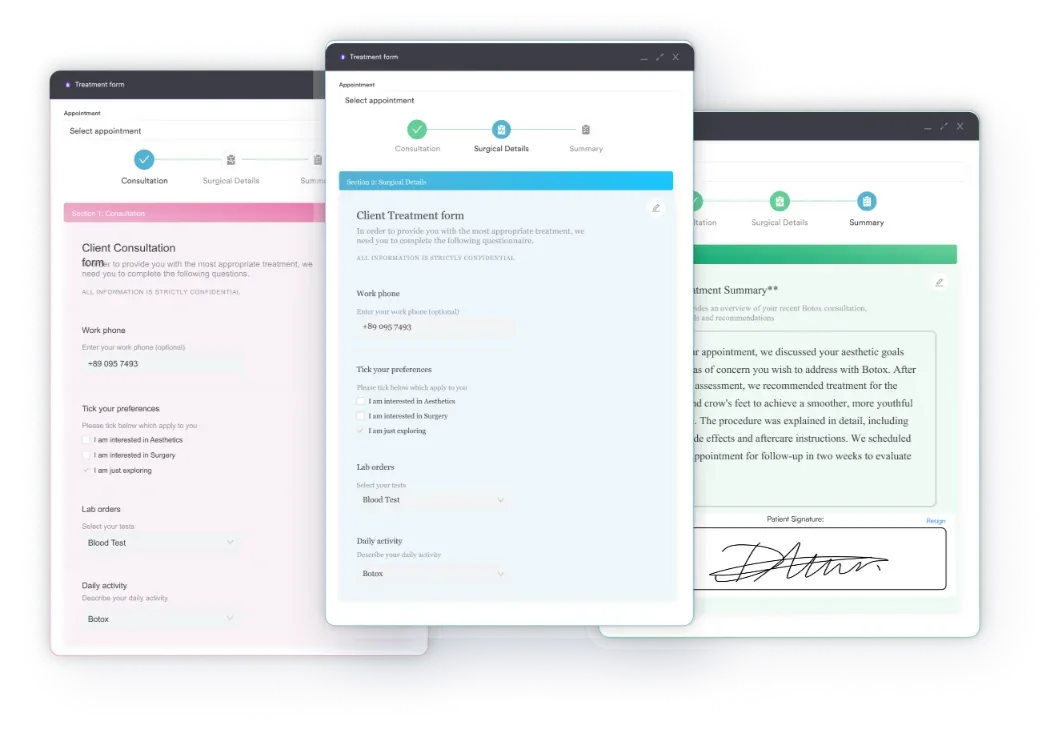
For example, a midwife can pull up the patient’s stored birth plan during active labor, confirm preferences for pain relief and fetal monitoring, and document any changes to the original plan in real time. This level of integration supports safer, more coordinated VBAC care across shifts and multiple clinicians.

Store patient birth preferences, consent forms, and postpartum plans in one searchable clinical record. Access preferences during labor without paper or delays.

VBAC success rates in the UK are approximately 60-80% for women who attempt labor after one prior low-transverse cesarean, according to RCOG guidance. If labor does not progress, uterine rupture risk emerges (approximately 0.5-0.9% per ACOG data), or fetal distress is detected, cesarean delivery becomes the safest option.
This is why the emergency contingency section of your birth plan matters. Pre-agreed preferences about anesthesia, partner presence, and immediate newborn care reduce stress and confusion if rapid cesarean delivery is needed. Your care team will have already discussed these scenarios with you, and your birth plan will guide decisions. Reproductive health care runs to a schedule, so a missed result changes the next appointment.

Monitoring blood pressure through pregnancy? Blood pressure pregnancy chart tracks trimester-specific ranges and warning signs for gestational hypertension and preeclampsia.
Documenting prenatal screening consent? Down syndrome test form records risk assessment and consent for NIPT, quad screen, and other prenatal tests.
Need a full birth plan template? Mama Natural birth plan template covers labor preferences, delivery wishes, postpartum care, and newborn procedures in one document.
A VBAC birth plan includes all standard birth preferences (labor environment, pain management, newborn care) plus two critical VBAC-specific sections: fetal monitoring requirements due to uterine rupture risk, and an emergency cesarean contingency plan. This extra detail reflects the clinical complexity of TOLAC.
Yes. ACOG and RCOG both recommend continuous electronic fetal monitoring during VBAC labor to detect early signs of uterine rupture. This is a clinical safety requirement, not a patient preference option. Telemetry monitoring (wireless EFM) allows mobility while maintaining safety.
Yes. Epidural anesthesia is safe during VBAC and does not increase uterine rupture risk. Many women choose epidural for pain relief, and it is also valuable if emergency cesarean becomes necessary (reducing the need for general anesthesia). Discuss timing and availability with your care team when completing your birth plan.
Your contingency plan guides this scenario. Pre-agreed decisions about who will be present, anesthesia preferences, and immediate postpartum care mean your care team can act quickly while honoring your preferences. Emergency situations may limit some choices (e.g. general anesthesia may be needed for speed), but your stated values help clinical staff make decisions in your best interest.
A birth plan guides conversation and expresses your values; it is not a rigid protocol. Labor is unpredictable, and your preferences may evolve as labor progresses. Communicate with your care team about changes, but understand that clinical safety always takes priority. Your willingness to adapt, combined with your documented preferences, creates the best foundation for a safe VBAC.
Candidates typically have one prior low-transverse cesarean, no contraindications (such as placenta praevia or prior uterine rupture), and access to a hospital with immediate cesarean capability. Multiple prior cesareans, classical (vertical) incisions, or other complications may affect candidacy. Discuss your individual circumstances with your obstetrician early in pregnancy.